
In a market where the construction sector contributes $62.4 billion to the state GDP, the margin for error in capital allocation has never been thinner. Most owners realize that the traditional bidding process often masks deep-seated operational risks, yet they remain vulnerable to the rising insurance premiums and litigation threats that define the current landscape. Understanding how to select a general contractor in Florida in 2026 requires a shift from superficial vetting to a rigorous, data-driven methodology that prioritizes technical transparency and structural resilience over empty promises.
You’ve likely experienced the frustration of contractors who project confidence during pre-construction only to falter when the 9th Edition Florida Building Code requirements become reality. This guide promises to equip you with a defensible selection process designed to protect your capital from financial and legal exposure. We’ll analyze the critical metrics of contractor stability, including the 660 minimum FICO requirement and the new ASCE 7-22 wind load standards, to ensure your choice aligns with the highest professional standards of risk management and project delivery.
Key Takeaways
- Distinguish between Certified and Registered DBPR licenses to ensure full legal compliance with the updated 2026 Florida regulatory environment.
- Analyze safety performance metrics, specifically the Experience Modification Rate (EMR), to accurately predict a contractor’s future insurance liabilities and financial stability.
- Implement a strategic framework for how to select a general contractor in Florida that prioritizes the mitigation of vicarious liability and protects the owner’s capital from litigation.
- Assess a contractor’s technical competence through their adoption of AI-powered project management and real-time site transparency tools required for modern delivery.
- Leverage professional Owner’s Representation to bridge the operational gap between the owner’s interests and the general contractor’s execution throughout the project lifecycle.
The Regulatory Baseline: Navigating Florida Licensing and Duty of Care
Florida’s construction regulatory framework in 2026 demands a sophisticated approach to procurement that extends far beyond a basic license search. Under Florida Statutes Chapter 489, the state maintains rigorous standards for construction contracting, yet many owners operate under the false assumption that hiring a licensed general contractor provides absolute immunity from project failures. In reality, the legal concept of Duty of Care dictates that an owner retains a level of responsibility for the selection and oversight of their project team. Failing to execute a rigorous vetting process can lead to claims of negligent selection, especially if the contractor has a history of DBPR disciplinary actions or financial instability.
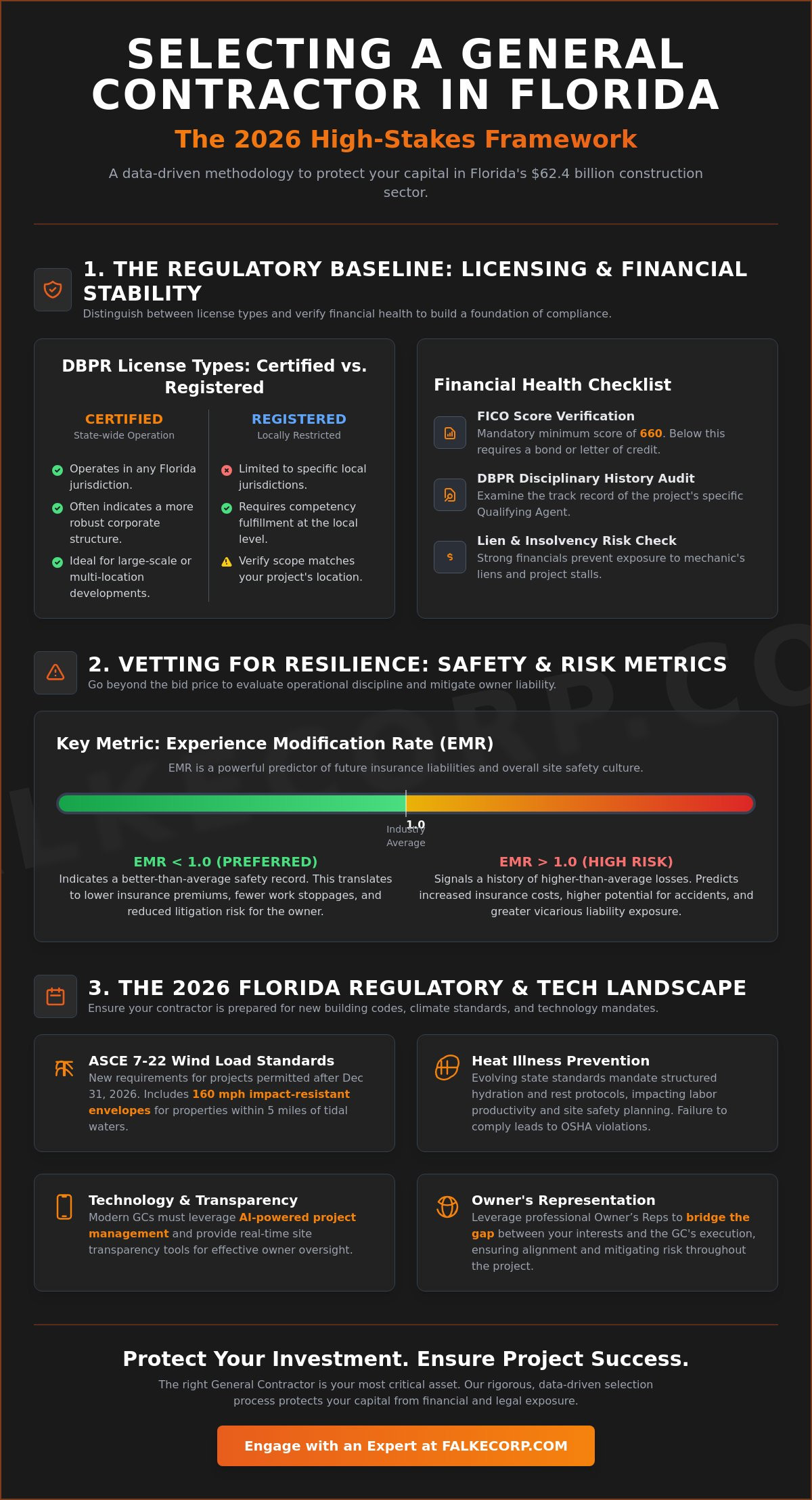
Understanding the distinction between Certified and Registered licenses is the first technical hurdle in the selection process. A Certified license allows a contractor to operate anywhere in the state, whereas a Registered license limits their scope to specific local jurisdictions where they’ve fulfilled competency requirements. For large scale developments, a Certified contractor often provides a more robust corporate infrastructure, but the specific needs of the project must dictate the choice. When determining how to select a general contractor in Florida, owners must verify that the contractor’s license status is active and that they’ve met the 2026 renewal requirements, which include 14 hours of continuing education and updated fee structures effective after August 31, 2026.
Verifying Licensure and Financial Stability
A deep-dive audit of a contractor’s DBPR history is a non-negotiable step in modern pre-construction services. You shouldn’t just check if a license exists; you must examine the track record of the Qualifying Agent assigned to your project. This individual is legally responsible for the contractor’s performance and must possess the technical competence to navigate the 9th Edition of the Florida Building Code. Furthermore, the state now mandates a minimum FICO score of 660 for new applicants. If a contractor’s score falls below this threshold, they’re required to complete a 14-hour Financial Responsibility course and provide a bond or letter of credit. Assessing these financial indicators provides a clearer picture of their ability to manage capital without exposing the project to mechanic’s liens or insolvency.
Florida-Specific Regulatory Nuances in 2026
The 2026 landscape introduces new complexities, particularly regarding worker safety and environmental compliance. Evolving Florida heat illness prevention standards now require contractors to implement structured hydration and rest protocols, a factor that directly impacts labor productivity and site safety. Owners must also account for OSHA Region 4 enforcement priorities, which have intensified their focus on South Florida’s high-density urban developments. When evaluating how to select a general contractor in Florida, it’s vital to ensure they’re prepared for the 9th Edition Building Code’s adoption of ASCE 7-22 wind load standards. This includes the expanded 160 mph impact-resistant envelope requirements for properties within five miles of tidal waters, a regulation that will redefine structural integrity for projects permitted after December 31, 2026.
Vetting for Resilience: How to Select a General Contractor in Florida Based on Safety Metrics
The financial viability of a commercial project is inextricably linked to the safety performance of the delivery team. While most owners prioritize the bottom-line bid price, the most experienced developers recognize that safety metrics are the most reliable leading indicators of a firm’s operational discipline. A low bid often masks the high cost of future litigation or insurance spikes. The critical phase of determining how to select a general contractor in Florida must prioritize technical transparency over simple cost estimation. While you should always use the DBPR portal to verify a contractor’s license, this step only confirms their legal eligibility; it doesn’t quantify their risk profile. A truly resilient selection process analyzes a contractor’s ability to manage high-impact coastal hazards and high-rise structural complexities through a robust Site-Specific Safety Plan (SSSP).
The process of how to select a general contractor in Florida must include a rigorous evaluation of the Total Recordable Incident Rate (TRIR) compared to state and national industry averages. A contractor with a TRIR significantly above the Florida average suggests a systemic failure in field supervision and risk mitigation. When these incidents occur, the resulting work stoppages and OSHA investigations don’t just threaten the timeline; they expose the owner to direct financial losses and reputational damage. Evaluating these metrics during the RFP stage ensures that you’re partnering with an organization that values capital preservation as much as project completion.
Quantifying Risk: EMR and Insurance Implications
A contractor’s Experience Modification Rate (EMR) is a precise mathematical representation of their safety history compared to their peers. An EMR below 1.0 indicates a superior safety record, which directly translates into lower premiums for Owner Controlled Insurance Programs (OCIP) or Contractor Controlled Insurance Programs (CCIP). If a contractor presents an EMR above 1.2, it’s a significant red flag. It signals a passive safety culture where accidents are treated as inevitable rather than preventable. These elevated rates are often correlated with project schedule slippage, as firms with poor safety records frequently struggle with labor retention and regulatory compliance hurdles.
Leveraging Pre-Construction Vetting for Long-Term Success
Sophisticated owners don’t wait for the construction phase to address safety; they integrate these audits into comprehensive strategic pre-construction services in miami. This involves conducting technical interviews with the proposed Project Superintendent and Safety Director to verify their experience with Florida’s unique environmental stressors, such as the 160 mph wind load requirements. Reviewing historical Job Hazard Analysis (JHA) samples for similar developments provides insight into how the contractor identifies and neutralizes site-specific risks before they escalate. Engaging a professional owner’s representative during this vetting stage ensures that the contractor’s safety claims are verified against their actual field performance, creating a foundation for zero-incident delivery.
Mitigating Vicarious Liability: The Owner’s Risk in the Florida Construction Market
In the high-stakes Florida real estate market, developers and owners are frequently viewed through the lens of the “Deep Pocket” theory. This litigation strategy targets the entity with the most substantial insurance limits and capital reserves, which is almost invariably the property owner rather than the trade contractors. When an incident occurs on site, the legal concept of vicarious liability can hold an owner responsible for the negligence of their contractor, even if the owner wasn’t directly involved in the daily operations. A primary factor in how to select a general contractor in Florida is evaluating their ability to operate as a truly independent entity, thereby insulating the owner from operational negligence. Establishing this separation is a technical necessity that requires a balance between professional oversight and the dangerous trap of “retained control.”
If an owner dictates the specific means and methods of construction, they risk losing the legal protections afforded by the independent contractor relationship. To mitigate this, sophisticated owners utilize third-party documentation and professional project management to maintain a defensible record of oversight without overstepping into direct supervision. This methodology ensures that every safety protocol and regulatory requirement is met while keeping the legal liability firmly with the executing firm. Mastering how to select a general contractor in Florida involves identifying partners who possess the corporate maturity to manage these risks autonomously while providing the transparency required for the owner’s peace of mind.
Legal Trends in South Florida Construction Litigation
Recent Florida case law has intensified the scrutiny on owner responsibility, particularly regarding subcontractor injuries on complex urban sites. Owners must demand robust indemnification clauses in the Prime Contract that specifically address both direct and vicarious liability. These provisions should be supported by independent safety audits that benchmark field performance against federal construction safety metrics. Such audits don’t just improve site safety; they serve as critical evidence in a lawsuit to prove that the owner exercised due diligence in their selection and oversight processes.
Contractual Safeguards and Protective Provisions
Relying on boilerplate AIA language is often insufficient in the current Florida regulatory climate. Ironclad contracts must include safety mandates that link performance benchmarks directly to progress payments and project milestones. It’s essential to include a “Right to Stop Work” clause, which allows the owner or their representative to halt operations if a life-safety hazard is identified without assuming liability for the contractor’s methods. This contractual mechanism provides a structured path for intervention, ensuring that safety remains the primary indicator of project health throughout the construction phase.
The 2026 Selection Framework: Technology and Environmental Readiness
By 2026, the intersection of digital infrastructure and site safety has become the primary differentiator in contractor performance. Owners can no longer rely on retrospective reporting; the complexity of modern Florida developments requires a proactive tech stack that provides real-time visibility into site conditions. When evaluating how to select a general contractor in Florida, you must examine their ability to leverage Building Information Modeling (BIM) to identify safety clashes before they manifest in the field. This digital coordination ensures that structural components meet the ASCE 7-22 wind load standards, which are central to the 9th Edition Florida Building Code taking effect on December 31, 2026.
Transparency is the cornerstone of a defensible selection process. A contractor’s reporting hierarchy should facilitate a seamless flow of data from the field to the boardroom, allowing owners to monitor progress and compliance without assuming direct supervision. This level of technical integration is essential for managing the expanded 160 mph impact-resistant envelope requirements mandated for new construction within five miles of tidal waters. Firms that lack a robust digital framework often struggle to document the rigorous inspections required for these high-performance systems, leaving the owner vulnerable to long-term liability.
Assessing 2026 Technological Competency
- AI Computer Vision: Advanced contractors utilize AI-powered cameras for automated PPE detection and hazard monitoring, reducing the reliance on manual safety walks and improving response times.
- Drone-Based Site Inspections: For high-rise developments, drones are indispensable for verifying envelope integrity and roof safety, providing high-resolution data that manual inspections can’t match.
- Wearable Sensors: These devices monitor worker heat stress and fatigue, providing the biometric data necessary to comply with Florida’s evolving labor safety regulations.
Environmental and Climate Risk Management
Florida’s environmental stressors demand a contractor with a sophisticated climate risk management plan. Vetting a GC’s hurricane preparedness protocols is a technical necessity; their plan must include specific contractual requirements for rapid site demobilization and the securing of materials during high-wind events. The selection process must also address the unique geotechnical challenges of South Florida’s high water table, which complicates foundation safety and structural stability. Ensuring your partner has the expertise to manage these variables is critical to project success. To safeguard your investment through every phase of construction, consider engaging a professional Owner’s Representative to oversee the implementation of these high-tech safety and readiness protocols.
Beyond Selection: The Owner’s Representative as the Catalyst for Zero-Incident Delivery
The procurement phase concludes with the execution of the prime contract, yet the actual risk management lifecycle is only beginning. While understanding how to select a general contractor in Florida provides the necessary technical foundation, the presence of a professional Owner’s Representative ensures those standards are maintained during the high-pressure construction phase. This role serves as a specialized consulting function that translates complex site data into actionable intelligence for the owner. By integrating safety oversight into the broader construction project management in florida framework, developers can maintain the separation required to avoid liability while ensuring project milestones are met without compromise.
Expert representation offers a quantifiable ROI by identifying operational inefficiencies before they escalate into costly work stoppages. When the vetting process for how to select a general contractor in Florida is followed by rigorous third-party oversight, the likelihood of zero-incident delivery increases significantly. This methodology doesn’t just lower insurance premiums through verified performance; it secures the project’s timeline against the labor shortages and regulatory hurdles typical of the South Florida market. It’s the difference between a project that’s merely finished and one that’s delivered as a stable, revenue-ready asset.
Strategic Oversight vs. Daily Supervision
A primary failure in many construction projects is the blurring of lines between the General Contractor’s field management and the owner’s interests. The GC is tasked with the daily means and methods of production, but FALKE Atlantic Corporation provides the high-level audit role necessary for true accountability. This oversight ensures that safety protocols never take a backseat to budget pressures. We provide owners with unbiased, data-driven reports that verify compliance with the 9th Edition Florida Building Code, ensuring that structural integrity and site safety are never treated as secondary objectives.
Zero-Incident Project Delivery with FALKE Atlantic Corporation
FALKE Atlantic Corporation utilizes a disciplined four-phase development methodology to protect client interests across the Miami-Dade and Broward regulatory landscapes. Our approach involves the coordination of all third-party vendors and specialized consultants to ensure that safety compliance is uniform across every tier of the project. We take full responsibility for the oversight of the delivery process, from pre-construction through commissioning and close-out. Secure your project’s future; Contact FALKE Atlantic Corporation for expert Owner’s Representation to ensure your investment is managed with the highest level of professional precision.
Securing Project Viability in the 2026 Florida Market
The strategic imperative for Florida developers in 2026 is the transformation of operational risk into a managed variable through technical excellence. As this guide has demonstrated, the process of how to select a general contractor in Florida isn’t a one-time administrative task but a multifaceted commitment to structural resilience and legal protection. By prioritizing technical transparency and independent verification over the superficial allure of a low bid, owners can insulate their capital from the volatility of the current litigation and insurance landscape. This disciplined approach ensures that every structural component and safety protocol remains strictly aligned with the highest professional standards of the industry.
Professional advocacy represents the final component of a successful, zero-incident project lifecycle. FALKE Atlantic Corporation provides the disciplined four-phase development methodology required to navigate the specific regulatory complexities of Miami-Dade and Broward counties. Our focus remains on the mitigation of vicarious liability and the maintenance of absolute financial control from pre-construction through project close-out. We don’t just oversee construction; we protect the long-term value of your asset. Protect your assets with professional Owner’s Representation in Miami. Partner with FALKE Atlantic Corporation to ensure your vision is realized through unwavering precision and expert representation.
Frequently Asked Questions
Is the owner legally responsible for safety on a construction site in Florida?
Owners can be held liable under Florida law if they exercise “retained control” over the means and methods of construction. While the general contractor is the primary employer, the owner is often targeted in litigation through vicarious liability. Maintaining a defensible record of professional oversight without overstepping into direct supervision is essential for mitigating this legal exposure and protecting your capital investment.
What is the most important metric when selecting a general contractor in Florida?
The most critical metrics are the Experience Modification Rate (EMR) and the contractor’s FICO score, which must be at least 660 for new applicants in 2026. These numbers provide a data-driven view of the firm’s safety history and financial stability. When determining how to select a general contractor in Florida, prioritize these objective indicators over the initial bid price to ensure long-term project health.
How does an Owner’s Representative improve site safety and lower risk?
An Owner’s Representative acts as an independent auditor who ensures that safety protocols aren’t sacrificed for schedule or budget gains. They provide the technical expertise to verify that the contractor’s field performance aligns with the agreed-upon Site-Specific Safety Plan. This professional oversight creates a system of accountability that protects the owner’s capital and reduces the risk of catastrophic project failures or litigation.
What are the specific 2026 OSHA requirements for construction in South Florida?
In 2026, OSHA Region 4 has intensified its focus on heat illness prevention and high-density urban development hazards in South Florida. Contractors must implement structured hydration and rest protocols to comply with these evolving standards. Additionally, the adoption of ASCE 7-22 wind load standards requires more rigorous structural calculations and component testing for projects permitted after the December 31, 2026, building code update.
Can a strong safety record lower my construction insurance premiums in Miami?
Yes, a contractor with a superior safety record directly reduces the cost of Owner Controlled Insurance Programs (OCIP). Insurance underwriters use the EMR as a primary factor in determining premiums; an EMR below 1.0 indicates a lower risk profile. By prioritizing safety performance during the selection process, owners can achieve significant financial ROI through reduced liability coverage costs and fewer project work stoppages or regulatory fines.
What is the difference between a GC’s safety officer and an Owner’s Rep’s oversight?
The general contractor’s safety officer manages the daily means and methods of field operations, while the Owner’s Representative provides high-level strategic oversight. The safety officer focuses on immediate site hazards; the Owner’s Rep ensures the contractor’s corporate safety culture and reporting hierarchy protect the owner’s interests. This separation prevents the owner from assuming direct liability while maintaining a rigorous standard of compliance across all project phases.
How should hurricane season impact my selection of a Florida general contractor?
Owners must vet a contractor’s hurricane preparedness plan to ensure it includes detailed protocols for rapid site demobilization and material securing. In the Florida market, a contractor’s ability to protect a site during high-wind events is a technical necessity that should be addressed in the Prime Contract. Evaluating how to select a general contractor in Florida requires verifying their historical performance in managing emergency response during the June to November storm season.
What safety technology should I expect from a top-tier Florida GC in 2026?
Top-tier contractors in 2026 utilize a tech stack that includes AI computer vision for PPE detection, drone-based envelope inspections, and wearable biometric sensors. These tools provide real-time data on worker fatigue and site hazards, allowing for proactive risk management. Building Information Modeling (BIM) is also expected to identify safety clashes during the pre-construction phase, ensuring that structural resilience is engineered into the project from the start.