
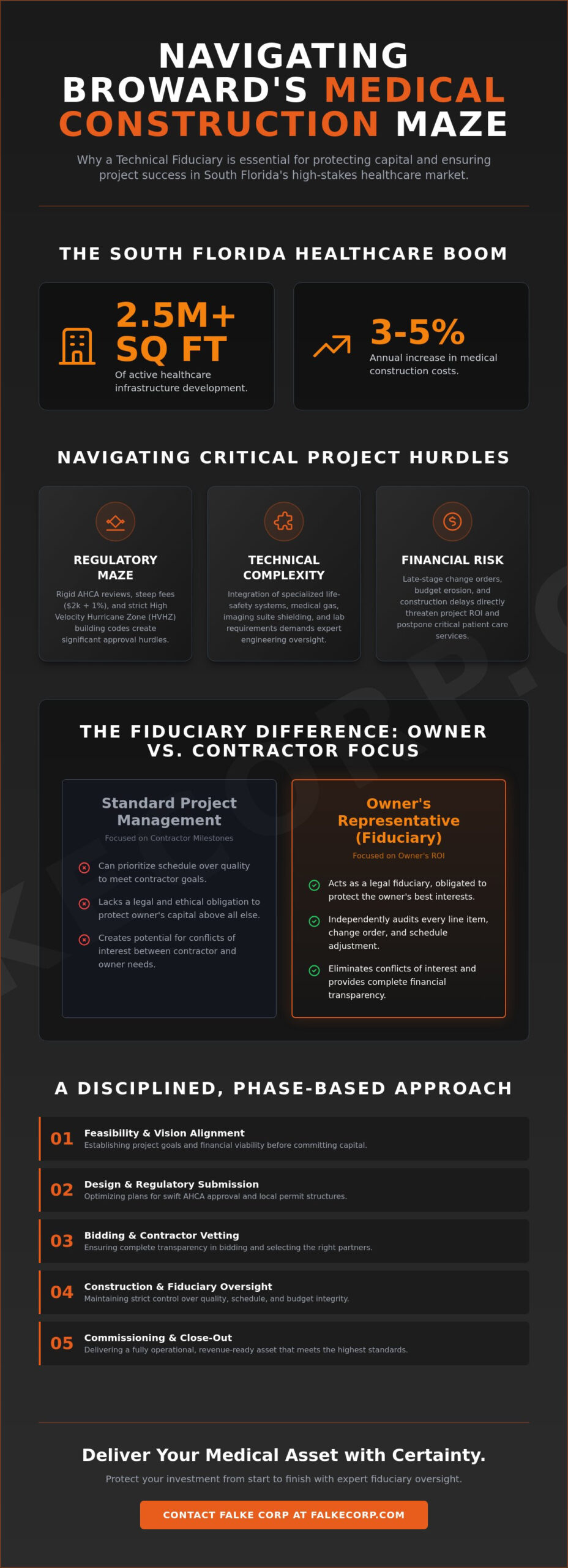
The current expansion of South Florida’s healthcare infrastructure, exceeding 2.5 million square feet of active development, necessitates a level of technical oversight that transcends traditional project management. In an environment where the Agency for Health Care Administration (AHCA) mandates a 60-day review period and assesses initial fees of $2,000 plus one percent of estimated construction costs, the financial risks of regulatory non-compliance are substantial. Engaging a dedicated owner’s representative for medical facility construction Broward provides the rigorous fiduciary oversight required to mitigate these complexities and protect the owner’s capital investment.
You understand that the intersection of specialized clinical requirements, such as medical gas systems and imaging suite shielding, with Broward County’s specific municipal permit structures creates a volatile environment for project budgets. It’s a reality that technical gaps often lead to late-stage change orders that erode reserves and delay patient care. This guide demonstrates how expert fiduciary representation ensures complete transparency during bidding and maintains strict control over the construction and commissioning phases. We’ll examine the strategic advantages of independent oversight in securing AHCA approval, managing regional fee schedules, and delivering a revenue-ready asset that meets the highest professional standards.
Key Takeaways
- Distinguish the role of a technical fiduciary from conventional project management to ensure the stability and quality of complex clinical infrastructure.
- Leverage the expertise of an owner’s representative for medical facility construction Broward to manage AHCA plan reviews and High Velocity Hurricane Zone (HVHZ) requirements.
- Implement a robust system of checks and balances that eliminates conflicts of interest by providing independent auditing of construction budgets and schedules.
- Master the logistical coordination of long-lead medical equipment, including the specialized structural requirements for advanced imaging suites and laboratories.
- Apply a disciplined, phase-based methodology that protects the project vision from initial feasibility through to final commissioning and close-out.
The Critical Role of an Owner’s Representative in Broward Medical Projects
In the high-stakes environment of South Florida healthcare development, an owner’s representative for medical facility construction Broward functions as a technical fiduciary. This role transcends traditional administrative support; it’s a commitment to the owner’s best interests through every phase of the project lifecycle. While standard commercial projects focus on shell delivery, medical assets require the integration of life-safety systems, specialized shielding, and complex mechanical requirements that demand a higher tier of oversight. Engaging a qualified owner’s representative for medical facility construction Broward ensures that technical decisions are grounded in engineering logic rather than contractor convenience.
The economic impact of specialized representation is measurable through the preservation of the project’s Return on Investment (ROI). Without rigorous oversight, the technical burden often falls on medical staff who lack the engineering background to evaluate construction change orders. This misalignment leads to expensive rework and operational delays. By shifting this burden to a dedicated expert, healthcare stakeholders can focus on clinical excellence while their representative manages the structural and financial integrity of the asset. This disciplined approach prevents the erosion of project contingencies and ensures the facility is revenue-ready upon completion.
Fiduciary Duty vs. Project Management
Understanding the distinction between a fiduciary advocate and a standard project manager is vital for successful delivery. Within a Construction Management Overview, the owner’s representative is identified as the singular entity with a legal and ethical obligation to protect the stakeholder’s capital. Unlike a traditional project manager who might prioritize schedule over quality to meet contractor milestones, an owner’s representative audits every line item. This independence is especially critical during the integration of complex medical equipment, where electrical and structural tolerances are unforgiving. They act as a check and balance against the general contractor, ensuring that the work performed aligns strictly with the approved specifications and budget.
The Broward County Healthcare Landscape in 2026
The South Florida healthcare sector is currently managing over 2.5 million square feet of new development. In cities like Fort Lauderdale and Hollywood, the demand for specialized outpatient facilities has created a highly competitive environment for skilled labor. National trends indicate that medical construction costs are rising by 3% to 5% annually, a figure that’s often higher in the Broward market due to regional demand. Navigating this landscape requires local expertise to manage the specific municipal requirements and labor shortages. A representative with deep roots in Broward’s regulatory environment can anticipate bottlenecks before they impact the critical path, providing the stability and quality necessary for a successful clinical launch.
Navigating AHCA and Broward Regulatory Requirements
Successful commissioning of a clinical asset begins long before the first inspection. In Florida, the Agency for Health Care Administration (AHCA) serves as the primary regulatory gatekeeper, overseeing a rigid three-stage review process that dictates a project’s viability. For developments in South Florida, an owner’s representative for medical facility construction Broward ensures that submissions aren’t just compliant, but optimized for administrative speed. AHCA mandates an initial non-refundable fee of $2,000 and collects up to 1% of the estimated construction cost for the initial review phase. Because the agency has 60 days to act on submissions, any technical deficiency in Stage I or II can lead to cascading delays that threaten the facility’s operational launch.
Broward County’s location within the High Velocity Hurricane Zone (HVHZ) adds a layer of structural complexity that standard commercial builds don’t encounter. Design documents must account for extreme wind loads and impact resistance as mandated by the Florida Building Code. An owner’s representative for medical facility construction Broward monitors the design team to ensure these specifications are integrated into the earliest drafts. This prevents the costly mid-construction revisions that occur when architectural plans fail to meet local environmental stressors. Our pre-construction services include a rigorous audit of these variables to maintain the project’s financial and structural integrity.
AHCA Compliance and Plan Review
Passing AHCA inspections on the first attempt requires a proactive management style that holds the design team to the highest standards of accountability. Following ASHE Best Practices, we prioritize aligning technical design with clinical workflows during the pre-construction phase. This ensures that life safety codes don’t conflict with the practical needs of medical staff. If a project is deemed abandoned—defined as construction failing to commence within one year of approval—it requires a complete resubmission as a new project. Expert oversight prevents such lapses by maintaining a disciplined timeline through every review cycle.
Local Permitting in Fort Lauderdale and Broward
Local municipalities in Broward, particularly Fort Lauderdale, maintain specific zoning and environmental health requirements that often exceed baseline state codes. For ambulatory surgical centers, life safety code requirements are exceptionally stringent, requiring precise coordination between mechanical, electrical, and plumbing (MEP) systems. As of 2026, new environmental standards in South Florida also influence HVAC efficiency and medical waste management systems. Navigating these local nuances requires a partner who understands the Broward County Building Code Services Division’s fee structures, including the $147 per hour plan examiner fees and the premium service options available for enhanced review timelines. This level of technical precision ensures the project remains on schedule while mitigating the risk of unforeseen regulatory fines.
Owner’s Rep vs. General Contractor: Eliminating Conflicts of Interest
The structural complexity of clinical environments creates a fundamental misalignment of interests when a general contractor operates without independent oversight. A general contractor’s primary objective is the management of their own profit margins and schedule, which often conflicts with the owner’s goal of cost minimization and technical perfection. It’s impossible for a contractor to objectively audit their own budget or the quality of their subcontractors’ work. Engaging an owner’s representative for medical facility construction Broward establishes a necessary system of checks and balances. This ensures the project contingency remains protected against the primary cause of capital loss: unverified change orders and technical deviations.
Change orders represent the most significant risk to medical facility ROI in South Florida. In clinical suites, minor discrepancies in technical specifications can trigger substantial financial claims from contractors. An independent representative reviews every request for technical validity and market pricing. They prevent the “front-loading” of billing schedules, where contractors seek payment for work not yet performed. This oversight ensures that capital flows only when milestones are verified against the contract documents, keeping the project’s financial health stable through the final close-out.
The Fiduciary Shield for Medical Owners
The fiduciary obligation of an independent representative is solely to the owner. This alignment is absolute and unwavering. While a general contractor might overlook a subcontractor’s minor deviation to maintain their own timeline, an owner’s representative for medical facility construction Broward enforces the strict technical standards required for medical gas, imaging systems, and life-safety protocols. They audit pay applications and lien waivers with forensic precision. This protects the owner from potential legal liabilities and financial overruns before they manifest as critical issues during the commissioning phase.
Bidding and Vendor Selection in Broward
Achieving true market value in the Broward healthcare market requires a transparent and competitive bidding process. This involves more than just collecting quotes; it requires vetting specialized medical subcontractors who understand the rigorous AHCA environment and the local labor shortages. When selecting an owner’s representative, stakeholders must prioritize technical engineering competence over mere administrative experience. The representative structures contracts to mitigate risk during construction phase management florida, ensuring that the owner’s interests are legally and operationally prioritized in every vendor agreement. This disciplined approach guarantees that the project benefits from South Florida’s most capable technical specialists without the risk of inflated costs.
Managing Technical Complexity: Imaging, Labs, and Clinical Suites
Integrating advanced clinical modalities such as MRI, CT, and Linear Accelerators requires a departure from standard commercial construction protocols. The structural floor loading, RF shielding, and vibration control necessary for these systems are unforgiving. An owner’s representative for medical facility construction Broward acts as the technical bridge between the design intent and the physical execution. They ensure that long-lead medical equipment is integrated into the critical path schedule with surgical precision. This oversight prevents the costly delays associated with misaligned utility stubs or inadequate structural reinforcement that often surface only during the final equipment installation phase.
The transition from a construction site to a sterile, operational medical facility is a phase defined by rigorous commissioning. It involves the verification of medical gas systems, HVAC pressure differentials, and specialized life-safety protocols. Our commissioning and close-out services ensure that every technical system operates at peak efficiency before patient intake begins. It’s a process that requires a deep understanding of 2026 clinical guidelines and Broward’s specific environmental standards.
Equipment Integration and Vendor Management
Managing the logistical complexity of third-party installers alongside the general contractor is a primary responsibility of the owner’s representative. ‘Just-in-Time’ delivery strategies are utilized to prevent the premature arrival of sensitive diagnostic equipment, which can lead to site congestion or environmental damage. Engaging an owner’s representative for medical facility construction Broward allows for the forensic review of vendor submittals against the architectural drawings. In Broward, MEP systems for ISO-certified cleanrooms must maintain specific pressure differentials and high-efficiency particulate air (HEPA) filtration rates to ensure the integrity of sterile compounding environments. This technical coordination ensures that the facility meets the highest standards of safety and functionality.
Clinical Workflow and Operational Readiness
Operational readiness extends beyond the physical structure to include the seamless integration of IT infrastructure, furniture, and medical supplies. A dedicated representative ensures the space supports efficient patient throughput and staff safety by conducting thorough walkthroughs during the construction phase. The close-out process is finalized with the delivery of clinical-grade O&M manuals and verified warranties. It’s essential that these documents are structured for immediate use by facility management teams. This disciplined approach guarantees that the medical asset is not merely finished, but fully prepared for its intended clinical function on Day 1.
The FALKE Methodology: A Disciplined Approach to Medical Assets
Delivering a sophisticated clinical environment in South Florida requires more than standard oversight; it demands a structured, phase-based framework that prioritizes technical fidelity and financial stability. The FALKE Atlantic Corporation methodology is a four-phase disciplined approach designed to manage the specific risks associated with healthcare infrastructure. Engaging an owner’s representative for medical facility construction Broward ensures that every phase of the development lifecycle is managed with the precision required for high-stakes medical assets. This process begins with Phase 1: Concept and Feasibility, protecting the vision through rigorous site analysis and budgetary modeling before the first shovel enters the ground.
Phase 2 involves comprehensive pre-construction planning, where we utilize our pre-construction services miami to align architectural intent with regulatory requirements. During Phase 3: Execution, we implement active construction project management Florida protocols to maintain strict financial oversight and schedule adherence. Finally, Phase 4: Commissioning focuses on the transition from a technical jobsite to a sterile, revenue-ready clinical environment. FALKE Atlantic Corporation provides the specialized oversight of an owner’s representative for medical facility construction Broward to ensure these standards are met without compromise.
Strategic Project Management and Financial Control
Industry data often indicates that unmanaged medical construction projects can incur a 10% to 15% waste factor due to technical misalignment and unverified change orders. FALKE Atlantic Corporation eliminates this inefficiency through data-driven reporting and forensic auditing of all pay applications. We provide hospital boards and stakeholders with real-time insights into project health, ensuring complete transparency. Because of our boutique structure, every Broward project receives principal-level attention, ensuring that technical decisions are never delegated to junior staff but are handled by experts with deep engineering competence.
Your Partner for Broward Medical Construction
Our experience in managing high-end, technically demanding environments, such as the precision required for Prada in the Design District, informs our approach to clinical standards. We apply that same level of aesthetic and structural detail to imaging suites and surgical centers where tolerances are measured in millimeters. Local South Florida roots are essential for effective vendor negotiations and navigating the specific labor market in Broward County. To ensure your clinical asset is delivered with rendingless quality and fiduciary integrity, Schedule a consultation for your Broward medical project today.
Securing the Future of Broward Healthcare Infrastructure
Broward’s medical construction landscape demands a shift from reactive management to proactive technical stewardship. Navigating the intersection of AHCA plan reviews and the Florida Building Code’s High Velocity Hurricane Zone requirements isn’t merely an administrative task; it’s a fundamental risk management strategy. By engaging an owner’s representative for medical facility construction Broward, stakeholders ensure that their capital is protected through independent fiduciary oversight that eliminates the inherent conflicts of interest found in traditional contractor-led models. This approach guarantees that complex imaging suites and clinical environments are delivered with technical precision and full operational readiness.
Our disciplined four-phase methodology provides the stability required to manage sophisticated clinical investments from initial feasibility through final commissioning. We maintain principal-level oversight on all South Florida projects, ensuring that your facility meets the highest professional standards of quality and safety. It’s time to elevate your project’s financial and structural integrity. Secure expert fiduciary oversight for your medical facility project and ensure your asset is prepared for the clinical demands of 2026 and beyond.
Frequently Asked Questions
What is the difference between an Owner’s Rep and a Project Manager in healthcare?
An owner’s representative serves as a technical fiduciary with a legal and ethical obligation to protect the stakeholder’s capital, whereas a project manager often focuses on the execution of specific contractor milestones. In a clinical setting, the representative audits the financial and technical integrity of the asset to ensure long-term operational success. This role provides an independent layer of oversight that transcends the standard logistics of a construction site.
How does an Owner’s Representative help with AHCA compliance in Florida?
The representative manages the Stage I, II, and III AHCA review process to ensure all submissions meet the 60-day action deadline required by the agency. They verify that the architectural design complies with the 2026 Florida Building Code, preventing the project from being classified as abandoned if construction doesn’t commence within one year of written approval. This proactive management ensures that clinical life-safety codes are integrated into the design before inspections begin.
When should I hire an Owner’s Rep for a medical facility project?
Stakeholders should engage an owner’s representative during the initial concept and feasibility phase to maximize the project’s financial stability. Early involvement allows for the alignment of the project vision with regulatory requirements before the first shovel enters the ground. Engaging a representative during the pre-construction phase prevents the technical gaps that often lead to expensive mid-project change orders and AHCA rejections.
Can an Owner’s Rep save money on a medical construction project in Broward?
Yes, an owner’s representative for medical facility construction Broward identifies cost-saving opportunities through rigorous financial oversight and the auditing of all change orders. They prevent the “front-loading” of billing schedules and ensure that the owner receives true market value during the competitive bidding phase. By protecting the project contingency from unverified claims, the representative preserves the overall return on investment for the healthcare provider.
Does an Owner’s Rep replace the need for a General Contractor?
No, the representative doesn’t replace the general contractor but provides independent auditing of their performance and budget. This relationship creates a necessary system of checks and balances where the contractor handles the labor and the owner’s representative for medical facility construction Broward protects the owner’s interests. This separation of duties ensures that technical quality isn’t sacrificed for the sake of the contractor’s internal schedule.
What are the specific Broward County building codes for medical facilities?
Medical facilities in Broward must adhere to High Velocity Hurricane Zone (HVHZ) standards and specific life-safety codes for ambulatory surgical centers. These requirements include precise MEP pressure differentials and HEPA filtration rates for sterile environments as mandated by the Broward County Building Code Services Division. Navigating these local codes requires a partner who understands the specific municipal fee structures and the overtime inspection protocols common in South Florida.
How does an Owner’s Rep manage medical equipment integration?
The representative coordinates the complex interface between the general contractor and third-party medical equipment vendors. They manage the structural and electrical tolerances for modalities like MRI and CT suites, ensuring “Just-in-Time” delivery to prevent site congestion or environmental damage. This technical coordination ensures that the facility’s infrastructure is fully prepared for equipment installation, avoiding the need for late-stage structural modifications.
What is the typical fee structure for an Owner’s Representative?
Fees are generally structured based on the specific complexity, scale, and duration of the clinical project. While some industry professionals report percentage-based models relative to total construction costs, others utilize fixed-fee arrangements for development management and commissioning phases. This flexibility allows healthcare owners to secure principal-level oversight while maintaining budgetary certainty for their project management and pre-construction service requirements.