
The most significant risk to a project’s financial stability isn’t found in the soil or the steel; it’s the unmanaged friction between architectural vision and engineering feasibility. While you’ve secured specialized talent, the presence of high-level expertise doesn’t inherently ensure a project remains within its defined parameters. Managing architects and engineers on a project requires a rigorous fiduciary framework that prevents professional ambition from eclipsing the owner’s strategic objectives. We recognize that maintaining this balance is often the difference between a predictable delivery and a project plagued by uncontrolled scope creep.
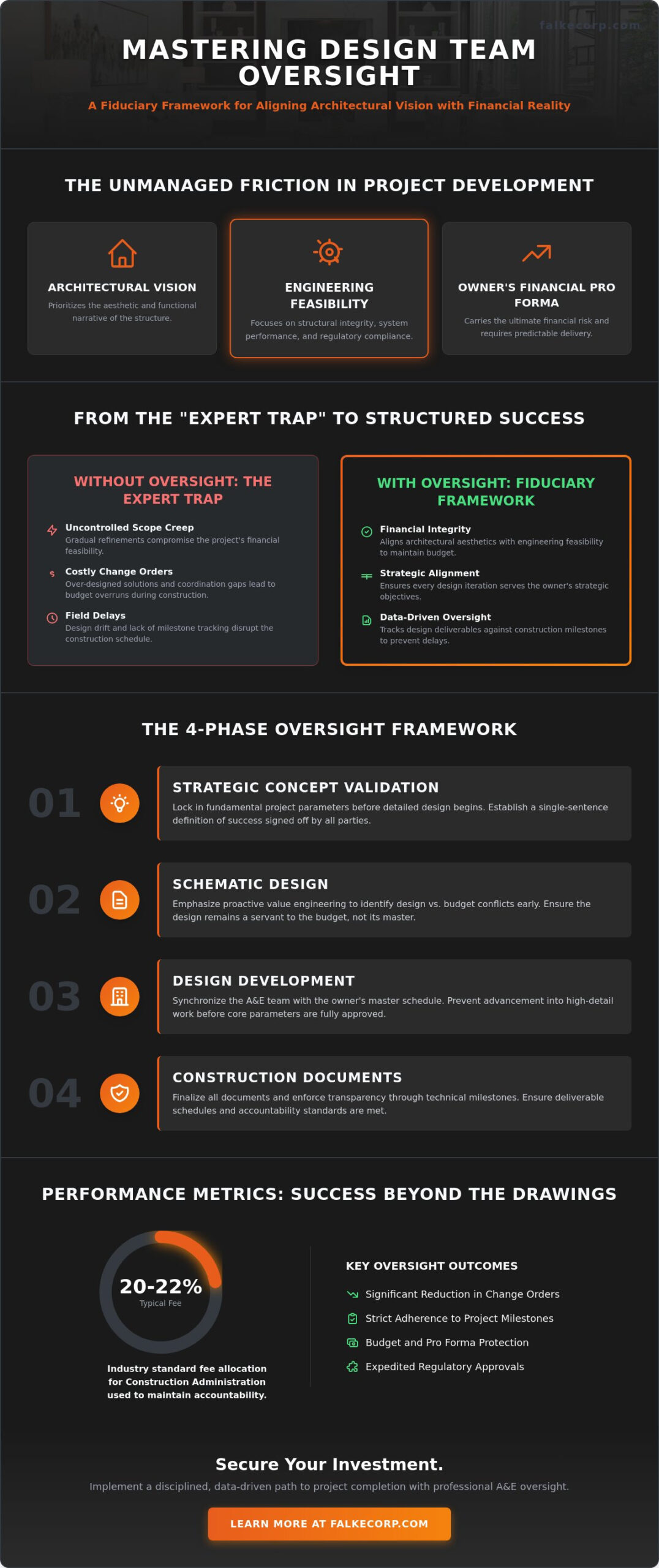
This guide provides a structured methodology for design team oversight to ensure your project remains on schedule and aligned with your vision. We’ll examine how to enforce transparency through technical milestones and how to utilize current industry standards, such as the 20-22% fee allocation for construction administration, to maintain accountability. By the end of this analysis, you’ll have the tools to implement pre-construction services that reduce change orders and secure a disciplined path to project completion, even as shifting regulatory requirements and rising billing rates increase the complexity of development management.
Key Takeaways
- Establish a rigorous fiduciary framework that aligns architectural aesthetics with engineering feasibility to maintain the project’s financial integrity.
- Define a clear hierarchy of authority for managing architects and engineers on a project to ensure every design iteration serves the owner’s strategic objectives.
- Implement a data-driven oversight methodology that tracks design deliverables against construction milestones to prevent field delays and uncontrolled scope creep.
- Navigate the specific regulatory complexities of South Florida by integrating local technical knowledge into the development management process for expedited approvals.
The Strategic Complexity of Managing Architects and Engineers on a Project
The development of a high-value asset requires the synthesis of three often competing priorities: architectural expression, engineering feasibility, and the owner’s financial pro forma. While architects prioritize the aesthetic and functional narrative, engineers focus on structural integrity and system performance. The owner, however, carries the ultimate financial risk. Without a structured framework, these professional silos can lead to design drift, where technical decisions are made without regard for the project’s economic viability. Managing architects and engineers on a project isn’t merely a task of coordination; it’s a rigorous exercise in fiduciary oversight that ensures every line drawn on a blueprint serves the final investment goal.
Traditional Project management frequently focuses on the execution phase, yet the most critical risks materialize long before the first shovel hits the ground. Many owners fall into the Expert Trap, assuming that the high fees and prestige of their design team negate the need for active management. In reality, unmanaged A&E teams often produce over-designed solutions or coordination gaps that result in costly change orders during construction. Moving from blind trust to a model of structured professional oversight is essential to mitigate delays and ensure that the design remains within the established budgetary constraints.
Why Technical Expertise is Not Enough for Owners
Technical design proficiency is distinct from project delivery management. An architect may excel at spatial configuration while lacking the bandwidth to manage the intricate timelines of various sub-consultants. This is where Owner’s Representation becomes vital. We bridge the communication gap by translating technical complexities into actionable business decisions. This process begins with the Professional Services Agreement (PSA). It’s critical that these contracts protect the owner’s interests by clearly defining deliverable schedules and accountability standards. We ensure professional services aren’t just technically sound, but also aligned with the owner’s long-term strategic vision.
Identifying the Design vs. Budget Conflict Early
Scope creep is rarely a sudden event; it’s a gradual accumulation of refinements that occur during the schematic design phase. If left unchecked, these refinements can compromise the entire project’s feasibility. Our Pre-Construction Services emphasize value engineering as a proactive tool rather than a reactive cost-cutting measure. We establish Success Metrics early, requiring all parties to sign off on a single-sentence definition of success. This clarity ensures that when managing architects and engineers on a project, the design remains a servant to the budget, not its master. By identifying these conflicts during the design phase, we secure the project’s financial stability before construction begins.
The Owner’s Representative Framework for Design Team Oversight
Effective oversight requires a departure from the passive, “hands-off” approach that often characterizes owner-designer relationships. Managing architects and engineers on a project is most successful when the owner implements a central authority figure to mediate technical requirements and financial constraints. This hierarchy ensures that design changes aren’t made in a vacuum but are vetted against the project’s strategic goals. By adopting a “Design Review Board” mentality, owners can treat private developments with the same level of scrutiny found in public institutional projects, ensuring that every design iteration adds measurable value.
We utilize a 4-phase methodology that synchronizes the A&E team with the broader development timeline: Strategic Concept Validation, Schematic Design, Design Development, and the finalization of Construction Documents. This structured approach prevents the design team from advancing into high-detail work before the fundamental project parameters are locked. Standardizing reporting requirements across all disciplines prevents information siloing. When Architectural and Engineering Managers align their internal workflows with the owner’s master schedule, the risk of “design drag” is significantly reduced.
Establishing Clear Lines of Authority and Communication
The Owner’s Representative acts as the sole conduit for directives, providing a single point of contact that streamlines decision-making. This structure prevents “backdoor” communication between designers and contractors, which often results in unauthorized field changes and subsequent cost increases. We implement a strict 24-hour response protocol for critical design inquiries to maintain momentum and ensure that technical bottlenecks don’t stall the project. For developers seeking to institutionalize these protocols, professional Owner’s Representation provides the necessary technical buffer to maintain project discipline.
Integrating A&E Workflows into the Master Schedule
Design milestones must be treated with the same rigidity as concrete pours or steel topping-out dates. In South Florida, tracking the critical path of permitting through agencies like DERM or local building departments is essential to avoid months of stagnation. We monitor these timelines as integrated components of the master schedule rather than separate administrative tasks. To maintain document integrity, we define the “Stop-Work” threshold clearly: The design process will be suspended if the 90% Construction Document set fails to demonstrate comprehensive inter-disciplinary coordination between structural, MEP, and architectural systems.
Performance Metrics: Measuring A&E Success Beyond the Drawings
While design firms often measure success through internal KPIs like staff utilization or billable hours, an owner’s metrics must focus on constructability and schedule adherence. Managing architects and engineers on a project requires a shift from evaluating conceptual intent to auditing the technical completeness of Construction Documents (CDs). A drawing set that is aesthetically superior but technically uncoordinated will inevitably lead to field delays; therefore, we prioritize the verification of inter-disciplinary coordination. High-performing Architectural and Engineering Managers recognize that their output is a functional tool for construction, not merely a conceptual deliverable.
The evaluation of professional performance must be data-driven. We look for specific indicators of quality, such as the ratio of Requests for Information (RFIs) to the total number of drawings. A high volume of RFIs during the bidding phase often indicates incomplete documentation, which translates to financial risk for the owner. By implementing rigorous audits, we ensure that the design team remains accountable to the project’s financial and temporal constraints.
Tracking Deliverables Against Construction Milestones
We utilize a comprehensive “Deliverables Matrix” to assign fixed deadlines to every consultant on the design team. These aren’t arbitrary dates. They’re linked directly to the construction critical path. Delaying a structural detail by two weeks can ripple into a two-month delay in steel procurement. We advocate for incentive structures that reward the timely delivery of coordinated documents rather than relying solely on penalty clauses. This level of rigor in pre-construction services miami ensures that site feasibility is fully confirmed before mobilization, protecting the owner from premature commitments.
Managing Soft Costs and Preventative Scope Creep
Soft costs can erode a project’s contingency if professional service invoices aren’t audited against tangible progress. We apply a “10% Rule” where any design change exceeding 10% of the allocated phase budget triggers a formal realignment and justification process. This prevents “preventative scope creep,” where designers add unnecessary complexity to mitigate their own perceived risks at the owner’s expense. Utilizing Construction Project Management Florida principles allows us to maintain strict cost control over these intangible expenses. Managing architects and engineers on a project involves recognizing that every additional detail has a secondary cost in both design fees and construction labor.
The ROI of a third-party peer review for structural and MEP systems is frequently realized within the first week of construction. These reviews identify clashes that the primary design team may have overlooked due to internal siloing. By identifying a pipe routing conflict or a structural interference on paper, we save the owner significant sums in field modification costs. We view external reviews not as a sign of distrust, but as a standard of professional excellence in high-stakes development.
Mitigating Risk Through Proactive Collaboration and Conflict Management
Managing architects and engineers on a project requires a sophisticated approach to conflict resolution that transcends basic administrative oversight. Disputes often arise when the aesthetic intent of the architect encounters the rigid physical or financial parameters defined by the engineering team. Without a decisive Owner’s Representative to mediate these technical frictions, the project risks entering a cycle of redesign and delay. We focus on establishing a collaborative environment where professional expertise is channeled toward the owner’s strategic objectives rather than individual departmental preferences.
The role of the Owner’s Rep extends into the critical evaluation of Errors and Omissions (E&O) insurance. We verify that liability coverage is commensurate with the project’s scale and complexity, ensuring that the owner’s financial exposure is minimized in the event of design deficiencies. By maintaining a rigorous audit trail of all design decisions, we provide the necessary documentation to resolve professional disputes before they escalate into legal or financial liabilities. Effective Development Management ensures that these risks are identified and mitigated during the design phase, long before they can impact the construction budget.
Architectural Vision vs. Engineering Constraints
We facilitate mandatory “Clash Detection” meetings throughout the design development phase to identify structural or MEP interferences in a digital environment. These sessions are designed to force compromise without sacrificing the project’s core aesthetic value. A prime example of this balance is seen in high-end retail developments, such as the Prada Design District store in Miami, where complex facade engineering had to align perfectly with a highly specific architectural brand identity. We ensure that technical constraints are viewed as parameters for innovation rather than excuses for budget overruns.
Streamlining the RFI and Submittal Process
Technical bottlenecks frequently occur during the transition from drawings to physical execution. Managing architects and engineers on a project effectively means ensuring that the design team’s response to field issues is both technically accurate and timely. We implement centralized digital document control systems, such as Procore or Newforma, to standardize the flow of information. This transparency is vital for construction phase management florida, as it reduces response times for Requests for Information (RFIs) and submittal reviews. By documenting every design decision and technical clarification, we build a robust audit trail that protects the owner’s interests and maintains the project’s momentum. Rapid, documented responses ensure that the contractor’s field operations are never stalled by design-related inquiries.
Securing Your Investment: Professional A&E Oversight in South Florida
Managing architects and engineers on a project within the South Florida corridor requires a level of technical acuity that transcends general development practices. The regulatory environments of Miami-Dade, Broward, and Palm Beach counties are characterized by a high degree of specificity, particularly regarding environmental impact and structural resilience. A failure to synchronize architectural intent with local building department expectations often results in months of administrative stagnation. We provide the technical oversight necessary to navigate these complexities, ensuring that professional ambition never compromises the project’s critical path.
The upcoming implementation of the Florida Building Code, 9th Edition, on December 31, 2026, represents a significant shift in design-phase engineering standards. This update mandates impact-resistant building envelopes capable of withstanding wind speeds of at least 160 mph for multistory residential projects and new construction within five miles of tidal waters. These stringent requirements, coupled with the 2026 OSHA emphasis on targeted inspections for high-risk activities, necessitate a proactive approach to design and safety management. Leveraging Owner’s Representative Miami services allows developers to integrate these regulatory mandates into the design process without inflating the pro forma.
Local Expertise in South Florida Regulatory Compliance
Navigating coastal construction and flood zone requirements in the Florida market demands more than just general proficiency; it requires local knowledge of agency nuances. We manage the complexity of entitlements by facilitating direct communication with departments such as DERM, ensuring that environmental constraints are addressed during the schematic design phase. This proactive coordination prevents the engineering team from developing unworkable solutions that would otherwise fail the permitting process. Our focus remains on securing local approvals through a disciplined, data-driven approach that respects both the legal landscape and the owner’s timeline.
Partnering with FALKE Atlantic for Comprehensive Management
FALKE Atlantic Corporation provides a disciplined framework that secures the owner’s investment from the initial concept through to the final close-out. Our four-phase methodology for A&E oversight ensures that every professional deliverable is vetted for both technical accuracy and financial feasibility. We act as the fiduciary buffer, protecting the owner’s equity through transparent reporting and rigorous financial audits of all soft costs. This strategic partnership ensures that the design team remains focused on delivering a high-performing asset that meets the highest professional standards.
The final transition from a construction site to a revenue-ready asset is managed through our comprehensive Commissioning and Close-out services. This phase is critical for ensuring that all systems, from structural envelopes to complex MEP arrays, function as intended by the design team and required by code. We invite developers to schedule a consultation to discuss how our professional oversight can stabilize their next high-stakes development project in the Florida market.
Advancing Toward Project Delivery Excellence
The successful execution of a complex development depends on the owner’s ability to maintain a disciplined oversight framework throughout the design lifecycle. Managing architects and engineers on a project is a continuous process of technical verification that ensures professional ambition remains subordinate to the project’s financial pro forma. By implementing a central authority and utilizing rigorous performance metrics, owners can transform potential coordination gaps into a streamlined path toward commissioning and close-out. The integration of local regulatory expertise in Miami-Dade and Broward further secures the asset against the administrative delays that frequently plague unmanaged teams.
FALKE Atlantic Corporation brings a disciplined four-phase project methodology and extensive experience managing high-profile South Florida assets to every engagement. We specialize in navigating the intricate technical and legal landscapes of the Florida market to protect your equity and ensure predictable delivery. Secure your project’s financial and operational integrity with FALKE Atlantic’s Owner’s Representation services. We look forward to establishing a strategic partnership that ensures your next development meets the highest standards of professional excellence.
Frequently Asked Questions
What is the difference between an architect and an engineer in terms of project management?
Architects primarily manage the spatial narrative, aesthetic hierarchy, and functional programming of a project. In contrast, engineers focus on the technical systems, structural integrity, and mechanical performance required to support that vision. From a management perspective, the architect coordinates the “what” and “why” of the user experience, while the engineer manages the “how” of technical execution and code compliance within their specific discipline.
How much authority should an owner give an architect over the project budget?
An architect should have zero final authority over the project budget. Their professional responsibility is to design within the owner’s established financial parameters, but the owner or a designated representative must retain absolute control over capital allocation and contingency funds. Granting budget authority to the design team often leads to “design drift,” where aesthetic goals inadvertently compromise the project’s financial feasibility and long-term ROI.
What are the most common mistakes when managing architects and engineers?
The most frequent error is maintaining a passive oversight model based on blind trust in professional expertise. Managing architects and engineers on a project requires active verification of deliverables against the master schedule and the initial project requirements. Another significant mistake is failing to enforce inter-disciplinary coordination, which often results in technical clashes that are only discovered during the construction phase, leading to expensive change orders.
How do I prevent scope creep during the design development phase?
Preventing scope creep requires the implementation of a formal “Design Change Order” protocol during the schematic phase. Every proposed addition or refinement that deviates from the original project scope must undergo a rigorous cost-benefit analysis. We recommend establishing a baseline budget early and requiring all design iterations to be vetted against that baseline before the team proceeds to the next level of technical detail.
Should the owner’s representative or the general contractor manage the design team?
The owner’s representative should manage the design team to ensure that decisions prioritize the owner’s long-term strategic interests. While a general contractor may manage design-build workflows, their primary focus is often on construction convenience and speed. An owner’s representative provides a technical buffer that ensures design quality and functional performance are not sacrificed for the sake of construction ease or contractor profit margins.
What is the ‘Owner’s Project Requirements’ (OPR) document and why is it critical?
The Owner’s Project Requirements (OPR) is a technical document that defines the functional goals, performance criteria, and operational expectations for the asset. It is critical because it serves as the objective baseline for all design audits and professional performance reviews. Without a clearly defined OPR, managing architects and engineers on a project becomes subjective, making it difficult to hold consultants accountable for technical or functional deficiencies.
How do I handle a conflict between my architect and my structural engineer?
Conflicts between architectural vision and structural necessity should be resolved through a structured “Clash Detection” review facilitated by a neutral third party. The owner’s representative must weigh the aesthetic value of the design against the cost and feasibility of the engineering solution. Decisions should be based on technical data and the project’s core success metrics, ensuring a compromise that maintains structural integrity without eroding the project’s brand identity.
Is it necessary to have a separate owner’s representative if I have a large internal team?
Yes, because an external representative provides an objective layer of technical oversight that internal teams often lack due to institutional bias or internal resource constraints. External experts bring diverse experience from multiple high-stakes developments, offering specialized knowledge in managing complex professional service agreements. This external perspective is vital for maintaining project discipline and ensuring that internal project managers aren’t overwhelmed by the technical complexities of design team oversight.