
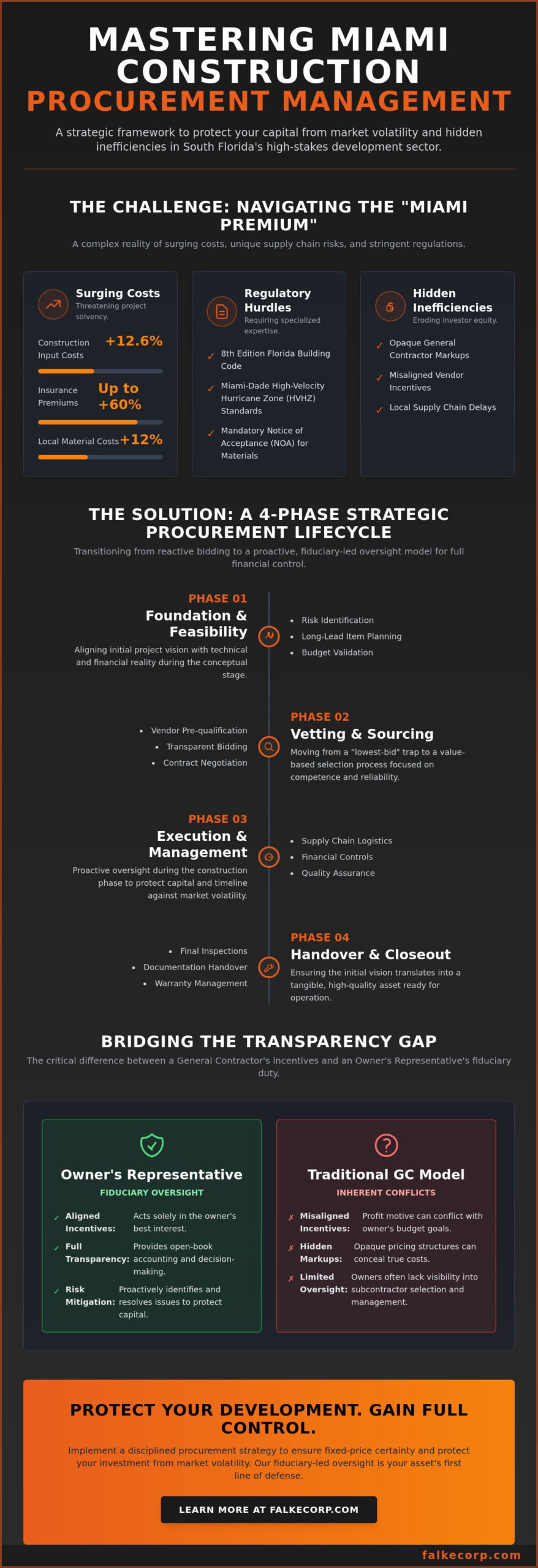
With construction input costs rising by 12.6 percent in early 2026 and insurance premiums surging by up to 60 percent, treating procurement as a simple administrative task is a direct threat to your project’s solvency. You likely recognize that the “Miami Premium” is a complex reality involving 12 percent higher material costs and specialized engineering requirements that often hide within opaque General Contractor markups. Implementing a strategic framework for construction procurement management Miami is the only way to ensure that your equity isn’t eroded by these hidden inefficiencies or the local supply chain delays unique to the South Florida climate.
This guide provides the technical methodology needed to master the complexities of the current landscape, from managing the 8th Edition of the Florida Building Code to leveraging the latest City of Miami procurement ordinances. You’ll learn how professional owner’s representation and pre-construction services deliver fixed-price certainty and full financial control over the project lifecycle. We will detail the exact strategies for vetting high-quality vendors and managing the construction phase to protect your capital and timeline against market volatility.
Key Takeaways
- Understand why Miami’s high-stakes private sector requires a disciplined, four-phase procurement methodology to align initial feasibility with technical execution.
- Identify the critical transparency gap between General Contractors and Owners to ensure your capital is protected from hidden markups and misaligned incentives.
- Master the complexities of construction procurement management Miami by effectively navigating Miami-Dade Notice of Acceptance (NOA) standards and high-density urban logistics.
- Gain full financial control over the development lifecycle by transitioning from administrative bidding to a strategic, fiduciary-led oversight model.
- Discover how professional pre-construction services mitigate the “Miami Premium” and stabilize project timelines despite current supply chain volatility.
Defining Construction Procurement Management in the Miami Private Sector
In the high-velocity real estate market of South Florida, construction procurement management Miami represents the technical discipline of acquiring the professional services, labor, and materials necessary to execute a development. While municipal procurement focus remains on statutory compliance and public trust, private sector procurement is an exercise in risk mitigation and capital preservation. It’s a strategic function that maintains the project’s financial and operational equilibrium by ensuring that every dollar spent contributes directly to the asset’s terminal value. This process transcends simple purchasing; it’s a rigorous methodology designed to prevent the “Miami Premium” from eroding investor equity through inefficient sourcing or misaligned vendor incentives.
Effective procurement isn’t merely an administrative order-taking task. It’s a proactive acquisition strategy that often mirrors the complexity found in the Engineering, Procurement, and Construction (EPC) model used in large-scale infrastructure. For luxury residential and commercial developments in Miami, this requires a disciplined four-phase methodology that begins long before a shovel hits the ground. By establishing a structured framework for bidding and contract negotiation, owners can move away from the reactive “lowest-bid” trap and toward a value-based selection process that accounts for technical competence and long-term reliability.
The Scope of Procurement in High-Stakes Development
The technical scope of procurement involves identifying long-lead items, such as specialized HVAC systems and custom glass facades, during the earliest stages of design. This early intervention is a cornerstone of strategic pre-construction services in Miami, where supply chain volatility can otherwise delay a project by months. When procurement is treated as the foundation of construction project management in Florida, it allows for the pre-qualification of vendors who possess the specific expertise required for the region’s unique architectural demands. This ensures that the project team is composed of vetted professionals who understand the rigorous demands of the local environment.
Why Miami-Dade County Requires a Specialized Approach
Navigating the regulatory landscape in South Florida requires more than just a general understanding of building practices. All procurement activities must align with the 8th Edition of the Florida Building Code and stringent Miami-Dade High-Velocity Hurricane Zone (HVHZ) standards. This means every material sourced, from roofing membranes to glazing, must carry a valid Notice of Acceptance (NOA). Furthermore, maintaining a “Cone of Silence” during the bidding phase isn’t just a public sector requirement; it’s a professional best practice in the private sector to ensure ethical standards and prevent collusive pricing. This level of oversight ensures that vendor selection is based purely on technical merit and financial transparency, protecting the owner from the hidden markups that often plague less disciplined projects.
The Strategic Procurement Lifecycle: A Four-Phase Methodology
The lifecycle of construction procurement management Miami requires a systematic approach to ensure that the initial project vision translates into a tangible, high-quality asset. Rather than viewing acquisition as a transactional event, sophisticated owners adopt a four-phase methodology that provides continuous oversight from inception to handover. This structured progression allows for the identification of risks before they manifest as cost overruns or schedule delays. As owners navigate the evolving landscape of procurement methods, the focus has shifted toward integrated strategies that prioritize long-term performance over short-term savings.
Phase 1 & 2: Setting the Procurement Foundation
Success begins during the conceptual stage of real estate development management. During Phase 1, procurement strategies must be mimetically aligned with the project’s feasibility studies and capital constraints to ensure the design remains within the financial guardrails. Moving into Phase 2, the focus shifts to pre-construction, where the drafting of high-precision Request for Proposals (RFPs) becomes paramount. These documents must be sufficiently detailed to minimize scope creep and prevent the proliferation of change orders during active construction. Vetting vendors at this stage involves more than a simple price comparison; it requires an exhaustive analysis of their financial stability and a review of their performance history within the specific constraints of the South Florida market.
Phase 3 & 4: Execution and Accountability
Phase 3 demands relentless oversight to ensure that the procurement plan is executed without deviation. This involves managing the logistical challenges of high-density areas like the Miami Design District, where staging and delivery windows are extremely narrow. It’s during this time that real-time monitoring of material deliveries becomes critical to prevent the cascading delays that often plague large developments. Key activities during this period include:
- Real-time tracking of long-lead material deliveries to ensure schedule adherence.
- Managing the technical requirements of the ‘Notice to Proceed’ for various trades.
- Continuous quality control inspections to verify that all materials meet stringent NOA standards.
Phase 4 focuses on the final reconciliation of the procurement budget and the formal asset handover. This includes the collection of all final lien waivers and the completion of the technical commissioning process. Our construction phase management services provide the structure needed to close out these complex developments with total financial transparency and technical precision.
Owner’s Representative vs. General Contractor: The Procurement Conflict
The structural tension within construction procurement management Miami often stems from the inherent misalignment of incentives between the owner and the general contractor. While a General Contractor is responsible for the physical execution of the project, their primary financial objective remains the management of their own margins, which frequently leads to a significant transparency gap. This gap manifests when contractors bundle procurement costs with labor and overhead, making it difficult for the owner to discern the actual market value of materials. In a market where material costs are approximately 12 percent above the national average, these obscured markups can quickly escalate a project’s total expenditure without providing equivalent value to the asset itself.
The Fiduciary Responsibility in Acquisition
An Owner’s Representative in Miami operates as a technical fiduciary, providing the unbiased oversight necessary to ensure that vendor evaluations are based on empirical data rather than contractor convenience. Unlike a General Contractor, who might favor specific subcontractors based on long-standing relationships or ease of coordination, an independent consultant audits every bid to confirm it aligns with current market benchmarks. This level of scrutiny protects owners from ‘favored vendor’ arrangements that often inflate costs. It ensures that procurement decisions are made through a lens of technical competence and financial prudence, maintaining the project’s long-term stability from the earliest phases of acquisition.
Cost Control and Transparency
Maintaining a single source of truth for all project expenditures is essential for protecting investor capital. This is achieved by implementing open-book accounting for all major material purchases, allowing the owner to see the direct cost of goods alongside any negotiated discounts. With Miami’s construction cost inflation rising by 4.74 percent year-over-year as of early 2026, the ability to audit contractor-led procurement in real-time is a critical defensive strategy. It effectively mitigates the risk of change order fraud by establishing precise initial procurement parameters that leave no room for opportunistic pricing adjustments later in the project lifecycle.
By shifting to a direct-to-owner procurement model for high-value items, such as hurricane-impact glazing or structural steel, owners can bypass the standard contractor markup. This approach doesn’t just save money. It provides a level of financial control that’s impossible to achieve when procurement is left entirely in the hands of the party responsible for building the project. The result is a more resilient budget that can absorb the localized pressures of the South Florida market without compromising the technical quality of the final asset.
Navigating Miami’s Unique Supply Chain and Regulatory Risks
Managing the technical requirements of construction procurement management Miami involves a level of regulatory complexity that’s virtually unparalleled in the United States. Beyond standard project constraints, developers must account for the rigorous 8th Edition of the Florida Building Code and the specific mandates of the High-Velocity Hurricane Zone (HVHZ). Every critical component, from structural fasteners to envelope systems, must carry a valid Miami-Dade Product Approval (NOA). Failing to verify these certifications during the procurement phase doesn’t just invite regulatory fines; it risks the entire structural integrity and insurability of the asset in a market where premiums have already risen by 30 to 60 percent since 2022.
Material Sourcing for Resiliency
Procuring impact-resistant glazing and specialized roofing systems requires an advanced understanding of local supply chain lead times. Hurricane-impact glazing systems, which typically cost between $80 and $250 per square foot of glass area, often necessitate extensive lead times that must be integrated into the initial project schedule. Verifying that all sourced materials comply with current codes is a primary function of our pre-construction services, ensuring that the project doesn’t stall during the threshold inspection phase. We also leverage extended vendor networks across Broward and Palm Beach counties to mitigate the localized price spikes often found within the immediate Miami-Dade area.
Logistics and Urban Site Constraints
Executing a development in high-density sectors like the Miami Design District or Brickell introduces significant logistical friction. Urban site constraints necessitate a just-in-time delivery strategy, as staging areas are often non-existent and right-of-way permits from local municipalities are strictly time-bound. Coordinating these deliveries requires precise construction phase management to avoid the high costs of idling labor or municipal penalties. When long-lead items arrive during the peak of Florida’s hurricane season, we implement contingency plans for off-site storage in climate-controlled inland facilities, protecting the owner’s investment from both environmental damage and the logistical paralysis that a major storm can cause.
If you’re overseeing a complex development in South Florida, securing a partner who understands these regional nuances is essential for maintaining project momentum. Learn how our Owner’s Representation team provides the disciplined oversight necessary to navigate Miami’s regulatory and logistical hurdles.
FALKE Atlantic: Disciplined Oversight for Complex Developments
FALKE Atlantic Corporation operates on the principle that technical competence and unwavering transparency are the only safeguards for capital in a volatile market. Our approach to construction procurement management Miami is defined by a 100 percent fiduciary focus, ensuring that our interests remain strictly aligned with those of the owner. By removing the conflict of interest inherent in contractor-led acquisition, we provide a level of financial control that protects high-net-worth and corporate developers from the hidden inefficiencies of the South Florida supply chain. This disciplined oversight transforms procurement from a point of vulnerability into a strategic advantage, where every acquisition is vetted for technical compliance and long-term asset value.
We don’t simply manage orders; we engineer a procurement environment where risk is quantified and mitigated before it impacts the project’s bottom line. Our boutique approach to commercial project management in Miami is built upon a foundation of precision and accountability. This methodology allows FALKE Atlantic Corporation to act as a true strategic partner, overseeing the most complex processes with a level of detail that larger, more generalized firms often overlook. It’s this commitment to professional stability that ensures your project remains secure under our expert supervision.
The FALKE Advantage in Miami
Our team brings deep local expertise across Dade, Broward, and Palm Beach counties, providing the necessary insight to overcome the specific logistical and regulatory hurdles that define the region. FALKE Atlantic Corporation has a documented track record of managing complex, high-value assets within the hospitality and retail sectors, where the demand for technical precision is absolute. Our focus remains on delivering revenue-ready assets through a rigorous procurement methodology that accounts for everything from long-lead coastal finishes to specialized hurricane-rated systems. This ensures that when the project reaches the construction phase, the supply chain is already stabilized and the path to completion is clear.
Securing Your Project’s Future
As the development progresses, we manage the seamless transition from procurement to final commissioning and close-out. This process includes maintaining a professionally managed construction audit trail that provides a clear, undeniable record of every transaction and technical certification. This level of documentation is invaluable for future asset management, refinancings, or divestments, as it proves the technical integrity and regulatory compliance of the building. By providing a single source of truth throughout the project lifecycle, FALKE Atlantic Corporation ensures that the owner remains in full control of their capital and their timeline. To protect your equity and ensure the successful delivery of your next South Florida development, Consult with FALKE Atlantic Corporation for your Miami procurement strategy.
Mastering the South Florida Development Lifecycle
The volatile nature of the South Florida market necessitates a shift from passive purchasing to a disciplined acquisition strategy. By adopting the structured methodology discussed, owners can effectively mitigate the “Miami Premium” and navigate the regulatory complexities inherent in the High-Velocity Hurricane Zone. Establishing a single source of truth through professional construction procurement management Miami ensures that capital is deployed with precision and that the project remains insulated from the conflicts of interest found in traditional contractor-led models.
FALKE Atlantic Corporation provides the technical competence required to maintain full financial control over the entire development lifecycle. Secure Your Project’s Financial Integrity with FALKE Atlantic Corporation. Our fiduciary-first methodology and specialized expertise in Miami-Dade regulatory standards provide the stability needed to guide projects from conceptual feasibility through final commissioning. We remain committed to ensuring your project’s success through professional accountability and meticulous oversight.
Frequently Asked Questions
What is construction procurement management in the private sector?
Construction procurement management in the private sector is the strategic acquisition of professional services, labor, and materials required to deliver a real estate asset. Unlike public sector processes that prioritize statutory compliance, private construction procurement management Miami focuses on capital preservation and technical ROI. It involves a disciplined methodology to align vendor selection with the project’s specific financial guardrails and feasibility goals.
How does procurement management differ from general contracting?
Procurement management is a fiduciary oversight function, whereas general contracting is an execution-based role. A procurement manager acts as the owner’s advocate to ensure transparency in material costs and labor rates. Conversely, a general contractor manages day-to-day site activities. By separating these functions, owners avoid the transparency gap that often occurs when a single entity controls both the budget and the physical implementation.
What are long-lead items in Miami construction projects?
Long-lead items are materials with manufacturing or delivery timelines that exceed the standard construction schedule, such as hurricane-impact glazing or specialized HVAC units. Identifying these during the pre-construction phase is critical to prevent cascading delays. This proactive approach is essential in South Florida to protect the project timeline from seasonal supply chain fluctuations and the logistical constraints of urban sites.
Why is an Owner’s Representative essential for procurement in Florida?
An Owner’s Representative provides the technical oversight required to navigate the region’s unique market pressures, such as the 12 percent material cost premium. They ensure that procurement activities align with the owner’s financial interests rather than the contractor’s convenience. This role is essential for maintaining a single source of truth for all expenditures and ensuring that every acquisition meets the project’s terminal value requirements.
How do Miami building codes affect material procurement?
Miami building codes require all envelope materials to meet High-Velocity Hurricane Zone (HVHZ) standards and carry a valid Notice of Acceptance (NOA). This limits procurement to a specific pool of vetted vendors and materials that can withstand Category 5 wind loads. Verification of these certifications during the acquisition phase is mandatory to ensure the structural integrity and insurability of the asset.
Can professional procurement management reduce project change orders?
Professional construction procurement management Miami reduces change orders by establishing a precise technical foundation before contracts are signed. By drafting detailed RFPs and conducting thorough vendor vetting, the procurement manager eliminates the ambiguity that typically leads to scope creep. This disciplined pre-construction effort ensures that all parties understand the technical requirements, leading to greater fixed-price certainty.
What are the risks of letting a contractor handle all procurement?
The primary risk is a lack of financial transparency, as contractors may bundle procurement costs with labor and markups. This can result in “favored vendor” arrangements that don’t necessarily offer the best value to the owner. Without independent oversight, owners often lose the ability to audit direct material costs, making the project vulnerable to opportunistic pricing and budget erosion.
How does FALKE Atlantic Corporation ensure transparency in the bidding process?
FALKE Atlantic Corporation ensures transparency by implementing an open-book accounting model and a fiduciary-focused oversight strategy. Every bid is audited against empirical market data to confirm it aligns with current South Florida benchmarks. This allows owners to see the direct cost of goods and labor, ensuring that all procurement decisions are based on technical merit and financial precision rather than contractor convenience.