
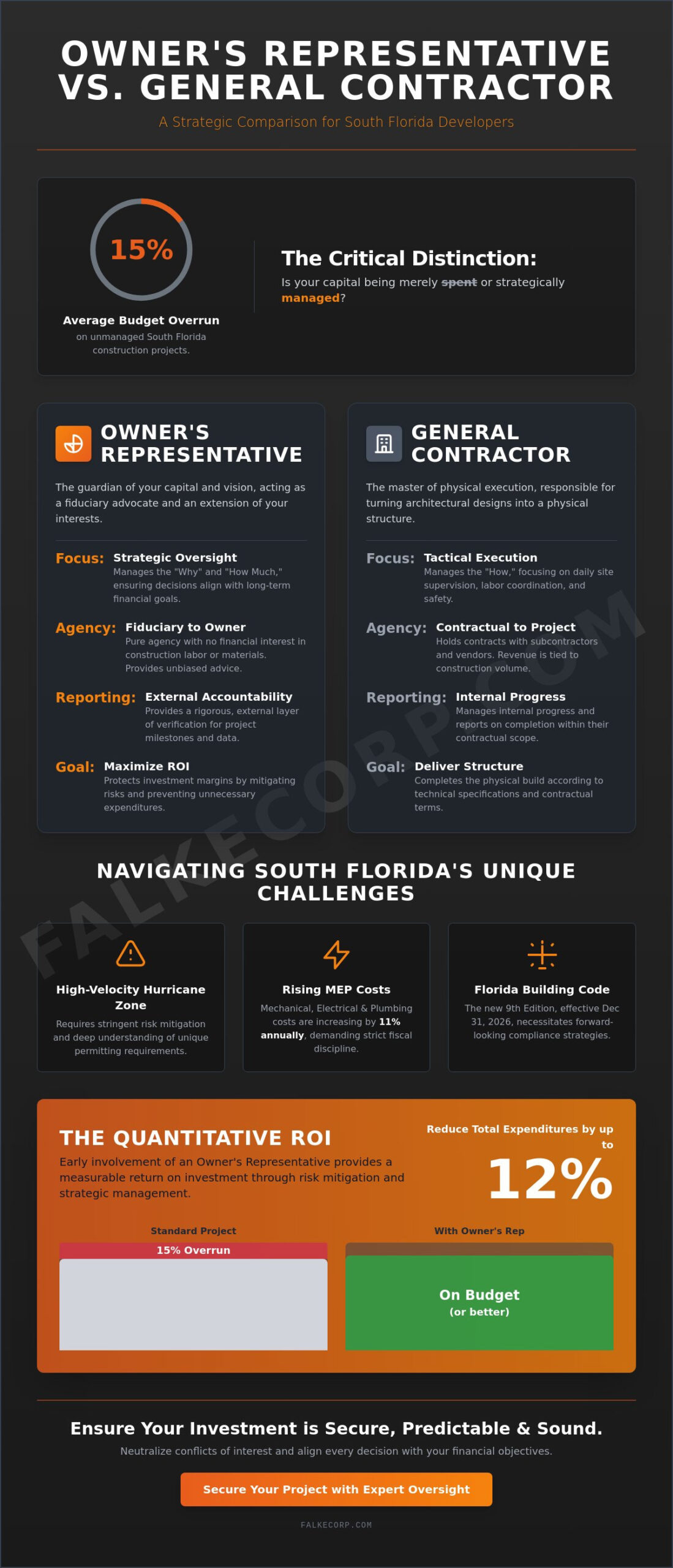
Unmanaged construction projects in South Florida currently face an average budget overrun of 15 percent, a figure that often stems from a fundamental misunderstanding of project hierarchy. While a licensed builder is essential for physical execution, the distinction between an owner’s representative vs general contractor Florida determines whether your capital is merely spent or strategically managed. You likely recognize that the 9th Edition of the Florida Building Code, effective December 31, 2026, and rising MEP costs, currently increasing by 11 percent annually, require more than just a competent builder to maintain fiscal discipline.
It’s reasonable to assume that a qualified general contractor should handle all aspects of your development; however, their primary objective remains the delivery of a physical structure within a specific contractual scope. This article clarifies the critical divergence between the contractor’s focus on execution and the owner’s representative’s role as a fiduciary advocate. You’ll understand how unbiased oversight mitigates risks associated with the High-Velocity Hurricane Zone and why early involvement of a representative can reduce total expenditures by up to 12 percent. We will examine the structural differences in licensing, transparency, and risk management to ensure your South Florida investment remains secure, predictable, and technically sound.
Key Takeaways
- Identify the critical distinction between technical execution and fiduciary advocacy to ensure project objectives remain aligned with your financial constraints.
- Analyze how the structural separation of reporting lines prevents the common pitfalls of self-reporting and masks of project delays.
- Understand the inherent conflict of interest within the owner’s representative vs general contractor Florida relationship and how to neutralize it through professional oversight.
- Navigate the specific complexities of Florida Chapter 489 licensing and the stringent permitting requirements unique to South Florida’s High-Velocity Hurricane Zones.
- Evaluate the quantitative return on investment achieved through a phased management methodology that prioritizes risk mitigation and schedule efficiency.
Defining the Fundamental Distinction in Florida Construction
Developing a commercial or high-end residential asset in South Florida requires a clear delineation of professional responsibilities to prevent the dilution of accountability. The structural distinction between an owner’s representative vs general contractor Florida is not merely a matter of job titles; it’s a fundamental separation between the fiduciary management of capital and the physical execution of a design. While both roles are essential to the success of a development, they operate on different planes of the project hierarchy. A foundational Construction Management Overview clarifies that while the industry involves various delivery methods, the core conflict often arises when owners expect a builder to act as an unbiased financial advisor.
In the context of Florida real estate development, the concept of Agency is central to this comparison. An Owner’s Representative operates with pure agency, meaning they’re a consultant and advocate who acts as an extension of the owner’s interest. They maintain no financial interest in the construction labor or the procurement of materials. This lack of a profit motive tied to the physical build allows for objective oversight. Conversely, the General Contractor is the entity responsible for the direct execution of the work, managing the complex web of subcontractors and vendors required to turn blueprints into a physical structure.
The General Contractor: Master of Physical Execution
The General Contractor assumes the primary responsibility for the “how” of the construction process. Their focus is tactical and operational, centering on the daily supervision of the job site to ensure the project meets the architect’s technical specifications. They manage the critical path by coordinating labor, ensuring site safety, and overseeing material procurement. Because their revenue is often tied to the volume of work performed and the efficiency of their crews, their perspective is inherently focused on the immediate requirements of the build phase. They’re the executors of the vision, not the architects of the project’s financial strategy.
The Owner’s Representative: Guardian of Capital and Vision
The Owner’s Representative manages the “why” and “how much” of the project. They serve as the single point of contact for all stakeholders, including architects, engineers, and the General Contractor themselves. Their role is to protect the owner’s financial interests through every phase of development, from initial pre-construction services to final commissioning and close-out. By providing unbiased oversight, they ensure that every decision aligns with the owner’s long-term revenue or operational goals. They don’t build the walls; they ensure the walls are built correctly, on time, and without the unnecessary change orders that frequently erode investment margins in the Florida market.
Comparative Analysis: Responsibilities, Risk, and Reporting
The structural divergence in an owner’s representative vs general contractor Florida arrangement becomes most apparent during the verification of project milestones. While the General Contractor focuses on the internal management of their labor force, the Owner’s Representative establishes an external layer of accountability. This separation ensures that project data isn’t just recorded, but rigorously analyzed for accuracy. This complexity explains the Rising Demand for Owner’s Reps as developers seek to insulate themselves from the risks of self-reported progress and optimistic scheduling.
Contractual Privity and the Chain of Command
In a standard Florida construction project, the General Contractor holds contractual privity with the subcontractors and vendors. This creates a vertical chain of command where the builder is responsible for the performance and payment of the trades. The Owner’s Representative, however, exists outside this construction contract. They maintain a direct fiduciary relationship with the owner, allowing them to provide unbiased advice without the conflict of interest inherent in managing a labor force. This positioning is vital for managing the “Triangle of Construction,” where the Owner’s Representative balances the often-competing interests of the owner, the architect, and the contractor to maintain project stability.
Effective reporting requires more than just passing along the General Contractor’s daily logs. It demands independent verification. When a builder reports that a phase is 50 percent complete, the Owner’s Representative conducts a site audit to confirm that the physical work matches the reported percentage. Engaging in detailed pre-construction services ensures that these reporting protocols are established before the first shovel hits the ground.
Budget Management vs. Construction Cost Estimating
A General Contractor provides a cost estimate, which is essentially a bid for the hard costs of construction, including materials, labor, and their own fee. In contrast, the Owner’s Representative develops a comprehensive project budget. This financial plan accounts for the “soft costs” that builders typically ignore, such as:
- Municipal permitting fees and impact taxes.
- Legal and financing expenses.
- Design and engineering contingencies.
- Insurance premiums and environmental testing.
The management of these funds requires constant vigilance throughout the construction phase. An Owner’s Representative audits a General Contractor’s monthly pay applications to ensure the percentage of work completed matches the funds disbursed, preventing the risk of over-billing. This level of oversight mitigates the 15 percent average budget overrun seen in unmanaged South Florida projects by identifying financial discrepancies in real time.
Resolving the Conflict of Interest in High-Stakes Developments
The structural tension between an owner’s representative vs general contractor Florida often centers on the alignment of financial incentives. A General Contractor is a for-profit entity whose primary obligation is to their own firm’s solvency and margin. In Florida’s current economic climate, where the cost of metal studs increased by 10 to 15 percent in early 2026, contractors face significant pressure to protect their bottom line. This pressure frequently manifests in change orders that serve as profit centers rather than necessary adjustments. An Owner’s Representative eliminates this friction by serving as a fiduciary whose only loyalty is to the project’s financial and technical integrity.
Self-reporting remains a critical vulnerability in unmanaged projects. When a General Contractor acts as the sole source of information regarding project health, delays or quality issues are often masked until they become critical. While certain Florida Statutes for Owner-Builders allow property owners to manage their own construction under specific exemptions, the regulatory and technical complexity of modern developments necessitates professional, unbiased oversight to verify “Work in Place” before any capital is disbursed.
Why a General Contractor Cannot Effectively Audit Their Own Performance
Institutional-grade projects require a system of checks and balances that a builder cannot provide internally. There’s a natural tendency for contractors to prioritize their profit margins, which may lead to the “front-loading” of pay applications. This practice involves billing for a higher percentage of work in the early stages of a project to improve the contractor’s cash flow at the owner’s risk. An independent representative provides the necessary technical audit to ensure that payment is strictly commensurate with verified physical progress on-site.
Protecting the Owner from Change Order Abuse and Scope Creep
Change order abuse is one of the primary drivers of the 15 percent average budget overrun seen in unmanaged South Florida developments. An Owner’s Representative vets the necessity, engineering validity, and market pricing of every proposed change before it reaches the owner’s desk. This rigorous scrutiny prevents scope creep and ensures that the established Construction Project Management in Florida strategy is followed without deviation. By adhering strictly to the initial project charter, the representative ensures that “Cost Plus” or “Lump Sum” contract risks are managed through technical competence rather than optimistic assumptions.
Navigating Florida-Specific Regulatory and Climate Challenges
Florida’s regulatory environment presents a unique set of technical frictions that can disrupt the financial stability of any development. The legal distinction in the standing of an owner’s representative vs general contractor Florida is governed primarily by Florida Chapter 489, which mandates specific licensing for those performing physical construction. While a General Contractor must hold a valid state license to execute the build, the representative operates as a consultant or agent. This “Agent” distinction is critical; the representative provides technical oversight and fiduciary advocacy without assuming the liabilities associated with the direct methods and means of construction. They evaluate the contractor’s adherence to the Florida Building Code, ensuring that the 9th Edition standards, which incorporate updated wind load requirements, are met without costly remediation.
Beyond licensing, the administrative burden of South Florida construction requires precise coordination of legal documents such as the Notice of Commencement. In Florida, this document is foundational to the lien law process. Failure to manage these filings correctly can leave an owner vulnerable to double-payment risks if a General Contractor fails to pay their subcontractors. A professional representative manages the flow of partial and final lien waivers, ensuring that every dollar disbursed is protected by a corresponding legal release.
Florida Licensing (Chapter 489) and the ‘Agent’ Distinction
The efficacy of an owner’s representative depends on their technical literacy. While they don’t function as the builder of record, they must possess a deep understanding of Florida’s statutory requirements to effectively audit the General Contractor. This is especially pertinent when utilizing Owner’s Representative Miami services, where the complexity of local municipal codes often exceeds state-wide minimums. A representative with technical construction knowledge can identify code violations in the field before they result in failed inspections and schedule delays.
Managing South Florida’s Environmental and Climate Timelines
Climate factors in Florida are not merely environmental concerns; they’re schedule and procurement risks. The High-Velocity Hurricane Zone (HVHZ) designations in Miami-Dade and Broward counties impose the most stringent impact-resistance standards in the United States. A professional Construction Phase Management in Florida strategy must account for the six-month hurricane season, building contingency days into the Master Schedule to mitigate weather-related stoppages. The representative ensures that long-lead items, such as specialized glazing or HVAC equipment currently facing 8 to 10 percent price increases, are procured early to avoid the volatility of the Florida market. To secure your project’s regulatory and environmental resilience, consider a structured development management approach that prioritizes risk mitigation over reactive problem-solving.
Integrating Professional Owner’s Representation into Your Project
The integration of professional oversight is the final step in securing a South Florida development. While the debate regarding an owner’s representative vs general contractor Florida often frames the roles as competitive, the most successful projects treat them as a high-performance team. The representative doesn’t replace the builder; they provide the technical guardrails that allow the builder to focus on execution while the owner’s capital remains protected. Achieving this balance requires a structured approach that spans the entire project lifecycle, from initial feasibility to final occupancy.
The FALKE Atlantic Corporation Methodology: Disciplined Oversight
Our approach utilizes a rigorous four-phase methodology: Concept, Pre-Construction, Execution, and Close-out. During the initial Concept phase, we focus on feasibility and site selection to ensure the project’s vision is grounded in technical reality. As the project moves into pre-construction, our Real Estate Development Management Services bridge the gap between design intent and physical delivery. This phase is critical for vetting the General Contractor’s bid and ensuring that the specific Florida Building Code requirements are technically integrated into the plans before the permit is issued.
The Execution phase involves the active monitoring of site progress, where we verify work in place and audit pay applications. However, the Close-out phase is where many unmanaged projects fail to cross the finish line. We ensure that all technical documentation, warranties, and certificates of occupancy are secured, making the asset revenue-ready without the typical delays associated with poor administrative management. FALKE Atlantic Corporation ensures financial transparency through a disciplined four-phase methodology.
Maximizing ROI in Miami’s Competitive Real Estate Market
Sophisticated owners in Miami-Dade and Palm Beach counties recognize that the ROI of hiring a representative is often realized through the avoidance of a single major change order. In a market where skilled labor costs are projected to rise by 12 percent through late 2027, schedule efficiency is the only way to preserve margins. Selecting a Florida-based firm requires looking for technical construction knowledge combined with established local presence. These relationships with municipalities and vendors are essential for clearing permitting hurdles and securing long-lead materials before price spikes occur.
Ultimately, the owner’s representative vs general contractor Florida dynamic should be one of mutual accountability. When the representative provides clear, technically sound directives based on the owner’s goals, the General Contractor can execute with greater precision. This collaborative framework reduces friction, eliminates common budget overruns, and delivers a finished asset that meets the highest professional standards. It’s a strategic partnership designed to turn complex construction variables into predictable investment outcomes.
Securing the Future of Your South Florida Asset
The strategic alignment of your project hierarchy depends on the fundamental choice between an owner’s representative vs general contractor Florida. While the builder remains the master of physical delivery, the representative functions as the fiduciary anchor, ensuring that the owner’s long-term operational and financial objectives aren’t compromised by the tactical pressures of the job site. This structural separation of duties is the most effective safeguard against the systemic inefficiencies and budget erosions that frequently plague unmanaged developments in the South Florida market.
FALKE Atlantic Corporation provides the technical stability required for these high-stakes investments through a disciplined four-phase methodology that integrates oversight from concept to close-out. Our specialization in high-value hospitality and retail assets, combined with a granular understanding of Miami-Dade and Broward county regulations, ensures that your project maintains both code compliance and fiscal discipline. By prioritizing transparency and technical competence, we transform complex construction variables into secure, revenue-ready assets. Schedule a consultation with FALKE Atlantic Corporation to protect your Florida development project. Your investment deserves a partnership built on professional accountability and unwavering precision.
Frequently Asked Questions
Is an Owner’s Representative the same as a Construction Manager in Florida?
An Owner’s Representative is a fiduciary consultant, whereas a Construction Manager in Florida often assumes a contractual role involving the direct management of subcontractors and site labor. While a Construction Manager at Risk (CMAR) may provide a guaranteed maximum price, the representative maintains no financial stake in the construction volume. This ensures their advice remains strictly unbiased and focused on the owner’s strategic goals rather than labor efficiency.
Can a General Contractor also act as the Owner’s Representative?
A General Contractor cannot effectively serve as an Owner’s Representative because this creates a structural conflict of interest between physical execution and financial oversight. The builder’s primary obligation is to their own firm’s margin, while the representative’s sole duty is to the owner’s investment. When evaluating an owner’s representative vs general contractor Florida arrangement, maintaining this separation is the only way to ensure that site reports undergo independent verification.
How much does an Owner’s Representative typically cost for a Miami project?
Professional fees for representation on Miami projects are typically structured as either a percentage of the total project value or a fixed hourly rate. These structures vary based on the development’s complexity, the required level of site supervision, and the duration of the construction lifecycle. This arrangement aligns the representative’s interests with project efficiency and cost avoidance rather than the volume of physical work performed on the job site.
Does Florida law require an Owner’s Representative to be a licensed contractor?
Florida law doesn’t mandate a contractor’s license for those acting strictly in a consulting or representative capacity. Florida Chapter 489 specifically regulates the entities performing the physical work, such as the General Contractor. However, an effective representative must possess deep technical literacy in the Florida Building Code to provide meaningful oversight of the licensed trades and ensure the project meets all statutory requirements.
When is the best time to hire an Owner’s Representative for a new development?
The optimal time to engage a representative is during the concept or site feasibility phase. Early involvement allows for the establishment of a disciplined project charter and the vetting of the General Contractor’s initial bid before any capital is committed. This proactive approach identifies potential risks during the pre-construction stage, which often results in significant cost avoidance during the later execution and construction phases.
How does an Owner’s Representative handle change orders differently than a GC?
An Owner’s Representative vets change orders for technical necessity and market-rate pricing before they reach the owner for approval. While a General Contractor may view change orders as a mechanism to address scope gaps or margin recovery, the representative audits the engineering validity of each request. This rigorous scrutiny ensures that only essential, fairly priced adjustments are integrated into the budget, preventing the common issue of scope creep.
What specific Miami-Dade building regulations should an Owner’s Rep manage?
A representative must manage compliance with the High-Velocity Hurricane Zone (HVHZ) standards and the updated wind load requirements of the 9th Edition Florida Building Code. In Miami-Dade, this includes overseeing the rigorous permitting timelines and ensuring that all specialized glazing and structural components meet local impact-resistance mandates. This technical supervision prevents the failed inspections and administrative delays that often stall South Florida developments.
Can an Owner’s Representative help with site feasibility and permitting in Florida?
Professional representation includes comprehensive development management services that cover site feasibility and the permitting process. By coordinating with municipal officials and environmental consultants, the representative identifies zoning constraints and utility requirements early. This structured oversight ensures the project moves from the planning stage to the construction phase without the administrative friction that typically arises from unmanaged regulatory filings.