
The most substantial financial erosion in a capital project rarely occurs during the physical execution of work; instead, it’s often rooted in the strategic voids left unaddressed before the first contract is signed. You likely understand that in a 2026 market defined by a shortage of 499,000 skilled workers and material price inflation of up to 4%, the margin for error has narrowed significantly. It’s common to experience anxiety over budget slippage or the technical complexities that obscure true transparency in general contractor reporting. This guide establishes the precise technical milestones and organizational red flags that signal when to hire an owner’s representative for a project to safeguard your interests.
You’ll discover how a structured, four phase methodology, from initial strategizing to final commissioning, provides the fiduciary protection necessary to maintain absolute financial control. We’ll explore the specific triggers within the project lifecycle where expert intervention shifts the trajectory from potential litigation and cost overruns toward a delivery that’s on schedule, within budget, and at the specified quality parameters. By identifying these critical intervention points early, you can transform technical risk into a predictable, high performance asset.
Key Takeaways
- Distinguish between standard project management and fiduciary owner representation to ensure your capital interests are protected by a dedicated technical advocate.
- Identify the strategic “Rule of Early Engagement” to determine precisely when to hire an owner’s representative for a project to capture maximum value during pre-construction.
- Recognize the critical operational red flags, such as persistent change order inflation and communication silos, that necessitate immediate expert intervention on active sites.
- Understand the sector-specific triggers within South Florida’s high-pressure luxury retail and hospitality markets that mandate specialized development management.
- Gain insight into a structured, four-phase methodology designed to align complex project visions with rigorous budget, schedule, and quality benchmarks.
Defining the Strategic Role of an Owner’s Representative in 2026
The professional landscape of 2026 requires a shift from tactical oversight to strategic fiduciary advocacy. While the technical foundations of Construction Management remain constant, the complexity of modern capital projects demands a dedicated representative who operates outside the standard contractual interests of designers and builders. An owner’s representative doesn’t replace the project manager; instead, they serve as an extension of your executive staff, providing the technical competence required to oversee the project’s financial and operational health. Determining when to hire an owner’s representative for a project depends on identifying the technical and financial gaps within your existing team structure.
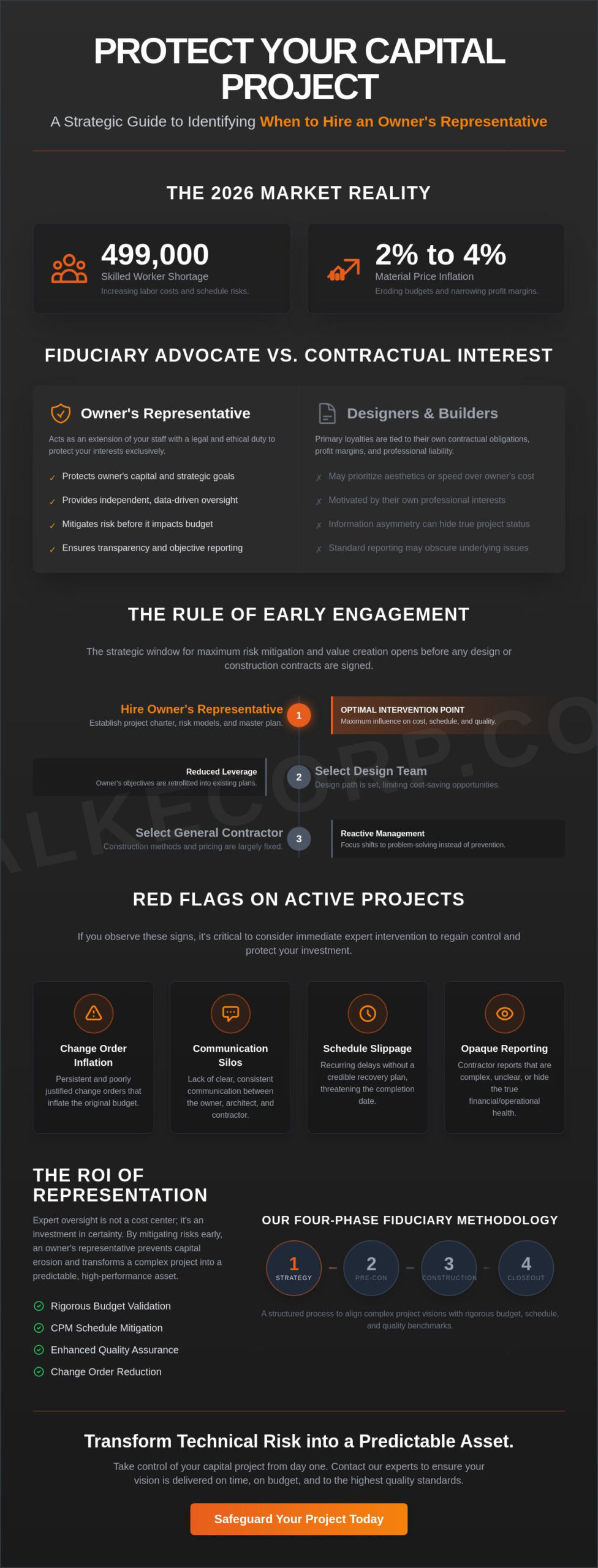
In 2026, this role has evolved to prioritize data-driven transparency. With the U.S. construction sector facing a shortage of 499,000 workers and material costs projected to rise by 2% to 4% this year, traditional reporting methods are no longer sufficient. Modern representation utilizes advanced analytics to provide real-time schedule validation and budget oversight. The primary objective is to eliminate the information asymmetry that often exists between the owner and the general contractor.
Independent Advocacy vs. Contractual Interest
Designers design. Builders build. While both are essential, their primary loyalties are tied to their own professional liability and profit margins. Architects may prioritize aesthetic integrity over cost efficiency, while general contractors might favor construction methods that maximize their speed and margin. An owner’s representative provides the necessary checks and balances to ensure the owner’s vision isn’t compromised by aggressive value engineering or hidden schedule delays. By maintaining an independent position, the representative can objectively audit progress and challenge assumptions that don’t align with the owner’s strategic goals.
The ROI of Professional Representation
The financial justification for expert representation is found in risk mitigation and the prevention of capital erosion. When you consider when to hire an owner’s representative for a project, the potential for change order mitigation alone often outweighs the professional fees. Effective representation identifies errors and omissions in the pre-construction phase, before they manifest as costly field corrections. Fiduciary oversight in capital project management constitutes a legal and ethical obligation to act solely in the owner’s best interest, ensuring every financial and technical decision prioritizes the preservation of the project’s capital and strategic objectives.
Core responsibilities of the representative include:
- Rigorous budget validation and cost-to-complete forecasting.
- Critical path method (CPM) schedule analysis and delay mitigation.
- Quality assurance protocols that exceed standard municipal inspections.
- Technical coordination between separate design and engineering consultants.
This level of oversight ensures that your project remains a predictable asset rather than a liability driven by external market pressures or internal team conflicts.
The Critical Timeline: Why Pre-Construction is the Optimal Hiring Window
The strategic window for maximum risk mitigation opens far earlier than most capital investors anticipate. Deciding when to hire an owner’s representative for a project is a choice that should ideally precede the formal selection of the design team or the general contractor. Under the ‘Rule of Early Engagement’, the project charter must be established before any consultants are retained. This ensures that the owner’s objectives are the primary driver of the project’s DNA, rather than being retrofitted into an architect’s vision or a contractor’s preferred delivery method. Early intervention allows for the creation of a master plan that includes rigorous cost, schedule, and risk models before capital is committed to irreversible design paths.
In the specific regulatory environments of Miami-Dade and Broward counties, the entitlement and permitting landscape is exceptionally dense. Navigating these requirements demands a level of technical coordination that standard project management often lacks. Public sector entities frequently recognize this necessity; for instance, the California DGS Construction Services model demonstrates how dedicated management branches are utilized to maintain oversight from the earliest feasibility stages. Replicating this professional rigor in the private sector is essential for protecting capital investments against local bureaucratic delays.
Phase 1: Concept and Feasibility
Site selection and due diligence in Florida involve more than just zoning checks. Environmental constraints, soil density, and local infrastructure capacity can derail a project’s financial viability before it leaves the conceptual stage. A representative conducts a rigorous gap analysis on the initial project pro forma, ensuring that the budget reflects market reality rather than optimistic projections. This phase is about vetting the team; an owner’s representative qualifies architects and engineers based on sector-specific expertise, ensuring the right technical competence is in place from day one.
Phase 2: Design and Bidding Strategy
Design management is a process of constant vigilance against scope creep. As drawings progress, the representative ensures that every detail aligns with the established budget and schedule baselines. This oversight extends to the procurement phase, where structuring construction bidding Florida becomes critical for ensuring competitive and transparent pricing. Protecting the owner’s interest during contract negotiation requires more than standard boilerplate language. It involves the integration of specific liquidated damages and milestone clauses that hold the project team accountable to the master schedule. If you’re currently evaluating your project’s feasibility, engaging a partner for pre-construction services can prevent the capital erosion that typically occurs when early-stage decisions are left unmanaged.
Red Flags: When to Hire an Owner’s Representative for an Active Project
While the strategic advantage of early engagement was established in previous sections, many capital investors only recognize the necessity of professional intervention once a project is already in progress. Identifying when to hire an owner’s representative for a project during the active phase requires a clinical assessment of technical and financial indicators. In a market where material price inflation is projected at 2% to 4% for 2026, the absence of rigorous oversight can lead to a rapid erosion of your contingency funds. The most prominent warning sign is the “death by a thousand” change orders, where the general contractor frequently requests additional capital for scope items that should’ve been captured during the initial bidding phase.
Technical friction often manifests as a communication breakdown between the architect of record and the general contractor. When these two primary stakeholders operate in silos, the owner is left to mediate technical disputes without the necessary engineering background. This lack of coordination inevitably leads to unexplained schedule delays and missed contractual milestones, which jeopardize the project’s projected completion date and overall financial viability. If these issues aren’t addressed through professional construction phase management florida, the project risks total operational failure.
The Crisis Intervention Protocol
When a project reaches a state of technical or financial instability, the representative initiates a comprehensive project audit. This process identifies the root causes of friction, whether they’re rooted in design deficiencies or contractor mismanagement. Re-establishing a strict chain of command and standardized reporting is the first step in reclaiming control. The representative utilizes forensic accounting to audit all payment applications and lien waivers. This mitigates the risk of mechanics’ liens and legal disputes, ensuring that your capital is actually reaching the subcontractors and suppliers performing the work.
Signs of Insufficient Oversight
You can often identify the need for representation by evaluating your own time allocation. If you’re spending more than 10 hours a week resolving technical field decisions or mediating team conflicts, your project lacks the necessary fiduciary oversight. Other critical red flags include:
- Monthly progress reports that are opaque, inconsistent, or lack verified site data.
- A noticeable absence of a structured construction quality control miami plan.
- Subcontractor disclosure failures, particularly concerning for projects where a single entity performs more than 50% of the work.
- Persistent quality control failures that manifest as recurring punch-list items or failed municipal inspections.
Engaging a representative at this stage isn’t a sign of project failure, but a strategic move to prevent further loss and ensure the final delivery meets your original specifications.
Sector-Specific Triggers for Development Management in South Florida
Determining exactly when to hire an owner’s representative for a project often depends on the specific operational triggers inherent to your asset class. While the foundational principles of budget and schedule oversight remain constant, the technical risks vary significantly between a high-rise hospitality renovation and a luxury retail fit-out. In South Florida’s 2026 market, characterized by a forecasted average effective rent of $2,407 in the multifamily sector and high stabilized occupancy, the cost of a delayed opening is quantifiable and severe. Expert development management ensures that sector-specific complexities don’t compromise your revenue-ready dates.
Hospitality and Resort Development
In the hospitality sector, the transition from construction to operations is a critical period where many projects experience significant friction. Managing the “Revenue-Ready” date requires precise synchronization of construction activities with the delivery and installation of Furniture, Fixtures, and Equipment (FF&E). A representative oversees the complex commissioning process to ensure all brand standards are met before the first guest arrives. This is particularly challenging during phased renovations where partial operations must be maintained. Additionally, ensuring compliance with Florida’s stringent coastal building codes is a technical requirement that demands constant professional vigilance to avoid permitting delays that could stall a seasonal opening.
Luxury Retail and Tenant Improvements
The high-pressure environments of the Miami Design District or Bal Harbour leave no room for technical errors or schedule slippage. Success in these precincts requires seamless coordination between the landlord’s base building shell and the tenant’s bespoke fit-out. Executing commercial project management miami for luxury brands requires a rigorous synchronization of international supply chains with local technical permitting requirements. Representatives manage specialized vendors and materials with long lead times, ensuring that the uncompromising finish quality expected by luxury brands is achieved within the specified timeframe. If you’re planning a high-value retail or hospitality asset, engaging Development Management services early is the most effective way to align your brand standards with local construction realities.
Other sectors present their own unique triggers:
- High-Net-Worth Residential: The priority shifts toward absolute privacy and the management of artisans to ensure uncompromising finish quality.
- Corporate Office: Triggers include the integration of complex technology systems and the management of tenant improvements (TI) within strict contractual move-in windows.
- Data Centers: With spending projected to grow by 17% to 20% in 2026, the trigger is the technical complexity of power redundancy and cooling infrastructure.
Regardless of the sector, the presence of a dedicated advocate ensures that the specific technical and operational requirements of your asset are prioritized throughout the project lifecycle.
Navigating the Four-Phase Methodology with FALKE Atlantic Corporation
The complexity of capital projects in 2026 requires more than just oversight. It demands a disciplined, systems-based approach to management where the technical competence of the representative serves as the primary safeguard for the owner’s capital. Determining when to hire an owner’s representative for a project is a critical decision, but the true value is realized through the application of a structured methodology. FALKE Atlantic Corporation employs a rigorous four-phase framework designed to eliminate technical ambiguity and ensure that every decision, from initial site selection to final commissioning, is rooted in financial stability and professional rigor.
Our methodology is divided into distinct, sequential stages that provide a clear roadmap for project success:
- Phase 1: Concept & Strategy (Initiate): We focus on defining the absolute objectives and constraints of the project. This involves reconciling the owner’s vision with market reality and establishing a technical foundation that prevents future scope creep.
- Phase 2: Pre-Construction (Strategize): During this stage, we develop a comprehensive master plan. This includes cost, schedule, and risk models that serve as the project’s baseline, ensuring that the budget and the team are locked in before any physical work begins.
- Phase 3: Execution: We transition to rigorous field oversight and financial control. Our team provides on-site coordination and quality control, ensuring that the general contractor’s performance matches the contractual specifications and that the project remains within its financial parameters.
- Phase 4: Close-out & Commissioning: The final phase ensures a seamless transition to operations. We manage technical testing, staff training, and the final project sign-off, ensuring the asset is fully revenue-ready.
The FALKE Approach to Transparency
Technical transparency is the cornerstone of our professional practice. We utilize real-time reporting systems to keep owners informed of progress and potential risks without overwhelming them with unnecessary technical jargon. As the single point of accountability for all third-party vendors, we eliminate the communication silos that often lead to project failure. We protect Real estate development management services through disciplined phase-gate approvals, where each stage of the project must meet specific technical and financial benchmarks before the next phase can commence.
Your Strategic Partner in South Florida
Success in the South Florida market requires more than just technical skill; it requires localized expertise. With the Florida Department of Transportation (FDOT) managing a $13.7 billion budget for the 2025-26 fiscal year, the regional infrastructure landscape is becoming increasingly complex. We leverage deep local relationships to navigate Miami’s unique entitlement hurdles and regulatory requirements. Our commitment is to deliver high-quality, revenue-ready assets that meet the highest professional standards. If you’re currently evaluating your capital requirements, schedule a consultation with FALKE Atlantic to evaluate your project needs and determine precisely when to hire an owner’s representative for a project to maximize your return on investment.
Strategic Fiduciary Protection for 2026 Capital Investments
The successful delivery of a capital project in 2026 requires a shift from reactive management to proactive fiduciary oversight. You’ve seen that the most effective risk mitigation occurs during the pre-construction phase, where a project’s financial and technical baseline is established. Whether you’re navigating the stringent coastal building codes of Miami-Dade or managing the complex brand standards of a luxury hospitality asset, the presence of a dedicated advocate is essential. Identifying exactly when to hire an owner’s representative for a project is the first step toward reclaiming absolute financial control and ensuring your vision isn’t compromised by technical friction or opaque reporting.
FALKE Atlantic Corporation provides the professional rigor needed to navigate these complexities through a proven four-phase methodology. Our deep expertise in Miami-Dade and Broward county regulations, combined with specialized experience in the hospitality and luxury retail sectors, ensures your project remains a predictable asset rather than a liability. Secure Your Project’s Success with FALKE Atlantic’s Expert Representation to ensure your investment is protected by disciplined, technical competence. We look forward to establishing a strategic partnership that delivers your project on schedule and at the specified quality.
Frequently Asked Questions
What is the difference between an Owner’s Rep and a General Contractor?
An owner’s representative serves as a fiduciary advocate focused on the owner’s strategic goals, whereas a general contractor is responsible for the physical execution of the work under a specific contract. The contractor manages their own labor and subcontractors to maximize their profit margin. Conversely, the representative audits the contractor’s performance, validating that the work aligns with the specified quality and budget.
How much does it cost to hire an Owner’s Representative in Florida?
Fees for professional representation are typically structured as a percentage of the total project cost or a fixed monthly management fee based on the scope of work. These costs vary depending on the project’s complexity and the level of technical oversight required. Most capital investors find that these professional fees are neutralized by the cost savings achieved through early-stage risk mitigation and the prevention of expensive construction delays.
Can I hire an Owner’s Rep if my project has already started construction?
You can engage professional representation at any stage, although hiring after construction begins often shifts the focus to crisis intervention and forensic auditing. If you recognize red flags like budget slippage or communication breakdowns, it’s critical to determine when to hire an owner’s representative for a project to prevent further capital erosion. Early intervention remains the optimal choice for establishing a rigorous project baseline.
Is an Owner’s Rep necessary for a small commercial renovation?
Professional representation is necessary for any project where technical complexity or financial risk exceeds the owner’s internal management capacity. Even a small commercial renovation involves intricate mechanical systems, permitting hurdles, and coordination between multiple vendors. A representative ensures that these smaller-scale projects receive the same level of fiduciary oversight and quality control as a major ground-up development.
How does an Owner’s Rep help with Florida building permits and zoning?
A representative coordinates the specialized consultants required to navigate the dense regulatory landscape of Florida. They manage the timeline for entitlements and municipal approvals, ensuring that the design team provides the necessary documentation for building permits without delay. This oversight is particularly valuable in South Florida, where local zoning codes and environmental regulations demand precise technical coordination to avoid costly project pauses.
What should I look for in an Owner’s Rep’s previous project experience?
Evaluate a representative based on their technical competence within your specific asset class, such as hospitality or luxury retail. You should prioritize a track record of successful fiduciary advocacy and a disciplined, phase-gate methodology. Look for a partner who demonstrates a clear history of managing complex budgets and schedules while maintaining absolute transparency through real-time reporting and structured project audits.
Does an Owner’s Rep replace the need for an Architect?
No, the representative doesn’t replace the architect; instead, they manage the architect’s performance to ensure the design remains within the established budget and schedule. While the architect focuses on aesthetic and structural integrity, the representative ensures that the drawings are complete and coordinated. This prevents scope creep and ensures the design team remains accountable to the owner’s overarching strategic and financial objectives.
How does hiring a rep reduce the risk of change orders?
Hiring a representative reduces the risk of change orders by conducting a rigorous gap analysis of the construction documents during the pre-construction phase. By identifying errors and omissions before the contract is signed, the representative ensures the bidding process is based on a complete scope of work. This technical vigilance prevents the “death by a thousand” change orders that typically occur when a project’s technical requirements are poorly defined.