
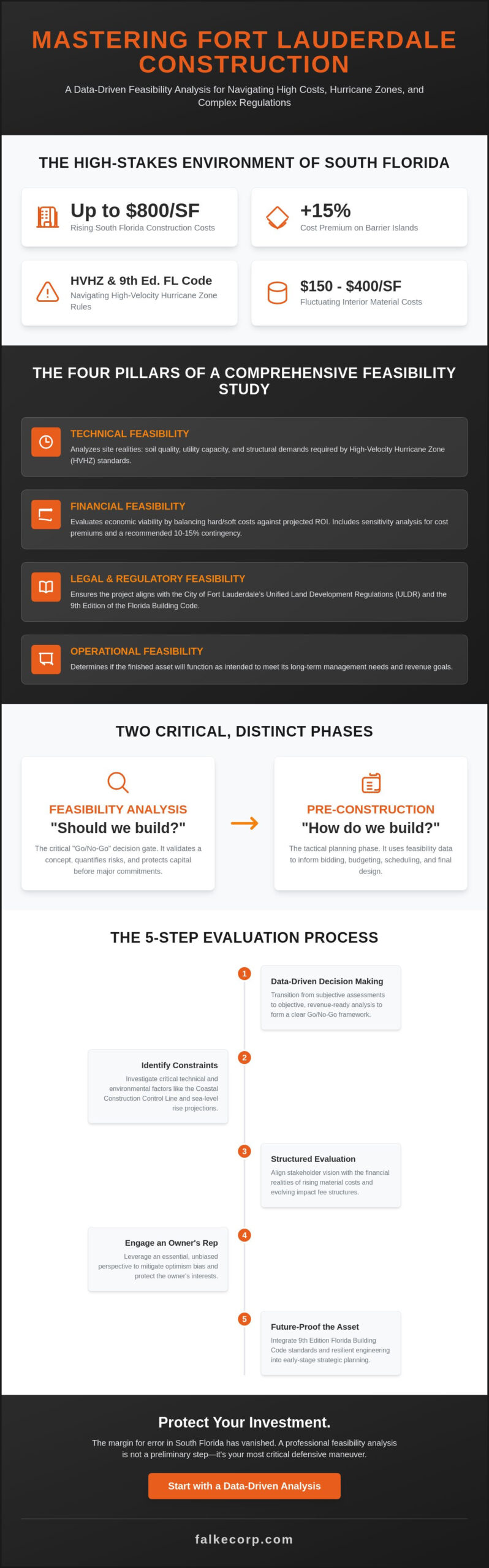
With South Florida construction costs reaching up to $800 per square foot and a 15% premium for barrier island projects, the margin for error in Broward County has effectively vanished. Investors often realize too late that a project’s viability isn’t determined by the aesthetic vision, but by the rigid intersection of the 9th Edition of the Florida Building Code and evolving impact fee limitations. Conducting a comprehensive construction project feasibility analysis Fort Lauderdale is no longer a preliminary step; it’s a critical defensive maneuver against the volatility of High-Velocity Hurricane Zone requirements and fluctuating material pricing.
You likely recognize that the current regulatory environment, specifically the strict timelines mandated by HB 267, requires a level of technical precision that standard planning often overlooks. This guide provides the strategic framework necessary to master these complexities through a disciplined approach to risk mitigation and development management. We’ll examine the data-driven ‘Go/No-Go’ decision process, analyze the impact of the 2026 building standards, and ensure your project objectives align perfectly with the specific zoning realities of Fort Lauderdale’s coastal landscape.
Key Takeaways
- Transition from subjective project assessments to a data-driven construction project feasibility analysis Fort Lauderdale to ensure objective, revenue-ready decision-making.
- Identify critical technical and environmental constraints, including the Coastal Construction Control Line and sea-level rise projections, that dictate structural requirements in South Florida.
- Implement a structured five-step evaluation process to align stakeholder vision with the financial realities of rising material costs and evolving impact fee structures.
- Understand how professional Owner’s Representation provides an essential, unbiased perspective that mitigates optimism bias during the critical pre-construction phase.
- Prepare for future-proofing assets by integrating the 9th Edition Florida Building Code standards and resilient engineering into early-stage strategic planning.
What is a Construction Project Feasibility Analysis?
A formal construction project feasibility analysis Fort Lauderdale is far more than a preliminary checklist or a cursory site visit. It’s a rigorous, disciplined interrogation of a project’s underlying assumptions designed to determine if a concept can transition into a revenue-ready asset. While many developers rely on historical intuition or outdated market metrics, a professional Feasibility study utilizes real-time data to validate whether a proposed development is technically possible, financially sound, and legally compliant. Within our structured four-phase project management methodology, this analysis serves as the critical gatekeeper. It ensures that capital is only deployed when risks are quantified and the project vision aligns with the physical and regulatory constraints of the South Florida landscape.
The transition from an initial concept to a validated development plan requires moving past “optimism bias.” This involves a granular review of the site’s unique characteristics against the owner’s financial thresholds. A data-driven report replaces vague estimates with concrete projections, providing a clear “Go/No-Go” framework that protects the owner’s interests before significant resources are committed to architectural design or permitting.
The Core Objectives of a Feasibility Study
Technical viability focuses on the physical reality of the site. We analyze soil quality, utility infrastructure capacity, and structural requirements necessitated by the High-Velocity Hurricane Zone (HVHZ) standards. Financial logic demands a deep dive into hard and soft costs, incorporating sensitivity analyses to account for the 6-10% cost premium typical of Broward County construction. Finally, legal and regulatory alignment ensures the project meets Fort Lauderdale’s specific zoning codes and the 9th Edition of the Florida Building Code, preventing costly mid-project redesigns.
Feasibility vs. Pre-Construction Services
It’s vital to distinguish this initial assessment from subsequent pre-construction services in Miami or Fort Lauderdale. Feasibility is the “Should we build?” phase, whereas pre-construction is the “How do we build?” phase. A comprehensive construction project feasibility analysis Fort Lauderdale provides the baseline data that informs the bidding and budgeting processes later in the lifecycle. Without this foundation, pre-construction efforts often suffer from scope creep or radical design changes when site realities finally surface. An Owner’s Rep acts as the objective bridge between these phases, ensuring the project remains tethered to the data-driven realities established during the initial assessment.
The Four Pillars of a Comprehensive Feasibility Study
The framework of a construction project feasibility analysis Fort Lauderdale rests on four distinct pillars that must be examined with clinical detachment. Each pillar represents a potential failure point if not properly mitigated through structured data. Technical feasibility assesses whether the site’s physical characteristics, such as soil composition and utility capacity, can support the project’s structural demands, particularly under High-Velocity Hurricane Zone (HVHZ) requirements. Financial feasibility evaluates the project’s economic viability by balancing hard and soft costs against projected ROI. Legal feasibility ensures the project aligns with the City of Fort Lauderdale’s Unified Land Development Regulations (ULDR). Finally, operational feasibility determines if the finished asset will function as intended to meet its long-term revenue goals.
Financial Modeling and Sensitivity Analysis
In the 2026 market, financial modeling must account for a 6-10% cost premium in Broward County and up to 15% for barrier island developments. A robust construction project feasibility analysis Fort Lauderdale includes a 10% to 15% contingency fund to buffer against material price fluctuations, which currently range from $150 to $400 per square foot for interior finishes alone. By conducting a ‘Highest and Best Use’ study, we identify the most profitable development path before capital is committed. This level of detail is a hallmark of professional Construction Feasibility Studies, allowing owners to spot deal-breakers early in the lifecycle. It’s about ensuring the math works under pressure.
Zoning and Entitlement Navigation
Navigating Fort Lauderdale’s Neighborhood Development Criteria requires more than just reading the code; it demands an understanding of how local entitlements impact project timelines. The entitlement process is often where projects stall, making early engagement with the Broward County Planning and Development Management Division a necessity. Utilizing specialized real estate development management services ensures that zoning hurdles are cleared systematically. We manage these complex interactions to ensure your vision remains compliant with local ordinances while protecting your delivery schedule. If you’re seeking to stabilize your project’s early phases, our development management team provides the oversight required to secure these critical approvals.
Navigating Fort Lauderdale’s Unique Construction Challenges
Fort Lauderdale’s geographical identity as the “Venice of America” introduces structural and logistical complexities that standard development models often fail to capture. A rigorous construction project feasibility analysis Fort Lauderdale must prioritize the Coastal Construction Control Line (CCCL), as any development seaward of this boundary falls under the jurisdiction of the Florida Department of Environmental Protection (DEP). These state-level permits operate on timelines independent of municipal approvals; failing to account for this dual-track process can lead to multi-month delays before a single shovel hits the ground. Furthermore, waterfront and canal-front builds require comprehensive seawall assessments and the use of marine-grade materials, which typically command a 10-15% cost premium over inland projects.
Environmental and Resilience Planning
Designing for the 2026 landscape requires strict adherence to the 9th Edition of the Florida Building Code, which becomes effective on December 31, 2026. This update mandates enhanced wind load requirements and stricter energy efficiency standards across the High-Velocity Hurricane Zone (HVHZ). Feasibility studies must evaluate the impact of these regulations on structural hard costs, particularly regarding impact-resistant fenestration and roof-to-wall connections. Mitigating risks from high water tables and saltwater intrusion isn’t merely a technical requirement; it’s a financial necessity. Proactive resilience planning directly influences the long-term liquidity of the asset and helps stabilize property insurance costs, which remain a significant variable in South Florida’s commercial sector.
Local Logistics and Neighborhood Impact
Executing a project in high-density corridors like Las Olas or the Design District presents significant staging and mobilization hurdles. Limited site access necessitates a disciplined approach to material delivery and equipment management to avoid city citations or community friction. Large-scale developments often require navigation through the City Commission’s Conference Meetings, where public sentiment can influence entitlement outcomes. Engaging professional construction project management in Florida ensures these logistical constraints are managed with technical precision. An Owner’s Rep maintains the critical balance between aggressive construction schedules and the sensitive requirements of the surrounding neighborhood, ensuring the project moves through the municipal pipeline without unnecessary social or regulatory friction.
Feasibility work rests on what the site investigation actually established, so it is worth running a structured preconstruction due diligence process first and bringing those findings into the analysis.
The 5-Step Process for a Successful Feasibility Analysis
A successful construction project feasibility analysis Fort Lauderdale follows a sequential, five-step methodology designed to eliminate variables and establish a reliable project baseline. This process begins with Stakeholder Alignment, where we define the owner’s financial thresholds and project vision with clinical precision. This ensures the technical team isn’t chasing a design that the capital stack cannot support. Following alignment, we move to Site and Market Data Collection, gathering intelligence on local absorption rates and infrastructure capacity. The third step, Multi-Disciplinary Analysis, involves the rigorous coordination of engineers, environmental consultants, and financial analysts to stress-test the project’s assumptions. Risk Assessment and Mitigation then identifies and prices potential obstacles, such as the 60-business-day permit approval windows mandated by HB 267. The process concludes with the Final Feasibility Report, providing the owner with a definitive “Go/No-Go” decision framework based on objective data.
Data Collection and Market Intelligence
Gathering local intelligence requires analyzing current absorption rates for luxury residential and commercial spaces within Broward County. We verify utility capacities and infrastructure readiness for your specific site, ensuring that the City of Fort Lauderdale’s FY 2026 Development Services budget allocations align with your project’s needs. By leveraging established local relationships, we anticipate upcoming regulatory shifts, such as the SB 548 impact fee limitations effective July 1, 2026. This proactive data gathering prevents the project from being blindsided by municipal policy changes during the entitlement phase.
The Feasibility Report as a Decision Tool
The final report serves as a high-stakes decision tool that translates technical data into executive metrics. Owners must look for internal rates of return (IRR) and sensitivity analyses that account for the 10% to 15% contingency funds recommended for 2026 coastal builds. This document is essential for securing institutional financing or attracting investment partners, as it demonstrates a disciplined approach to risk. A well-structured report ensures a seamless transition into construction phase management in Florida, providing the roadmap for execution once the project is deemed viable. It’s the difference between a speculative venture and a calculated investment. If you’re ready to validate your project’s potential with technical rigor, our development management services provide the comprehensive oversight required to move from concept to reality.
Why an Owner’s Representative is Essential for Feasibility
Entrusting a construction project feasibility analysis Fort Lauderdale solely to a design firm or a prospective builder creates an inherent conflict of interest. Architects are naturally focused on the realization of a creative vision, while general contractors prioritize securing a construction contract. An Owner’s Representative remains the only stakeholder whose sole objective is the preservation of the owner’s capital and the long-term viability of the asset. By providing a coolly elegant, third-party perspective, we protect our clients from “optimism bias,” which often obscures the technical and financial risks inherent in South Florida’s coastal environment. This objective oversight ensures that the project is grounded in the reality of current market conditions rather than speculative projections.
Our role involves assembling a highly specialized team of consultants, including geotechnical engineers, environmental experts, and financial analysts. We coordinate these diverse disciplines to ensure that every data point, from soil density to utility capacity, is verified before the project moves to the next phase. This disciplined approach ensures that the feasibility study isn’t merely a document for the archives, but a strategic roadmap that translates into a high-quality, revenue-ready asset. We bridge the gap between theoretical planning and operational success, holding every vendor accountable to the owner’s specific quality standards and budget constraints.
The FALKE Methodology: Transparency and Control
We act as a strategic partner to protect your financial interests through our rigorous four-phase project management methodology. This process provides the transparency and control necessary to manage complex developments in high-stakes markets. By utilizing professional Owner’s Representative services in Miami and Fort Lauderdale, you ensure that your project is overseen with technical competence from the initial concept. Our methodology has been refined through years of managing diverse developments, where we’ve successfully mitigated the risks associated with evolving building codes and municipal impact fees.
Maximizing ROI Through Strategic Oversight
Strategic oversight during the feasibility stage identifies cost-saving opportunities that are often missed during the standard bidding process. We analyze the “Highest and Best Use” of the property to maximize ROI, ensuring that every dollar spent on materials or labor contributes directly to the asset’s value. We hold all third-party vendors to a standard of absolute precision, preventing the scope creep that frequently compromises coastal builds. If you’re ready to secure your investment with a data-driven approach, Contact FALKE Atlantic for a feasibility consultation in Fort Lauderdale to ensure your project begins on a foundation of professional reliability.
Executing a Disciplined Path to Project Viability
The success of a capital-intensive development in South Florida depends on the ability to anticipate regulatory shifts and environmental constraints before they impact the bottom line. By integrating a rigorous construction project feasibility analysis Fort Lauderdale into your initial planning, you replace architectural optimism with technical certainty. This disciplined approach ensures that your project remains resilient against the 60-day permitting windows of HB 267 and the structural demands of the High-Velocity Hurricane Zone.
FALKE Atlantic provides the specialized oversight required to manage these complexities through our established four-phase methodology. Our expert Owner’s Representation and deep local expertise across Broward County ensure that every technical and financial variable is accounted for; it’s a strategic layer that protects your capital from unforeseen volatility. Moving from a conceptual vision to a revenue-ready asset requires a partner who prioritizes precision over promises.
Secure Your Investment with a FALKE Feasibility Analysis and ensure your project is built on a foundation of professional reliability. We look forward to stabilizing your development process and delivering the strategic clarity your investment deserves.
Frequently Asked Questions
What is the typical cost of a construction feasibility study in Fort Lauderdale?
Costs for a comprehensive study are determined by the project’s scale and the depth of technical interrogation required. Factors such as geotechnical exploration, environmental assessments near the Coastal Construction Control Line, and complex financial modeling influence the final investment. Owners should view this as a risk-mitigation expense that prevents the misallocation of much larger capital sums during the construction phase.
How long does it take to complete a full feasibility analysis for a commercial project?
A standard analysis typically requires four to eight weeks to reach a definitive conclusion. This duration allows for the systematic collection of site data, coordination between multi-disciplinary consultants, and the development of sensitivity models. Projects involving waterfront logistics or high-density urban staging may require additional time to account for specific municipal due diligence.
Do I need a feasibility study if I already own the land?
Land ownership is only one variable in the viability equation. A construction project feasibility analysis Fort Lauderdale determines if the site’s current zoning and utility infrastructure can support your specific vision under the 9th Edition of the Florida Building Code. It validates whether the projected return on investment justifies the hard costs, regardless of the equity held in the real estate.
What are the most common deal-breakers found during feasibility in South Florida?
Deal-breakers often include insufficient utility capacity for high-density builds or restrictive environmental boundaries that limit the buildable footprint. Unexpected soil conditions or the inability to meet the 15% cost premium for barrier island construction standards can also render a project economically unviable. Identifying these hurdles early prevents the loss of significant pre-construction capital.
Can a feasibility study help me secure construction financing?
Lenders and institutional investors prioritize projects that demonstrate a disciplined approach to risk management. A professional feasibility report provides the data-driven assurance that the project’s financial and technical assumptions have been stress-tested. It serves as a critical document during the underwriting process, showing that the owner has a validated path to asset liquidity.
What is the difference between an architect’s site plan and a full feasibility study?
An architect’s site plan is a design-oriented document focused on the physical arrangement of the structure. A construction project feasibility analysis Fort Lauderdale is a broader strategic interrogation that includes financial ROI modeling, legal entitlement audits, and operational logic. While the site plan shows what could be built, the feasibility study determines if it should be built.
Does the City of Fort Lauderdale require a feasibility study for permitting?
The city doesn’t mandate a formal feasibility report for permit approval. However, the technical data generated during the feasibility phase, such as drainage studies and soil reports, is required for a complete application. Having this data ready ensures compliance with HB 267 timelines, which require local governments to process applications within 30 to 60 business days.
How does an Owner’s Representative improve the feasibility process?
An Owner’s Representative provides the objective oversight necessary to eliminate the optimism bias often found in design or contracting proposals. They manage the assembly of the consultant team and ensure that all findings are translated into a clear “Go/No-Go” framework. This third-party perspective ensures the owner’s financial interests remain the primary focus throughout the evaluation.