
In the high stakes environment of Florida marine development, the inherent conflict between a contractor’s profit margin and an owner’s long term asset value is often the primary driver of project failure. Most developers and private owners recognize that securing an Environmental Resource Permit from the FDEP is only the first hurdle in a process fraught with technical and financial risks. You likely understand that without rigorous oversight, the complexity of Chapter 62-330 regulations and the 24.2% surge in copper component costs recorded in May 2026 can quickly erode your capital. Engaging a specialized owner’s rep for marina and dock construction Florida ensures that your project maintains structural integrity against hurricane force stressors while remaining strictly aligned with your fiscal objectives. This article examines the methodologies used to enforce contractor transparency, manage the FDEP’s evolving 2026 guidelines, and deliver a revenue ready waterfront asset through disciplined project management. By prioritizing technical competence over marketing rhetoric, you can mitigate the impact of rising construction input prices and secure a resilient investment that meets the highest engineering standards.
Key Takeaways
- Distinguish the fiduciary role of an owner’s representative from the profit-driven motives of a general contractor to ensure your waterfront vision remains the project’s primary objective.
- Navigate the complex regulatory landscape of Florida marine permitting, including FDEP and USACE requirements, to prevent costly environmental delays and compliance failures.
- Implement rigorous technical oversight during the construction phase to verify piling depth and material quality, securing the long-term structural integrity of your marine asset against hurricane stressors.
- Maintain full financial transparency and control by utilizing an owner’s rep for marina and dock construction Florida to audit contractor payment applications and validate change orders.
- Transition from high-risk construction to a revenue-ready waterfront asset through meticulous logistical coordination and professional development management.
What is an Owner’s Rep for Marina and Dock Construction in Florida?
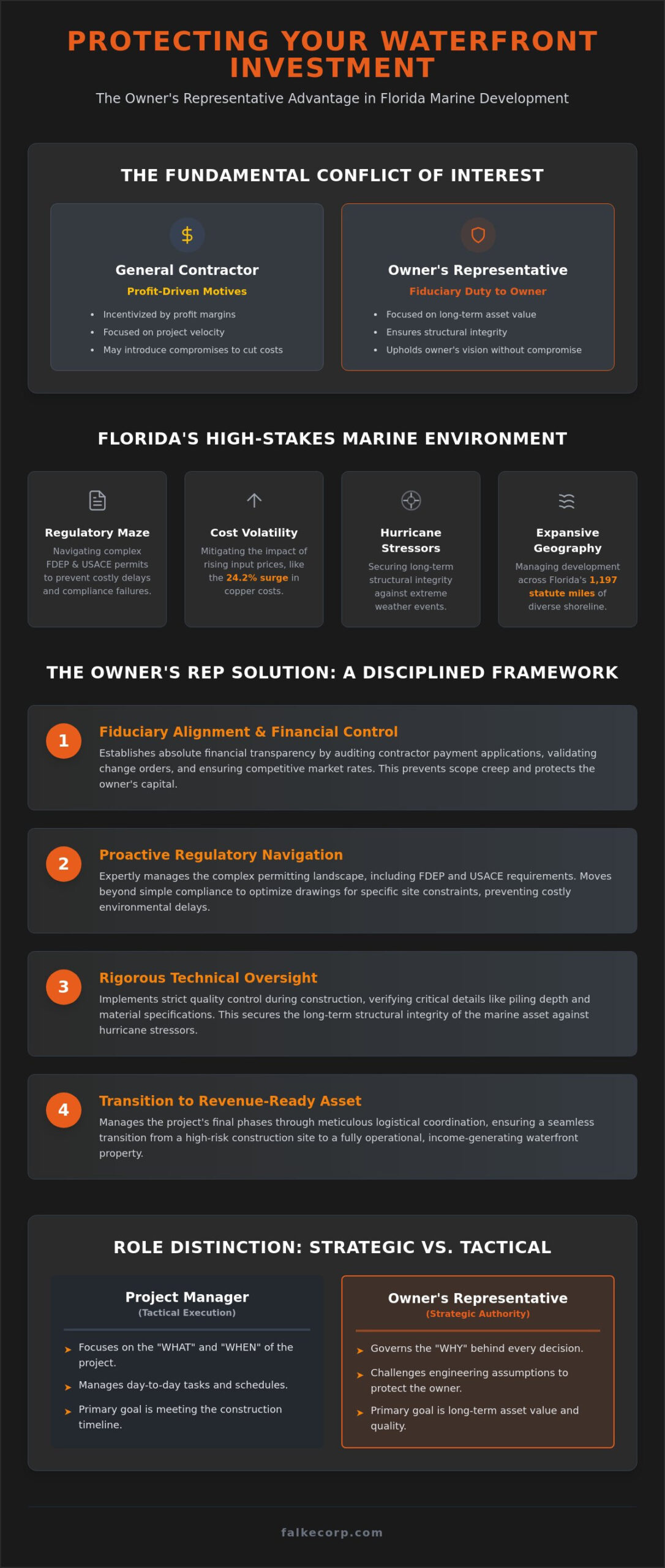
An owner’s rep for marina and dock construction Florida acts as the principal’s technical and financial surrogate throughout the lifecycle of a waterfront development. This role is defined by a strict fiduciary obligation to the owner, serving as a strategic partner who operates independently of the general contractor. While a contractor is incentivized by profit margins and project velocity, the owner’s representative focuses exclusively on the long term value and structural integrity of the asset. This distinction is critical in the maritime sector, where technical errors in piling depth or material selection can lead to catastrophic financial losses during extreme weather events.
The core mission of this role involves the meticulous synchronization of budget, schedule, and quality standards. In Florida’s unique coastal environment, which encompasses 1,197 statute miles of diverse shoreline, construction requires more than just mechanical execution. It demands a sophisticated understanding of construction management principles applied to marine engineering. The representative ensures that every phase, from the initial seabed analysis to the final commissioning of electrical pedestals, adheres to the owner’s original vision without the compromises often introduced by builders seeking to minimize their own overhead.
The Fiduciary Duty in Marine Construction
The primary advantage of engaging an owner’s rep for marina and dock construction Florida is the establishment of absolute financial transparency. The representative audits every aspect of vendor selection and contract negotiation to ensure that the owner receives competitive market rates rather than inflated “convenience” pricing. By maintaining a constant presence during the pre-construction phase, the rep identifies potential scope creep before it manifests as a costly change order. This proactive oversight prevents contractors from introducing unnecessary technical complexities that serve their own bottom line rather than the project’s actual requirements. Every decision is filtered through the lens of the owner’s financial interest, ensuring that capital is deployed with maximum efficiency.
Owner’s Rep vs. Project Manager: Understanding the Difference
While the terms are often used interchangeably, a fundamental difference exists between a standard project manager and an owner’s representative. A project manager typically focuses on the tactical execution of specific tasks, ensuring that the “what” and “when” of the construction schedule are met. In contrast, an owner’s representative possesses the high level strategic authority to challenge engineering assumptions and realign the project with long term asset goals. This distinction is vital for high net worth individuals and hospitality developers who require a partner capable of managing the “why” behind every investment. For a deeper analysis of these roles, you may review this guide on Owner’s Rep vs Project Manager: Key Differences in Florida. Strategic alignment ensures that the finished marina is not just completed on time, but is also a sustainable, revenue ready asset.
The High Stakes of Florida Marine Permitting and Pre-Construction
The pre-construction phase of a marine project in Florida is defined by a rigorous regulatory framework that often overwhelms developers. Managing the requirements of the Florida Department of Environmental Protection (FDEP), the U.S. Army Corps of Engineers (USACE), and local agencies like the Miami-Dade Department of Regulatory and Economic Resources (DERM) requires more than administrative diligence. It demands technical foresight. An owner’s rep for marina and dock construction Florida ensures that permit-ready drawings aren’t merely “compliant” but optimized for the specific environmental constraints of the site. This process begins with comprehensive site feasibility studies, identifying submerged land leases or riparian rights issues before capital is committed to mobilization.
Effective Strategic Pre-Construction Services in Miami involve managing the design team to prevent the “rubber stamp” approach that often leads to project shutdowns. When a contractor manages their own permitting, there’s a risk of prioritizing speed over long term compliance. A dedicated representative mitigates this by auditing every submission, ensuring that the engineering reflects the latest 2026 FDEP guidelines. This oversight is the only reliable defense against the environmental fines that can arise from unpermitted impacts on protected wetlands. It demands technical foresight.
Environmental Compliance and Coastal Construction Control Lines
The Coastal Construction Control Line (CCCL) program adds a layer of complexity to dock positioning and material selection. Projects must account for the 2026 legislative focus on resilience, ensuring that structures don’t just meet the Florida Building Code but exceed it to withstand storm surges. Managing specialized consultants for seagrass surveys and manatee protection plans is a logistical necessity. An owner’s rep coordinates these experts to ensure that construction timelines align with environmental windows, avoiding the delays common in “Impaired Waters” as designated by the FDEP.
Bidding and Marine Contractor Vetting
In the marine sector, the lowest bid is rarely the best value. It often signals a lack of understanding regarding Florida’s complex soil conditions or the current 9.7% increase in nonresidential construction input prices. A professional representative analyzes contractor experience with specific local bathymetry and tidal ranges. Contracts are structured with performance milestones and liquidated damages to enforce accountability. For those seeking to secure their investment, engaging a development management specialist provides the necessary leverage during these critical negotiations. This ensures that the selected builder has the technical capacity and financial stability to complete the project without the “surprises” that typically derail waterfront budgets. This is why hiring an owner’s rep for marina and dock construction Florida remains the most effective strategy for risk mitigation.
Construction Phase Oversight: Managing Quality and Climate Risks
Transitioning from the permitting phase to active mobilization introduces a new set of technical and environmental variables. The presence of an owner’s rep for marina and dock construction Florida during this stage is the only way to ensure that the theoretical engineering standards defined in your permit drawings are executed with precision. On-site representation is critical for verifying piling depth and embedment ratios, which are the primary determinants of structural resilience during storm surges. Without independent verification, contractors may prioritize speed over the exacting standards required to secure a 1,197-mile coastline against the volatile Atlantic and Gulf environments. This oversight extends to the coordination of specialized marine equipment, where barge access logistics and crane positioning must be managed to avoid damaging submerged resources like seagrass beds.
Execution requires a disciplined approach to Construction Phase Management in Florida: The Owner’s Guide. Given that labor costs currently account for 30% to 50% of total project expenses as of mid-2026, any inefficiency in the scheduling of underwater and overwater phases can lead to significant budget overruns. A professional representative synchronizes the arrival of divers, marine electricians, and structural teams to maintain momentum while the ENR Construction Cost Index remains at a record 14307.59. This structured management ensures that the complex sequence of marine development proceeds without the logistical bottlenecks that typically plague unmanaged waterfront projects.
Hurricane Season and Weather Contingency Planning
Florida’s hurricane season necessitates a proactive strategy rather than a reactive one. An owner’s representative schedules major structural milestones outside of peak activity windows to minimize the risk of damage to unfinished assets. They implement “Storm Readiness” protocols that mandate the securing of all floating equipment and loose materials well before a tropical system approaches. Furthermore, the rep manages the nuances of force majeure clauses and insurance requirements, ensuring that the owner’s financial exposure is minimized if a weather event disrupts the construction timeline. This level of foresight protects the capital investment from the unpredictable nature of the coastal climate.
Quality Control for Marine Environments
Quality control in a marine setting involves the rigorous inspection of concrete PSI levels, the integrity of epoxy rebar coatings, and the chemical treatment depth of timber pilings. With copper wire and cable prices rising 24.2% in the year leading up to May 2026, the representative ensures that all electrical pedestals and plumbing systems meet marine-grade safety standards to prevent premature failure. Saltwater corrosion mitigation serves as the non-negotiable quality standard for any sustainable marine asset. By enforcing these technical requirements, the representative guarantees that the finished dock or marina isn’t just aesthetically pleasing but is engineered to withstand the corrosive reality of the Florida coast for decades.
Cost Control and Financial Advocacy for Waterfront Assets
Financial management in marine development requires a level of scrutiny that exceeds standard land-based projects. An owner’s rep for marina and dock construction Florida operates as a technical fiduciary, ensuring that the 9.6% increase in construction input prices recorded in May 2026 does not translate into unchecked budget inflation. This advocacy begins with the systematic validation of contractor payment applications. Each request is cross-referenced against verified on-site progress and material delivery logs. By auditing these applications, the representative ensures that capital is only released for work that meets the specified quality standards. This process includes the mandatory collection of lien waivers at every payment interval, a critical step to protect the property title from legal encumbrances during the build.
Managing the project budget through a disciplined four-phase methodology allows for the early identification of fiscal variances. Change orders in marine construction often stem from technical oversights or shifting material costs, such as the 24.2% surge in copper pricing seen in early 2026. A professional representative subjects every proposed change to a rigorous audit, challenging any item that falls within the contractor’s original scope of work. This disciplined approach maintains the integrity of the project budget throughout its lifecycle, ensuring that the owner’s vision is realized without the “surprises” that typically erode capital reserves.
Preventing Budget Overruns in Sub-Surface Work
Underwater excavation and dredging are high-risk phases where contractors frequently claim “unforeseen conditions” to trigger contingency funds. An owner’s rep utilizes geotechnical data and bathymetric surveys to validate or refute these claims with technical precision. If the soil conditions align with pre-construction reports, the representative ensures the contractor adheres to the agreed-upon unit pricing. This strategic use of contingency funds protects the overall project ROI, ensuring that reserves are only deployed for genuine geological anomalies rather than contractor inefficiencies. It requires a partner who understands the engineering behind the dredging equipment as well as the financial contract.
Close-out and Commissioning of the Marina
The final phase involves the meticulous commissioning of the marina to ensure it is fully operational and compliant. This includes managing a comprehensive punch-list for docks, boat lifts, and seawall stability, ensuring every component meets the 2026 Florida Building Code. The representative ensures that all as-built drawings and FDEP permit closures are filed correctly with the appropriate state and local agencies. This transition is vital for moving the project from a construction site to a revenue-ready asset. For those requiring expert oversight of these complex financial and technical milestones, engaging a professional owner’s representative ensures that the final close-out is as precise as the initial engineering. Meticulous close-out management facilitates a seamless handover to hospitality or operations teams, securing the long-term viability of the waterfront investment.
FALKE Atlantic: Your Strategic Partner in Florida Marine Development
FALKE Atlantic operates as a boutique consultancy specializing in the technical and financial advocacy of waterfront owners across the state’s most demanding markets. Unlike larger, multi-disciplinary firms that may prioritize project volume, our approach is defined by surgical precision and a deep commitment to the fiduciary interests of high-net-worth (HNW) individuals and hospitality developers. We bridge the gap between an initial conceptual vision and a revenue-ready marine asset by managing every technical and logistical variable with unwavering discipline. This involves the seamless integration of complex marine engineering standards with the commercial realities of the Florida market, ensuring that the final structure is both resilient and economically viable. Our local expertise in Miami, Ft. Lauderdale, and Palm Beach allows us to anticipate regional regulatory shifts and environmental constraints before they impact the critical path of construction.
The complexity of modern marine construction demands a partner who can translate engineering data into actionable financial strategies. By maintaining a constant presence from the earliest feasibility studies through to the final close-out, we ensure that the owner’s vision isn’t diluted by the technical compromises often suggested by builders. Our role is to enforce the highest standards of construction management, ensuring that every dollar of capital is deployed with maximum efficiency. This level of oversight is particularly vital in Florida, where the intersection of environmental regulation and coastal engineering leaves no margin for error.
A Disciplined Methodology for Florida Construction
Our management framework is built upon a rigorous four-phase methodology that spans from Concept to Commissioning. This structured approach ensures that the strategic alignment and quality control measures discussed in previous sections are maintained through every stage of development. By serving as a strategic partner, we provide the stability required to navigate the volatile pricing of construction inputs, such as the recent 9.7% rise in nonresidential prices, and the evolving FDEP guidelines. For a comprehensive look at how we safeguard capital in these environments, you can review our insights on Owner’s Representative Miami: Protecting Your Real Estate Assets. This partnership transforms the construction process from a high-risk liability into a disciplined execution of the owner’s long-term strategic goals.
Contact FALKE Atlantic for Your Marina Project
Securing the future of a waterfront investment requires more than just a builder; it requires a dedicated owner’s rep for marina and dock construction Florida who understands the intersection of marine engineering and financial transparency. Whether you’re developing a private estate dock or a multi-slip commercial marina facility, FALKE Atlantic provides the technical competence to manage complex barge logistics, contractor accountability, and environmental compliance. FALKE Atlantic Corporation provides the professional oversight necessary to deliver high-quality marine assets on time and within budget. We invite you to schedule a consultation to discuss your upcoming development and explore how our project management, development management, and pre-construction services can mitigate risk and maximize your asset’s long-term value. Our commitment to transparency, financial control, and quality remains unyielding, ensuring that every piling driven and every seawall reinforced meets the highest professional standards.
Maximizing Long-Term Value in Florida Marine Development
The successful execution of a marine project in Florida requires a precise synthesis of technical engineering, regulatory mastery, and rigorous financial advocacy. You’ve seen how independent oversight mitigates the risks of environmental non-compliance and prevents the budget inflation often associated with sub-surface work. By prioritizing structural resilience and fiscal transparency, owners can transform complex waterfront construction into a predictable, high-standard development process. This approach ensures that every piling driven and every permit filed serves the long-term viability of the asset.
FALKE Atlantic brings specialized expertise in Florida DEP and USACE permitting, ensuring that your project adheres to the most stringent 2026 standards. Our disciplined four-phase methodology provides a structured path from initial concept to final commissioning, a process we’ve refined through extensive collaboration with high-net-worth and hospitality clients. When you hire an owner’s rep for marina and dock construction Florida, you secure a partner dedicated to protecting your capital against the unique volatility of the coastal environment. Secure your waterfront investment with FALKE Atlantic’s professional owner representation. We look forward to ensuring your next marine asset is delivered with the precision and quality your vision demands.
Frequently Asked Questions
What is the difference between a marine general contractor and an owner’s rep?
A marine general contractor is responsible for the physical execution and labor of the build, whereas an owner’s rep for marina and dock construction Florida serves as your technical surrogate and fiduciary advocate. While the contractor focuses on project velocity and profit margins, the representative ensures that all technical specifications, financial audits, and schedule milestones are met without a conflict of interest. This independent oversight prevents the builder from making unilateral decisions that might compromise the long term integrity of the waterfront asset.
How much does an owner’s representative cost for a Florida marina project?
The fee structure for a professional representative typically aligns with the complexity and scale of the marine development. Most industry professionals operate on either a fixed monthly retainer or a fee based on a percentage of the total project value, ensuring their compensation remains transparent. This investment is frequently offset by the mitigation of unnecessary change orders and the prevention of costly regulatory fines that often arise from unmanaged construction processes.
Why is permitting so difficult for dock construction in Florida?
Permitting is exceptionally complex due to the overlapping jurisdictions of federal, state, and local agencies, including the FDEP and the U.S. Army Corps of Engineers. Florida’s coastline is subject to rigorous Environmental Resource Permitting standards that prioritize the protection of submerged lands and water quality. Navigating these requirements demands precise engineering drawings and a thorough understanding of the 2026 legislative updates that govern coastal construction control lines.
Can an owner’s rep help with environmental compliance for seagrass or manatees?
An owner’s representative coordinates the specialized consultants required for seagrass surveys and manatee protection plans to ensure full regulatory compliance. They verify that construction schedules respect environmental windows and that all on-site activities adhere to FDEP mitigation requirements. This proactive management prevents project shutdowns and the significant fines associated with accidental habitat disruption during dredging or piling installation phases.
When is the best time to hire an owner’s rep for a waterfront project?
The optimal time to engage an owner’s rep for marina and dock construction Florida is during the initial conceptual or feasibility stage. Involving a representative before the design is finalized allows for the early identification of regulatory hurdles and technical constraints. This early intervention ensures that the project begins with a realistic budget and a permit-ready strategy, preventing expensive redesigns or logistical failures during active construction.
Does an owner’s rep handle hurricane damage repairs and insurance claims?
A representative provides technical support during the recovery phase by managing damage assessments and coordinating with insurance adjusters. They verify that repair scopes align with original engineering standards and oversee the contractor’s execution to ensure restored assets meet current Florida Building Code requirements. This oversight ensures that insurance disbursements are utilized efficiently to restore the structure’s technical integrity and long term investment value.
How does an owner’s rep ensure construction quality for underwater structures?
Technical oversight involves the verification of piling embedment logs and the inspection of material treatments, such as epoxy coatings on rebar and concrete PSI levels. The representative ensures that underwater components are installed according to the bathymetric survey and geotechnical reports. This independent verification prevents contractors from prioritizing speed over the exacting standards required for sub-surface elements that are difficult to inspect once the project is completed.
Is an owner’s rep necessary for a private residential dock project?
A representative is essential for high value residential projects involving complex permitting or specialized marine engineering. If the project exceeds 1,000 square feet or is located within protected waters, the regulatory and technical risks increase significantly. A representative provides the professional oversight needed to ensure the residential asset is built to the highest standards and remains fully compliant with all state and federal environmental regulations.