
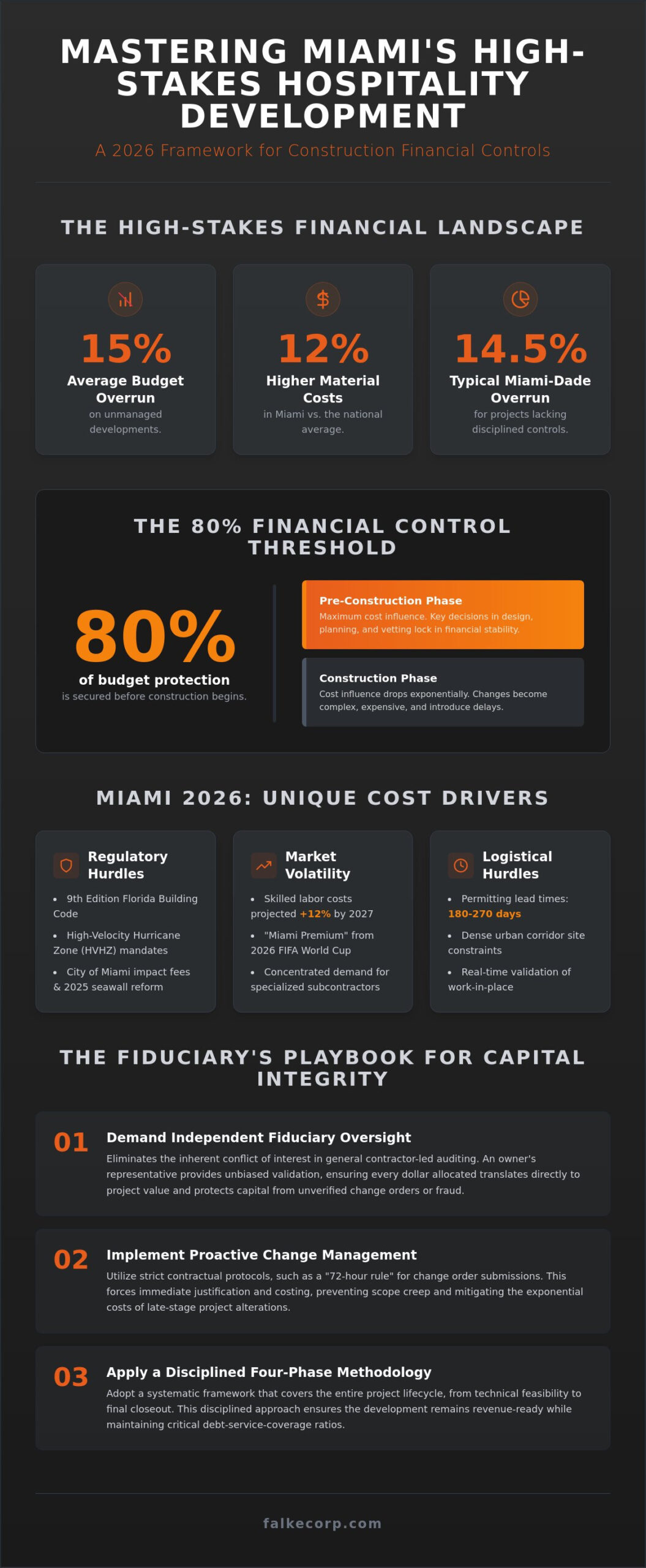
In a market where unmanaged developments face an average budget overrun of 15%, the distinction between a high-yield asset and a distressed liability rests on a single, rigorous discipline. You’re likely aware that Miami’s hospitality sector is currently navigating material costs that sit 12% above the national average, alongside the complex financial implications of the impending 9th Edition Florida Building Code. Implementing sophisticated construction financial controls for hospitality projects miami isn’t merely an accounting function; it’s a proactive engineering requirement to protect capital against labor escalations and insufficient line-item transparency from general contractors.
You’ll gain the technical and fiduciary frameworks necessary to master these high-stakes variables and prevent budget erosion. This strategic guide details how to secure 80% of your budget protection during pre-construction, ensuring your project delivers a revenue-ready asset without debt-service-coverage ratio issues. We’ll analyze the disciplined methodology designed to eliminate change order fraud and maintain absolute capital integrity throughout the 2026 development lifecycle.
Key Takeaways
- Understand the technical distinction between standard bookkeeping and the rigorous financial oversight required to navigate Miami’s unique 2026 luxury hospitality cost drivers.
- Discover why 80% of budget protection is established during the pre-construction phase through the implementation of construction financial controls for hospitality projects miami.
- Identify the inherent conflicts of interest in general contractor-led auditing and the necessity of independent fiduciary oversight to preserve capital integrity.
- Implement contractual protocols and the 72-hour rule to proactively manage scope creep and mitigate the exponential costs of late-stage project changes.
- Apply a disciplined four-phase methodology to ensure your development remains revenue-ready while maintaining critical debt-service-coverage ratios.
The Landscape of Construction Financial Controls for Hospitality Projects in Miami (2026)
Effective financial management in high-spec development isn’t a retrospective exercise. Many owners mistake basic bookkeeping for robust oversight. True construction financial controls for hospitality projects miami involve a technical engineering of the budget to mitigate systemic risks before they manifest as irrevocable losses. In South Florida’s current climate, where material costs sit 12% above the national average, passive accounting is insufficient. Technical oversight requires real-time validation of work-in-place and a deep understanding of the local supply chain. These frameworks align with established Construction Management Principles, focusing on the rigorous synchronization of time, cost, and quality to protect the owner’s fiduciary interests.
Hospitality assets face higher financial risks than standard commercial builds due to their intricate fit-out requirements and operational deadlines. A delay in a hotel opening doesn’t just increase carry costs; it erases projected room revenue during peak seasonal windows. This reality has shifted the market toward fiduciary-first management in the Miami-Dade and Broward corridors. Owners now recognize that general contractors, while essential for execution, cannot serve as their own financial auditors. Independent oversight ensures that every dollar allocated translates directly into project value without the dilution of unverified change orders.
Market Drivers: RevPAR Trends and Capital Concentration
The 2026 FIFA World Cup and the continued expansion of luxury retail in the Miami Design District have created a concentrated demand for specialized subcontractors. This capital concentration drives a “Miami Premium” that standard commercial builds rarely encounter. When RevPAR projections are high, developers often accelerate schedules, inadvertently inviting labor inefficiencies. Skilled labor costs in South Florida are projected to increase by 12% through late 2027. This volatility makes the 14.5% average budget overrun in Miami-Dade a statistical reality for projects lacking a disciplined four-phase methodology.
2026 Florida Building Code and Hurricane Hardening
Resiliency isn’t optional. The 9th Edition of the Florida Building Code, scheduled for implementation on December 31, 2026, mandates stringent standards for hurricane-rated glazing and structural integrity. In the High-Velocity Hurricane Zone (HVHZ), these requirements add significant layers of cost to the building envelope. Beyond materials, the City of Miami’s revised impact fees and the 2025 seawall reform ordinance require precise financial modeling. Navigating these mandates requires more than just compliance; it demands a strategic shield for capital integrity that accounts for specialized structural labor and extended permitting lead times, which currently average 180 to 270 days.
Pre-Construction: Securing the 80% Financial Control Threshold
Establishing a project’s financial trajectory occurs long before the first shovel hits the ground. In high-spec developments, 80% of budget protection is secured during the design and planning phases. Once concrete is poured, your ability to influence costs drops exponentially. Implementing construction financial controls for hospitality projects miami during pre-construction transforms the budget from a passive estimate into an engineered blueprint. This stage requires a technical feasibility study that goes beyond surface-level numbers. It scrutinizes site constraints, utility capacities, and the specific logistical hurdles of South Florida’s dense urban corridors. If these variables aren’t quantified early, they manifest as late-stage crises that erode capital integrity.
Lean principles like Value Stream Mapping (VSM) are essential at this juncture. In hospitality design, VSM identifies non-value-added steps in the development process, such as redundant design cycles or over-specified finishes that don’t enhance the guest experience. By mapping every dollar against the brand’s core standards, you eliminate waste before it’s codified in contract documents. Success depends on assembling a vendor team that prioritizes financial discipline. Architects and engineers must be vetted not just for their aesthetic portfolio, but for their historical accuracy in cost estimation and their willingness to adhere to a rigid fiduciary framework. Vetting these partners carefully is the first step in maintaining a revenue-ready asset.
Strategic Bidding and Total Cost of Ownership (TCO)
A common failure in Miami’s market is the lowest bid trap. Selecting a contractor based solely on the initial price often leads to a cycle of aggressive change orders later. A sophisticated approach evaluates the Total Cost of Ownership, considering long-term asset performance and maintenance. Utilizing expert pre-construction services miami allows owners to vet subcontractor solvency and insurance limits thoroughly. In a region where general contractors must maintain a 660 FICO score and specific liability thresholds, verifying these credentials during the RFP process is a critical layer of capital protection.
Value Engineering vs. Arbitrary Cost Cutting
Value engineering is often misunderstood as a simple reduction in quality. In reality, it’s a systematic method to maintain brand standards while optimizing expenditures. It identifies design elements that inflate budgets without contributing to the property’s RevPAR or operational efficiency. An experienced owner’s representative Miami acts as a mediator in these discussions, ensuring that financial adjustments don’t compromise the asset’s market positioning. This level of technical oversight ensures the project remains a high-yield investment rather than a victim of unmanaged scope creep.
Fiduciary Oversight: Owner’s Rep vs. General Contractor
A general contractor’s operational objective is the efficient delivery of a physical structure, yet this focus often creates an inherent conflict of interest when it comes to financial reporting. While a GC manages the day-to-day site logistics, they shouldn’t be expected to act as their own financial auditors. Fiduciary oversight requires a strategic shield that prioritizes the owner’s capital integrity above the contractor’s profit margins. This is where technical competence meets professional reliability. By implementing construction financial controls for hospitality projects miami through an independent representative, owners ensure that every dollar spent is a dollar of value added to the asset.
The distinction between a GC’s monthly invoice and a fiduciary audit is significant. An invoice is a request for payment based on internal accounting; a fiduciary audit is a technical validation of work-in-place, material stored, and contractual compliance. During high-stakes negotiations with third-party vendors, an owner’s representative acts as a professional mediator. They ensure that the owner’s interests aren’t diluted by the complexities of subcontractor markups or unverified labor escalations. This disciplined oversight transforms the financial relationship from one of blind trust to one of verified transparency.
The ‘Black Box’ Budget Trap
Relying solely on a general contractor’s initial bid often leads to the ‘black box’ budget trap, contributing to the 14.5% average budget overrun seen in Miami-Dade developments in 2026. Lumped-sum pricing frequently lacks the necessary line-item transparency to identify where capital is actually being deployed. Without granular visibility, owners can’t distinguish between essential costs and avoidable waste. Engaging expert construction project management Florida provides the independent verification needed to dismantle these opaque pricing structures and secure the project’s financial baseline.
Independent Verification of Work-in-Place
Releasing funds based on perceived progress rather than verified milestones is a primary driver of liquidity issues. Fiduciary management demands that every payment authorization is preceded by an independent site inspection. This process confirms that the field progress aligns exactly with the draw request. It isn’t just about preventing overpayment; it’s about ensuring the project remains on a trajectory toward being revenue-ready. By aligning construction milestones with the owner’s revenue goals, construction financial controls for hospitality projects miami protect the debt-service-coverage ratio and ensure the asset is ready for its intended market debut without financial distress.
Proactive Management of Change Orders and Scope Creep
Change orders represent the most significant threat to a project’s financial equilibrium. Without a pre-defined protocol, these requests often bypass the owner’s fiduciary defenses, leading to unmanaged budget erosion. Implementing construction financial controls for hospitality projects miami requires that every change order undergo a technical audit before approval. A rigorous protocol established in the initial contract documents serves as the primary mechanism for cost suppression. This includes the 72-hour rule, which mandates that any field condition requiring a change must be reported and costed within three business days. In Miami’s high-velocity market, delays in identifying these changes lead to exponential cost increases as subsequent trades are impacted by the unresolved scope.
Technical auditing distinguishes between a legitimate scope change and a contractor’s failure to coordinate. Errors in the field or omissions in the general contractor’s buyout are not the owner’s financial responsibility. Maintaining a strategic contingency fund is essential, yet it must be managed with extreme discipline. This fund should never be treated as a discretionary account for scope creep; it is a risk-mitigation tool for unforeseen site conditions only. By enforcing these boundaries, owners prevent the gradual dilution of capital integrity that often plagues complex hospitality developments.
The Anatomy of a Change Order Audit
- Step 1: Origin verification. Determine if the change is driven by an owner-requested enhancement, a design discrepancy, or a legitimate field condition.
- Step 2: Document cross-referencing. Audit the original contract documents to ensure the work wasn’t already included in the base scope, allowances, or the contractor’s coordination responsibilities.
- Step 3: Benchmark negotiation. All labor and material rates must be audited against 2026 Miami standards. With local material costs currently 12% above national averages, verifying these rates against current market data is critical to prevent price gouging.
Managing Finishes and Long-Lead Items
Hospitality projects are defined by their high-spec finishes, which often carry significant lead times and logistical complexity. Experts in commercial project management miami handle these elements by securing procurement schedules early in the execution phase. Supply chain volatility directly impacts carrying costs and interest rates, which currently range from 5.50% to 12% depending on the project’s risk profile. Mitigating the financial risks of Tenant Improvement (TI) scope changes requires a technical understanding of how these finishes integrate with primary building systems. To protect your development from unmanaged cost escalations, secure independent fiduciary oversight to manage your project’s financial lifecycle.
FALKE Atlantic’s Methodology: A Disciplined Four-Phase Approach
Securing capital integrity in South Florida’s volatile development sector requires more than occasional oversight. It demands a repeatable, engineering-led framework that treats financial stability as a primary project objective. FALKE Atlantic Corporation utilizes a disciplined four-phase methodology to implement construction financial controls for hospitality projects miami, ensuring that every asset is delivered revenue-ready and compliant with the stringent 2026 regulatory landscape. This process moves beyond simple project management by integrating fiduciary accountability into every technical milestone, from initial site selection to final commissioning.
The methodology begins with Phase 1: Initiate. During this stage, we establish the financial baseline through rigorous site feasibility studies and objective constraint mapping. We identify potential “Miami Premiums” early, ensuring that the initial concept aligns with realistic capital allocations. Phase 2: Strategize focuses on the pre-construction efforts discussed earlier, where we secure the 80% control threshold. By applying Value Stream Mapping, we strip away non-value-added design elements and finalize a master plan that includes integrated cost and risk models.
Execution occurs in Phase 3: Construction phase management florida. This phase is defined by fiduciary field oversight, where we validate every draw request against verified work-in-place and material stored. We act as the owner’s strategic shield, managing the 72-hour change order rule and ensuring subcontractor performance remains within the established financial guardrails. Finally, Phase 4: Commission involves the technical reconciliation of the project. This stage ensures all systems are fully operational and all financial accounts are settled, delivering an asset that is ready to generate immediate RevPAR without lingering debt-service issues.
Case Study Insights: Hospitality Success in Miami-Dade
Our methodology has been proven effective in high-spec environments, including luxury retail-hospitality hybrids within the Miami Design District. In these projects, disciplined oversight protected capital from the aggressive labor escalations and material volatility typical of the South Florida market. Even for remote owners, our framework provides a reliable guide for virtual oversight, utilizing real-time reporting and technical auditing to maintain transparency. The result is consistently the same: sophisticated assets delivered on-budget, meeting the highest professional standards of the luxury hospitality sector.
Securing Your Investment with FALKE Atlantic Corporation
Choosing a boutique firm for owner representation provides a distinct technical advantage. Unlike large organizations with excessive overhead and diluted focus, we offer specialized expertise tailored to the complexities of the Miami-Dade and Broward corridors. Our commitment to capital integrity ensures that your fiduciary interests are never compromised by the operational shortcuts of third-party vendors. If you’re planning a high-stakes development in 2026, you can secure your construction budget with FALKE Atlantic Corporation and ensure your project remains a high-yield investment from inception to handover.
Securing Your Development’s Financial Future
The 2026 South Florida hospitality market leaves no room for financial ambiguity. Successfully delivering a high-spec asset requires a shift from reactive bookkeeping to proactive engineering oversight. You’ve seen how establishing the 80% control threshold during pre-construction and enforcing a rigorous 72-hour change order protocol can prevent the 14.5% average budget overruns typical of Miami developments. Implementing robust construction financial controls for hospitality projects miami is the only way to ensure your capital remains protected against labor escalations and complex regulatory costs.
FALKE Atlantic provides the technical competence and engineering-led fiduciary oversight needed to navigate these variables. Our disciplined four-phase methodology ensures your project remains revenue-ready while maintaining critical debt-service-coverage ratios across Miami-Dade, Broward, and Palm Beach Counties. We take full responsibility for the financial lifecycle of your development so you can focus on your long-term strategic goals. Your vision deserves a foundation of absolute stability and professional precision.
Secure Your Capital Integrity: Contact FALKE Atlantic for a Consultation
Frequently Asked Questions
What is the average construction cost per square foot for Miami hotels in 2026?
While specific dollar amounts vary by luxury tier and site complexity, 2026 costs are heavily influenced by material prices sitting 12% above the national average. Owners should model budgets based on a 4.2% annual escalation rate in Florida. Technical factors like High-Velocity Hurricane Zone (HVHZ) compliance and specialized labor for high-spec finishes further elevate the baseline compared to other major US markets.
How much should I set aside for a hospitality construction contingency fund in Florida?
A contingency fund of 10% to 15% is standard for South Florida hospitality assets to account for the region’s unique volatility. This range addresses the 14.5% average budget overrun seen in unmanaged Miami-Dade projects. However, the fund’s release must be governed by strict fiduciary protocols to ensure it remains a risk-mitigation tool rather than a source of discretionary spending for unmanaged scope creep.
Does an Owner’s Representative save more money than they cost in hospitality projects?
Technical oversight typically identifies cost savings that far exceed the representative’s fee by securing the 80% control threshold during pre-construction. By eliminating change order fraud and verifying work-in-place, an independent fiduciary prevents the 15% overruns common in the local market. These savings, combined with the delivery of a revenue-ready asset on schedule, protect the project’s debt-service-coverage ratio and overall capital integrity.
What are the primary causes of budget overruns in Miami-Dade hospitality developments?
Budget erosion is primarily driven by unpredicted labor escalations and a lack of line-item transparency in general contractor reporting. In 2026, the 12% increase in skilled labor costs and complex compliance with updated building codes contribute significantly to financial distress. Without rigorous construction financial controls for hospitality projects miami, these factors often lead to the 14.5% average overrun observed across the county’s luxury development sector.
How does the 2026 Florida Building Code affect my hotel’s construction budget?
The 9th Edition of the Florida Building Code, effective December 31, 2026, mandates enhanced resiliency and sustainability standards that increase upfront capital requirements. These updates require specialized hurricane-rated glazing and reinforced structural components to meet High-Velocity Hurricane Zone (HVHZ) criteria. Owners must account for these technical mandates during the design phase to avoid late-stage redesign costs that exponentially inflate the budget.
Can I manage a Miami hospitality construction budget remotely without an Owner’s Rep?
Remote management without local fiduciary oversight often results in a “black box” budget where transparency is sacrificed for contractor convenience. Field progress must be independently verified to ensure payment draws align with actual work-in-place. While digital reporting exists, the lack of a physical advocate to enforce the 72-hour change order rule and audit site logistics often leads to unmanaged scope creep and significant financial dilution.
What is the difference between value engineering and cost cutting in luxury hotels?
Value engineering is a systematic method to maintain brand standards while optimizing expenditures through technical analysis. It focuses on removing non-value-added design elements that don’t enhance the guest experience or RevPAR. In contrast, cost cutting is often an arbitrary reduction in quality that compromises the asset’s market positioning. Effective construction financial controls for hospitality projects miami prioritize engineering-led value over reactive spending reductions.
How do I audit a General Contractor who is requesting frequent change orders?
Auditing frequent change orders requires a three-step technical verification of origin, documentation, and market benchmarks. Every request must be cross-referenced against the original contract scope to ensure the work wasn’t already included or a result of contractor coordination errors. Labor and material rates should be benchmarked against 2026 Miami standards to prevent price gouging, ensuring every released dollar corresponds to legitimate field conditions.