
In the high-stakes environment of 2026 South Florida development, a single oversight in Miami-Dade’s updated 2024 Building Code can trigger a 15% budget overrun before the first foundation is even poured. You recognize that the path from a conceptual blueprint to a revenue-generating hotel asset is fraught with systemic friction. Effective hospitality project management in this region requires more than just oversight; it demands a technical hedge against the intersection of stringent hurricane-resiliency requirements and a fragmented vendor landscape that leaves little room for error.
This guide provides a disciplined, owner-centric framework that prioritizes technical transparency and rigorous risk mitigation to ensure your asset is delivered on schedule. We’ll examine the structural methodologies required to bypass local permitting bottlenecks, eliminate the risk of change order fraud through precise financial auditing, and harden your project against the unique operational challenges of the Miami market. By the end of this analysis, you’ll possess the technical roadmap necessary to convert complex industrial processes into a stable, high-yield hospitality asset.
Key Takeaways
- Identify why specialized hospitality project management is the critical factor in navigating the complex development lifecycles of Miami-Dade and Broward counties.
- Implement a disciplined four-phase framework to validate project feasibility and ensure rigorous oversight from initial concept through to pre-construction entitlements.
- Distinguish between tactical project management and strategic owner representation to secure the transparency and financial control that traditional GC-led models often lack.
- Navigate South Florida’s stringent regulatory landscape by mastering High Velocity Hurricane Zone (HVHZ) requirements and proactive sea-level rise planning.
- Leverage a technical, engineering-aligned methodology to mitigate long-term risks and maintain quality standards for high-stakes 2026 hospitality developments.
Understanding Hospitality Project Management in the Miami Market
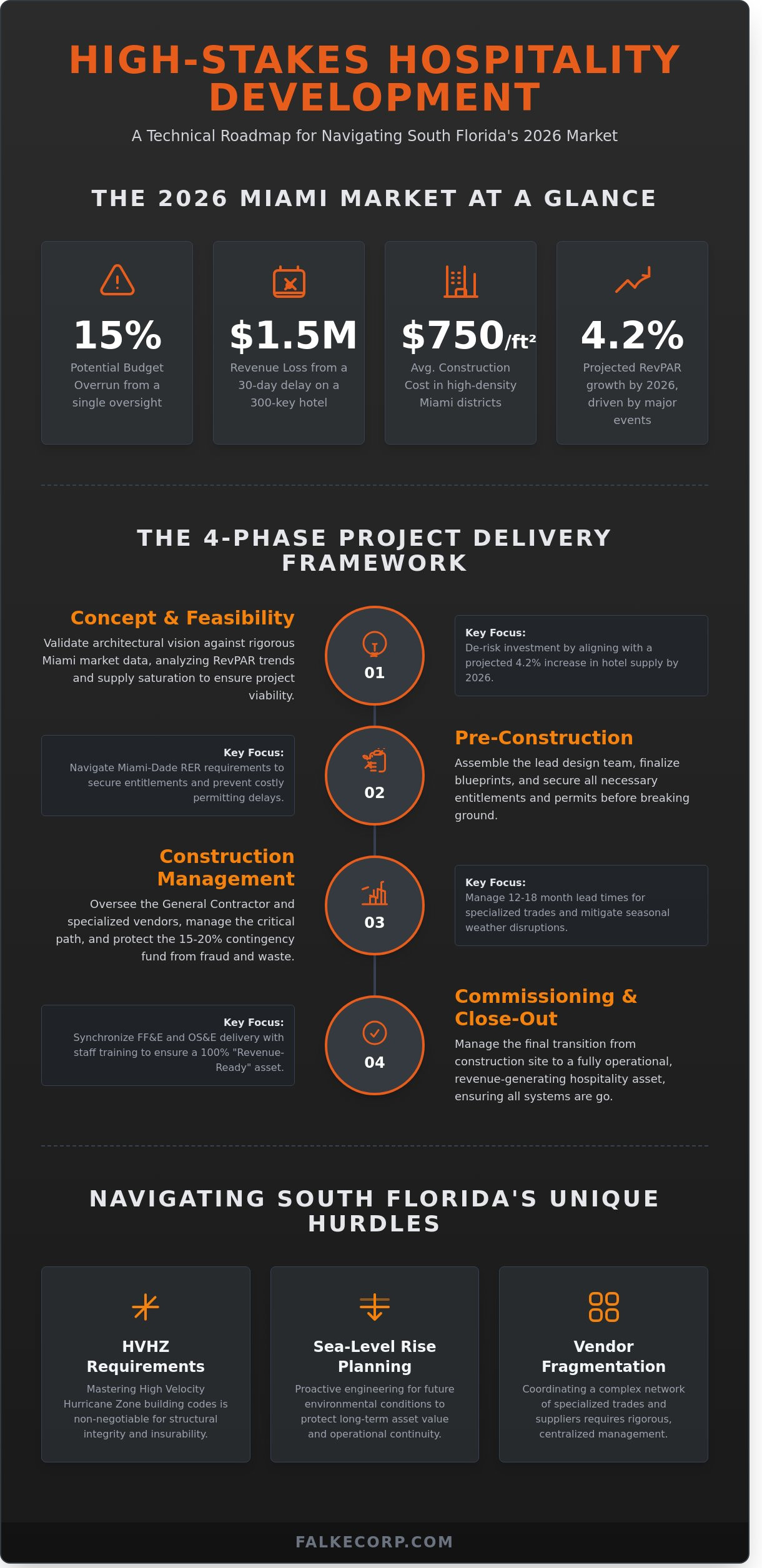
Hospitality project management represents the technical integration of architectural intent, brand requirements, and operational readiness within a fixed financial framework. In the Miami-Dade and Broward corridors, this discipline moves beyond traditional construction oversight. It requires a systematic approach to navigating the specific geological and regulatory constraints of South Florida. Unlike standard commercial real estate, where shell completion is often the primary milestone, hospitality assets demand a seamless transition into a functioning ecosystem. The complexity increases when balancing the 2026 demand for ultra-luxury finishes with the $750 per square foot average construction costs currently seen in high-density Miami districts like Brickell and Wynwood.
The distinction between a standard office build and hospitality project management lies in the depth of technical systems and the intensity of the finished environment. A hotel must function as a 24-hour machine, requiring sophisticated MEP (Mechanical, Electrical, and Plumbing) configurations that support commercial kitchens, laundry facilities, and integrated guest technology. Owners can’t afford the luxury of post-occupancy adjustments; the asset must be 100% operational from the moment the first guest checks in.
The High Stakes of South Florida Hospitality
The 2026 market projections for Miami and Fort Lauderdale indicate a 4.2% increase in RevPAR (Revenue Per Available Room), driven largely by international events such as the FIFA World Cup. Owners must prioritize the “revenue-ready” date over the traditional “substantial completion” certificate. A 30-day delay in a 300-key luxury hotel can result in a $1.5 million loss in projected top-line revenue. South Florida’s labor market presents additional challenges, with specialized trades for high-end millwork requiring 12 to 18 months of lead time to ensure schedule adherence. Success depends on:
- Proactive procurement of long-lead items like switchgear and specialized glazing.
- Strict adherence to the 2023 Florida Building Code updates.
- Mitigation of seasonal weather disruptions through rigorous site management.
Core Objectives of a Hospitality Project Manager
A hospitality project management expert functions as the technical steward of the owner’s capital. Their primary objective is the protection of equity through granular budget oversight, ensuring that the 15% to 20% contingency funds remain intact for critical path items. They maintain alignment with brand standards from the 30% design development phase to final walkthroughs. Managing the transition from a construction site to an operational asset involves coordinating the FF&E (Furniture, Fixtures, and Equipment) installation with the OS&E (Operating Supplies and Equipment) delivery. This process requires total synchronization with the property management team to ensure the staff is trained and the systems are tested before the grand opening.
Work on an operating property follows a different sequence, where phasing has to protect room revenue as well as the schedule; our checklist for hotel renovation project management in Miami covers that case in detail.
The 4-Phase Methodology for Hospitality Project Delivery
Effective hospitality project management relies on a structured, technical approach that removes ambiguity from the development lifecycle. This methodology ensures that every dollar of the investment aligns with the projected 2026 market demands. Developers must move through four distinct stages with engineering-grade precision to maintain the project’s financial and structural integrity.
- Phase 1: Concept and Feasibility. This stage validates the architectural vision against rigorous Miami market data. With Miami’s hotel supply projected to increase by 4.2% by 2026, feasibility studies must analyze RevPAR (Revenue Per Available Room) trends and local saturation points.
- Phase 2: Pre-Construction. This involves assembling the lead design team and securing entitlements. It requires a deep dive into the Miami-Dade County RER (Regulatory and Economic Resources) requirements to ensure the project meets all environmental and structural codes before the first shovel hits the ground.
- Phase 3: Construction Phase Management. The focus shifts to overseeing the General Contractor (GC) and specialized vendors. It’s about maintaining the critical path while managing the 15% contingency fund typically required for South Florida’s volatile material costs.
- Phase 4: Commissioning and Close-out. This is the final transition to operational readiness. It involves the exhaustive “Punch List” for luxury finishes and obtaining the Temporary Certificate of Occupancy (TCO) so the operator can begin staff training 60 days before the soft opening.
Strategic Pre-Construction and Permitting
Securing a building permit in the City of Miami is a complex logistical operation. Projects often face delays during the “Dry Run” review process if the MEP (Mechanical, Electrical, and Plumbing) plans don’t align perfectly with Florida Building Code 2023 standards. Site feasibility studies must address the specific zoning constraints of Chapter 33, especially regarding flood elevations in zones AE and VE. Establishing technical project oversight early prevents scope creep by fixing a cost-estimate baseline during the initial 30% design phase. This prevents the 20% budget overruns commonly seen in unmanaged luxury builds.
Construction Oversight and Quality Control
Quality control for luxury hospitality requires a level of scrutiny that goes beyond standard commercial builds. Project managers must enforce Level 5 drywall finishes and millwork tolerances of less than 1/16th of an inch. The schedule must account for the 122 days of measurable precipitation Miami experiences annually, which can halt exterior work for weeks. Coordinating FF&E (Furniture, Fixtures, and Equipment) is equally critical. Lead times for custom Italian marble or bespoke lighting systems now exceed 24 weeks. A failure to synchronize these deliveries with the construction schedule will delay the Grand Opening and erode the first year’s ROI. Rigorous hospitality project management ensures these logistical variables don’t compromise the delivery date.
Owner’s Rep vs. Project Manager: Which Does Your Miami Hotel Need?
Distinguishing between tactical execution and strategic oversight is critical for any developer entering the 2026 Miami market. While the terms are often used interchangeably, they represent different levels of technical responsibility. A project manager focuses on the daily mechanics of the build, coordinating vendors and tracking specific timelines. In contrast, an owner’s representative operates as a strategic fiduciary, ensuring that every technical decision aligns with the owner’s long-term financial objectives. In the high-stakes environment of South Florida, where land costs and regulatory hurdles are at an all-time high, confusing these roles leads to significant budget leakage.
General Contractor-led projects often suffer from inherent information asymmetry. Without independent oversight, owners frequently receive filtered data that obscures budget slippage or material substitutions. Professional hospitality project management requires a layer of transparency that a GC, who is focused on their own profit margins, cannot provide. This is especially true in 2026 as Miami implements stricter structural integrity standards, requiring precise technical compliance that must be verified by a party without a conflict of interest.
The Case for Independent Owner Representation
An owner’s rep serves as a technical buffer between the developer and the construction team. In the complex South Florida regulatory environment, where 2026 building codes demand advanced flood mitigation and energy efficiency, this role prevents change order fraud. It’s common for unmonitored hospitality projects to see a 14% increase in costs due to avoidable or inflated change orders. This advocacy ensures budget accountability by scrutinizing every invoice against the original engineering scope. For a deeper look at asset protection, see our guide on Owner’s Representative Miami.
When to Hire a Project Management Firm
If your internal team lacks the specific technical depth to oversee a $50 million hospitality asset, a dedicated firm is mandatory. Professional hospitality project management mitigates risks related to labor shortages and supply chain delays, which currently impact 65% of South Florida developments. The ROI is measurable; projects with professional management typically see a 10% reduction in schedule delays compared to self-managed builds. This efficiency is vital when opening dates are tied to peak tourism seasons. You can explore more about these strategies in our guide on Commercial Project Management in Miami.
The decision depends on your internal bandwidth and the complexity of the asset. While a project manager handles the “how” of the construction process, the owner’s rep manages the investment itself. For a 2026 Miami build, having both layers of protection is often the only way to guarantee a project remains financially viable through completion.
Navigating South Florida’s Unique Regulatory and Environmental Hurdles
Executing a development in Miami requires an engineering mindset that prioritizes structural integrity and regulatory precision over aesthetic whim. The technical landscape is defined by the Florida Building Code 8th Edition (2023), which enforces the High Velocity Hurricane Zone (HVHZ) requirements. These protocols are the most stringent in the United States. Every external component, from reinforced glazing systems to specialized roofing membranes, must possess a valid Miami-Dade Notice of Acceptance (NOA). Failure to verify these certifications during the procurement phase results in catastrophic delays during the inspection cycles. Professional hospitality project management ensures that these technical benchmarks are integrated into the design phase long before the first shovel hits the ground.
The complexity increases when working within historic districts like Miami Beach’s Art Deco corridor, established in 1979. Owners must navigate the Historic Preservation Board (HPB), which demands a meticulous balance between preserving 20th-century facades and implementing 21st-century infrastructure. This often involves complex structural shoring and the integration of modern MEP (Mechanical, Electrical, and Plumbing) systems into restricted, legacy footprints. Precision in these environments isn’t optional; it’s a structural necessity.
Environmental Compliance and Resilience
Resilience in Miami is a data-driven requirement. The 2021 Miami-Dade Sea Level Rise Strategy outlines a framework for managing a projected 2-foot rise by 2060. For hospitality assets, this means implementing “dry floodproofing” for mechanical rooms and elevating finished floor elevations (FFE) beyond minimum FEMA requirements. These technical adjustments are critical for long-term valuation. The financial impact of climate risk is already evident; property insurance premiums in Florida rose by an average of 42% in 2023. Implementing LEED Gold or Platinum standards isn’t just about sustainability. It’s a risk mitigation strategy that stabilizes operational costs and improves the asset’s profile for institutional investors.
Local Entitlements and Community Relations
Securing entitlements in Miami-Dade County involves a structured engagement with neighborhood boards and zoning committees. Large-scale hospitality projects often function as Public-Private Partnerships (PPP), requiring the developer to provide community benefits like public beach access or infrastructure upgrades. Technical compliance also extends to the interior experience. ADA (Americans with Disabilities Act) Title III compliance must be audited at the 30%, 60%, and 90% design intervals. We ensure that guest-facing areas meet the 2010 ADA Standards for Accessible Design without compromising the premium guest experience. This rigorous approach to hospitality project management guarantees that the project remains compliant, insurable, and operationally efficient through 2026 and beyond.
Ensure your South Florida development meets every technical and regulatory benchmark by partnering with experts in complex hospitality project management and execution.
Executing High-Stakes Hospitality with FALKE Atlantic
FALKE Atlantic operates with a methodology rooted in technical precision and engineering discipline. For the 2026 development cycle, we’ve refined our hospitality project management framework to address the specific volatility of the South Florida labor market and material supply chains. We don’t rely on generic project schedules. Instead, we implement 48-hour reporting cycles that provide owners with absolute visibility into every dollar and man-hour spent on site. This level of transparency is essential for high-net-worth developers who require more than just administrative oversight. Our boutique structure ensures that senior principals personally verify the integrity of critical systems, from complex HVAC automation to high-voltage electrical distribution.
In the Miami Design District, our team managed the integration of ultra-luxury retail with high-end hospitality services for a 22,000 square foot flagship project completed in late 2023. By implementing a rigorous technical audit during the construction phase, we identified and corrected 14 significant MEP (mechanical, electrical, plumbing) deviations before they could impact the opening date. This proactive approach saved the owner an estimated $340,000 in potential rework costs and ensured the facility met the stringent standards required for luxury guest experiences. We treat every square foot as a critical asset, ensuring that the engineering backbone supports the aesthetic vision without compromise.
Our Four-Phase Execution Strategy
Protecting the owner’s capital requires a structured progression from groundbreaking to the first guest arrival. Our strategy focuses on technical validation at every milestone. We begin with contract hardening, where we finalize scopes to eliminate 95% of potential change orders before construction begins. This is followed by on-site technical oversight, where daily inspections ensure work matches the engineering specifications exactly. During the third phase, we conduct 72-hour stress tests on all building systems to guarantee operational stability. Finally, we manage the exhaustive punch list and warranty transfers to ensure a clean transition. Our Retail Construction Management framework provides additional insights into how we handle these high-finish environments with surgical precision.
Partnering for Strategic Success in Miami
The transition from a construction site to a revenue-generating asset is the most vulnerable period for any developer. We bridge this gap by aligning construction milestones with operational training schedules. By the time the 2026 season arrives, your project won’t just be a finished building; it’ll be a fully functional machine. Owners seeking disciplined hospitality project management can schedule a development management consultation to review their 2026 pipeline. Contact FALKE Atlantic for your Miami hospitality project to secure technical expertise that prioritizes your financial interests and long-term asset stability.
Securing Your 2026 Miami Hospitality Investment
The 2026 Miami hospitality market presents a high-stakes environment where technical precision determines the difference between a landmark asset and a costly liability. Success in this region requires a disciplined four-phase methodology that integrates feasibility, design, procurement, and execution into a single, cohesive workflow. Navigating the specific requirements of the Miami-Dade High Velocity Hurricane Zone (HVHZ) codes is a non-negotiable element of structural engineering that demands expert oversight from the earliest planning stages. FALKE Atlantic serves as a dedicated owner advocate, ensuring that every luxury development meets the rigorous standards of South Florida’s regulatory landscape.
Comprehensive hospitality project management relies on the systematic elimination of variables through engineering reliability and professional accountability. We prioritize the stability of your investment by applying structured logic to complex industrial processes. By maintaining total control over project milestones, we’ll ensure your facility is prepared for operational excellence on schedule. Your vision deserves a partner that values technical competence over marketing promises. For owners managing mixed-use developments that include both hospitality and commercial components, our corporate construction management Miami framework provides the disciplined oversight necessary to coordinate multiple asset types within a single development timeline. We’re ready to optimize your investment’s performance and structural resilience.
Request a Strategic Hospitality Project Consultation
Frequently Asked Questions
What is the role of a hospitality project manager?
A hospitality project manager serves as the technical lead responsible for the strategic integration of all development phases, from initial site feasibility to final operational handover. They manage the critical path of the project by synchronizing the outputs of architects, engineers, and specialty contractors while maintaining strict adherence to the Florida Building Code 2023. This role ensures that technical specifications meet the owner’s investment objectives without compromising structural or operational integrity.
How much does hospitality project management cost in Miami?
Professional fees for hospitality project management in South Florida typically range between 3% and 5% of the total construction value. For a mid-scale development with a $50 million budget, owners should allocate approximately $1.5 million to $2.5 million for comprehensive management services. These figures fluctuate based on the technical complexity of the mechanical systems and the specific requirements of the chosen site location.
Why do I need an Owner’s Representative if I already have a General Contractor?
An Owner’s Representative functions as an independent technical auditor who protects your financial interests, whereas a General Contractor focuses primarily on the physical execution of the build. Data from 2024 projects indicate that professional representation can reduce unauthorized change orders by 12% to 15% through proactive design review. This oversight ensures that the contractor remains accountable to the original specifications and the established 2026 delivery schedule.
How long does a typical hotel renovation take in South Florida?
A comprehensive hotel renovation in the Miami market generally requires a timeline of 12 to 18 months from the commencement of demolition to the final inspection. Smaller scale soft-goods refreshes involving 200 rooms or fewer typically conclude within 6 to 9 months. These durations account for the specific procurement cycles required for custom materials and the necessary municipal permitting phases in Miami-Dade County.
What are the biggest risks in Miami hospitality development for 2026?
The primary risks for 2026 developments include a projected 15% labor shortage in skilled trades and significant lead times for specialized HVAC components. Compliance with the updated 2023 Florida Building Code also introduces technical challenges that can impact structural engineering costs. Effective hospitality project management mitigates these risks by securing long-lead items 12 months in advance and implementing rigorous contingency planning.
Can an Owner’s Rep help with brand approval and alignment?
Yes, an Owner’s Representative acts as the technical liaison between the developer and the brand’s design review team to ensure total Property Improvement Plan compliance. They manage the submittal process for finishes and systems, which historically results in a 95% first-time approval rate for major flags like Marriott or Hilton. This alignment prevents costly post-installation modifications that arise from brand standard deviations.
How does hurricane season affect hospitality project timelines in Florida?
Hurricane season, spanning from June 1 to November 30, necessitates the inclusion of a 14 to 21-day weather contingency in every master schedule. Project managers must implement site-specific safety protocols once a storm enters the five-day forecast cone to secure cranes and loose materials. These mandatory disruptions are factored into the critical path to maintain the integrity of the 2026 completion date.
What is FF&E in hospitality project management?
FF&E stands for Furniture, Fixtures, and Equipment, representing the movable assets that aren’t permanently attached to the building’s structure. In most Miami developments, FF&E accounts for 10% to 20% of the total project budget and requires a dedicated procurement schedule. Managing these assets involves complex logistics, from international shipping coordination to final installation in guest rooms and public spaces.