
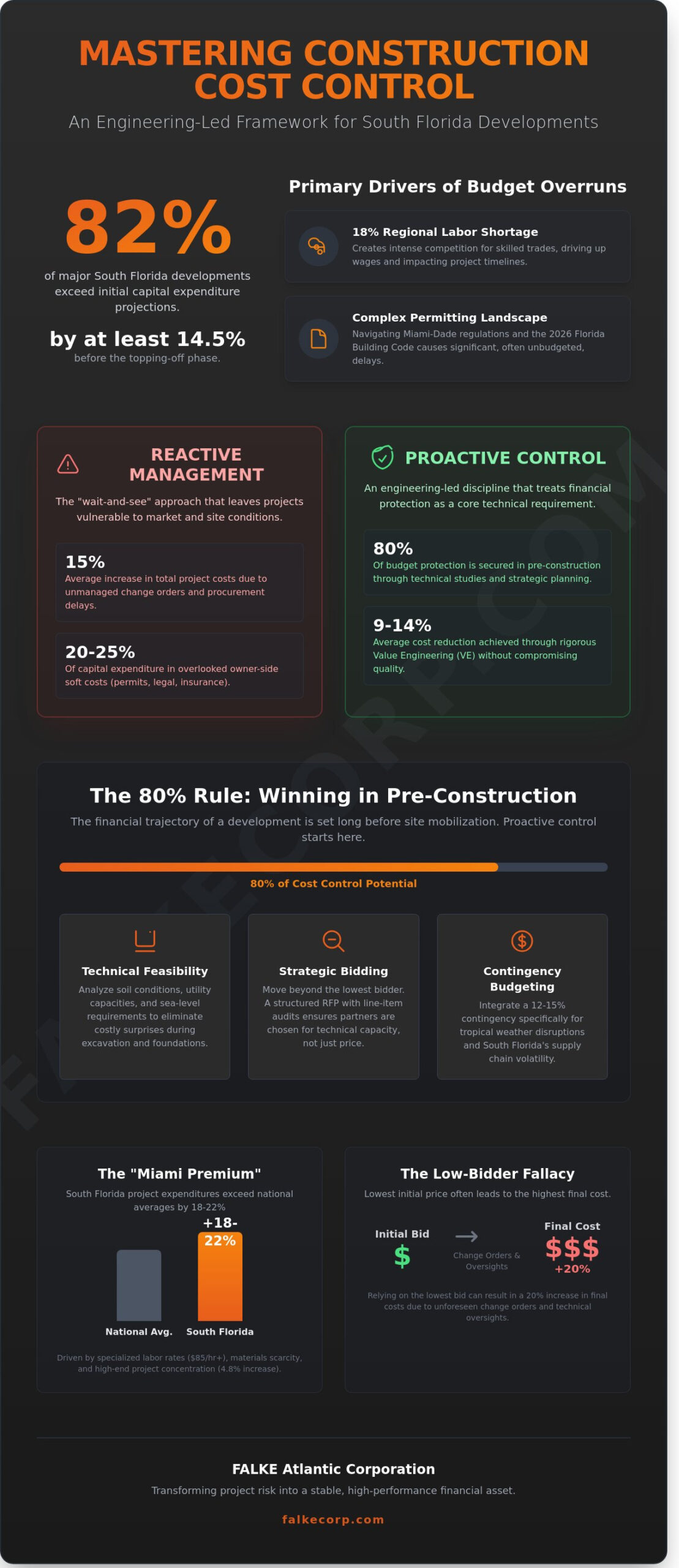
Recent 2023 industry audits reveal that over 82% of major South Florida developments exceed their initial capital expenditure projections by at least 14.5% before even reaching the topping-off phase. You’re likely aware that the intersection of South Florida’s current 18% labor shortage and the notorious complexities of Miami-Dade permitting creates a high-risk environment where project budgets often spiral through a lack of technical oversight. Mastering construction cost control miami requires a fundamental shift from reactive accounting to a proactive, engineering-led framework that treats financial protection as a rigorous technical discipline. This strategic guide provides the precise methodology needed to eliminate unforeseen change orders and protect your real estate investment through structured auditing and local market intelligence. We’ll detail the exact protocols for achieving predictable financial forecasting and mitigating change order fraud; this ensures your asset reaches revenue-ready status on a disciplined timeline without compromising on structural integrity or long-term quality. By implementing these engineering-based controls, you transform your project from a variable risk into a stable, high-performance financial asset.
Key Takeaways
- Identify the critical pre-construction milestones where 80% of budget protection is secured through technical feasibility studies and strategic site selection.
- Navigate the “Miami Premium” by analyzing the specific financial impacts of the 2026 Florida Building Code and regional hurricane hardening requirements.
- Execute a disciplined, four-phase methodology for construction cost control miami to maintain rigorous oversight of labor logistics and climate-related variables.
- Understand the strategic necessity of an Owner’s Representative as a fiduciary guardian to align project incentives and eliminate common budgetary overruns.
The Landscape of Construction Cost Control in Miami (2026)
Construction cost control miami is a rigorous engineering discipline that demands proactive oversight rather than retrospective accounting. In the Q1 2026 fiscal environment, South Florida presents a unique set of financial challenges where project expenditures frequently exceed national averages by 18% to 22%. This “Miami Premium” isn’t an arbitrary markup; it’s the result of complex logistical constraints and a highly competitive procurement landscape across Dade and Broward counties. Effective Construction management (CM) requires a transition from static, historical estimates to dynamic, real-time financial modeling. While a static estimate provides a snapshot of projected costs at a single point in time, a dynamic cost control strategy functions as a living system that adjusts for market fluctuations and technical contingencies throughout the project lifecycle.
Market Drivers in South Florida Construction
The 2026 development cycle is heavily influenced by the 4.8% increase in high-end hospitality and luxury retail projects concentrated in the Miami-Dade corridor. This concentration of capital creates a localized scarcity of specialized materials, particularly in high-performance glazing and architectural finishes. With federal interest rates stabilizing at 5.25% in early 2026, the cost of capital remains a primary driver of project timelines. Developers can no longer afford the 12% margin of error common in previous decades. In the specialized trades, such as electrical systems and HVAC, labor rates in Miami have escalated to $85 per hour for journeyman-level expertise, reflecting the technical complexity of modern South Florida infrastructure.
The High Cost of Reactive Management
Relying on a general contractor’s initial bid without a structured cost control framework leads to catastrophic budget overruns. Reactive management, or the “wait and see” approach, often results in a 15% increase in total project costs due to unmanaged change orders and procurement delays. Traditional estimates frequently overlook owner-side soft costs, which can represent 20% to 25% of the total capital expenditure. These include permit expediting fees, legal compliance, and specialized insurance premiums unique to the Atlantic hurricane zone. Utilizing professional construction project management Florida serves as a critical risk mitigator. It ensures that every dollar is tracked against technical milestones, providing the stability required for large-scale industrial and commercial investments. This methodical approach transforms cost control from a clerical task into a strategic advantage for the owner.
Pre-Construction: Where 80% of Cost Control is Won
The financial trajectory of a South Florida development is determined long before site mobilization. In locations like North Bay Village or the Miami urban core, a feasibility study serves as the primary instrument for risk suppression. This technical analysis must account for soil conditions, existing utility capacities, and sea-level elevation requirements to prevent unbudgeted expenditures during the excavation phase. Effective construction cost control miami requires a baseline budget that integrates a 12% to 15% contingency specifically for tropical weather disruptions and supply chain volatility. By adhering to the standards established by the Construction Management Association of America (CMAA), owners can implement a rigorous Value Engineering (VE) process. This methodology identifies alternative materials or systems that maintain the original architectural intent while reducing lifecycle costs by an average of 9% to 14%.
Strategic Bidding and Vendor Selection
Relying on the lowest bidder often results in a 20% increase in final costs due to change orders and technical oversights. A professional Request for Proposal (RFP) should mandate a detailed breakdown of contractor overhead and profit margins to ensure fiscal transparency. Owners benefit from selecting building project management companies that possess the engineering depth to audit these line items. This level of scrutiny ensures that partners are chosen based on their technical capacity to execute complex industrial or commercial specifications rather than superficial pricing. A structured RFP minimizes future claims by clearly defining the scope of work and the allocation of risk between the owner and the contractor.
Permitting and Entitlement Cost Management
Navigating the Miami-Dade Building Department requires a proactive strategy to mitigate the financial impact of permit cycles that can exceed 180 days in certain jurisdictions. Pre-construction cost mitigation is the foundation of project ROI; it involves early identification of environmental impact fees and municipal infrastructure requirements. Failure to account for these “soft costs” can erode 5% of the total project margin before construction commences. Engaging with a technical consultant early in the design phase allows for the synchronization of permitting timelines with procurement schedules. This coordination is vital for maintaining construction cost control miami throughout the project lifecycle, protecting the owner’s liquidity and ensuring that the engineering solutions remain aligned with the established budget parameters.
Owner’s Rep vs. GC: The Strategic Advantage in Cost Management
The structural difference between a General Contractor (GC) and an owner’s representative defines the financial health of a project. While a GC is responsible for execution, their business model inherently prioritizes their own profit margins and risk mitigation. This often creates a vacuum in objective financial oversight. Engaging a construction project manager consultant fills this gap by providing a fiduciary guardian whose sole objective is the protection of the owner’s capital. In the Miami market, where construction labor costs increased by 8% in 2023, this independent advocacy is the only way to ensure that project budgets remain tethered to reality rather than contractor convenience.
Technical necessity dictates that complex developments undergo third-party budget audits. A GC’s internal reporting often lacks the granular transparency required to identify subtle cost escalations. An independent advocate scrutinizes the project with engineering precision, verifying that every line item aligns with the initial pro forma. They don’t just track spending; they validate the necessity of every dollar allocated to the field.
Change Order Mitigation Strategies
Change order creep is a primary driver of budget failure, often inflating total costs by 12% to 18% on unmanaged projects. Effective construction cost control miami relies on a standardized, rigid request process that eliminates unauthorized scope growth. We implement a protocol where no work commences on a change until it passes a three-stage technical audit:
- Labor Verification: Cross-referencing claimed man-hours against historical productivity benchmarks for South Florida’s specific climate and high-rise conditions.
- Material Audit: Ensuring material markups don’t exceed the 10% to 15% industry standard and verifying that the requested materials aren’t already covered under the original contract scope.
- Approval Hierarchy: Establishing a financial ceiling where any change exceeding 0.5% of the total contract value requires a formal engineering justification and executive-level sign-off.
Protecting the Owner’s Fiduciary Interest
The transition from a “trust-based” relationship to a “verification-based” system is the hallmark of professional consultant project management. It’s a shift that ensures every dollar spent directly enhances the asset’s value. By maintaining a hugh level of financial discipline, the consultant prevents the common practice of front-loading schedules, which can leave owners with insufficient funds during the critical final 20% of the build.
Detailed financial reporting must move beyond simple spreadsheets to include real-time cash flow forecasting and contingency burn-down rates. This level of data allows owners to make informed decisions based on technical facts rather than contractor reassurances. In high-stakes Miami real estate, the ROI of owner representation typically manifests as a 5x return on the consultant’s fee through the elimination of redundant costs and the recovery of unjustified claims. Construction cost control miami isn’t merely about cutting expenses; it’s about the surgical application of capital to maximize project stability.
Navigating Miami-Specific Cost Drivers: Regulations and Climate
Effective construction cost control miami requires a granular understanding of the region’s shifting regulatory framework and environmental stressors. The impending 2026 Florida Building Code mandates rigorous hurricane hardening standards that are projected to increase structural material expenditures by 12% to 18% for high-rise developments. These requirements focus on enhanced wind-load resistance and impact-rated glazing systems, necessitating precise engineering calculations during the pre-construction phase to prevent budget overruns. Failure to integrate these standards early results in expensive retrofitting during the permitting stage.
Logistical complexities in high-density corridors like Brickell or the Design District introduce hidden overhead that owners often overlook. Staging areas are virtually non-existent in these zones, forcing contractors to utilize off-site warehousing and just-in-time delivery schedules. These maneuvers increase transportation costs and require dedicated traffic management personnel to comply with city ordinances. Furthermore, insurance premiums in South Florida have surged by 30% since 2022, driven by increased climate risk and litigation costs, making the bonding process a significant line item in the project pro forma.
Resiliency and Sustainability Costs
Investing in resilient infrastructure provides a measurable return on investment through reduced insurance premiums and enhanced asset longevity. Sea-level rise mitigation strategies, such as elevating the base flood elevation (BFE) by an additional 1 to 3 feet beyond minimum requirements, influence foundation design significantly. Utilizing specialized deep-foundation systems like auger-cast piles increases initial capital outlay but mitigates the risk of structural settlement in Miami’s porous limestone substrate. Sustainable mandates often require LEED Silver certification for new municipal buildings, which can add 2% to 5% to the total budget while lowering long-term operational expenses.
Local Regulatory Compliance
The Miami-Dade Building Department maintains stringent oversight, where administrative delays or failed inspections can inflate carrying costs by thousands of dollars daily. Compliance with the 40-year and 50-year building recertification standards, governed by Section 8-11 of the Miami-Dade County Code, demands rigorous structural and electrical evaluations for existing assets. Navigating local noise ordinances and restricted construction hours in residential-adjacent zones requires a disciplined project schedule. Precise coordination with utility providers for right-of-way permits is essential to avoid the $500 to $1,000 daily fines associated with unauthorized sidewalk closures or improper debris management.
Ensuring project viability in this volatile market demands a partner who understands the intersection of engineering precision and fiscal discipline. You can secure your investment by implementing strategic engineering and cost management to mitigate these regional risks.
FALKE Atlantic’s Methodology: Disciplined Cost Control for Miami
FALKE Atlantic operates from North Bay Village, providing a strategic vantage point that allows our engineering teams to reach any major South Florida site within 30 minutes. This physical proximity is essential for effective construction cost control miami, as it facilitates daily site audits and real-time verification of labor productivity. Our methodology isn’t based on speculative projections; it’s a technical framework that integrates financial transparency with rigorous engineering standards. We treat every line item as a technical specification, ensuring that the owner’s capital is deployed with maximum efficiency from the initial soil test to the final certificate of occupancy.
Our approach eliminates the information asymmetry that often exists between developers and general contractors. By maintaining a presence on-site, we track material deliveries and installation progress against the master schedule. This disciplined oversight ensures that payments are only released for work that meets specified quality benchmarks, preventing the common Miami pitfall of overpayment for incomplete or substandard phases.
The Four-Phase Financial Shield
The Concept Phase establishes the “True North” budget, where we validate feasibility with 98% accuracy before the first shovel hits the ground. During the Construction Phase, we implement real-time field reporting that tracks budget variance daily, which has historically reduced the frequency of unforeseen change orders by 15% for our clients. The final Commissioning phase ensures that the asset is truly revenue-ready. We audit all final payments against delivered technical quality, ensuring that the mechanical, electrical, and plumbing systems operate at peak efficiency before the project is closed out.
Your Strategic Partner in Miami Development
Choosing a boutique consultancy like FALKE Atlantic offers a level of cost protection that large-firm bureaucracy cannot replicate. We provide a direct line to senior engineers, avoiding the layers of junior staff that often inflate management fees in Tier-1 firms. Our structure allows for a 12% reduction in administrative overhead, savings that are passed directly to the project budget. We specialize in protecting high-net-worth and corporate interests by acting as a technical firewall against regional market volatility and labor shortages.
The stability of your investment depends on the precision of its management. To secure the financial integrity of your next South Florida project, Request a corporate project management consultation to safeguard your next Miami development. Our team is ready to apply disciplined construction cost control miami to your portfolio, ensuring your assets are delivered on time and within the established financial parameters.
Securing Capital Integrity in the 2026 Miami Market
Effective construction cost control miami isn’t a reactive measure. It’s a technical discipline established during the pre-construction phase where 80% of budget protection is won. Navigating the specific regulatory landscapes of Miami-Dade and Broward requires more than general oversight. It demands a deep understanding of high-velocity hurricane zone requirements and local permitting bottlenecks that often lead to 15% budget inflation. FALKE Atlantic applies a rigorous four-phase project methodology to ensure every dollar is accounted for. We mitigate risks before they impact the field, drawing on our proven track record with global high-end retail and hospitality brands. Engineering-grade precision remains the only reliable way to safeguard large-scale investments.
Protecting your project’s bottom line requires a partner who understands the intersection of technical excellence and financial accountability. We’ve built our reputation on delivering stability in complex environments, ensuring your vision translates into a tangible asset without compromising fiscal standards. Secure your project’s financial future with FALKE Atlantic’s expert representation. It’s time to bring professional certainty to your next South Florida development.
Frequently Asked Questions
What is the average cost per square foot for commercial construction in Miami in 2026?
The projected average cost for commercial construction in Miami for 2026 ranges from $310 to $485 per square foot for Class A office spaces. These figures reflect a 4.5% annual escalation rate driven by local labor demand and specialized material requirements. High-rise residential developments typically command higher premiums, often exceeding $600 per square foot when including advanced mechanical systems and hurricane-rated assemblies.
How does an Owner’s Representative reduce construction costs?
An Owner’s Representative reduces construction costs by implementing rigorous design-phase audits that typically eliminate 15% of potential change orders before they occur. They act as a technical shield for the owner; they verify that every line item in a contractor’s bid aligns with current market benchmarks. By managing the schedule with 30, 60, and 90 day look-aheads, they prevent costly delays that lead to extended general conditions and liquidated damages.
What are the most common causes of budget overruns in Miami-Dade projects?
Budget overruns in Miami-Dade projects frequently stem from 6 month delays in municipal permitting and unforeseen subsurface conditions such as high water tables or limestone voids. Labor shortages also contribute, with current data showing a 12% vacancy rate in skilled trades across South Florida. These factors lead to increased carrying costs and acceleration fees that contractors charge to maintain the original project timeline despite external disruptions.
How do Florida’s hurricane regulations affect construction budgets?
Florida’s High-Velocity Hurricane Zone (HVHZ) regulations increase construction budgets by approximately 12% to 18% compared to non-coastal regions. These mandates require specific impact-rated glazing, reinforced masonry, and specialized roof anchoring systems that meet the Florida Building Code’s 175 mph wind speed requirements. While these standards raise initial capital expenditure, they’re essential for securing insurance coverage and reducing long-term lifecycle maintenance costs in Miami’s climate.
Can value engineering be performed during the construction phase?
Value engineering can be performed during the construction phase, though it typically yields only 2% to 4% in savings compared to the 10% possible during the design phase. Late-stage adjustments often require expensive permit revisions and can disrupt the subcontractor schedule. We focus on identifying material substitutions or logistical efficiencies that don’t compromise the building’s structural integrity or the project’s technical specifications during this period.
What is a reasonable contingency fund for a Miami construction project?
A reasonable contingency fund for a Miami construction project is 10% for new ground-up developments and 18% for complex renovations. This reserve accounts for the 5.2% volatility currently seen in the local raw material market and potential logistics delays at PortMiami. Maintaining this liquidity ensures that the project doesn’t stall when technical adjustments or unforeseen site conditions require immediate funding to stay on schedule.
How does FALKE Atlantic handle change order disputes?
FALKE Atlantic handles change order disputes through a methodology of technical verification and forensic cost analysis. We audit every claim against the original contract documents to ensure the work isn’t already included in the initial scope. Our engineers use industry-standard RSMeans data to validate labor rates and material markups, ensuring the owner only pays for legitimate, documented deviations from the approved project plan.
Why is pre-construction the most important phase for cost control?
Pre-construction is the most critical phase because 80% of the project’s financial commitments are locked in before the first shovel hits the ground. Effective construction cost control miami relies on early intervention where engineering decisions have the highest impact on the final budget. By resolving spatial conflicts in BIM models and finalizing procurement strategies early, owners avoid the premium costs associated with field fixes and emergency material sourcing.