
In the volatile South Florida real estate market, a luxury residential project is not merely a design challenge; it’s a complex industrial operation where a single permitting delay in Miami-Dade County can freeze a multi-million dollar asset for over 150 days. You likely recognize that achieving a superior build quality requires more than just a reputable architect. It demands a rigorous, engineering-led methodology to eliminate the systemic issues of opaque pricing and fragmented contractor communication. Mastering how to manage a luxury home build in Miami effectively means shifting from a traditional oversight model to a disciplined, risk-mitigation framework that prioritizes technical precision over aesthetic guesswork.
This strategic guide for 2026 provides the exact protocols high-net-worth owners need to secure complete financial transparency and operational stability throughout the construction lifecycle. We’ll outline a framework that transforms your vision into a move-in ready asset while neutralizing climate-related risks and legal vulnerabilities. You’ll gain a comprehensive understanding of the technical milestones, from structural hardening to advanced project management systems, that ensure your investment remains protected and on schedule.
Key Takeaways
- Adopt a disciplined, four-phase strategic framework designed to mitigate financial and operational risks throughout the lifecycle of a high-end South Florida construction project.
- Learn how to manage a luxury home build in Miami by utilizing an Owner’s Representative as a technical “Chief of Staff” to resolve inherent conflicts of interest with general contractors.
- Master the technical requirements of Miami-Dade’s regulatory environment, specifically focusing on High Velocity Hurricane Zone (HVHZ) compliance and sophisticated permitting workflows.
- Evaluate the specific labor market dynamics and supply chain volatility of the 2026 Miami market to ensure project stability and budgetary precision.
- Implement a rigorous commissioning protocol for integrated smart home systems and specialized HVAC infrastructure to ensure 100% technical completion and long-term asset protection.
The Landscape of Luxury Construction in South Florida (2026)
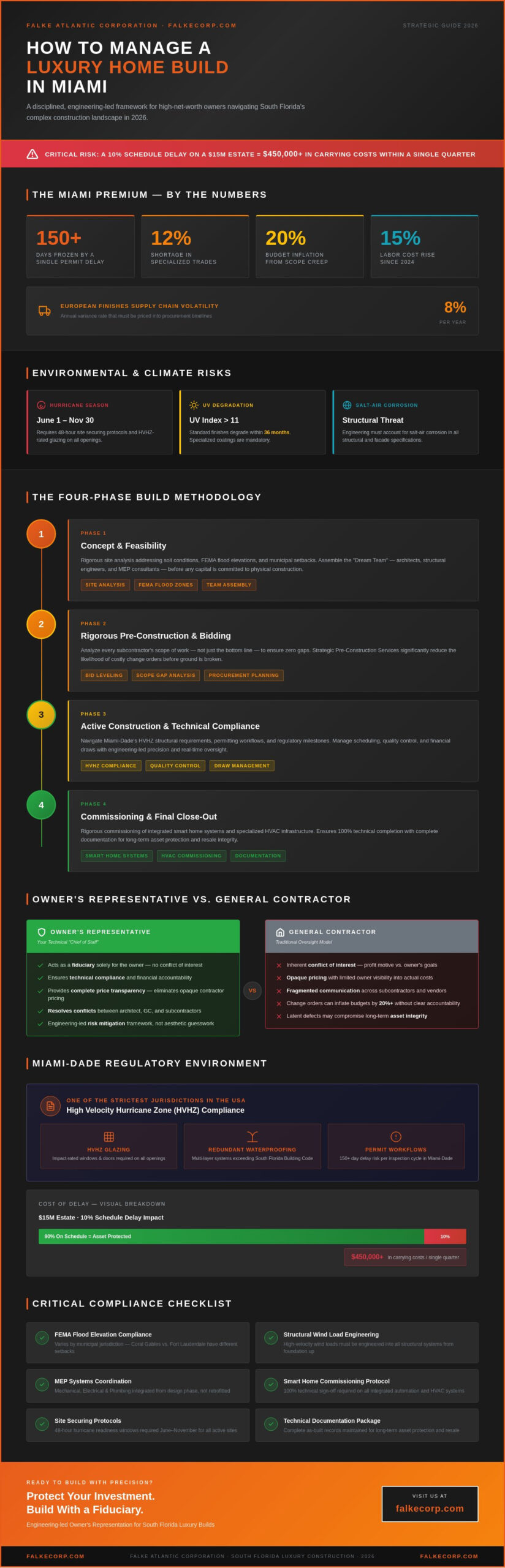
The 2026 Miami luxury market demands a level of technical rigor that exceeds traditional residential standards. Building a high-end residence in this environment requires the integration of complex structural engineering with sophisticated automation systems. Understanding how to manage a luxury home build in Miami starts with recognizing that these projects are industrial-grade operations. The “Miami Premium” isn’t a myth; it’s a quantifiable economic factor. Local labor markets currently face a 12% shortage in specialized trades, while supply chain volatility for European finishes remains at 8% annually. A disciplined approach is mandatory in 2026 because the margin for error has vanished. Primary risks include scope creep, where undocumented changes inflate budgets by 20%, and shifting regulatory frameworks. Effective Construction management provides the structural framework to mitigate these variables through precise scheduling and rigorous procurement protocols.
The High Stakes of Miami-Dade Real Estate
Financial exposure in South Florida is acute. A 10% schedule delay on a $15 million estate results in carrying costs and lost opportunity value exceeding $450,000 within a single quarter. Mismanagement devalues high-net-worth assets by introducing latent defects and compromising the integrity of the build’s technical documentation. It’s a risk that most owners can’t afford to ignore. An Owner’s Representative serves as a fiduciary safeguard, ensuring technical compliance and financial accountability throughout the project lifecycle.
Environmental and Climate Considerations
Miami’s climate dictates material selection with uncompromising physics. Intense UV exposure, where the index regularly exceeds 11, degrades standard finishes within 36 months. Designing for resilience in 2026 means exceeding the South Florida Building Code by implementing redundant waterproofing and high-velocity hurricane zone (HVHZ) glazing. Timelines must account for the Atlantic hurricane season from June 1 to November 30. During this window, logistics planning requires 48-hour site securing protocols to protect the structural investment. Successful execution depends on a deep understanding of these environmental constraints.
- Structural Integrity: Engineering must account for salt-air corrosion and high-velocity wind loads.
- Regulatory Compliance: Miami-Dade’s building department remains one of the strictest jurisdictions in the United States.
- Market Dynamics: Labor costs for master craftsmen have increased by 15% since 2024.
A Four-Phase Methodology for Managing Your Build
Successful delivery of a high-end residence requires a structured, engineering-led approach that eliminates ambiguity. Understanding how to manage a luxury home build in Miami involves breaking the process into four distinct, logical stages that prioritize risk mitigation and technical accuracy. This methodology ensures that the owner’s vision is translated into a physical asset without the common pitfalls of budget overruns or structural delays.
Phase 1 & 2: The Importance of Pre-Construction
The concept and feasibility stage serves as the project’s technical foundation. In Miami-Dade and Broward counties, this involves rigorous site analysis to address specific soil conditions and strict 2026 building codes. You’ll need to assemble a “Dream Team” consisting of architects, structural engineers, and specialized MEP (mechanical, electrical, plumbing) consultants early. This group validates the project’s technical viability before any capital is committed to physical construction. Detailed site studies must account for FEMA flood elevations and specific municipal setbacks that vary between jurisdictions like Coral Gables and Fort Lauderdale.
Rigorous bidding follows the design phase. It’s not enough to compare bottom-line numbers; you must analyze the scope of work for every subcontractor to ensure no gaps exist. Owners who invest in Strategic Pre-Construction Services in Miami significantly reduce the likelihood of change orders during the execution phase. This stage is where the project’s financial and temporal boundaries are set with precision.
Phase 3 & 4: From Groundbreaking to Handover
Phase 3 shifts focus to site execution and financial discipline. Daily oversight ensures the general contractor adheres to the technical specifications defined during pre-construction. Real-time budget tracking and weekly schedule auditing are essential to maintain momentum. Given the rising complexity of modern coastal architecture, there’s a growing demand for owner’s representatives to handle daily site coordination and conflict resolution. This role acts as a technical shield for the owner, ensuring that every pour of concrete and every electrical run meets the approved engineering standards.
Phase 4, the commissioning stage, ensures the residence functions as a high-performance asset. This transition isn’t a simple move-in; it’s a comprehensive asset transfer. It includes final inspections, system stress tests, and the delivery of all warranties and digital operation manuals. A project isn’t complete until every system, from the HVAC balancing to the smart-home automation, is verified and documented. If you’re planning a project of this scale, you can consult with our technical team to ensure your management structure is robust enough for the 2026 market demands.
Effective management during these final stages prevents the “90% complete” trap where projects stall during the finishing touches. By implementing a strict close-out checklist, owners ensure that all subcontractor liens are released and all equipment is fully operational before the final payment is issued. This disciplined approach is the only way to master how to manage a luxury home build in Miami while protecting your investment’s long-term value.
Owner’s Representation vs. General Contracting: The Critical Distinction
The structural relationship between a property owner and a general contractor is inherently transactional. While a general contractor (GC) manages the execution of the build, their primary objective involves maintaining their own profit margins and operational schedule. This creates a natural conflict of interest when delays, material substitutions, or site errors occur. An Owner’s Representative functions as the project’s Chief of Staff, providing an independent layer of technical oversight that prioritizes the owner’s financial and qualitative interests. Understanding this hierarchy is central to learning how to manage a luxury home build in Miami, where 2026 market conditions demand tighter control over escalating labor costs and specialized procurement.
Professional management often identifies 5% to 12% in potential cost avoidance through rigorous pre-construction plan reviews and value engineering. When a GC claims they handle project management, they’re referring to the internal coordination of their crews and subcontractors. They aren’t managing the owner’s risk, the design team’s deliverables, or the long-term asset value. An Owner’s Rep operates outside the contractor’s profit motive, ensuring that every dollar spent translates directly into project equity.
Fiduciary Duty and Financial Transparency
Financial transparency isn’t a byproduct of a good relationship; it’s the result of strict auditing. The Owner’s Rep manages the draw request process, ensuring that payments align strictly with the percentage of work verified on-site. They audit change orders to determine if a request stems from a legitimate unforeseen condition or avoidable scope creep. To validate contractor claims, the Rep performs a physical verification of installed quantities against the submitted schedule of values, preventing the common practice of front-loading contracts. This level of scrutiny ensures that the owner never pays for work that hasn’t been executed to the required technical standard.
Communication and Reporting Standards
A single point of contact eliminates the noise of conflicting reports from various trades and consultants. Professional construction progress reports must include critical path analysis, photographic evidence of milestones, and budget variance tracking. Utilizing an Owner’s Representative Miami ensures that asset protection remains the priority throughout the 18 to 30-month lifecycle of a high-end residential project.
- Weekly Executive Summaries: A high-level overview of schedule health and pending decisions.
- Risk Mitigation Logs: Identification of potential supply chain disruptions or permit delays before they impact the critical path.
- Meeting Minutes: Documenting all verbal agreements to prevent future disputes over scope or intent.
Technical Compliance: Navigating Miami’s Regulatory Environment
Miami’s regulatory landscape for 2026 demands a shift from reactive to proactive engineering management. Building in a High Velocity Hurricane Zone (HVHZ) requires more than standard adherence; it necessitates a deep understanding of the Florida Building Code’s evolving structural mandates. For a 2026 delivery, projects must meet the stringent energy efficiency targets set by the latest Energy Conservation Code updates. These updates dictate specific R-values for insulation and solar heat gain coefficients for glazing that often conflict with traditional luxury aesthetics if not managed correctly.
Understanding how to manage a luxury home build in Miami involves anticipating the technical friction between design and compliance. Owners must ensure their management team monitors the Testing Application Standards (TAS) for all exterior components. This includes rigorous verification of “Miami-Dade Notice of Acceptance” (NOA) documentation for every window, door, and roofing assembly. Failure to secure these certifications during the procurement phase can lead to catastrophic delays during the final inspection cycles.
Permitting and Entitlements in South Florida
Successful execution depends on mastering the “dry-run” permit review process. This involves a pre-submission technical audit where your management team identifies code conflicts before they reach the municipal desk. In jurisdictions like Coral Gables or North Bay Village, architectural review boards impose aesthetic restrictions that must align with structural engineering. Your manager acts as the technical bridge between the architect’s vision and the City of Miami Building Department’s rigid requirements. They ensure the master permit and sub-permits for electrical, mechanical, and plumbing systems move in a synchronized sequence. This coordination prevents the common “stop-work” orders that plague unmanaged sites.
Quality Control and Site Safety
Managing a luxury home build in Miami involves overseeing specialized installations that exceed standard residential scopes. Large-format structural glass and integrated home automation systems require specific moisture mitigation and thermal bridge analysis. A project-specific Quality Control (QC) plan should include third-party threshold inspections to verify that every structural element, from the foundation pilings to the roof tie-downs, meets the engineered specifications. Precision is non-negotiable when handling custom millwork or high-value finishes that are sensitive to Florida’s humidity levels.
You’ll need a manager who coordinates specialized engineering consultants to oversee these high-risk phases. For a deeper dive into the technical oversight required during these stages, review our guide on Construction Phase Management in Florida. Ensuring technical compliance isn’t just about passing inspections; it’s about protecting the long-term structural integrity of the asset. Owners who prioritize technical competence over speed reduce the risk of costly retrofits or insurance premium spikes.
Securing Your Investment: Commissioning and Final Close-out
The final phase of how to manage a luxury home build in Miami requires a transition from mechanical assembly to operational validation. This isn’t a mere walkthrough; it’s a systematic audit of every integrated system. We demand a zero-item punch list before final payment. This disciplined approach ensures that the architectural intent aligns perfectly with the physical reality. In the high-salinity, high-humidity environment of South Florida, “mostly finished” is a failure state that leads to rapid degradation of materials and electronics.
Technical commissioning focuses heavily on the building envelope and climate control systems. We mandate stress tests on HVAC configurations to ensure they meet ASHRAE 62.2 standards for ventilation and moisture removal, which is critical for preserving art collections and high-end millwork. Smart home integration, including Lutron lighting arrays and Crestron automation, undergoes a 48-hour burn-in period to identify any logic conflicts or hardware latencies. We don’t accept systems that simply work; they must perform reliably under peak load conditions.
Financial reconciliation marks the definitive end of the risk phase. You must secure final, unconditional lien waivers from every subcontractor and tier-two supplier involved in the project. Under Florida Statute 713, this documentation is your only shield against future claims. We hold the 10% retainage until the Certificate of Occupancy is issued and every technical specification is verified. This process ensures that the fiscal close-out is as precise as the engineering that preceded it.
Operational Readiness
Transitioning a 15,000-square-foot estate into a functional residence requires specialized training. We facilitate deep-dive sessions for estate managers or owners on the property’s life-safety systems and automation logic. Every project concludes with the delivery of a Digital Asset Library. This repository contains BIM (Building Information Modeling) data, warranty schedules, and submittal logs. If you intend to use the property for high-end hospitality, this library ensures the asset is revenue-ready, with maintenance protocols that protect its valuation from day one.
The FALKE Atlantic Commitment
Our methodology is rooted in engineering precision and unwavering accountability. We don’t rely on optimistic projections; we rely on verified data and rigorous oversight. By applying a structured, industrial-grade management style to luxury residential development, we protect your capital and your time. Our team ensures that your vision is realized without the typical friction of the Miami construction market. Contact us for a strategic consultation to discuss the technical requirements of your 2026 development project.
Securing Your Architectural Legacy in the 2026 Miami Market
The 2026 South Florida construction landscape demands a transition from traditional oversight to a rigorous, engineering-led management framework. Successfully navigating the complexities of high-net-worth residential assets requires more than aesthetic vision; it necessitates a disciplined four-phase methodology that addresses technical compliance and logistical risk at every milestone. Understanding how to manage a luxury home build in Miami involves recognizing the critical distinction between a general contractor’s execution and an owner representative’s strategic advocacy. Technical commissioning and strict adherence to Florida’s evolving regulatory environment are non-negotiable for securing a high-value investment against market volatility. FALKE Atlantic provides this specialized oversight, utilizing deep local expertise to manage the intricate lifecycle of both hospitality and residential projects. Our team’s focus on engineering reliability ensures that every specification meets the highest standards of stability and quality. It’s essential to maintain this level of professional scrutiny from the initial planning stages through to the final close-out. You’ve the opportunity to transform complex architectural concepts into a precise, enduring reality through methodical planning and expert representation. Contact FALKE Atlantic for Expert Owner Representation in Miami to ensure your project achieves its full potential through technical excellence.
Frequently Asked Questions
What is the difference between an Owners Rep and a Project Manager in Miami?
An Owner’s Representative functions as your fiduciary advocate across the entire project lifecycle, whereas a Project Manager typically operates under the General Contractor to oversee daily site operations. The Owner’s Rep manages the architect, contractor, and legal consultants to ensure alignment with your strategic brief. In contrast, the Project Manager focuses on tactical execution, scheduling labor, and material procurement within the construction phase.
How much does it cost to build a luxury home in Miami per square foot in 2026?
Luxury residential construction costs in Miami for 2026 are projected to range from $800 to $1,500 per square foot based on recent inflationary indices and high-end material demand. These figures exclude land acquisition and soft costs like architectural fees or specialized engineering reports. Achieving the upper tier of quality requires a rigorous budget management strategy to mitigate the 5% annual escalation in specialized labor costs recorded in South Florida.
How long does the permitting process typically take in Miami-Dade County?
The permitting process in Miami-Dade County currently requires a window of 6 to 12 months for high-end residential projects. This timeline accounts for the initial submission, mandatory municipal reviews, and the inevitable corrections required by the Building Department. You’ll optimize this duration by ensuring all technical drawings comply with the 2023 Florida Building Code prior to the first filing.
Why is an independent Owners Rep necessary if I have a reputable General Contractor?
An independent Owner’s Representative is essential because they provide a layer of technical oversight that a General Contractor can’t offer due to inherent conflicts of interest. While a reputable contractor manages their own profit margins and subcontractors, the Rep focuses exclusively on your financial and structural requirements. This role is a critical component of how to manage a luxury home build in Miami to ensure technical specifications aren’t compromised for the sake of construction speed.
What are the specific hurricane requirements for new luxury homes in Miami?
New luxury homes must adhere to the High-Velocity Hurricane Zone (HVHZ) standards, which mandate impact-resistant glazing and reinforced concrete tie-beams. The 2023 Florida Building Code requires structures to withstand wind speeds exceeding 175 mph in specific coastal sectors of Miami. These engineering protocols involve rigorous uplift pressure calculations for roof assemblies and the installation of secondary water barriers to prevent envelope failure during a 100-year storm event.
How can I prevent change order fraud during my construction project?
You’ll prevent change order fraud by establishing a fixed unit price schedule within the initial contract and requiring a digital audit trail for every modification. Industry data indicates that 15% of project cost overruns stem from undocumented verbal agreements or inflated material quotes. Implementing a strict approval workflow ensures that no additional work commences until the Owner’s Rep verifies the technical necessity and market-rate pricing of the proposed change. Understanding these controls is vital for anyone learning how to manage a luxury home build in Miami effectively.