
Did you know that as of July 1, 2026, Florida law mandates a minimum 75% reduction in local permit fees for commercial projects that utilize private providers for both plan reviews and inspections? For developers operating within the High-Velocity Hurricane Zone of South Florida, integrating a third-party construction project review Broward County is no longer merely an alternative; it’s a critical financial and operational strategy. You’re likely familiar with the persistent backlogs in Fort Lauderdale and the broader Broward building departments, where administrative delays often translate into substantial lost carry costs and missed market opportunities.
We recognize that the traditional municipal permitting process frequently lacks the technical precision required for complex industrial or commercial developments. This guide provides a professional analysis of how leveraging Florida Statute 553.791 allows owners to bypass municipal bottlenecks, ensure strict adherence to the 8th Edition (2023) Florida Building Code, and eliminate the unexpected change orders that stem from superficial initial reviews. We’ll examine the technical framework of private provider services, the specific fee structures such as the 1.85% job value assessment, and the precise steps necessary to accelerate your project’s speed-to-market while mitigating long-term structural litigation risks.
Key Takeaways
- Learn how to leverage Florida Statute 553.791 to secure mandated permit fee reductions of up to 75% for commercial developments.
- Understand the critical distinction between municipal oversight and the technical precision of a third-party construction project review Broward County for High-Velocity Hurricane Zones.
- Identify how dual-track plan reviews and field inspections eliminate design flaws and contractor deviations before they result in expensive change orders.
- Evaluate the essential criteria for selecting a review partner, including asset-specific experience and the necessary professional liability coverage.
- Discover the FALKE Atlantic Corporation methodology for integrating third-party data into a disciplined management framework to ensure long-term asset excellence.
Table of Contents
- Understanding Third-Party Construction Project Review in Broward County
- Plan Review vs. Field Inspections: A Dual-Track Approach to Quality
- The Financial Case: ROI of Third-Party Reviews in South Florida
- Selecting the Right Review Partner for Broward Developments
- The FALKE Methodology: Beyond Compliance to Asset Excellence
Understanding Third-Party Construction Project Review in Broward County
A third-party construction project review Broward County serves as a specialized regulatory alternative to the standard municipal building department oversight. While government inspections remain a mandatory component of the development cycle, Florida Statute 553.791 grants owners the right to elect a private provider to perform these critical functions. This process is essentially a rigorous technical peer review of both construction documents and field execution, conducted by licensed professionals rather than municipal staff. For commercial developments in South Florida, where the 8th Edition (2023) Florida Building Code imposes stringent structural requirements, the role of a private provider (a dually licensed engineer or architect) becomes a primary safeguard against administrative stagnation.
The distinction between mandatory government oversight and elective private review lies in the allocation of resources. Municipal departments often struggle with high volume, leading to generalized reviews. In contrast, a private provider offers dedicated technical competence, focusing exclusively on the project’s specific engineering complexities. As Broward County continues to see high-density growth, the demand for this specialized oversight has transitioned from a luxury to a technical necessity for maintaining project momentum.
The Legal Framework: Florida Statute 553.791
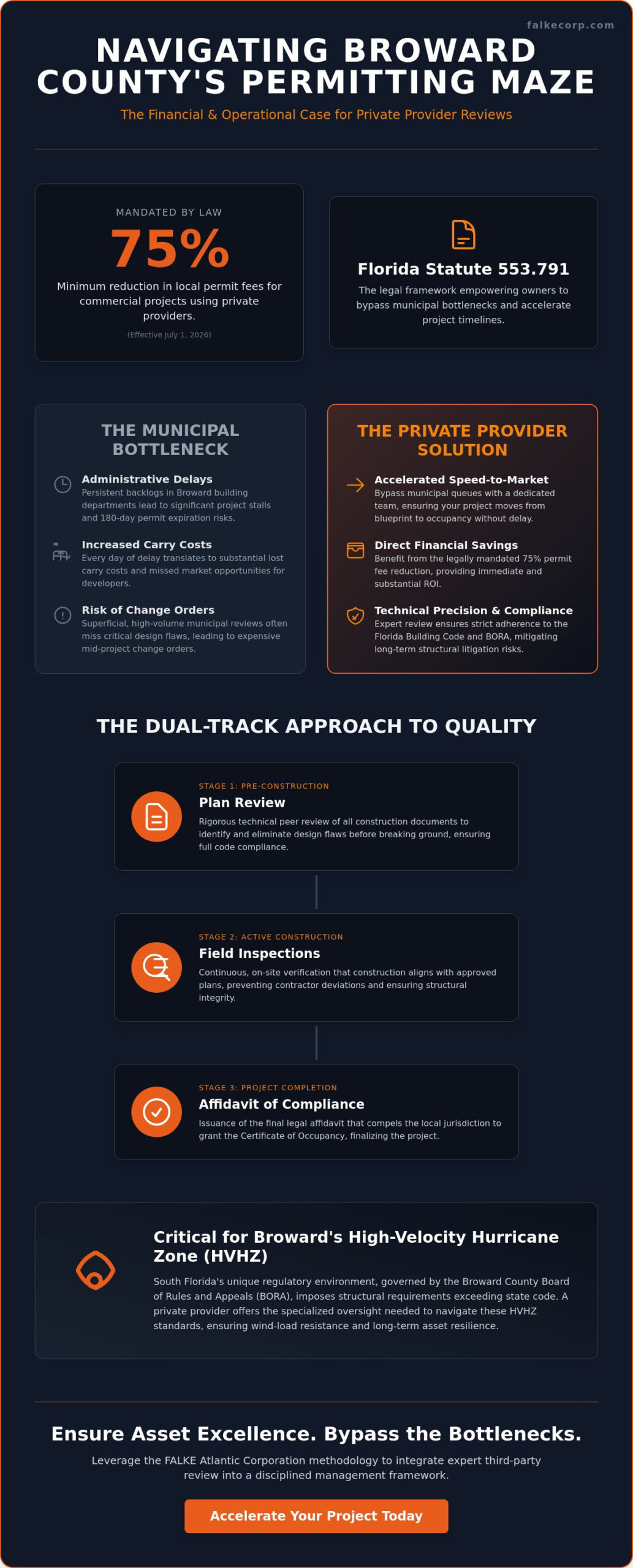
Florida Statute 553.791 provides the statutory authority for owners to bypass traditional municipal timelines. To utilize this path, an owner must file a formal “Notice to Building Official” either at the time of permit application or no less than 30 days before the first scheduled inspection. This legal mechanism empowers the private provider to perform plan reviews and inspections, ultimately issuing a final affidavit of compliance. This affidavit carries significant legal weight; it’s the primary document that compels the local jurisdiction to issue a Certificate of Occupancy, provided all other zoning and fire safety requirements are satisfied. It ensures that the technical integrity of the asset is verified by a professional who bears direct liability for the accuracy of the review.
Why Broward County Projects Require Specialized Oversight
Broward County operates under a unique regulatory layer via the Broward County Board of Rules and Appeals (BORA). These local amendments often exceed the baseline requirements of the Florida Building Code, particularly regarding High-Velocity Hurricane Zone (HVHZ) standards and wind-load resistance. With municipal backlogs in jurisdictions like Fort Lauderdale often extending permit lead times, the carry costs for a mid-to-large scale commercial project can escalate by thousands of dollars per day. A third-party construction project review Broward County mitigates these financial risks by providing the precise, expert attention required to navigate BORA amendments. This disciplined approach ensures that structural and environmental code requirements are integrated during the pre-construction phase, preventing the 180-day permit expiration risks that often plague projects caught in municipal administrative loops.
Plan Review vs. Field Inspections: A Dual-Track Approach to Quality
A high-performance third-party construction project review Broward County operates through a disciplined, two-stage methodology. It isn’t merely a substitute for municipal presence; it’s a strategic instrument for engineering precision. By separating the technical lifecycle into distinct tracks-pre-construction plan analysis and active field inspections-owners ensure that the engineering intent survives the transition from digital blueprints to physical structures. This dual-track approach is foundational for maintaining the long-term value of the asset and preventing the technical debt associated with poor initial oversight.
The Manhattan Institute has documented the economic benefits of third-party reviews, emphasizing how private-sector efficiency reduces the friction inherent in government-managed permitting. When technical competence is applied early, the project avoids the cascading costs of mid-cycle redesigns. This level of oversight is a core component of our pre-construction services in Miami and Broward, where we treat the review process as a proactive risk management tool rather than a reactive compliance hurdle.
Phase 1: The Strategic Plan Review
The initial plan review serves as a technical filter for constructability. Before mobilization, the private provider conducts an exhaustive audit of the construction documents to identify conflicts between structural, MEP, and architectural systems. This stage ensures strict adherence to the 8th Edition (2023) Florida Building Code and ADA requirements. By resolving these discrepancies during the design phase, owners significantly reduce the number of municipal review cycles. This efficiency expedites permit issuance and prevents the expensive field corrections that typically arise from uncoordinated design documents.
Phase 2: Rigorous Field Inspections
Once construction commences, the focus shifts to verifying that field execution mirrors the approved plans. Third-party providers conduct milestones inspections for structural integrity, electrical load-bearing, and mechanical systems with a level of detail that municipal staff rarely achieve. One of the most significant operational advantages is the ability to schedule inspections with 24-hour notice, bypassing the multi-day municipal waiting lists that often stall the critical path. This responsiveness ensures that concrete pours and wall closures proceed without administrative delay. Comprehensive documentation of these inspections provides a transparent record of compliance, which is essential for insurance underwriting and future asset disposition. For owners seeking to protect their capital, a disciplined management approach to field inspections is the only way to ensure as-built conditions meet the highest engineering standards.
The Financial Case: ROI of Third-Party Reviews in South Florida
The financial viability of a commercial development in South Florida often hinges on the compression of the permitting and inspection cycle. While some view a third-party construction project review Broward County as an additional line item, a rigorous analysis reveals it’s a high-yield investment. On a mid-sized commercial asset, a single month of municipal backlog can inflate carry costs by $15,000 to $50,000 depending on interest rates and operational overhead. By bypassing these delays, owners achieve revenue-readiness for hospitality or retail tenants weeks earlier, fundamentally shifting the project’s internal rate of return.
This strategic acceleration serves as a primary safeguard within our broader construction phase management framework. It ensures that capital isn’t tied up in administrative waiting lists but is instead actively driving the critical path toward completion. In an environment where the minimum permit fee is $125.00 and structural permits are calculated at 1.85% of the total job value, the cost of administrative friction is a risk that disciplined developers don’t ignore.
Permit Fee Reductions and Incentives
Effective July 1, 2026, Florida law mandates significant financial incentives for utilizing private providers. Local enforcement agencies must reduce permit fees by at least 50% if a private provider performs all plan reviews or building inspections. If the provider handles both, the reduction increases to at least 75%. These credits often entirely offset the professional fees of the third-party reviewer. This allows owners to redirect saved capital toward high-impact design elements or project contingency funds without increasing the total budget.
Mitigating Costly Change Orders
A technical third-party construction project review Broward County identifies design discrepancies that superficial municipal reviews frequently overlook. By catching coordination errors between structural and MEP drawings during pre-construction, owners avoid the “stop-work” orders that occur when field conditions don’t match code requirements. The reviewer also provides an objective layer of verification for contractor pay applications, ensuring that billed work accurately reflects verified field inspections. This disciplined oversight eliminates the budget bloat typically associated with unmanaged change orders in complex South Florida developments.
An independent review is only as good as the records it examines, which is why disciplined construction document control across RFIs, submittals and change orders determines how much a reviewer can actually verify.
Selecting the Right Review Partner for Broward Developments
Selecting a partner for a third-party construction project review Broward County is a high-stakes technical procurement decision. It requires more than a cursory check of licensure; it demands a thorough audit of the firm’s engineering reliability and its specific experience within the Broward County regulatory ecosystem. The technical demands of a hospitality project differ significantly from those of an industrial facility or a high-rise tower. An experienced owner’s representative in Miami or Broward manages this relationship, ensuring that the review firm’s professional liability insurance is commensurate with the project’s total capital risk.
A reviewer’s effectiveness often depends on their established rapport with local building officials and their understanding of the Broward County Board of Rules and Appeals (BORA) interpretations. These relationships don’t imply a bypass of regulations. Instead, they facilitate a professional dialogue that resolves technical ambiguities before they escalate into project delays. We recommend that owners prioritize firms that demonstrate a disciplined, engineering-first approach to compliance, as this stability is essential for safeguarding complex industrial and commercial processes.
Verification of Credentials and Experience
The first step in the evaluation process for a third-party construction project review Broward County is confirming that the lead reviewers are Florida-licensed Professional Engineers (PE) or Registered Architects (RA) in good standing. Owners should request a detailed portfolio of successfully completed projects within Broward County that match the current asset class. Verification of the firm’s standing with BORA is equally critical. Local amendments to the Florida Building Code require specialized knowledge that generalist firms often lack, particularly regarding High-Velocity Hurricane Zone (HVHZ) standards.
Integration with the Project Team
A third-party reviewer must function as a seamless extension of the owner’s technical team. This requires establishing a clear reporting cadence with the Architect of Record and the General Contractor to ensure that plan deficiencies are identified and corrected in real-time. The scope of work must be precisely defined to eliminate gaps between the reviewer’s inspections and the work of the commissioning agent. This structured information transfer is vital for maintaining the project’s momentum. For developers seeking to optimize their project’s technical execution, engaging a disciplined development management partner ensures that these third-party relationships are managed with the highest level of professional rigor.
The FALKE Methodology: Beyond Compliance to Asset Excellence
FALKE Atlantic Corporation’s approach to a third-party construction project review Broward County transcends simple regulatory compliance. We embed the review data into our broader framework for construction project management in Florida, treating every inspection as a data point for long-term asset performance. This disciplined four-phase methodology ensures that technical findings from the private provider don’t exist in a vacuum. Instead, they inform our management of the critical path, allowing us to anticipate structural or mechanical bottlenecks before they impact the commissioning schedule. By integrating these reviews into our project management ecosystem, we transform a statutory requirement into a strategic advantage for our clients.
The stability of a commercial development depends on the seamless transition from construction to operations. Our methodology prioritizes the technical integrity of the asset, ensuring that the engineering standards established during the pre-construction phase are maintained through to final close-out. We manage the third-party construction project review Broward County as a rigorous quality control layer that protects the owner’s capital from the risks of latent defects and operational inefficiencies. This commitment to engineering reliability is what allows our partners to focus on their core business processes while we secure their technical interests.
Strategic Oversight and Transparency
FALKE Atlantic Corporation acts as the owner’s primary technical filter during the review process, providing a level of oversight that municipal departments cannot offer. Our team translates complex engineering data and code citations from the private provider into actionable executive summaries. This transparency ensures that the owner is fully informed of the project’s technical status without needing to navigate the intricacies of the 8th Edition (2023) Florida Building Code. We maintain strict impartiality in the review process, ensuring that the third-party provider remains focused exclusively on the owner’s long-term interests rather than the contractor’s convenience. This structured communication bridge prevents information silos and keeps the project aligned with the original design intent.
Final Commissioning and Revenue-Readiness
The ultimate objective of our management framework is the delivery of a revenue-ready asset. We leverage the final inspection affidavit provided by the private provider to secure the Temporary Certificate of Occupancy (TCO) or final Certificate of Occupancy (CO) without the administrative friction typical of municipal departments. This efficiency is critical for aligning the close-out process with the broader real estate development management goals. Before the asset is handed over, we conduct a final verification of all building systems to ensure they’re fully operational and compliant with the approved engineering specifications. This final stage of commissioning guarantees that the asset is prepared for immediate use, maximizing the owner’s speed-to-market and protecting the project’s financial yield.
Optimizing Capital and Compliance in South Florida Developments
Selecting a third-party construction project review Broward County represents a shift from reactive compliance to proactive asset management. As detailed throughout this guide, the 75% permit fee reduction available as of July 1, 2026, transforms this service from an added expense into a self-funding risk mitigation tool. By bypassing municipal bottlenecks and adhering to the 8th Edition (2023) Florida Building Code through private sector efficiency, developers secure a critical advantage in speed-to-market. This methodology ensures that the technical integrity of the structure is verified with the precision required for South Florida’s High-Velocity Hurricane Zones.
FALKE Atlantic Corporation applies a disciplined four-phase methodology to navigate these regulatory complexities. Our expertise in complex hospitality and retail developments ensures that financial control and revenue-readiness remain the primary focus from pre-construction through final commissioning. We provide the technical competence necessary to manage every phase of the development lifecycle with unwavering reliability. Secure Your Broward Project’s Timeline with FALKE Atlantic Corporation’s Strategic Oversight and ensure your asset reaches its operational milestones without administrative compromise.
Your development deserves the technical rigor and professional reliability required to thrive in Broward’s regulatory environment.
Frequently Asked Questions
What is a Private Provider under Florida Statute 553.791?
A Private Provider is a professional dually licensed as a Florida Professional Engineer or Registered Architect who is authorized under Florida Statute 553.791 to perform building code compliance. They operate as an alternative to municipal staff, providing a third-party construction project review Broward County. These professionals bear direct liability for their findings and must maintain specific insurance coverage to protect the owner’s interests during the development lifecycle.
Does Broward County allow third-party reviews for all project types?
Broward County permits third-party reviews for most commercial and residential developments, though specific exclusions apply. While structural, mechanical, electrical, and plumbing systems are eligible, the local building department retains exclusive authority over zoning, fire safety, and public works reviews. Owners should verify that their asset class aligns with the Broward County Board of Rules and Appeals (BORA) amendments before engaging a private firm.
Will using a third-party reviewer actually speed up my permit approval?
Utilizing a private provider typically reduces the permit approval timeline by 30 to 45 days compared to municipal processing. Because these firms operate without the administrative volume of public agencies, they can dedicate technical resources to a single project’s critical path. This efficiency is vital for high-density developments in Fort Lauderdale where municipal backlogs often delay mobilization and inflate carry costs.
What is the difference between a third-party reviewer and a special inspector?
The primary difference lies in their statutory authority and scope of work. A third-party reviewer acts as a surrogate for the building official to ensure overall code compliance for permitting. In contrast, a Special Inspector is a mandatory technical expert required for “threshold buildings” to verify structural integrity during specific high-risk construction phases. While one professional can sometimes fulfill both roles, the legal requirements for each are distinct.
How much can I save on permit fees in Broward County by using a private provider?
Owners can secure significant financial credits under the legislation effective July 1, 2026. Florida law requires local jurisdictions to reduce permit fees by at least 50% if a private provider handles all plan reviews or all inspections. If the provider manages both tracks, the mandatory reduction increases to at least 75%. These savings often exceed the professional fees of the third-party construction project review Broward County.
Can a third-party reviewer also provide engineering design services for the same project?
No, a Private Provider cannot perform a third-party review on a project where they or their firm served as the Architect or Engineer of Record. Florida Statute 553.791 prohibits this conflict of interest to ensure the technical integrity of the review process remains objective. The reviewer must be an independent entity focused solely on code compliance and the owner’s strategic interests.
What happens if a municipal building official disagrees with a third-party inspector?
If a municipal building official identifies a code violation that the private provider overlooked, they retain the authority to issue a notice of non-compliance. However, the official must provide a specific technical basis for the disagreement. If a resolution isn’t reached, the matter is typically escalated to the Broward County Board of Rules and Appeals for a final binding determination.
How do I notify the Broward County building department that I am using a private provider?
Notification is achieved by filing a “Notice to Building Official” form with the local jurisdiction. This document must be submitted during the initial permit application or no less than 30 days before the first inspection is scheduled. The form must include the names of the private providers and proof of their professional liability insurance to ensure the municipal department recognizes their statutory authority.