
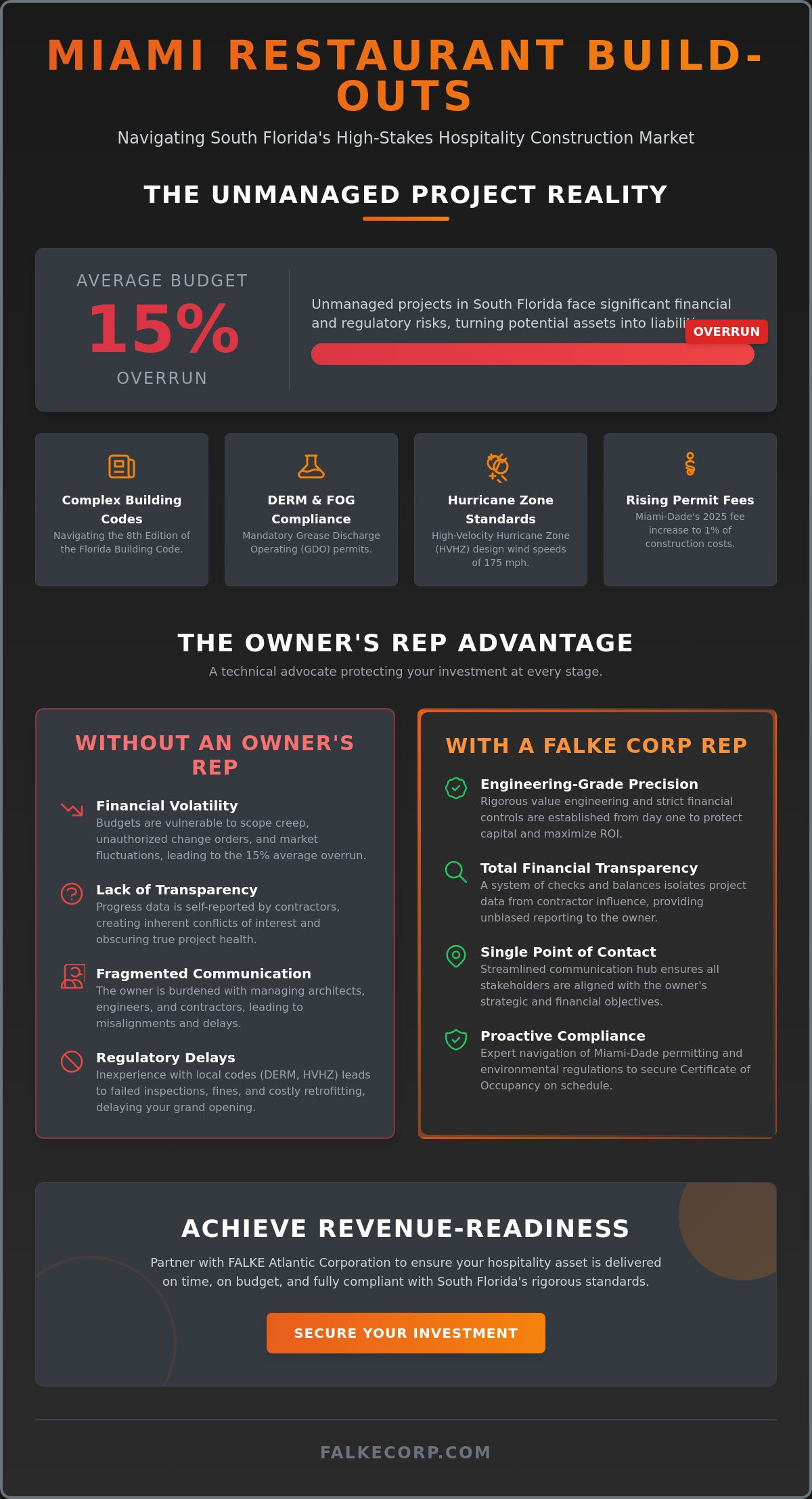
Unmanaged construction projects in South Florida currently experience an average budget overrun of 15%, a figure that highlights the inherent volatility of the regional hospitality sector. For sophisticated investors, engaging a professional owner’s representative for restaurant build-outs Miami is a technical requirement to ensure that capital is managed with engineering-grade precision rather than reactive adjustments. You’re likely aware that navigating the 8th Edition of the Florida Building Code and the mandatory DERM Grease Discharge Operating permit requirements presents significant hurdles that can delay your grand opening by months. This guide demonstrates how professional owner representation mitigates these specific technical risks and accelerates your project’s path to revenue-readiness. We’ll examine the strategic oversight of Miami-Dade County’s 2025 permit fee increases, the enforcement of total financial transparency during contractor change orders, and the rigorous process of securing a Certificate of Occupancy within the High-Velocity Hurricane Zone where design wind speeds reach 175 mph.
Key Takeaways
- Implementation of technical construction oversight to counteract the market volatility and budget overruns inherent in South Florida’s hospitality sector.
- Strategic navigation of Miami-Dade DERM compliance and complex grease trap specifications to prevent operational delays and regulatory fines.
- The critical function of an owner’s representative for restaurant build-outs Miami in executing a structured four-phase methodology from feasibility to commissioning.
- Establishing a system of checks and balances that isolates project data from contractor influence to prevent scope creep and unauthorized change orders.
- Technical requirements for achieving revenue-readiness while adhering to the 8th Edition of the Florida Building Code and High-Velocity Hurricane Zone standards.
The Strategic Necessity of an Owner’s Representative for Miami Restaurant Build-Outs
In the current South Florida hospitality market, the role of an owner’s representative for restaurant build-outs Miami has transitioned from a supplemental service to a technical necessity. As of May 2026, unmanaged construction projects in this region face an average budget overrun of 15%, a statistic that underscores the volatility of local labor markets and material procurement. A professional owner’s representative serves as a technical advocate, operating with the precision of a lead engineer to ensure that every phase of the project aligns with the investor’s financial and operational objectives. Unlike a general contractor, who focuses on the execution of a specific scope of work, the representative maintains a holistic view of the project’s health, providing a system of checks and balances that prevents the conflict of interest inherent in self-reported progress data.
The complexity of the modern construction process requires a level of coordination that extends beyond simple site supervision. With the 8th Edition of the Florida Building Code in full effect and the 9th Edition scheduled for adoption by December 31, 2026, the technical requirements for hospitality assets are increasingly stringent. Sophisticated oversight ensures that the project team adheres to these evolving standards without sacrificing the speed-to-market required for a revenue-ready asset. This strategic partnership transforms the build-out from a series of reactive corrections into a disciplined, engineering-led execution.
Protecting the Owner’s Interests in South Florida
Operating as the single point of contact, the representative streamlines communication between architects, engineers, and general contractors. This centralized structure is particularly critical for out-of-town owners who face the disadvantage of managing local Miami-Dade vendors from a distance. The representative ensures that every technical decision, from the selection of high-velocity hurricane zone (HVHZ) materials to the final kitchen equipment layout, remains consistent with the brand’s long-term standards. By maintaining a constant presence in the local market, the representative identifies potential bottlenecks in the Miami-Dade ePermits portal or vendor delays before they impact the critical path of the project schedule.
The Financial Impact of Professional Oversight
Financial discipline begins during the initial concept and feasibility stages, where the representative identifies cost-saving opportunities through rigorous value engineering. An owner’s representative prevents budget creep by establishing a rigid baseline during the pre-construction phase and vetting all subsequent modifications against the original technical specifications. This early intervention is essential for managing the 2025 permit fee increases, which now include a 1% charge on construction costs for projects up to $30 million. Furthermore, documented technical oversight often correlates with reduced insurance premiums for construction, as underwriters recognize the lower risk profile associated with projects managed by a dedicated professional representative. This structured approach ensures that capital is deployed efficiently, protecting the project’s internal rate of return.
Navigating Technical Hurdles: Miami-Dade Permitting and DERM Compliance
The regulatory landscape in South Florida requires more than just administrative filing; it demands a deep understanding of environmental engineering and municipal code. As of October 1, 2025, Miami-Dade County implemented its first building permit fee increase in 17 years, setting the rate at 1% of construction costs for projects up to $30 million. The role of an owner’s representative involves the meticulous coordination of these costs alongside the technical requirements of the Department of Regulatory and Economic Resources (DERM). Central to any restaurant build-out is the Fats, Oils, and Grease (FOG) Discharge Control program. Every food service establishment must obtain an annual Grease Discharge Operating (GDO) permit, which expires every December 31st. Failure to size grease interceptors correctly based on the specific hydraulic load of the kitchen equipment can lead to structural retrofitting costs that compromise the project’s viability.
Managing the intersection of Miami-Dade Water and Sewer requirements with the Florida Department of Business and Professional Regulation (DBPR) standards is where technical advocacy becomes most valuable. An owner’s representative for restaurant build-outs Miami ensures that the design team’s specifications meet both the 8th Edition of the Florida Building Code and the specific local environmental mandates. This prevents the common pitfall of receiving a “Notice of Violation” from DERM during the final inspection phase, a scenario that often results in indefinite operational delays.
Grease Traps and Infrastructure Requirements
In high-density districts like Wynwood or the Design District, existing sewer infrastructure often dictates the maximum capacity of a new hospitality venue. Technical specifications for grease interceptors must account for the specific volume of the facility; a 1,000-gallon tank might be a standard requirement, but site-specific constraints often necessitate custom engineering. An owner’s representative conducts early site feasibility studies to verify that the local utility grid can support the intended use before the lease is signed. This prevents utility surprises where an owner might discover that the municipal line requires a significant upgrade to accommodate the restaurant’s discharge requirements, an expense that can reach six figures.
Expediting the Permitting Timeline
The City of Miami utilizes a sophisticated electronic plan review process that requires simultaneous coordination with multiple municipal agencies. It’s common for projects to stall when these agencies provide conflicting feedback on kitchen layouts or fire suppression systems. A representative manages these concurrent reviews, utilizing the Miami-Dade ePermits portal to track progress in real-time. By identifying permit risks early through strategic pre-construction services Miami, we ensure that the critical path remains unblocked. If you’re evaluating a potential site, a technical review of the current infrastructure is a prudent first step toward securing your timeline.
A Four-Phase Methodology for Financial Control and Risk Mitigation
Technical reliability in hospitality development is not achieved through oversight alone; it requires a structured, engineering-led framework that governs every capital expenditure. An owner’s representative for restaurant build-outs Miami implements a disciplined four-phase methodology designed to isolate project variables and maintain strict financial control. This process begins with Phase 1: Concept and Feasibility, where we validate the physical viability of the asset against the 8th Edition of the Florida Building Code. We verify that the site’s structural integrity can support the 175 mph design wind speeds required in the High-Velocity Hurricane Zone (HVHZ) before the first dollar of construction capital is committed. This early validation prevents the 15% average budget overrun typically seen in unmanaged South Florida projects.
Phase 2: Pre-Construction focuses on design management and technical parity during the bidding process. By utilizing AIA standards, we ensure that contractor proposals are evaluated on an identical technical basis, eliminating the ambiguity that leads to future claims. Phase 3: Construction Phase Management involves active on-site quality control and the management of local vendor logistics. Finally, Phase 4: Commissioning and Close-out ensures that the asset is fully operational. This includes securing the Certificate of Occupancy, which in Miami-Dade County carries a fee of $0.10 per square foot, and ensuring all systems are ready for immediate revenue generation.
Discipline in Pre-Construction and Bidding
Bidding in the Miami market requires a granular analysis of labor and material allocations. We perform exhaustive bid leveling to ensure that every contractor’s quote accounts for the specific complexities of the local regulatory environment, such as the 2.5% solid waste surcharge. Value engineering is applied here not to reduce quality, but to optimize the mechanical and electrical systems for long-term efficiency. We develop a robust project schedule that accounts for seasonal labor fluctuations and the increased administrative time required for Miami-Dade’s ePermits portal. This precision ensures the project remains on the critical path.
Construction Phase Oversight and Transparency
Execution requires unwavering transparency. By implementing rigorous construction phase management Florida protocols, we provide owners with a clear view of the project’s financial health. We utilize cloud-based management tools to deliver real-time reporting on site progress and budget utilization. Our team meticulously verifies every pay application and lien waiver. This protects the owner from secondary financial liability and ensures that contractors are compensated only for work that meets our engineering standards. It’s a system of total accountability. We manage the details so you can focus on the brand. This level of technical oversight is what differentiates a successful opening from a compromised investment.
Owner’s Rep vs. General Contractor: Protecting the Integrity of Your Investment
The distinction between a general contractor (GC) and an owner’s representative for restaurant build-outs Miami is defined by the direction of fiduciary responsibility. While a GC is contractually obligated to deliver a specific scope of work, their internal business objectives often prioritize project velocity and profit margins over the owner’s long-term operational efficiency. This creates an inherent conflict of interest where the GC becomes the sole source of project data, potentially obscuring technical errors or cost-saving opportunities. Engaging an independent representative ensures that every data point, from schedule updates to material substitutions, is vetted by a technical advocate whose only priority is the owner’s investment. This layer of oversight is essential for maintaining the strategic value of Owner’s Representative Miami services.
A representative doesn’t just watch the work; they enforce the technical standards established during the pre-construction phase. This is particularly vital in Miami-Dade, where the 8th Edition of the Florida Building Code mandates rigorous compliance for structural and environmental systems. We ensure that the GC isn’t just meeting the minimum code requirements but is adhering to the specific hospitality brand standards that drive revenue. By isolating project data from contractor influence, we provide a transparent view of the project’s health, ensuring that quality control meets your specific standards rather than the contractor’s convenience.
Managing Change Orders and Scope Creep
Change orders represent the primary threat to a project’s financial stability, often contributing to the 15% budget overruns common in unmanaged South Florida builds. We implement a formal review process where every request for additional capital is scrutinized against the original contract documents and actual site progress. Technical validation of field conditions reduces unnecessary change orders by distinguishing between genuine unforeseen obstacles and contractor errors or omissions. This discipline preserves the project contingency fund for actual emergencies, such as structural repairs necessitated by the 175 mph design wind speed requirements, rather than allowing it to be depleted by administrative scope creep.
Quality Control and Brand Integrity
Luxury dining in Miami requires high-specification finishes and robust MEP (Mechanical, Electrical, Plumbing) systems that can handle high-volume demands. We conduct independent inspections of these systems to verify that they meet the engineering specifications required for long-term durability. Addressing the unique challenges of commercial project management Miami in high-rise or mixed-use environments requires precise coordination between the restaurant’s infrastructure and the building’s core systems. If you’re concerned about the technical execution of your current build-out, consult with our technical team to ensure your asset remains revenue-ready and fully compliant.
Partnering with FALKE Corp for Revenue-Ready Hospitality Assets
Precision is the foundation of profitability in the South Florida hospitality sector. Delivering a high-quality, revenue-ready asset requires more than just oversight; it demands a disciplined, engineering-led approach that governs every technical and financial variable. FALKE Corp operates as a specialized owner’s representative for restaurant build-outs Miami, providing the stability and technical competence necessary to navigate one of the most complex construction environments in the United States. Our boutique consultancy model ensures that your project receives the dedicated attention of senior experts who possess deep local roots in Miami-Dade and Broward counties. We don’t just manage tasks. We take full responsibility for the technical integrity and financial transparency of your investment.
Our methodology is built on the principle that technical reliability is non-negotiable. By maintaining a hűvösen (coolly) elegant and objective stílus, we provide the unwavering truth about your project’s status, free from the marketing-driven optimism that often obscures real risks. Partnering with us means your most complex hospitality processes are in capable hands, ensuring that the final result reflects the highest professional standards.
The FALKE Corp Advantage
With decades of combined experience in Florida’s complex real estate and construction sectors, our team brings a level of technical depth that larger, generalist firms cannot match. We focus on engineering-grade reliability, ensuring that every MEP system and structural component is optimized for the high-volume demands of a modern restaurant. Our strategic partnership extends far beyond simple site visits. We engage in the full lifecycle of the project, from initial site selection and feasibility analysis to the final securing of the certificate of occupancy. This comprehensive involvement ensures that the original vision remains intact while adhering to the rigorous 8th Edition of the Florida Building Code. We provide the stability your capital requires in a volatile market.
Securing Your Investment
The most successful hospitality projects in Miami begin with technical oversight long before the first shovel hits the ground. Engaging an owner’s representative during the lease negotiation phase allows us to identify potential infrastructure deficits that could lead to significant unbudgeted expenses. Our oversight translates directly to faster opening dates by eliminating the administrative friction and technical errors that typically stall South Florida builds. This accelerated timeline ensures an immediate return on investment and a faster path to revenue generation. If you are preparing for a new development, Contact FALKE Atlantic Corporation for a consultation on your Miami restaurant build-out to ensure your project is executed with kompromisszumok nélkül (without compromise) and total professional precision.
Optimizing Your Path to Revenue-Readiness
Delivering a hospitality asset that’s truly revenue-ready requires more than just meeting minimum codes; it demands the technical precision of an engineering-led management framework. We’ve examined how a disciplined owner’s representative for restaurant build-outs Miami isolates financial variables and mitigates the specific regulatory risks associated with Miami-Dade’s 2025 permit fee increases and DERM’s FOG program. By implementing a structured four-phase methodology, you ensure that your project transitions from feasibility to commissioning without the common 15% budget overruns seen in unmanaged South Florida developments. This level of oversight isn’t a luxury, but a technical requirement for sophisticated investors.
Our expertise in local Broward and Miami-Dade County regulations provides the stability your capital requires in a volatile construction market. You don’t have to navigate these complexities alone. Establishing a system of technical checks and balances protects your brand’s integrity and accelerates your opening timeline. Secure your Miami hospitality investment with FALKE Atlantic Corporation’s expert owner representation and ensure your next project meets the highest professional standards of quality and efficiency. We’re ready to engineer your project’s success with unwavering reliability.
Frequently Asked Questions
What exactly does an owner’s representative do for a restaurant project?
An owner’s representative acts as the primary technical advocate for the investor, managing the entire project lifecycle from initial feasibility to final commissioning. They ensure that all stakeholders, including architects and contractors, adhere to the established budget and technical specifications. By providing a system of checks and balances, the representative maintains total transparency in reporting and protects the owner’s fiduciary interests throughout the construction process.
How much does it cost to hire an owner’s rep in Miami?
Fees for professional representation in the Miami market typically range between 3% and 5% of the total project budget as of May 2026. This percentage is influenced by the technical complexity of the build-out and the level of oversight required. This investment is frequently offset by the mitigation of the 15% average budget overrun that unmanaged South Florida hospitality projects often experience.
When is the best time to hire an owner’s representative for a build-out?
The optimal time to engage an owner’s representative for restaurant build-outs Miami is during the site selection and lease negotiation phase. Early intervention allows for technical feasibility studies that identify infrastructure deficits, such as inadequate grease trap capacity or electrical service, before a lease is signed. This proactive approach prevents costly retrofitting and ensures the project timeline remains realistic from the outset.
Can an owner’s representative help with Miami-Dade liquor licensing?
While we don’t provide legal services, we coordinate the technical site requirements and municipal approvals necessary for a successful license application. This involves ensuring the floor plan aligns with Florida Department of Business and Professional Regulation (DBPR) standards and coordinating with the Fire Rescue Department for occupancy certificates. Technical compliance is a prerequisite for licensing; we ensure these hurdles don’t delay your opening.
How does an owner’s rep differ from a construction project manager?
An owner’s representative has a broader fiduciary duty that encompasses the entire investment, whereas a project manager often focuses strictly on site-level execution. The representative manages the interactions between all parties, including lenders, insurance underwriters, and municipal agencies like DERM. This role provides strategic oversight of the developer’s capital, ensuring that the project’s long-term business goals are prioritized over short-term construction convenience.
Will hiring a representative actually save me money on my restaurant build?
Professional oversight generates savings by identifying cost-avoidance opportunities during value engineering and by strictly validating contractor change orders. We prevent the depletion of contingency funds by ensuring that contractors are held to their original fixed-price agreements unless a genuine, technically verified field condition arises. This disciplined financial control protects the project’s internal rate of return and ensures capital is deployed efficiently.
What are the biggest risks of managing a Miami construction project without a rep?
The primary risks include indefinite operational delays due to DERM non-compliance and unmanaged exposure to Miami-Dade’s 2025 permit fee increases. Without a technical proxy, owners often struggle to navigate the ePermits portal or fail to account for the 2.5% solid waste surcharge on construction costs. These administrative and technical oversights can lead to significant revenue loss before the restaurant even opens its doors.
How does FALKE Corp handle out-of-state restaurant owners?
We serve as the local technical proxy for out-of-state investors, providing engineering-grade reliability through real-time, cloud-based reporting. This structure allows owners to maintain full visibility of their South Florida assets without the need for constant travel. We manage local vendor logistics and municipal inspections with the same precision as an in-house development team, ensuring that brand standards are maintained kompromisszumok nélkül (without compromise).