
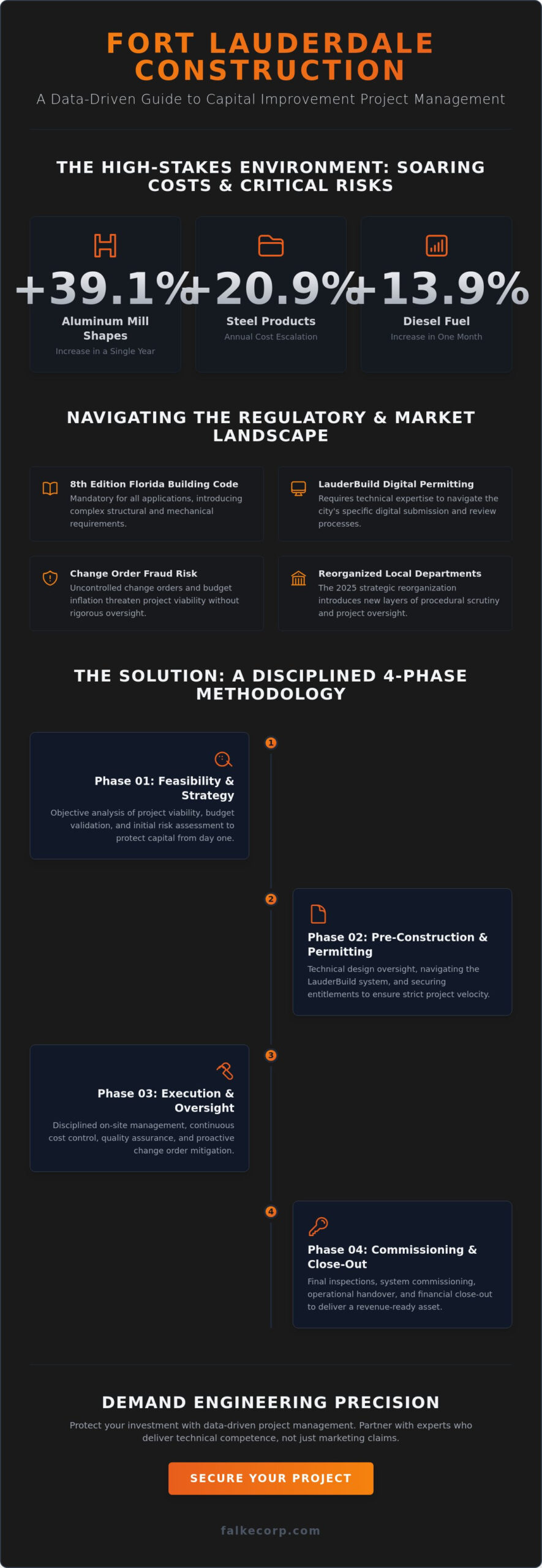
With aluminum mill shapes rising by 39.1% and steel products increasing by 20.9% within a single year, the margin for error in South Florida construction is non-existent. You likely recognize that capital improvement project management Fort Lauderdale requires a level of technical rigor and engineering precision usually reserved for public infrastructure. Managing a remote renovation in this climate means facing the risk of change order fraud and the complexity of the 8th Edition Florida Building Code without a constant physical presence on-site. It’s a high-stakes environment where architectural intent often clashes with local permitting realities and rising material costs.
This guide provides a disciplined, four-phase methodology designed to protect your capital and ensure project delivery through objective, data-driven oversight. You’ll learn how to secure a revenue-ready asset while maintaining complete financial transparency across all stakeholders. We’ll examine the specific requirements of the LauderBuild digital permitting system, the nuances of the newly reorganized Fort Lauderdale Capital Projects Department, and the strategies necessary to meet stringent local resiliency standards without compromising your budget.
Key Takeaways
- Understand the technical distinction between private capital assets and public infrastructure within the specific regulatory environment of South Florida.
- Navigate the 2025 strategic reorganization of local departments and Broward County resiliency standards to maintain strict project velocity.
- Deploy a disciplined cost-control framework for capital improvement project management Fort Lauderdale to mitigate the risks of change order fraud and budget inflation.
- Implement a structured four-phase methodology that ensures project viability from initial feasibility through to final asset commissioning and close-out.
- Evaluate project management firms based on engineering precision and technical competence rather than superficial marketing claims.
What is Capital Improvement Project Management in Fort Lauderdale?
Capital improvement project management Fort Lauderdale is the disciplined, strategic oversight of large-scale construction, renovation, or infrastructure upgrades specifically engineered to enhance the long-term valuation of an asset. Within the South Florida market, this function serves as the technical bridge between an owner’s financial objectives and the complex mechanical, structural, and regulatory requirements of the local building environment. It’s not merely a supervisory role; it’s a rigorous process of risk mitigation that ensures every dollar of capital is deployed with engineering precision. For private owners, this means navigating a landscape where material volatility and labor scarcity can instantly erode projected returns without professional intervention.
The 2026 market dynamics in Broward County have fundamentally shifted the requirements for successful project delivery. With aluminum mill shapes rising by 39.1% and steel products increasing by 20.9% over the past twelve months, the necessity for professional owner representation has moved from a luxury to a technical requirement. Owners in the hospitality, luxury retail, and high-density residential sectors are currently facing a dual challenge: maintaining the competitive edge of their assets while managing the highest construction costs in recent history. Effective Capital Improvement Plan (CIP) execution requires a deep understanding of these economic variables to prevent budget drift before the first permit is even issued.
Public vs. Private CIP Initiatives
There’s a critical distinction between the City of Fort Lauderdale’s public Community Investment Plan and private capital developments. The city’s current $200 million Parks Bond initiative, while beneficial for local infrastructure, creates significant competition for top-tier construction labor and equipment. Private developers must account for this resource drain during their pre-construction planning. Aligning private development goals with the city’s strategic priorities, such as stormwater resiliency or streetscape improvements, can often lead to more predictable entitlement outcomes and streamlined reviews through the LauderBuild system. Whether the scope involves complex tenant improvements or ground-up commercial builds, the methodology remains the same: technical compliance must match financial discipline.
The Economic Impact of Capital Projects in Broward County
Current trends in real estate development management services show a marked focus on asset lifecycle extension. In the Florida hospitality market, where the 8th Edition of the Florida Building Code now dictates all permit applications, capital improvements are the primary vehicle for maintaining market relevance against newer inventory. The rapid escalation of diesel fuel costs, which saw a 13.9% increase in February 2026 alone, directly impacts the logistics of every local project. Professional management ensures these logistical pressures don’t translate into uncontrolled change orders or schedule delays. Professional owner representation provides the technical shield necessary to convert volatile construction inputs into a predictable, high-yield physical asset.
Navigating Fort Lauderdale’s Regulatory and Resiliency Landscape
The regulatory framework in Fort Lauderdale is currently undergoing a significant transition following the 2025 strategic reorganization of the city’s internal departments. This structural shift aims to strengthen community resilience by centralizing infrastructure oversight, but for private owners, it introduces new layers of procedural scrutiny. Success in capital improvement project management Fort Lauderdale requires more than just following a standard checklist. It demands an engineering-led understanding of how the 8th Edition of the Florida Building Code, mandatory for all applications since December 31, 2023, interacts with Broward County’s stringent environmental and drainage standards. Navigating these changes necessitates a technical partner who understands the internal logic of the Capital Projects Department and the Development Services Department.
Local expertise is mandatory when dealing with the specific administrative nuances of City Hall. For instance, any project with a job value of $2,500 or more in Broward County requires a recorded Notice of Commencement before the first inspection can occur. Failure to manage these seemingly minor procedural steps can halt a multimillion-dollar project’s momentum. Furthermore, the city’s reliance on the LauderBuild digital permitting system means that all documentation must be perfectly structured for electronic review. Errors in digital submittals often lead to avoidable plan review fees, currently charged at $60.00 per hour with a minimum charge for any revision to approved plans.
Permitting and Entitlements in South Florida
Accelerating the pre-construction phase in Broward and Miami-Dade counties requires a proactive approach to entitlement management. A common pitfall in Fort Lauderdale’s vertical infrastructure permitting is the failure to account for the 1.50% permit fee assessment on total construction costs, which can significantly alter initial pro forma projections if not budgeted with precision. For owners managing assets across the region, leveraging strategic pre-construction services in Miami and Fort Lauderdale ensures that entitlement risks are mitigated before capital is fully committed. This technical foresight prevents the friction often encountered during the transition from design to active construction.
Climate-Adaptive Construction Management
Resiliency in Fort Lauderdale is a structural mandate. Managing a capital project here involves integrating advanced flood mitigation and hurricane-ready specifications that exceed baseline requirements to ensure long-term asset viability. The construction phase in Florida’s climate presents unique technical challenges, particularly regarding high-moisture environments and the recent 13.9% rise in diesel fuel costs impacting site logistics. High-wind specifications must be calculated with engineering precision to withstand South Florida’s specific atmospheric pressures. Our development management services prioritize these technical requirements to prevent weather-related delays and protect the structural integrity of your investment.
Financial Control: Preventing Cost Overruns and Change Order Fraud
Financial integrity in capital improvement project management Fort Lauderdale is maintained through a rigorous, engineering-led audit of every line item rather than simple accounting oversight. In an environment where aluminum mill shapes have risen by 39.1% and steel products by 20.9% within a twelve-month period, owners cannot afford a passive approach to budget management. A disciplined cost-control framework begins with the establishment of a technical baseline that accounts for current market volatility and specific South Florida logistical pressures. This stewardship involves a continuous reconciliation of work-in-place against the approved schedule of values to ensure that capital is only deployed for verified progress.
Identifying red flags early is the only way to prevent change order fraud from impacting the bottom line. Fraud often manifests as subtle duplications of scope, front-loading of billings, or the submission of “unforeseen condition” claims for items that were clearly identified in the pre-construction surveys. We implement a system of transparent reporting and third-party vendor auditing that subjects every invoice to technical scrutiny. This process ensures that owners don’t pay for the same scope twice and that all material escalations are documented with verifiable mill certificates and shipping manifests rather than anecdotal claims of inflation.
The Owner’s Rep vs. General Contractor Conflict
An inherent conflict of interest exists when a General Contractor is tasked with auditing their own financial performance. A GC’s primary objective is the optimization of their own profit margin, which often creates an incentive to maximize change order volume. FALKE acts as the client’s strategic partner to provide an objective layer of financial control that a contractor cannot provide. Understanding the Owner’s Rep vs Project Manager: Key Differences in Florida is essential for owners who require a representative whose loyalty is tied strictly to the project’s fiscal health. This separation of duties is the most effective safeguard against budget drift in complex South Florida developments.
Strategic Bidding and Vendor Selection
Developing robust RFPs and RFQs tailored specifically to the Fort Lauderdale market is the foundation of a stable project. This involves more than just collecting quotes. It requires negotiating detailed task orders for professional consultants and architects to ensure there are no gaps in the technical documentation that contractors could later exploit. We focus on vetting vendors for their technical competence and their capacity to handle the specific hurricane-ready specifications required by local codes. Selecting a partner based solely on the lowest initial bid frequently results in the highest final cost due to inevitable claims and poor execution quality.
FALKE’s 4-Phase Methodology for Fort Lauderdale Projects
Successful capital improvement project management Fort Lauderdale relies on a repeatable, technical framework that eliminates the ambiguity often found in standard construction supervision. We utilize a disciplined four-phase methodology designed to move a project from a financial concept to a physical, revenue-generating asset without sacrificing quality or budget integrity. This process ensures that every decision is backed by engineering logic and market data rather than architectural preference alone. By maintaining a structured approach, we provide the stability necessary to navigate the volatility of the South Florida construction market.
Phase 1 focuses on Concept and Feasibility, where we validate the project’s viability against current Broward County benchmarks, such as the 5.4% industrial vacancy rate and rising asking rents. Phase 2 transitions into Pre-Construction, where we assemble the design team and coordinate entitlements through the LauderBuild system. Phase 3 involves rigorous Construction Phase Management, providing the oversight necessary to maintain the schedule despite the volatility of material costs. Finally, Phase 4 covers Commissioning and Close-out, ensuring all systems are fully operational and the asset is ready for occupancy and revenue generation.
Pre-Construction and Design Coordination
Managing the transition from architectural vision to constructible plans is the primary objective of design coordination. During the site feasibility study, we implement risk mitigation strategies that identify potential structural conflicts before they reach the field. This is particularly vital for retail or hospitality projects where specific operational requirements must be integrated into the mechanical, electrical, and plumbing designs during the earliest stages of pre-construction. We ensure that the design remains compliant with the 8th Edition of the Florida Building Code while preserving the owner’s original development goals.
Execution and Final Commissioning
Execution requires real-time field reporting to maintain quality control throughout the build. We move beyond the standard “punch list” by conducting a technical audit of every system to ensure it meets professional standards and resiliency mandates. For a deeper analysis of these procedures, refer to our guide on Construction Phase Management in Florida: The Owner’s Guide to Execution. This level of oversight ensures that the final delivery is not just complete, but fully optimized for its intended use. Secure the technical oversight your investment requires by partnering with our development management experts today.
Selecting a Capital Project Management Firm in Broward County
Selecting a partner for capital improvement project management Fort Lauderdale is a decision that dictates the structural and financial trajectory of your investment. In a market where construction costs for light industrial warehouses range between $130 to $185 per square foot for basic shell construction alone, the margin for administrative error is non-existent. High-net-worth individuals and corporate entities often find that large, multi-national firms lack the granular technical engagement required to manage the nuances of the South Florida ecosystem. A boutique consultancy offers a superior layer of protection because the senior technical experts who define the strategy are the same individuals overseeing the field execution. This ensures that the engineering logic established during pre-construction isn’t diluted by a disconnected project hierarchy.
Evaluating technical competence requires looking beyond polished marketing materials and focusing on a firm’s ability to manage complex, high-stakes developments. A strategic partner must demonstrate a deep understanding of the 8th Edition Florida Building Code and the specific administrative requirements of the LauderBuild digital portal. It’s about finding a representative who acts as a faithful steward of your capital, providing objective, data-driven reporting that allows you to make informed decisions without being physically present on-site. This local expertise is the only way to ensure your project remains a priority within the competitive Broward County labor market, where vacancy rates for industrial properties sat at 5.4% in early 2026.
The FALKE Advantage in South Florida
Our approach to development management is rooted in technical precision and professional humility. We’ve successfully guided complex, high-profile developments, such as the Prada Design District store, where architectural excellence had to be balanced with rigorous structural and mechanical requirements. Our commitment to professional and objective representation means we don’t just report on progress; we take full responsibility for the technical integrity of the final delivery. We ensure your asset is revenue-ready and meets the highest professional standards, protecting the interests of a global clientele who demand excellence without compromise.
Following the delivery of a revenue-ready asset, the final stage of any capital improvement involves the physical transition of personnel or inventory. For clients overseeing diverse portfolios across the state, partnering with specialized moving companies Pensacola FL ensures that the logistical phase of the project is executed with the same level of professional care and precision as the construction itself.
Initiating Your Capital Improvement Project
Preparing for your 2026 development plans requires a proactive assessment of current market conditions and regulatory hurdles. We offer a range of services tailored to your specific needs, from initial site feasibility retainers to full-phase construction management. A confidential consultation allows us to perform a technical audit of your project’s current status and define a clear path toward successful commissioning. You can request a professional project management consultation with FALKE Atlantic Corporation to begin securing the engineering-led oversight your capital deserves.
Maximizing the Structural and Financial Integrity of Your Portfolio
Success in the South Florida construction market is determined by the quality of oversight established before the first permit is issued. Navigating the technical complexities of the 8th Edition Florida Building Code and the city’s digital infrastructure requires a level of engineering precision that standard project management doesn’t provide. By implementing a disciplined 4-phase methodology, owners can mitigate the risks of material volatility and change order fraud while ensuring compliance with stringent resiliency standards. This structured approach is the only reliable way to transform a high-stakes development into a predictable, revenue-ready asset.
Effective capital improvement project management Fort Lauderdale demands a partner who understands the local ecosystem and maintains a proven track record with high-net-worth and luxury retail brands. We provide the objective representation necessary to protect your interests through every stage of the development lifecycle. Our team specializes in South Florida resiliency standards to ensure your portfolio remains competitive and operational for the long term. Secure your investment with FALKE Atlantic’s expert Owner Representation and gain the technical clarity your project requires. We look forward to engineering the success of your next Broward County development.
Frequently Asked Questions
What is the difference between a project manager and an owner’s representative in Fort Lauderdale?
An owner’s representative serves as a fiduciary proxy for the client, overseeing the entire asset lifecycle from feasibility to final commissioning. While a traditional project manager often focuses on the tactical execution of the construction contract, the representative manages all stakeholders, including architects and consultants, to align the project with the owner’s broader financial objectives. This role provides a layer of strategic oversight that protects the owner’s capital across all phases of development.
How much does capital improvement project management cost for commercial properties?
Management fees are typically structured as a percentage of the total construction cost or as a fixed monthly retainer based on the project’s complexity and duration. Per the current market data for Broward County, soft costs, which include professional management and design services, generally add between 15% and 20% to the total project budget. These fees are an investment in risk mitigation, designed to prevent the much higher costs associated with budget drift and schedule delays.
Do I need an owner’s rep if I already have an architect and a general contractor?
Yes, because neither the architect nor the general contractor is positioned to provide objective financial auditing of the entire project. The architect focuses on design intent, while the general contractor’s primary incentive is the optimization of their own profit margin. An owner’s representative provides the technical and financial oversight necessary to reconcile these competing interests, ensuring that the owner’s budget and schedule remain the primary priority throughout the build.
How does Fort Lauderdale’s resiliency infrastructure plan affect private construction?
The city’s 2026 Capital Improvement Program mandates higher standards for stormwater management and flood mitigation that private developments must incorporate into their structural designs. Private projects that fail to align with these community resilience goals often face increased scrutiny during the entitlement process. Integrating these standards early ensures that your asset remains compliant with the 8th Edition of the Florida Building Code and is protected against the long-term environmental risks of South Florida.
What are the most common causes of budget overruns in South Florida construction?
Budget overruns are primarily driven by extreme material volatility and inadequate pre-construction coordination. With aluminum mill shapes rising by 39.1% and steel products increasing by 20.9% in a single year, failing to secure pricing early can be catastrophic. Other factors include change order fraud and administrative delays, such as re-inspection fees that start at $65.00 per hour, which quickly accumulate if the technical execution isn’t managed with precision from the outset.
Can FALKE Atlantic manage remote renovations for out-of-state owners?
We specialize in providing the technical presence required for owners who cannot be on-site to manage the daily complexities of the South Florida market. We act as your local eyes and ears, providing data-driven reporting and rigorous field oversight to ensure your standards are met without compromise. This remote management capability is essential for protecting investments in the competitive Fort Lauderdale environment, where local regulatory knowledge is the only way to maintain project momentum.
What is included in the commissioning and close-out phase of a capital project?
This phase involves a final technical audit of all mechanical, electrical, and structural systems to ensure they function according to the design specifications. It includes the resolution of the punch list, the transfer of all warranties and operations manuals, and the final verification of compliance with the Florida Building Code. We ensure the asset is fully operational and revenue-ready before the final transition to the owner or property management team.
How does the four-phase methodology mitigate financial risk for project owners?
Our methodology validates the project’s technical and financial viability during the concept phase before significant capital is committed. By integrating capital improvement project management Fort Lauderdale at the earliest stage, we identify potential structural or regulatory conflicts that would otherwise lead to expensive field corrections. This disciplined approach provides a continuous loop of financial control and quality assurance that protects the owner’s ROI from feasibility through to close-out.