
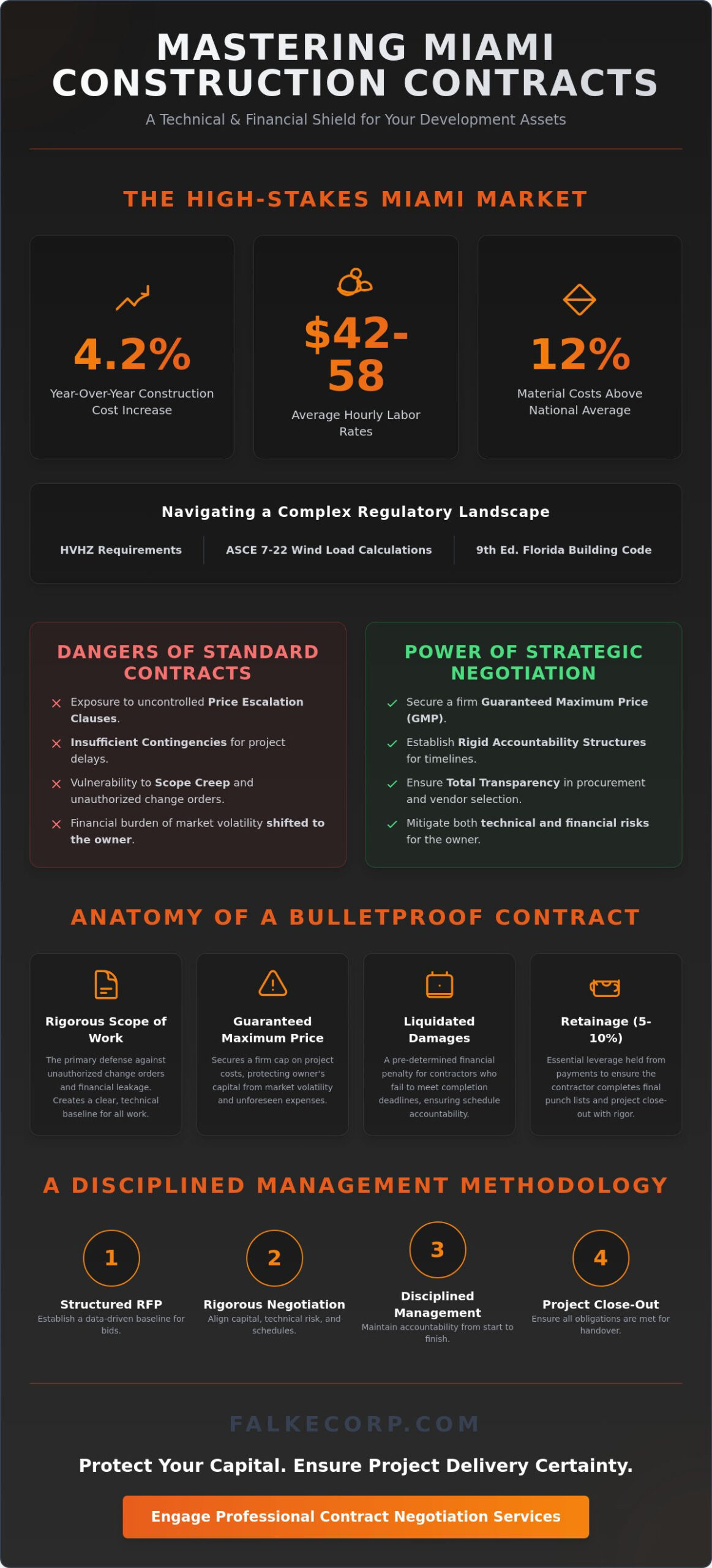
With Miami construction costs experiencing a 4.2% year-over-year increase as of early 2026, a single oversight in scope definition can jeopardize your entire project’s financial feasibility. You’ve likely realized that the South Florida market presents unique challenges, from High-Velocity Hurricane Zone (HVHZ) requirements to a labor market where rates now average between $42 and $58 per hour. Relying on standard, proprietary builder contracts often leaves owners exposed to price escalation clauses and insufficient delay contingencies that favor the contractor over the capital provider. Utilizing professional construction contract negotiation services Miami allows you to move beyond basic legal review into the realm of rigorous technical and financial risk mitigation. This guide will demonstrate how to secure a Guaranteed Maximum Price (GMP) that remains firm, establish rigid accountability structures for project timelines, and ensure total transparency in vendor selection and material procurement. By mastering these contractual nuances, you protect your capital and ensure that project delivery remains certain despite the evolving regulatory landscape and the technical demands of ASCE 7-22 wind load calculations. We’ll explore the strategic framework required to manage the complex transition into the 9th Edition of the Florida Building Code while maintaining complete control over your development assets.
Key Takeaways
- Effective contract negotiation in the South Florida market requires a precise alignment of capital, technical risk, and delivery schedules to counteract labor shortages and material price volatility.
- Rigorous scope definitions and the inclusion of specific “Must-Have” clauses serve as the primary defense against unauthorized change orders and financial leakage.
- Engaging professional construction contract negotiation services Miami provides the technical oversight necessary to identify scope creep that standard legal reviews often overlook.
- A structured Request for Proposal (RFP) process is critical for establishing a data-driven baseline, ensuring transparency in vendor selection and material procurement.
- Adopting a disciplined, multi-phase management methodology acts as a strategic shield for the owner, maintaining accountability from initial pre-construction through project close-out.
The High Stakes of Construction Contract Negotiation in Miami
Effective construction contract negotiation isn’t merely a legal formality; it’s a rigorous technical alignment of capital, risk, and schedule. In the South Florida market, where construction costs have seen a 4.2% year-over-year increase as of early 2026, the margin for error has narrowed significantly. A Construction contract must serve as a precise instrument that dictates how a project absorbs market shocks while maintaining the owner’s financial objectives. Utilizing specialized construction contract negotiation services Miami ensures that the agreement moves beyond the vague language found in standard AIA documents to address the specific volatility of the local landscape.
Standard form contracts often fail to account for the disconnect between legal theory and job site reality. While a lawyer ensures that the terms are enforceable, an Owner’s Representative ensures that the technical scope is accurate and that the contractor’s obligations are measurable. This professional oversight is essential for luxury and commercial assets where labor shortages drive rates to between $42 and $58 per hour. Without a disciplined negotiation phase, owners frequently find themselves trapped by “Standard Form” agreements that inadvertently shift the burden of supply chain flux and labor scarcity entirely onto the developer’s balance sheet.
Market Volatility and Escalation Clauses
Miami’s material costs currently sit approximately 12% above the national average. This discrepancy makes the negotiation of escalation clauses a critical focal point for any 2026 project budget. We analyze these clauses to ensure they don’t provide a blank check for price increases. In a volatile market, the choice between a fixed-price and a cost-plus contract determines who carries the weight of unforeseen spikes. We advocate for structures that provide transparency in vendor selection, ensuring that any cost-plus arrangement is backed by rigorous auditing and competitive bidding requirements during the pre-construction phase.
The Regulatory Landscape of South Florida
The technical specifications of a Miami contract must integrate the upcoming 9th Edition of the Florida Building Code, which takes effect on December 31, 2026. This update mandates the adoption of ASCE 7-22 for wind load calculations, a change that directly impacts material selection and structural design costs. Furthermore, contracts must account for local permitting timelines in municipalities like North Bay Village or Coral Gables, where delays can derail a project’s critical path. We ensure that hurricane-season contingencies aren’t just mentioned but are structurally integrated into the project schedule, defining clear accountability for weather-related delays and site stabilization costs.
Core Technical Components of a Robust Construction Contract
Technical precision within the contractual framework is the only reliable method for preventing financial leakage in high-value Miami developments. A robust agreement must move beyond generalities to include specific “Must-Have” clauses that address the regional complexities of South Florida. Effective construction contract negotiation services Miami ensure that the “Scope of Work” is not a mere summary but an exhaustive technical index. This level of detail is the primary defense against change order fraud, as it establishes a clear baseline that prevents contractors from claiming “unforeseen” tasks that were logically part of the original project intent.
Accountability is further reinforced through the strategic application of liquidated damages and retainage. Liquidated damages provide a pre-determined compensatory mechanism for the owner if the contractor fails to meet the substantial completion date, bypassing the need to prove actual damages in court. Simultaneously, the retainage mechanism—typically held at 5% to 10% of each progress payment—serves as essential leverage. It ensures that the contractor remains motivated to complete the punch list and final commissioning with the same rigor applied to the initial structural phases.
Guaranteed Maximum Price (GMP) vs. Lump Sum
For sophisticated owners in the Miami market, the Guaranteed Maximum Price (GMP) structure is often superior to a traditional lump sum agreement. The GMP model utilizes “Open Book” accounting, allowing the owner to verify actual costs for labor and materials. This transparency is vital when navigating the technical standards of Contracting by Negotiation, where the goal is to achieve best-value tradeoffs. We focus heavily on negotiating the “Contractor’s Contingency,” ensuring this fund is reserved for genuine project unknowns rather than serving as a hidden profit center for the general contractor.
Milestone-Based Payment Schedules
Payments must align with verifiable technical progress rather than arbitrary calendar dates. This structure requires a disciplined approach to construction phase management in Florida to validate that each milestone—such as the completion of the 160 mph impact-resistant envelope—has been met according to the approved specifications. Each payment application must be accompanied by unconditional lien waivers and updated insurance certificates to protect the owner from third-party claims. By tying capital release to physical reality, the owner maintains a position of strength throughout the project lifecycle.
Owner’s Rep vs. Legal Counsel: Why You Need Both
A legal-only approach to contract formation often leaves critical technical vulnerabilities unaddressed. While legal counsel ensures that the contract is enforceable and that liability is appropriately allocated, they typically lack the engineering expertise to verify the technical accuracy of the contract exhibits. In contrast, comprehensive construction contract negotiation services Miami integrate technical representation to bridge the gap between the written law and the physical job site. FALKE Atlantic Corporation acts as the lead negotiator who provides the empirical data required for the lawyer’s defense, ensuring that the contractual language is rooted in the actual requirements of the development. This partnership ensures that the “Defense” provided by the legal team is supported by the “Data” generated through technical analysis.
The synergy between these two roles is vital for identifying “Technical Scope Creep.” A lawyer may confirm that a “Scope of Work” clause exists, but only a technical expert can determine if that scope is missing the specific structural reinforcements necessitated by the High-Velocity Hurricane Zone (HVHZ) standards. By merging legal drafting with technical feasibility studies, owners can prevent the contractor from exploiting vague specifications later in the project lifecycle. This dual-layered protection is the only way to ensure that the document signed in the boardroom remains viable once the first shovel hits the ground.
Technical Scope Verification
FALKE Atlantic Corporation conducts a meticulous review of architectural drawings and engineering specifications to ensure the contract reflects the actual build requirements. This process identifies missing details, such as specific waterproofing membranes or electrical load capacities, that frequently serve as the foundation for future change orders. Utilizing strategic pre-construction services in Miami during the negotiation phase allows owners to lock in technical details before a single dollar of capital is committed to mobilization. We ensure that every architectural intent is translated into a binding contractual obligation, leaving no room for the contractor to claim that a necessary component was outside the original scope.
The Financial Oversight Advantage
A significant portion of financial leakage occurs within the “General Conditions” and “General Requirements” sections of a contract. We negotiate these line items with precision to prevent fee stacking, where contractors might apply markups to already burdened costs or double-charge for supervisory personnel. Beyond simple fee structures, our oversight extends to vendor selection transparency and the procurement of contractor-purchased materials. Integrating real estate development management services ensures that the project’s pro-forma remains protected against the subtle erosion caused by unverified contractor claims and opaque procurement processes. This level of oversight ensures that the owner’s capital is utilized with maximum efficiency.
Negotiation Strategies for Miami Real Estate Assets
Strategic negotiation for Miami assets requires a methodical approach that prioritizes empirical data over intuition. High-end development managers employ a five-step framework consisting of RFP generation, competitive bidding, bid leveling, post-bid interviews, and final contract execution. By utilizing professional construction contract negotiation services Miami, owners can leverage the Request for Proposal (RFP) process to set a rigid baseline for all responses. This ensures that every contractor is evaluated against the same technical specifications, preventing the scope gaps that typically lead to cost overruns during the construction phase. The RFP serves as the owner’s primary instrument for dictating terms rather than reacting to contractor-provided templates.
The transition from receiving bids to solidifying terms happens during the Post-Bid Interview. This phase isn’t merely a price discussion; it’s a technical deep dive where the owner’s team verifies the contractor’s understanding of the project’s critical path. We use this time to solidify the transparency of vendor selection and to ensure that the contractor’s management team is technically capable of executing the specific requirements of the South Florida market. This disciplined approach ensures that the final agreement isn’t just a financial document but a comprehensive operational manual for the project’s success.
The Competitive Bidding Leverage
Leveraging competitive bidding data is essential for neutralizing the impact of Miami’s material costs, which currently sit 12% above the national average. We perform detailed “Apples-to-Apples” bid leveling to ensure that every line item, from structural steel to hurricane-impact glazing, is accounted for with technical precision. This process is designed to expose “Low-Ball” bids that often hide future change order risks by intentionally omitting complex technical requirements or underestimating labor hours. Using data from secondary bids allows the owner to negotiate more favorable terms with their preferred contractor without compromising on the project’s structural integrity or safety standards.
Negotiating for Quality and Commissioning
The negotiation of “Quality Control” (QC) and the “Commissioning and Close-out” phase is critical for ensuring a revenue-ready asset. We advocate for contract language that mandates specific testing protocols for the building envelope and mechanical systems before final payments are released. This includes defining the exact parameters for verifying that the structure meets the high-wind resistance standards required in Miami-Dade County. To understand how these negotiations integrate into the broader project lifecycle, owners should consult our strategic guide for owners, which details the transition from contract execution to physical delivery and final commissioning.
FALKE Atlantic Corporation’s Methodology: Disciplined Contract Management
FALKE Atlantic Corporation utilizes a disciplined, four-phase methodology designed to transform contract negotiation from a reactive exercise into a proactive shield for the owner. This systematic approach ensures that every technical specification and financial obligation is scrutinized before execution. During the high-pressure environment of South Florida development, our construction contract negotiation services Miami act as a stabilizing force; they prevent the erosion of project margins through unverified contractor claims. By establishing a framework of absolute transparency and rigorous financial control, FALKE Atlantic Corporation ensures that the owner’s capital remains protected against the inherent volatilities of the regional market. This methodology isn’t based on emotional persuasion but on the strength of technical competence and professional reliability.
The core of this approach lies in maintaining an unwavering focus on project stability. We don’t just negotiate terms; we build the operational infrastructure that governs the entire project lifecycle. This ensures that the technical and financial nuances mastered during the negotiation phase are actually enforced on the job site. By acting as a technical intermediary, FALKE Atlantic Corporation provides the level of expert oversight necessary to manage the most complex construction processes. This ensures that every partner in the development chain remains accountable to the owner’s original vision and budget.
Phase-Based Risk Mitigation
Contract negotiation doesn’t end when the ink dries; it transitions into a continuous process of contract administration. In the initial concept and pre-construction phases, FALKE Atlantic Corporation establishes the technical baseline that dictates every subsequent job site action. As the project moves into active construction, we perform the essential owner’s representative Miami duties required to verify that field execution aligns perfectly with the negotiated terms. This ongoing oversight prevents scope creep and ensures that the contractor’s performance remains compliant with the high-wind resistance and structural standards established during the initial negotiation phase. We bridge the gap between pre-construction promises and active phase reality through constant, data-driven monitoring.
Securing Your Investment in South Florida
The long-term return on investment for professional construction contract negotiation services Miami is realized through the avoidance of change order fraud and the successful delivery of a revenue-ready asset. For owners planning complex developments in Dade, Broward, or Palm Beach counties, the technical precision of the contract is the only safeguard against the rising costs of labor and materials. FALKE Atlantic Corporation remains committed to ensuring that every project phase, from initial procurement to final commissioning, is managed with the same level of professional rigor. We invite owners to discuss their upcoming South Florida developments to see how a disciplined contractual framework can secure their capital and ensure project delivery according to the highest professional standards.
Securing Long-Term Asset Value through Technical Precision
The successful delivery of luxury residential, hospitality, or high-stakes retail assets in South Florida depends on the rigorous alignment of technical specifications and financial risk mitigation. We’ve established that relying on standard legal reviews is insufficient when navigating Miami’s unique labor constraints and evolving building codes. By integrating professional construction contract negotiation services Miami, owners transform their agreements from mere legal documents into precise operational manuals that enforce accountability. This level of technical oversight ensures that a project’s pro-forma remains protected against the subtle erosion caused by unverified contractor claims and opaque procurement processes.
FALKE Atlantic’s disciplined four-phase methodology provides the stability required to manage complex development processes from initial concept through final commissioning. Our strategic presence across Miami-Dade, Broward, and Palm Beach counties ensures that your capital remains protected against market shocks and technical scope creep. We take full responsibility for the contractual integrity of your development, allowing you to focus on the broader strategic goals of your investment portfolio.
Secure Your Miami Development with Expert Owner Representation today to ensure your next project is built on a foundation of professional certainty and uncompromising quality. We’re ready to help you navigate the complexities of the South Florida market with confidence.
Frequently Asked Questions
What is the difference between an Owner’s Rep and a construction lawyer in contract negotiations?
An Owner’s Representative provides technical verification of the project scope and constructability, while a construction lawyer focuses on legal enforceability and the allocation of liability. Successful construction contract negotiation services Miami require both perspectives to ensure that the legal language is supported by empirical data from the field. This collaboration prevents technical omissions that a legal professional might not identify during a standard document review.
Why should I avoid using standard AIA contracts without professional modification in Miami?
Standard AIA contracts are generic templates that lack the specific technical protections required for the Miami-Dade High-Velocity Hurricane Zone. These forms often fail to address the 12% material cost premium in the local market or the rigorous requirements of the upcoming 9th Edition of the Florida Building Code. Professional modification is necessary to integrate precise escalation clauses and hurricane-season contingencies that protect the owner’s capital from regional volatility.
What are the most common change order traps in Miami construction projects?
The most frequent change order traps involve vague scope definitions and “unforeseen conditions” that a thorough pre-construction analysis should have identified. Contractors may exploit missing specifications in architectural drawings to claim additional costs for structural reinforcements or specialized glazing. By establishing an exhaustive technical index during the negotiation phase, owners can mitigate these claims and maintain the project’s original financial baseline.
How long does the construction contract negotiation process typically take in Florida?
The duration of the contract negotiation process in Florida typically ranges from four to eight weeks, depending on project complexity and the number of bidding entities. This timeline allows for a disciplined RFP process, detailed bid leveling, and post-bid interviews to solidify technical terms. Rushing this phase often results in contractual gaps that lead to significantly longer delays and higher costs during the active construction phase.
What is a ‘Guaranteed Maximum Price’ (GMP) and why is it beneficial for owners?
A Guaranteed Maximum Price is a contractual structure where the contractor is compensated for actual costs plus a fixed fee, up to a pre-defined ceiling. This model is beneficial because it utilizes “Open Book” accounting, which allows the owner to verify all expenditures for labor and materials. It shifts the risk of cost overruns to the contractor while ensuring that the owner only pays for the work actually performed.
Can an Owner’s Representative help with contractor selection and bidding in Miami-Dade?
An Owner’s Representative is essential for managing the contractor selection and bidding process to ensure technical alignment with the owner’s goals. They perform “Apples-to-Apples” bid leveling to ensure that every proposal is evaluated against identical technical standards. This oversight identifies “Low-Ball” bids that often hide future risks, ensuring that the selected contractor possesses the technical competence required for high-stakes South Florida developments.
How do I handle contract disputes if the negotiation phase didn’t cover a specific issue?
Disputes regarding issues not explicitly covered during negotiation are handled through the contract’s established dispute resolution framework, which typically mandates mediation or arbitration. If the negotiation phase was conducted with technical rigor, these instances are minimized by the presence of broad “intent” clauses. When gaps occur, the Owner’s Representative provides the technical documentation and job site data necessary to support the owner’s position during the resolution process.
What are ‘Liquidated Damages’ and how do they protect a project schedule?
Liquidated damages are pre-determined monetary amounts that the contractor must pay for every day the project exceeds the substantial completion date. They protect the project schedule by providing a clear financial consequence for delays, bypassing the need for the owner to prove actual damages in court. This mechanism ensures that the contractor remains focused on the critical path and the timely delivery of a revenue-ready asset.