
A multi-million dollar construction lawsuit is rarely the result of a single technical error. It’s the inevitable conclusion of systemic oversight and eroded transparency. In the high-stakes environment of South Florida, where Broward County multifamily construction inventory continues to expand, owners often find themselves trapped between uncontrolled change orders and weather-driven schedule slippage. You’ve likely felt the frustration of a General Contractor’s opaque reporting while the risk of a lien under Florida’s Chapter 713 looms over your capital investment. Utilizing professional construction dispute resolution services Fort Lauderdale isn’t just about damage control. It’s about re-establishing the technical and financial equilibrium of your project through expert oversight.
We understand that your primary objective is a recovered schedule and absolute fiscal clarity. This guide demonstrates how proactive Owner’s Representation functions as a critical mechanism for conflict mitigation, ensuring your development avoids the astronomical costs of the Florida court system. We’ll examine the technical frameworks of dispute resolution, the impact of the upcoming 9th Edition Florida Building Code, and the strategic implementation of rigorous oversight to protect your asset’s ROI. By prioritizing professional management over reactive litigation, you can secure the stability and quality your project requires.
Key Takeaways
- Identify the critical distinction between reactive legal ADR and proactive technical Owner’s Representation to protect your project’s capital.
- Recognize early-stage “pre-dispute” signals to mitigate risks before they necessitate formal intervention or impact the delivery schedule.
- Utilize expert construction dispute resolution services Fort Lauderdale to navigate local challenges like seasonal weather delays and South Florida quality control standards.
- Apply a disciplined strategic framework for project recovery, focusing on comprehensive audits and technical mediation to establish a transparent re-baseline.
- Leverage a structured four-phase management methodology to ensure continuous oversight and prevent conflicts from the pre-construction phase through final commissioning.
The Landscape of Construction Dispute Resolution in Fort Lauderdale
Construction dispute resolution represents a technical and legal spectrum designed to address conflicts arising from the execution of complex build contracts. In the specific context of South Florida, where over 8,831 multifamily units were under construction in Broward County as of mid-2025, the density of development creates a high-friction environment. Technical negotiation often serves as the first line of defense; however, when internal communications fail, formal Construction law mechanisms become necessary. While many firms focus solely on legal Alternative Dispute Resolution (ADR), professional construction dispute resolution services Fort Lauderdale prioritize technical Owner’s Representation. This distinction is critical. Legal ADR reacts to a breach that has already occurred, whereas an Owner’s Representative identifies the engineering and financial root causes before they escalate into an irreparable conflict.
The high-density development environment in Fort Lauderdale leads to frequent friction regarding scope and schedule. When a project involves significant capital, even minor delays in the supply chain or quality control oversights can spiral into multi-million dollar claims. A neutral third-party expert provides the necessary technical fidelity to interpret complex Florida construction contracts, ensuring that the owner’s interests remain protected against aggressive general contractor claims. This expert oversight establishes a baseline of transparency that is often missing in high-pressure South Florida developments.
Common Dispute Resolution Pathways in South Florida
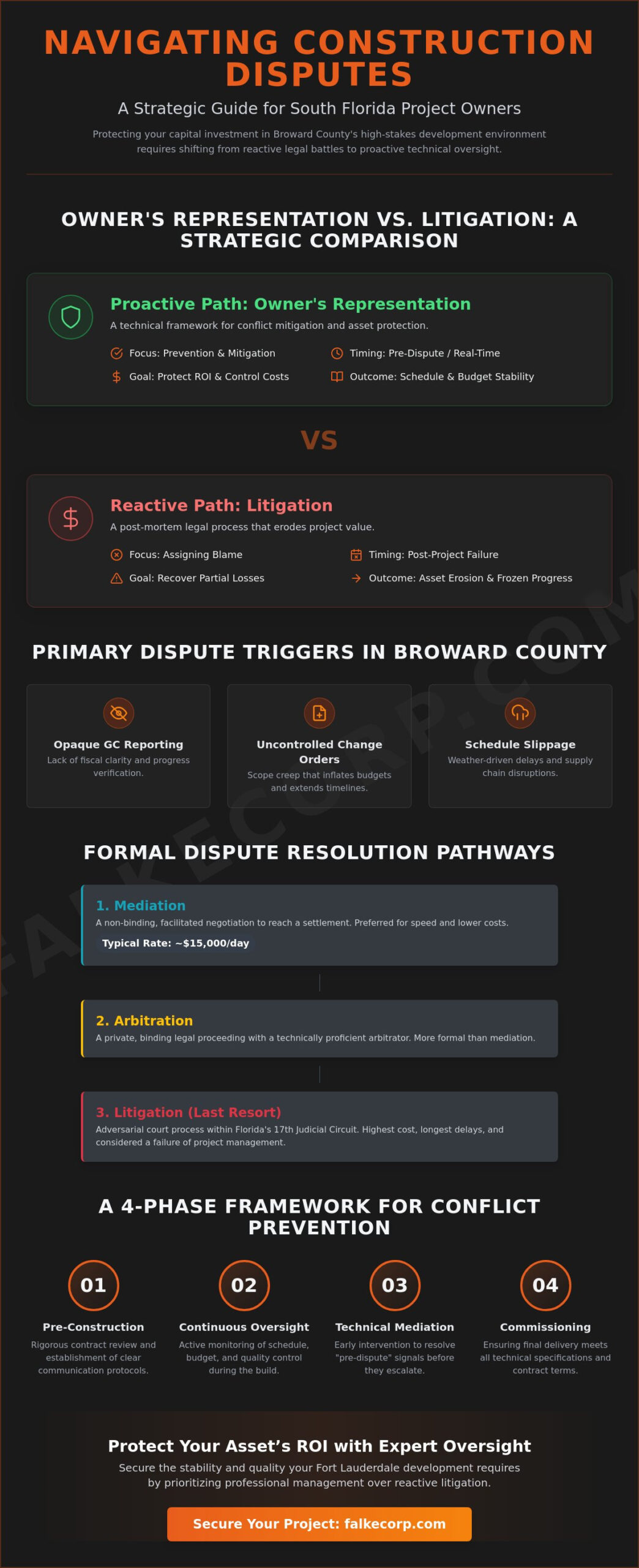
- Mediation: This is a non-binding process facilitated by a neutral professional. It aims to reach a settlement without the rigid structure of a courtroom. In 2026, daily mediation rates for complex construction cases can reach $15,000, reflecting the high value of the assets at stake.
- Arbitration: A private, binding legal proceeding. It’s often preferred for its confidentiality and the ability to select an arbitrator with specific technical expertise in South Florida building standards.
- Litigation: The traditional, adversarial path within the 17th Judicial Circuit of Florida. It’s the most resource-intensive method and is generally considered a failure of project management.
Why Traditional Litigation Often Fails the Owner
Traditional litigation is fundamentally reactive and often proves prohibitive for owners seeking to maintain their ROI. The cost of legal fees and expert testimony can quickly eclipse the value of the disputed work, particularly in projects where the margin for error is slim. Beyond the financial burden, court delays in Fort Lauderdale can freeze project progress for months or even years. This loss of momentum is catastrophic in a market where interest rates and material costs fluctuate rapidly. Furthermore, the risk of “lien-heavy” developments, governed by the strict requirements of Florida’s Chapter 713, means that unresolved disputes can cloud a property’s title, preventing necessary refinancing or sale. Integrated construction dispute resolution services Fort Lauderdale aim to resolve these technical impasses before they reach the steps of the courthouse.
Owner’s Representation vs. Litigation: A Strategic Comparison
Choosing between litigation and professional management is a choice between asset recovery and asset erosion. While traditional construction dispute resolution services Fort Lauderdale often focus on the legal aftermath of a project failure, Owner’s Representation prioritizes the technical prevention of that failure. Litigation is inherently reactive; it’s a post-mortem process that attempts to assign blame after the budget has been exhausted and the schedule has collapsed. By contrast, an Owner’s Representative functions as a technical sentinel. They identify “pre-dispute” signals, such as unverified change order requests, slow submittal responses, or minor deviations from the baseline schedule, before these issues necessitate legal intervention.
The ROI of proactive management is quantifiable. Industry data suggests that litigation and the resulting project stalls can impose a 20-30% premium on the total project cost. These expenses stem from legal fees, expert witness costs, and the “litigation tax” of halted production. While the American Arbitration Association’s construction dispute services provide a structured path for settling existing claims, technical competence in the field is more effective for resolving conflicts as they arise. A manager who understands the physics of a building and the mechanics of a schedule can settle a field-level dispute in hours, whereas a legal theory might take months to argue in a deposition.
The Financial Impact of Proactive Oversight
Financial stability begins long before the first shovel hits the ground. By implementing rigorous pre-construction services Miami, owners can eliminate the ambiguities that typically lead to change order friction. Proactive oversight reduces the “soft costs” that often go unrecovered in court: ballooning interest on construction loans, lost rental revenue, and the reputational damage associated with a stalled development. Owner’s Representatives utilize forensic budget audits to reconcile actual expenditures against contract values, resolving financial discrepancies through data-driven negotiation rather than judicial mandate. This level of professional project management ensures that every dollar spent is verified against work-in-place.
Technical Knowledge as a Settlement Lever
Technical knowledge provides the leverage required to debunk inflated delay claims from General Contractors. Through schedule forensics, an Owner’s Rep can distinguish between excusable delays, such as hurricane season requirements, and contractor-caused slippage. Verifying work-in-place allows for the immediate resolution of payment disputes, which often prevents the filing of mechanic’s liens under Florida’s Chapter 713. It’s essential to have a representative who speaks “contractor” and “lawyer” fluently. They must be able to argue the technical merits of a concrete pour while understanding the contractual implications of a notice of commencement. This dual-fluency allows for settlements based on engineering reality rather than legal posturing.
Primary Triggers for Construction Disputes in Broward County
Disputes in the South Florida market are rarely spontaneous; they’re the result of specific environmental and regulatory pressures that characterize Broward County development. Schedule volatility is perhaps the most frequent catalyst. Between June 1 and November 30, hurricane season requirements impose rigorous securing protocols and potential work stoppages that General Contractors often fail to account for in their baseline schedules. When these seasonal realities collide with rigid completion dates, the resulting delay claims require sophisticated construction dispute resolution services Fort Lauderdale to determine excusable versus non-excusable slippage through forensic schedule analysis.
Technological and quality control friction also plays a significant role in modern development. In the context of construction phase management Florida, disputes frequently emerge when field execution deviates from the approved design documents. This is particularly prevalent in high-value commercial and multifamily projects where the margin for error in structural integrity or waterproofing is non-existent. The 2026 market continues to experience fluctuations in material costs, which puts immense pressure on fixed-price contracts and often leads to aggressive attempts by contractors to recoup losses through obscure change order requests that lack technical justification.
Scope Creep and Change Order Fraud
Poorly defined initial project concepts serve as an invitation for scope creep. When the owner’s requirements are not technically codified during pre-construction, General Contractors may leverage these ambiguities to submit aggressive change order requests later in the cycle. Identifying “padded” or fraudulent change orders requires a granular line-item auditing process that compares requested costs against current market benchmarks. We implement a disciplined four-phase methodology to maintain absolute project transparency, ensuring that every modification is justified by a legitimate change in scope rather than a contractor’s attempt to inflate the budget. This structured oversight is a core component of effective construction dispute resolution services Fort Lauderdale.
Regulatory and Permitting Friction
The regulatory landscape in Fort Lauderdale is exceptionally demanding, especially with the 9th Edition of the Florida Building Code taking effect on December 31, 2026. This new code mandates strict adherence to updated wind-load standards and energy efficiency requirements. Disputes often arise when unapproved design deviations lead to failed inspections, causing significant bottlenecks within City of Fort Lauderdale and Broward County agencies. Navigating these complexities requires a representative who can facilitate communication between the design team and the General Contractor during the entitlement phase. As noted by JAMS construction dispute resolution, neutral expertise is vital when resolving technical impasses related to code compliance and permitting delays, as these issues can otherwise result in prolonged and costly litigation if left unmanaged.
A Strategic Framework for Dispute Mitigation and Project Recovery
Fixing a failing project is a technical operation, not just a legal negotiation. When momentum stalls, owners must pivot from reactive frustration to a structured recovery framework. Professional construction dispute resolution services Fort Lauderdale provide the necessary distance and technical fidelity to salvage a development’s ROI through a disciplined, five-step process. This methodology moves beyond assigning blame; it focuses on the engineering and financial realities required to reach the certificate of occupancy.
- Step 1: Project Audit. A forensic reconciliation of the budget, schedule, and quality of work-in-place.
- Step 2: Technical Mediation. A neutral facilitation between the owner and the GC to establish a realistic technical re-baseline.
- Step 3: Financial Controls. The implementation of rigorous reporting structures to restore transparency to every dollar spent.
- Step 4: Recovery Plan. A formalized roadmap with fixed milestones and non-negotiable accountability for all parties.
- Step 5: Commissioning and Close-out. The final verification of all systems, securing of warranties, and execution of final lien waivers to clear the title.
The Audit: Identifying the Root Cause of the Conflict
The recovery process initiates with a forensic audit that reconciles the project’s financial standing with its physical progress. We meticulously review the “Schedule of Values” against the actual work performed on-site to identify discrepancies in billing or over-payment. Trust breakdowns often leave a paper trail; by analyzing communication logs and submittal histories, we determine exactly where the project’s management structure failed. We also evaluate the performance of third-party vendors and consultants. This ensures that every stakeholder is contributing to the recovery rather than hindering it with further technical errors or delays.
Re-Baselining the Project for Success
Establishing a new baseline requires a deep understanding of the local Fort Lauderdale labor market. We negotiate completion dates that reflect actual resource availability rather than optimistic projections that have already failed. To prevent future slippage, we implement a “Zero-Tolerance” change order policy for the project’s remaining phases. By integrating advanced Construction Project Management Florida tools, we provide owners with real-time tracking of every task. This technical oversight transforms a chaotic site into a predictable environment where progress is measured by data, not promises.
Restoring financial transparency is equally critical. We implement strict controls that require verified work-in-place documentation before any further funds are released. This prevents the contractor from using current project funds to cover losses elsewhere. If your project has deviated from its original objectives and is currently mired in conflict, our team at FALKE Atlantic Corporation can provide the technical leadership required to restore order and protect your investment through professional project management.
FALKE Atlantic Corporation: Expert Oversight for Complex Fort Lauderdale Developments
FALKE Atlantic Corporation operates as a specialized technical partner, ensuring the preservation of owner interests throughout the entire development lifecycle. Our approach moves beyond traditional project management by integrating deep engineering competence with rigorous financial oversight. We utilize a disciplined four-phase methodology that establishes a transparent baseline during the pre-construction phase, ensuring that potential conflicts are mitigated before they escalate into formal claims. This preventative stance is the defining feature of our construction dispute resolution services Fort Lauderdale, where we prioritize technical stability over reactive legal intervention.
The value of our technical oversight is particularly evident in high-stakes retail and hospitality developments. Managing projects like the Prada store in the Miami Design District requires a level of precision that standard general consultancies often lack. These developments demand absolute adherence to global brand standards and compressed delivery timelines. By providing expert Owner’s Representative Miami services, we act as a technical buffer, ensuring that the complexities of South Florida’s building environment never compromise the owner’s strategic vision or the asset’s eventual revenue readiness.
Why Boutique Management Trumps Large-Scale Consultancy
Large-scale consultancies frequently delegate project recovery and dispute resolution to junior staff, which often results in a loss of technical fidelity. At FALKE Atlantic Corporation, we ensure direct principal involvement in every project recovery effort and dispute resolution process. This hands-on approach allows us to leverage deep local knowledge of the Fort Lauderdale and Miami-Dade construction ecosystems, which is vital for navigating regional labor dynamics and specific coastal building codes. Our focus remains on delivering revenue-ready assets; we manage the physical and financial completion of the building to ensure it meets the highest professional standards.
Your Strategic Partner in South Florida Construction
High-net-worth individuals and corporate entities require a level of financial control and transparency that traditional general contracting often fails to provide. We provide this stability by acting as a technical shield between the owner and the inherent chaos of the job site. This role involves the meticulous verification of every payment application, the forensic analysis of every schedule update, and the uncompromising enforcement of quality control protocols. By maintaining this level of rigorous oversight, we eliminate the ambiguities that typically lead to contractor friction and project stalls. FALKE Atlantic Corporation remains unyielding in its commitment to protecting client capital through expert technical oversight and disciplined process management.
Securing Your Capital Investment Through Technical Oversight
Navigating the complexities of Broward County development requires a fundamental shift from reactive legal strategies to disciplined technical management. The most effective construction dispute resolution services Fort Lauderdale are those that prioritize the early detection of “pre-dispute” signals and the rigorous enforcement of contract compliance. By implementing a structured recovery framework, owners can reclaim control over stalled schedules and opaque budgets, ensuring that their assets reach completion without the erosion of capital typically caused by prolonged litigation. Asset stability is achieved through engineering reality, not just legal theory.
FALKE Atlantic Corporation remains a specialist in project recovery and financial control, utilizing a disciplined Four-Phase Methodology to protect high-stakes investments. Our experience with premier luxury brands, including the Prada Design District project, demonstrates our ability to maintain quality and stability in the most demanding South Florida environments. Whether you’re facing permitting bottlenecks or contractor friction, we provide the technical shield necessary to secure your project’s future. Request a Strategic Consultation for Your Fort Lauderdale Project and ensure your development remains on a path toward successful delivery. Your vision deserves the protection of uncompromising professional expertise.
Frequently Asked Questions
What is the difference between an Owner’s Rep and a construction lawyer?
An Owner’s Representative provides technical oversight and field-level management, whereas a construction lawyer focuses on legal theory and contract litigation. While a lawyer reacts to a breach of contract after it occurs, an Owner’s Rep identifies technical friction points before they escalate into legal battles. This proactive approach is a core element of construction dispute resolution services Fort Lauderdale, ensuring that the project remains physically and financially viable through engineering reality rather than just legal posturing.
How long does a typical construction dispute take to resolve in Fort Lauderdale?
Resolution timelines depend entirely on the chosen method; litigation in the 17th Judicial Circuit can often span two to four years. Technical resolution through professional management typically concludes in a matter of weeks or months. By conducting a forensic audit and establishing a technical re-baseline, owners can bypass the procedural delays inherent in the Florida court system and return the project to a productive schedule.
Can an Owner’s Representative help if a mechanic’s lien has already been filed?
Yes, an Owner’s Representative assists by verifying work-in-place to determine if the lien accurately reflects the value of the completed work. Under Florida’s Chapter 713, strict technical requirements and deadlines apply to lien filings. We use technical forensics to challenge “padded” claims, providing the data necessary to resolve the dispute or support a legal defense against an invalid or exaggerated lien.
What are the most common causes of construction delays in South Florida?
Primary delays in South Florida include hurricane season protocols, permitting bottlenecks within Broward County agencies, and labor shortages in the high-density multifamily sector. The transition to the 9th Edition Florida Building Code on December 31, 2026, is also expected to introduce new compliance hurdles. Professional management accounts for these regional variables during the initial scheduling phase to mitigate risk before work begins.
How does FALKE Atlantic handle change order disputes?
FALKE Atlantic manages change order disputes through a granular line-item auditing process that compares requested costs against current market benchmarks. We verify every request against the original contract scope to ensure the work isn’t already covered. This technical verification prevents aggressive “scope creep” and ensures that owners only pay for legitimate, un-contracted modifications that add actual value to the asset.
Is mediation required before I can sue a contractor in Florida?
Florida courts often mandate mediation as a prerequisite for trial in construction litigation cases. Many standard industry contracts also include specific clauses requiring Alternative Dispute Resolution (ADR) before any formal legal action can be taken. Engaging construction dispute resolution services Fort Lauderdale early can often satisfy these requirements while achieving a technical settlement that avoids the adversarial and costly court process.
What is project recovery and when should I consider it?
Project recovery is a specialized management intervention designed to restore a stalled or failing development to its original financial and schedule objectives. You should consider this service when schedule slippage becomes critical, trust with the General Contractor has eroded, or financial transparency is lost. It involves a comprehensive project audit followed by a technical re-baseline to secure the project’s successful completion.
How can I prevent construction disputes from starting in the pre-construction phase?
Prevention begins with rigorous pre-construction services that eliminate technical ambiguities in the design and contract documents. Establishing clear financial controls and a “Zero-Tolerance” change order policy during the planning phase creates a transparent environment for all stakeholders. This structured approach ensures that the project’s technical and financial foundations are logically sound before any field work commences.