
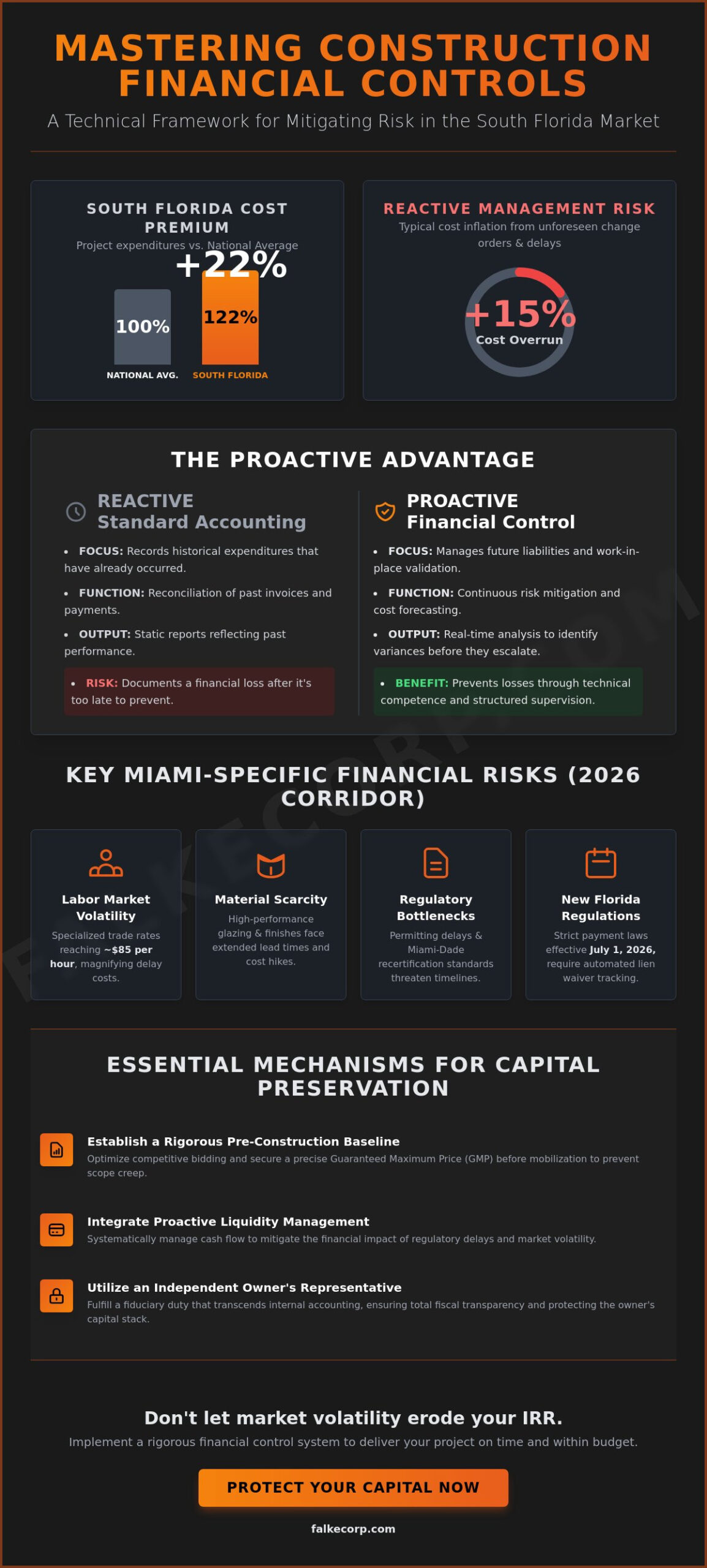
The 22% premium currently observed in South Florida project expenditures represents more than a regional cost variance; it is a systemic risk that necessitates a rigorous engineering approach to capital preservation. For owners developing in the 2026 corridor, implementing sophisticated construction project financial controls Miami is the only viable method to mitigate the 15% cost inflation typically associated with reactive management. You likely recognize that unforeseen change orders and the interest carry from permitting delays are not just inconveniences but direct threats to your internal rate of return.
This guide provides the technical framework required to master the financial oversight mechanisms that protect your capital and ensure total transparency. You’ll gain the expertise to navigate the new Florida payment regulations effective July 1, 2026, while protecting your project from change order fraud. We’ll examine how transitioning from static historical estimates to dynamic, real-time financial modeling delivers a revenue-ready asset that remains strictly within its fiscal parameters.
Key Takeaways
- Identify the technical mechanisms required to navigate the high volatility of the South Florida labor and materials market through a structured system of checks and balances.
- Implement sophisticated construction project financial controls Miami to achieve total fiscal transparency and protect capital against the 15% cost increases typical of reactive management.
- Establish a rigorous pre-construction financial baseline to optimize competitive bidding and secure a precise Guaranteed Maximum Price (GMP) before site mobilization.
- Mitigate the impact of localized regulatory bottlenecks and Miami-Dade recertification standards by integrating proactive liquidity management into the project schedule.
- Understand the strategic advantage of an independent owner’s representative in fulfilling a fiduciary duty that transcends traditional internal accounting roles.
Navigating Financial Complexity in the Miami Construction Market
Construction project financial controls Miami represent a rigorous engineering discipline rather than a simple administrative task. In the South Florida market, where project expenditures frequently exceed national averages by 18% to 22%, these controls serve as a critical system of checks and balances designed to preserve the owner’s capital stack. Unlike traditional accounting, which records historical expenditures, financial control involves the systematic management of future liabilities and the continuous validation of work-in-place. This proactive approach is essential for maintaining the integrity of a project financing structure, ensuring that every dollar deployed contributes directly to the asset’s value.
Primary leakage points in large-scale Miami developments often stem from unmanaged change orders and interest carry resulting from regulatory bottlenecks. Without a dedicated oversight mechanism, these inefficiencies can lead to a 15% increase in total project costs. The volatility of the local labor market, where specialized trade rates have reached approximately $85 per hour, means that even minor delays translate into significant fiscal erosion. Owners who rely solely on static reports find themselves in a reactive posture, unable to pivot when material scarcities or permitting delays disrupt the baseline budget.
The Distinction Between Accounting and Financial Control
Standard accounting software lacks the granularity required for complex development oversight because it’s built for reconciliation, not risk mitigation. It records what has already been spent, but it doesn’t forecast the cost-to-complete with technical precision. You shouldn’t view your general contractor’s monthly report as an independent audit; it’s a reflection of their internal ledger, not necessarily a transparent view of project health. True financial control requires a real-time analysis that identifies budget variances before they become irreversible. It’s the difference between documenting a loss and preventing one through technical competence and structured supervision.
Miami-Specific Financial Risks in 2026
The Miami corridor faces unique pressures in 2026. A 4.8% increase in luxury retail and hospitality projects has triggered a localized scarcity of high-performance glazing and architectural finishes. This scarcity drives up procurement costs and extends lead times, impacting your interest carry. Additionally, the new Florida payment regulations effective July 1, 2026, impose strict penalties for non-payment to subcontractors, making automated lien waiver tracking a financial necessity rather than an option. Aggressive vendor management and a deep understanding of South Florida’s climate-driven insurance premiums are required to insulate the contingency fund from these external market shocks. By establishing these controls early, you ensure the delivery of a revenue-ready asset that respects the original fiscal mandate.
Essential Financial Control Mechanisms for Owners
Rigorous construction project financial controls Miami require more than just a passive review of monthly invoices. They demand a structured Project Management Information System (PMIS) that integrates all fiscal data into a single source of truth. This prevents the fragmentation of information that often leads to double-payments or overlooked liabilities. By standardizing the Schedule of Values (SOV) across all major trades, you ensure that every line item is measurable and verifiable. This level of technical precision allows for the early detection of budget variances, providing the lead time necessary to implement corrective measures before the capital stack is compromised.
Implementing automated lien waiver tracking is a critical component of this framework. With the new Florida regulations taking effect on July 1, 2026, which impose criminal penalties for non-payment to subcontractors after 45 days, owners must have absolute certainty that funds are reaching the intended parties. An automated system ensures that no payment is released without a corresponding, verified waiver. This protects the asset from title encumbrances and ensures compliance with the increased $5,000 threshold for the notice of commencement requirements.
Change Order Discipline and Scope Creep Prevention
Scope creep remains the primary driver of budget erosion in South Florida. A rigorous protocol distinguishes between field directives, which are immediate technical adjustments, and contractual changes that alter the project’s scope. Every proposed change must undergo a formal approval hierarchy before work commences. This ensures that the project contingency budget is adjusted in real-time. It’s vital to link these changes to the cost-to-complete forecast immediately, ensuring the owner maintains a clear view of the final financial outcome at every stage of the build.
Cash Flow Forecasting and Requisition Audits
Requisition audits serve as the cornerstone of fiscal transparency. During “pencil pull” meetings, your team must physically verify the percentage-of-completion against the contractor’s billing. This prevents front-loading, where contractors bill for more work than has been performed. Verifying material-on-hand versus billed amounts ensures that your capital isn’t being used to finance the contractor’s other obligations. For developers seeking to maintain this level of oversight, engaging professional construction phase management services ensures that every requisition is audited with technical competence. Maintaining appropriate retainage until final commissioning provides the necessary leverage to guarantee a successful project close-out.
Implementing a Proactive Four-Phase Financial Strategy
Executing a development in South Florida requires a transition from reactive accounting to a methodical, phase-based oversight system. By integrating construction project financial controls Miami into every stage of the project lifecycle, owners can insulate their capital from the inherent volatility of the 2026 market. This structured approach ensures that fiscal transparency isn’t merely a reporting requirement but a proactive management discipline. Each phase serves as a gate, preventing cost overruns from cascading into subsequent stages of the build.
The procurement phase specifically addresses the “Miami premium,” where project expenditures often exceed national averages by up to 22%. Through competitive bidding and the optimization of contract terms, owners can lock in pricing for specialized materials, such as high-performance glazing, which currently face localized scarcity. This phase also involves the rigorous vetting of subcontractor financial health to ensure compliance with the new Florida payment regulations effective July 1, 2026. By securing these commitments early, you establish a stable fiscal environment that protects the project’s internal rate of return.
The Pre-Construction Baseline
Establishing an accurate financial baseline is the most critical step in capital preservation. It’s a verified industry fact that approximately 80% of a project’s financial commitments are determined before construction begins. Utilizing strategic pre-construction services in Miami allows owners to develop a realistic budget that accounts for local permitting bottlenecks and the revised building fee schedules implemented in late 2025. A technical baseline must distinguish between the owner’s contingency for scope changes and the contractor’s contingency for trade-specific risks, ensuring that the Guaranteed Maximum Price (GMP) remains a firm ceiling rather than a moving target.
Construction Phase Execution and Auditing
During the execution phase, the focus shifts to field-to-office audits that verify the technical accuracy of every draw request. This involves the independent verification of labor hours, which for specialized trades in Miami now reach $85 per hour, and the continuous monitoring of equipment usage. Effective construction phase management in Florida requires monthly financial reporting that speaks directly to the owner’s ROI, rather than just the contractor’s progress. These audits ensure that the project maintains its liquidity and that the final transition to close-out—including the release of retainage and the verification of warranty bonds—proceeds without the encumbrance of unresolved financial disputes.
Local Miami Regulatory Impacts on Project Liquidity
Navigating the regulatory landscape of South Florida requires a granular understanding of how municipal mandates influence project liquidity. Beyond the direct costs of construction, owners must account for the fiscal impact of Miami-Dade’s revised building fee schedule, which, as of October 2025, imposes a 1% fee on commercial projects up to $30 million. These structural costs, combined with the stringent requirements of the 40/50-year recertification standards, demand sophisticated construction project financial controls Miami to ensure that regulatory compliance doesn’t erode the development’s margin. Technical oversight is necessary to manage the capital stack against these localized pressures, where administrative delays translate directly into increased interest carry.
Sea Level Rise (SLR) regulations and high-velocity hurricane zone requirements have fundamentally altered structural engineering standards, driving up both initial capital expenditures and long-term insurance premiums. Managing the financial risk of hurricane-season-related work stoppages requires a robust contingency strategy that accounts for both demobilization costs and potential liquidated damages. By integrating these regional variables into the initial pro forma, owners can maintain the liquidity required to sustain the project through unpredictable environmental or administrative cycles.
Permitting and Entitlement Carry Costs
Stalled projects in high-growth areas like North Bay Village or the Design District incur substantial daily burn rates. With construction loan interest rates for professional builders ranging from 6.5% to 9.5% in early 2026, every week of administrative delay significantly increases the debt service. Utilizing professional real estate development management services allows for the acceleration of the entitlement process through technical coordination with municipal authorities. This proactive management is essential when budgeting for impact fees, which in Florida can add between $10,000 and $33,000 to the total cost of new construction depending on the specific county and municipality.
Insurance and Bonding in the Florida Climate
The hardening insurance market in South Florida necessitates a strategic approach to risk transfer and capital protection. Builder’s Risk insurance costs in Miami have maintained a consistent upward trajectory since 2024, reflecting the increased replacement value of specialized materials and heightened catastrophic risk modeling. Owners must distinguish between performance bonds, which guarantee the completion of the work according to the contract documents, and payment bonds, which protect the asset from subcontractor liens. For developers seeking to insulate their assets from these regional risks, engaging an expert in development management provides the structured oversight necessary to navigate Miami’s complex regulatory and insurance environment without compromising the project’s fiscal health.
The Role of Owner’s Representation in Safeguarding Capital
The deployment of capital in the South Florida market requires more than traditional accounting; it necessitates a specialized technical authority capable of enforcing construction project financial controls Miami with surgical precision. While an internal accountant manages the ledger, they often lack the engineering background to challenge a general contractor’s percentage-of-completion claims or to identify the subtle front-loading of a Schedule of Values. An independent representative provides a higher return on investment by identifying these fiscal irregularities early. This professional maintains a strict fiduciary duty to the owner, ensuring that every requisition is verified against physical work-in-place before funds are released from the capital stack.
Bridging the communication gap between the design team, the general contractor, and the lender is a primary function of this role. Lenders in the 2026 market, facing interest rates as high as 9.5% for professional builders, require absolute transparency and technical validation of all draws. The representative acts as the central coordinator, ensuring that the design intent remains within the budget and that the contractor’s performance aligns with the lender’s funding schedule. This coordination is vital during the final close-out phase, where the transition from a construction site to a revenue-ready asset depends on the meticulous reconciliation of all final accounts and warranty bonds.
Independent Oversight vs. Internal Management
Outsourcing fiscal supervision to a firm specializing in commercial project management in Miami significantly reduces the owner’s administrative overhead. Internal management teams are often stretched across multiple operational functions, which can lead to oversight fatigue during complex development cycles. FALKE Atlantic Corporation acts as a strategic financial partner, providing the unwavering trust and technical competence required to manage sophisticated budgets. By leveraging third-party expertise, owners ensure that the project benefits from specialized knowledge of local trade scarcity and regulatory bottlenecks without the long-term cost of a permanent internal department.
Securing Your Investment
The psychological and financial benefits of total transparency shouldn’t be underestimated when dealing with institutional investors or private equity partners. Providing detailed, audited reports that demonstrate a proactive approach to construction project financial controls Miami instills a level of confidence that often results in more favorable lending terms. This is particularly evident in luxury retail or hospitality developments, where architectural finishes and high-performance glazing lead to complex, volatile budgets. Protecting your interest from the initial concept through to final commissioning isn’t just a management preference; it’s a fundamental requirement for delivering a high-yield asset. For developers who prioritize fiscal integrity, engaging an owner’s representative in Miami is the final, essential step in securing the long-term success of their South Florida investment.
Advancing Toward Fiscal Integrity and Revenue-Readiness
The successful delivery of a high-value asset in South Florida depends on the transition from traditional bookkeeping to an engineering-based management discipline. Implementing rigorous construction project financial controls Miami ensures that your capital stack remains protected against the 22% cost premiums and regulatory complexities of the 2026 market. You’ve seen how a structured four-phase methodology and independent oversight can prevent the 15% budget erosion typically caused by reactive management. This technical approach isn’t just about recording expenses; it’s about the proactive preservation of your internal rate of return.
FALKE Atlantic Corporation provides the disciplined oversight required for high-net-worth and hospitality developments across the Miami-Dade and Broward corridors. Our team bridges the gap between technical execution and fiscal transparency, ensuring your project meets the highest professional standards. It’s time to elevate your development strategy with a partner who understands the nuance of the Florida regulatory landscape and the necessity of absolute precision. Secure your project’s financial future with FALKE Atlantic Corporation and ensure your investment transitions seamlessly from commissioning to a revenue-ready asset. Your vision deserves the stability of expert fiduciary management.
Frequently Asked Questions
What are the most common financial risks in Miami construction projects?
The primary financial risks involve unmanaged change orders and the substantial interest carry resulting from municipal permitting delays. In the South Florida market, project expenditures frequently exceed national averages by 18% to 22%, making any inefficiency in the capital stack particularly damaging. Owners also face significant risks from localized material scarcities and the volatility of specialized trade labor rates, which currently average $85 per hour in the Miami-Dade corridor.
How does an owner’s representative differ from a construction project controller?
An owner’s representative acts as a strategic technical fiduciary who manages the entire development lifecycle, whereas a controller typically focuses on internal accounting and reconciliation. While a controller records historical data, the representative implements construction project financial controls Miami to proactively mitigate risks before they impact the budget. This role bridges the gap between the design team, the general contractor, and the lender to ensure total fiscal transparency across all project phases.
What is the typical cost for professional financial oversight on a Miami development?
Professional oversight costs are generally structured as a percentage of the total construction value or a monthly fixed fee based on the project’s complexity and duration. These costs are often offset by the significant savings realized through reduced change orders and more efficient procurement strategies. It’s a technical investment that protects the owner’s capital from the 15% cost increases typically associated with reactive or unmanaged financial processes.
Can financial controls prevent change order fraud in South Florida?
Rigorous financial controls eliminate the opportunity for fraud by establishing a formal approval hierarchy and requiring independent field-to-office audits. By verifying physical work-in-place against the contractor’s draw request, owners ensure they only pay for completed, contractually compliant work. The implementation of automated lien waiver tracking further protects the project from the criminal penalties associated with the new Florida payment regulations effective July 1, 2026.
How do Miami-Dade permitting delays affect a project’s overall budget?
Permitting delays impact the budget primarily through increased debt service on construction loans, which currently feature interest rates ranging from 6.5% to 9.5%. A stalled project in North Bay Village or the Design District incurs a daily burn rate that can quickly erode the contingency fund. Additionally, the revised building fee schedule implemented in October 2025 means that administrative delays now occur within a more expensive regulatory environment, necessitating tighter liquidity management.
What software tools are best for construction financial control in 2026?
The most effective tools in 2026 are centralized Project Management Information Systems (PMIS) that offer dynamic, real-time cost-to-complete modeling. These systems move beyond static, historical spreadsheets to provide a transparent view of future liabilities and procurement risks. Integrating these tools allows owners to monitor the capital stack continuously and make data-driven decisions that reflect the current South Florida market conditions rather than outdated estimates.
Why is a Schedule of Values critical for owner transparency?
A detailed Schedule of Values (SOV) provides the technical breakdown necessary to prevent front-loading, where a contractor bills for more work than has been physically performed. It serves as the baseline for every requisition audit, allowing the owner’s team to verify the percentage-of-completion for each specific trade. This transparency ensures that the project’s cash flow remains aligned with actual progress, protecting the asset from overpayment and financial imbalance.
How does South Florida’s climate impact construction contingency planning?
The local climate necessitates a more robust contingency for hurricane demobilization, demobilization costs, and high-velocity hurricane zone engineering requirements. These environmental factors drive up insurance premiums and require specialized materials that often face procurement delays. Effective financial planning must account for these climate-driven soft costs to ensure the project remains viable through the unpredictable weather cycles inherent to the Miami and Fort Lauderdale regions.