
For a family office, a construction project is not merely a physical development; it’s a significant deployment of capital that requires the same level of fiduciary rigor as a private equity investment. Managing a capital-intensive project in a volatile market often leads to unforeseen complications. You likely recognize that a traditional reliance on a General Contractor’s reporting frequently fails to provide the transparency required to prevent uncontrolled change orders or mitigate the risks of vendor fraud. Effective construction project management for family offices Florida must transcend basic oversight to become a disciplined exercise in risk management and asset protection.
This guide provides a professional framework for maintaining total financial control and ensuring assets are delivered revenue-ready through the lens of owner’s representation. We’ll examine the technical implications of the upcoming 9th Edition of the Florida Building Code, the shortened seven-year statute of repose for design defects, and the structural protocols necessary to navigate complex South Florida permitting. By implementing a systematic approach to project oversight, your office can transform a high-risk construction venture into a predictable, high-performing asset.
Key Takeaways
- Understand the fundamental distinction between execution and oversight by utilizing professional construction project management for family offices Florida to protect generational wealth.
- Implement a structured four-phase development management lifecycle that validates investments from initial concept through to final commissioning and close-out.
- Establish rigorous fiduciary oversight to audit monthly pay applications and mitigate the financial risks associated with uncontrolled change orders and vendor fraud.
- Navigate the technical complexities of the South Florida regulatory environment, including stringent Miami-Dade permitting and the 9th Edition of the Florida Building Code.
- Ensure the delivery of revenue-ready assets by integrating technical competence with comprehensive process management across the entire project duration.
The Strategic Role of Owner’s Representation for Florida Family Offices
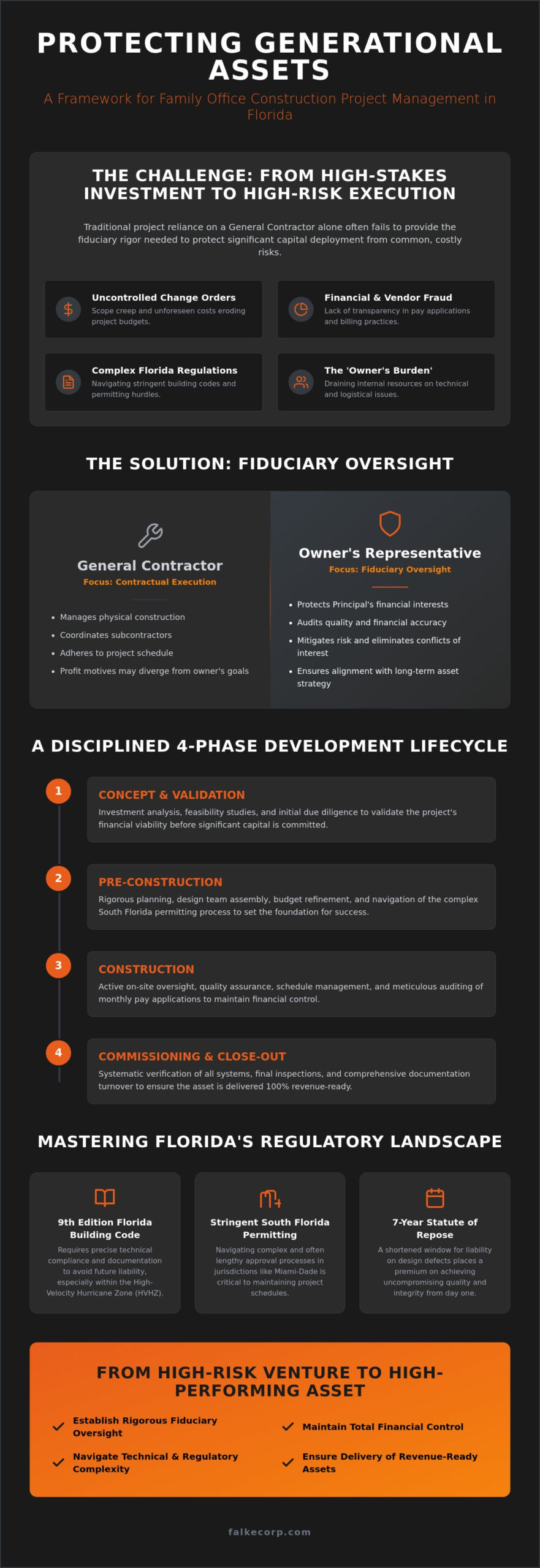
An Owner’s Representative serves as a specialized fiduciary extension of the family office staff, operating with the singular objective of protecting the principal’s interests. While a General Contractor focuses on the contractual execution of the build, the Owner’s Representative provides the essential layer of independent oversight. This distinction is critical in Construction project management because it separates the entity performing the physical work from the entity auditing its quality and financial accuracy. For family offices, this separation of duties is the first line of defense against capital mismanagement.
Florida’s construction market is notoriously volatile, characterized by shifting regulatory requirements and labor shortages. In this environment, relying solely on a General Contractor’s internal reporting creates a structural vulnerability. Professional construction project management for family offices Florida mitigates the ‘Owner’s Burden’ by handling technical disputes and logistical bottlenecks. This allows principals to remain focused on high-level investment strategies rather than site-level minutiae. By centralizing authority in a representative who understands the technical complexities of South Florida’s High-Velocity Hurricane Zone (HVHZ), the family office ensures that its standards are never compromised by the contractor’s operational pressures.
Fiduciary Duty vs. Contractual Execution
The primary value of an Owner’s Representative lies in the elimination of conflicts of interest. In multi-million dollar developments, a General Contractor’s profit motives may occasionally diverge from the owner’s long-term asset goals. A third-party representative ensures that every project decision, from material selection to schedule adjustments, aligns with the family’s broader financial strategy. This objective oversight isn’t just about cost-cutting. It’s about verifying that the technical integrity of the asset remains uncompromised throughout the construction lifecycle. When an Owner’s Rep manages the construction project management for family offices Florida, they act as a neutral arbiter, ensuring that quality isn’t sacrificed for the sake of the contractor’s convenience.
Addressing the ‘Special Project’ Complexity
Family office portfolios often include bespoke residential estates or niche commercial developments that demand a high degree of customization. These ‘special projects’ require seamless coordination between legal, tax, and construction teams to ensure compliance with complex holding structures. Managing these interdisciplinary requirements is a core component of Owner’s Representative Miami: Protecting Your Real Estate Assets in 2026. By centralizing communication, the representative ensures that technical execution never outpaces legal or financial planning. This is especially vital when navigating the 9th Edition of the Florida Building Code, where technical compliance must be documented with absolute precision to avoid future liability.
The ‘Owner’s Burden’ often manifests as a significant drain on internal family office resources. Without a dedicated technical lead, staff members find themselves interpreting complex change orders or navigating the nuances of Miami-Dade permitting without the necessary engineering background. A professional representative absorbs these complexities. They act as the primary point of contact, distilling technical data into actionable executive summaries. This structured approach ensures that the project progresses according to the predetermined milestones while maintaining the highest professional standards of transparency and accountability.
The Four-Phase Methodology for Construction Development Management
A structured methodology serves as the cornerstone of risk mitigation for high-net-worth investors. Professional construction project management for family offices Florida relies on a rigorous four-phase lifecycle: Concept, Pre-construction, Construction, and Commissioning. This phase-gate approach ensures that capital is never deployed without technical validation. Each stage acts as a mandatory checkpoint, transforming a traditionally chaotic building process into a series of logical, manageable milestones that protect the principal’s financial interests.
The process begins with initial concept and feasibility studies. This first phase is designed to validate the investment before significant resources are committed. We analyze site constraints, zoning entitlements, and preliminary cost estimates to ensure the project’s goals are realistic. By the time a project reaches the commissioning phase, the objective is to deliver a revenue-ready asset that meets every technical specification and quality standard defined at the outset.
Phase 1 & 2: Setting the Foundation for Success
Success in South Florida development is determined long before the first shovel hits the ground. During the concept and pre-construction phases, we focus on site selection and entitlement coordination in markets like Miami and Palm Beach. These regions present unique regulatory hurdles that require early intervention. Utilizing pre-construction services Miami is vital for preventing downstream budget overruns. This phase involves assembling the ‘A-Team’ by vetting architects and engineers through competitive bidding and rigorous qualification reviews.
A well-managed bidding process does more than just find the lowest price; it identifies the most capable partners for the specific asset class. We ensure that contracts are structured with clear performance metrics and transparency requirements. This proactive planning phase establishes the baseline for the entire project, allowing the family office to maintain control over the scope and budget before physical construction introduces higher levels of financial risk.
Phase 3 & 4: Execution and Delivery
Once the project moves into active construction, the focus shifts to site oversight and schedule adherence. Managing the day-to-day complexities of a Florida job site requires constant vigilance. The construction phase management Florida process involves auditing monthly pay applications, verifying lien waivers, and ensuring compliance with Florida’s environmental regulations regarding stormwater and site activity. This level of oversight prevents the common pitfalls of vendor fraud and technical negligence.
The final phase, commissioning and close-out, is where many projects lose momentum. We manage the transition from a construction site to an operational asset with meticulous attention to detail. This includes verifying that all mechanical systems are fully functional, obtaining the Certificate of Occupancy, and ensuring that the final punch list is completed to the highest standard. This disciplined execution ensures that construction project management for family offices Florida results in a property that is truly revenue-ready and operationally sound. For offices seeking to secure their next development, a consultation regarding development management can provide the necessary technical foundation.
Financial Stewardship: Cost Control and Change Order Mitigation
High-value development in South Florida demands a financial oversight structure that matches the sophistication of the family office’s other asset classes. Within the framework of construction project management for family offices Florida, cost control isn’t merely about budget tracking; it’s about the technical validation of every dollar spent. Since the median price per square foot for new construction in South Florida has risen by 41% since 2020, the financial margin for error has narrowed significantly. Professional stewardship requires a rigorous audit of monthly pay applications to ensure that the work billed has been physically completed to the specified standard.
This auditing process must include the systematic collection and verification of lien waivers. In Florida, construction lien laws are strictly enforced. Failure to secure proper waivers can lead to double payment or clouded titles. We also manage the financial implications of Florida’s environmental regulations for construction, where non-compliance can result in substantial fines that disrupt the project’s pro forma. By acting as a technical filter between the contractor’s accounting department and the family office, the representative ensures that disbursements are only made for verified progress.
Preventing Change Order Fraud
Change order fraud is the unauthorized inflation of project scope for financial gain. To mitigate this risk, we establish a strict protocol where every deviation from the original contract must be justified by a technical necessity and approved through a multi-stage authorization process. The Owner’s Representative acts as the final gatekeeper for these disbursements, preventing the “scope creep” that often plagues the luxury market. This disciplined approach ensures that the contingency fund is preserved for genuine emergencies rather than contractor inefficiencies.
Transparency and Reporting
Investment committees require clear, data-driven insights to make informed decisions. We standardize monthly reports to provide a comprehensive view of budget versus actuals, identifying potential variances before they become critical issues. This real-time tracking is a core element of Construction Project Management in Florida: A Strategic Guide for Owners. By maintaining this level of transparency, the family office can manage its cash flow requirements with precision, ensuring that the project remains a stable component of the broader portfolio.
Fee structures for these services typically fall into two categories: a percentage of the total construction cost or a fixed monthly retainer. While percentage-based fees are common, fixed retainers often align better with fiduciary interests by removing any incentive to increase the project budget. Regardless of the structure, the priority remains the delivery of a revenue-ready asset within the established financial parameters, protecting the principal’s capital from the volatility of the regional construction market.
Navigating Florida’s Local Regulatory and Environmental Landscape
Florida’s regulatory environment is a complex matrix of state statutes and municipal ordinances that demand technical foresight. For family offices, the stakes are elevated by the specific requirements of the High-Velocity Hurricane Zone (HVHZ), primarily affecting Miami-Dade and Broward counties. These jurisdictions impose the most stringent building standards in the United States. Professional construction project management for family offices Florida ensures that every technical detail, from roof-to-wall connections to impact-resistant glazing, meets the threshold for approval before the first inspection is scheduled. This level of coordination is essential to prevent the administrative bottlenecks that frequently stall large-scale developments.
The legislative landscape has shifted significantly to provide more predictability for owners. Under HB 267, local governments are now mandated to approve or deny complete permit applications within 30 business days for single-family homes under 7,500 square feet. For non-residential buildings under 25,000 square feet, the timeline is 60 business days. An Owner’s Representative leverages these “shot clock” provisions to maintain project momentum, ensuring that the municipality adheres to these statutory limits. This proactive management prevents the open-ended delays that historically plagued the South Florida market.
Permitting and Entitlements in South Florida
Navigating the building departments of Miami, Fort Lauderdale, or Palm Beach requires a disciplined approach to documentation. We manage the coordination of impact fees and environmental assessments, ensuring that all filings are accurate and complete. This is particularly critical as we approach the implementation of the 9th Edition of the Florida Building Code, which takes effect on December 31, 2026. All projects submitted after this date must comply with updated wind load requirements and enhanced flood protections. By integrating these future standards into the current design phase, we protect the asset from premature obsolescence and ensure long-term regulatory compliance.
Climate Risk and Hurricane Mitigation
Construction in Florida is inextricably linked to the Atlantic hurricane season, which runs from June 1 to November 30. Managing this risk requires a structured scheduling strategy that avoids exposing vulnerable phases of the build during peak storm activity. We prioritize the selection of materials designed for high-humidity environments to prevent moisture intrusion and structural degradation. This technical precision extends to navigating FEMA requirements and Coastal Construction Control Lines (CCCL), which dictate minimum floor elevations and the use of flood-resistant materials in Special Flood Hazard Areas. Ensuring these standards are met is the only way to guarantee that the asset remains resilient and insurable at competitive rates. To secure your portfolio against these regional complexities, professional owner’s representation provides the technical oversight necessary for successful project delivery.
Zoning codes in affluent South Florida neighborhoods often include specific landmark and historic preservation requirements. We coordinate with local boards to ensure that bespoke residential or commercial designs respect these neighborhood-specific constraints without compromising the principal’s vision. This requires a balanced approach where technical engineering meets aesthetic sensitivity. By centralizing this communication, the family office avoids the friction that often arises when design teams and local regulators have conflicting priorities.
FALKE Atlantic Corporation: Disciplined Management for Generational Assets
FALKE Atlantic Corporation operates as a boutique consultancy, providing the specialized oversight necessary to manage the capital-intensive developments of family offices. By prioritizing discretion and technical accuracy, we serve as the primary point of contact, shielding the principal from the operational friction inherent in the South Florida market. Our commitment to construction project management for family offices Florida is rooted in the belief that generational wealth requires a higher standard of fiduciary protection than traditional project management provides. This approach ensures that every decision aligns with the long-term preservation of the family’s capital and reputation.
The firm leverages a structured four-phase methodology to transform complex architectural visions into revenue-ready properties. This lifecycle, which spans from initial feasibility to final commissioning, is designed to eliminate the ambiguities that lead to budget overruns. Our experience across high-profile retail, hospitality, and bespoke residential developments allows us to anticipate the technical requirements of diverse asset classes. By maintaining a singular focus on the owner’s interests, we ensure that the project’s technical execution remains consistent with its financial pro forma.
Why Family Offices Choose FALKE Atlantic Corporation
Technical competence is the foundation of our service, yet it’s our coolly elegant professional tone that distinguishes our interactions with family office principals. We don’t rely on emotional persuasion; instead, we influence through the strength of technical data and professional reliability. This style reflects a deep respect for the precision required in modern development. Our commitment to transparency ensures that the family office investment committee receives objective, unvarnished reporting at every milestone. This level of rigor is especially evident in our work regarding commercial project management Miami, where we’ve established a proven track record of delivering quality excellence in one of the nation’s most demanding regulatory environments.
Next Steps for Your Florida Development
Initiating a partnership with FALKE Atlantic Corporation begins with a comprehensive feasibility study or a detailed audit of an existing project. This initial phase is critical for identifying latent risks in the design, permitting, or contractual structures. The onboarding process for new family office clients is designed to be seamless, integrating our technical leads with your existing legal and financial teams. This collaborative foundation ensures that our construction project management for family offices Florida provides immediate value, whether the asset is in the concept stage or already under construction.
We invite family office principals and directors to contact FALKE Atlantic Corporation for a strategic consultation. During this session, we’ll examine the specific requirements of your South Florida asset and outline how our four-phase methodology can mitigate your operational risks. Protecting a generational asset requires more than a contractor; it requires a fiduciary partner who understands that quality is not a variable, but a constant requirement. Our team is prepared to provide the technical oversight necessary to ensure your next development is delivered on time, on budget, and fully optimized for its intended use.
Securing Your Portfolio Through Technical Oversight
The successful delivery of a South Florida development depends on the integration of technical competence and disciplined process management. As we’ve explored, the distinction between contractual execution and fiduciary oversight is the primary factor in mitigating financial risk and operational volatility. By adopting a structured four-phase methodology, family offices can ensure their capital is protected from the common pitfalls of uncontrolled change orders and regulatory bottlenecks. Professional construction project management for family offices Florida provides the necessary framework to transform high-risk ventures into stable, revenue-ready assets that meet the highest standards of quality.
FALKE Atlantic Corporation brings specialized expertise in Miami-Dade and Broward County regulations, ensuring your project remains compliant with the most stringent building codes in the nation. Our approach focuses on asset protection and transparency, allowing your internal staff to maintain their focus on core investment strategies. To begin securing your next development with this level of technical rigor, you may Schedule a Strategic Consultation with FALKE Atlantic Corporation. We look forward to helping you build a legacy of architectural excellence and financial stability through meticulous oversight.
Frequently Asked Questions
What is the difference between an Owner’s Representative and a Project Manager?
An Owner’s Representative acts as a fiduciary extension of your staff, while a Project Manager typically operates under the General Contractor or Architect. While a PM focuses on the tactical execution of the build, the Owner’s Rep provides independent oversight of the entire development lifecycle. This distinction is critical for construction project management for family offices Florida, as it ensures that financial and quality audits remain separate from the entity performing the physical work.
How does a family office benefit from hiring an Owner’s Rep early in the concept phase?
Engaging a representative during the concept phase allows for the technical validation of the investment before capital is committed. We coordinate feasibility studies, site selection, and preliminary zoning analysis to ensure the project’s objectives are realistic. Early intervention prevents downstream budget overruns by identifying site-specific constraints, such as Coastal Construction Control Lines, during the initial entitlement process rather than after the design has been finalized.
Can an Owner’s Rep help with residential construction in North Bay Village or Palm Beach?
Yes, we manage bespoke residential projects in affluent enclaves such as North Bay Village and Palm Beach. These locations require specialized knowledge of local neighborhood zoning codes and environmental regulations. Our oversight ensures that high-end residential assets are built to withstand the rigors of the Atlantic hurricane season while adhering to the aesthetic and structural requirements of specific municipal building departments.
What are the typical fees for construction project management for family offices in Florida?
Professional fees for owner’s representation are typically structured as either a fixed monthly retainer or a percentage of the total construction cost. A fixed retainer often aligns better with fiduciary duties by removing any incentive to increase the project budget. While industry standards vary based on project complexity, our priority is to provide a transparent fee structure that reflects the technical rigor required to protect the family’s capital throughout the build.
How do you manage construction projects remotely for out-of-state family offices?
We act as the local “boots on the ground” for out-of-state family offices, providing a physical presence that remote staff cannot maintain. Through standardized monthly reporting and real-time budget tracking, we ensure the principal remains fully informed of site progress. Our team performs regular site audits and technical inspections, distilling complex field data into executive summaries that allow for informed decision-making from any location.
What is the four-phase methodology used for South Florida developments?
The methodology consists of four disciplined stages: Concept, Pre-construction, Construction, and Commissioning. This phase-gate approach ensures that each milestone is technically validated before the project moves forward. By following this lifecycle, construction project management for family offices Florida becomes a predictable process. It transforms a high-risk development into a series of manageable checkpoints that prioritize asset protection and financial control.
How do you prevent change order fraud on a large-scale Florida renovation?
Preventing change order fraud requires a strict authorization protocol where every scope adjustment must be justified by technical necessity. We act as the final gatekeeper for all financial disbursements, auditing contractor requests against the original contract documents. This prevents the unauthorized inflation of project costs. By requiring detailed documentation and technical proof for every change, we protect the contingency fund from being depleted by contractor inefficiencies.
What local Florida regulations should family offices be aware of before starting a project?
Family offices must navigate the High-Velocity Hurricane Zone (HVHZ) requirements and the upcoming 9th Edition of the Florida Building Code. Additionally, recent legislation like HB 267 mandates specific timelines for permit approvals that can be leveraged to prevent administrative delays. Understanding the implications of the seven-year statute of repose for construction defects is also essential for managing long-term liability and ensuring the asset is properly insured.