
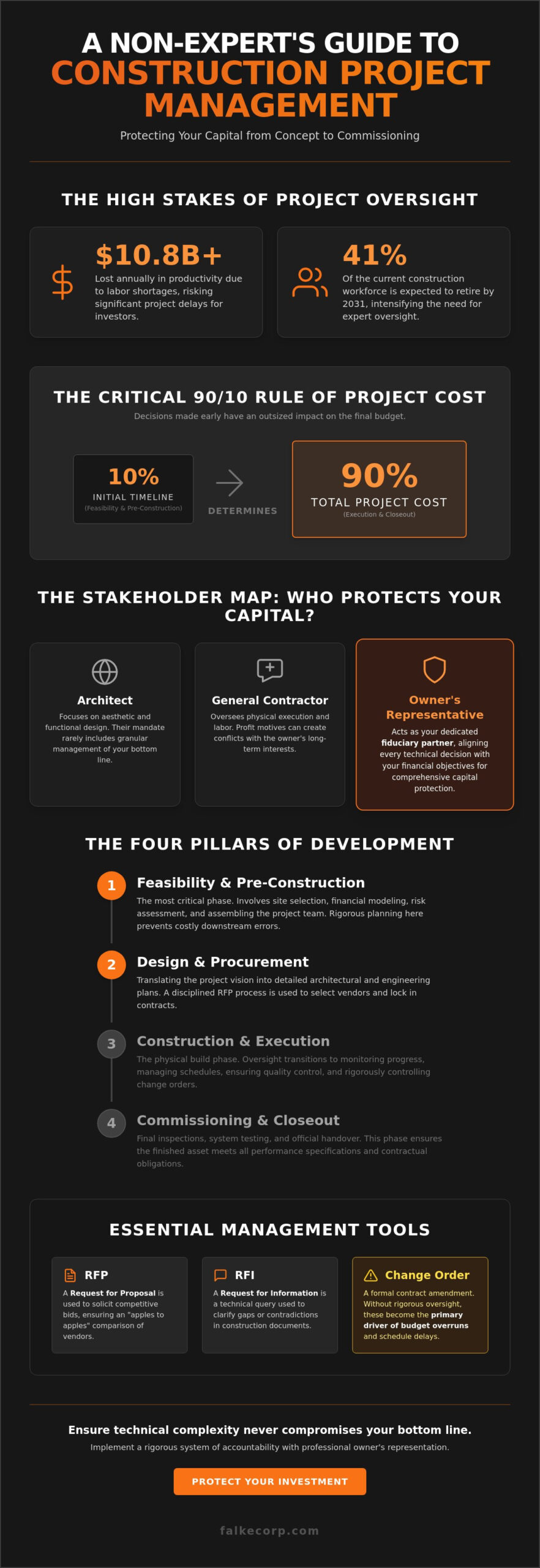
With labor shortages currently costing the construction industry over $10.8 billion annually in lost productivity, the risk of project delays has reached a critical threshold for private investors. These market pressures, combined with the fact that 41% of the current workforce is expected to retire by 2031, create an environment where technical oversight is no longer optional. You likely recognize the inherent difficulty in maintaining financial control when technical jargon obscures the true state of your development. This guide to construction project management for non-experts addresses the anxiety of being overcharged or losing grip on a timeline due to a lack of engineering expertise.
We’ll provide a definitive framework to help you master complex oversight and protect your capital through every phase of the build. This discussion details a structured approach to project transparency, clarifies the precise responsibilities of your consulting team, and establishes the logic needed to make confident financial decisions. By implementing a rigorous system of accountability, you can ensure that technical complexity never compromises your strategic objectives or your bottom line. Our objective is to replace confusion with a systematic methodology for project success.
Key Takeaways
- Distinguish between the operational execution of a General Contractor and the fiduciary oversight provided by an Owner’s Representative to ensure comprehensive capital protection.
- Understand the financial logic where the initial 10% of a project’s timeline determines 90% of its total cost, necessitating rigorous pre-construction planning.
- Implement a structured methodology for construction project management for non-experts that eliminates the need for technical engineering degrees while maintaining full project control.
- Learn to navigate the mechanics of change orders and scope creep to prevent budget overruns and ensure transparency across all development phases.
- Utilize a disciplined RFP process to objectively evaluate and select third-party vendors, ensuring professional alignment with your strategic investment goals.
Decoding the Construction Ecosystem: A Primer for Owners
For the capital provider, Construction management represents the systematic application of technical oversight to ensure that every dollar invested translates into tangible asset value. It isn’t merely about supervising a job site; it’s the disciplined management of financial risk and contractual obligations. Within the framework of construction project management for non-experts, this discipline functions as a protective layer between the owner’s capital and the inherent volatility of the building process. It transforms complex engineering data into actionable business intelligence that allows you to maintain control without needing a background in structural design.
Effective construction project management for non-experts requires a firm grasp of the industry’s standard communication tools. A Request for Proposal (RFP) is the formal document used to solicit competitive bids from vendors, ensuring you compare services on an “apples to apples” basis. A Request for Information (RFI) serves as a technical query used to clarify gaps or contradictions in construction documents. Most critically, a Change Order is a formal amendment to the original contract that alters the scope of work. Without rigorous oversight, these orders become the primary driver of budget overruns and schedule slippage.
Owner’s Representation is the strategic shield for the investor, providing a dedicated fiduciary layer that aligns every technical decision with the owner’s financial and operational objectives.
The Stakeholder Map: Who is Actually on Your Side?
The Architect focuses on aesthetic and functional design, yet their mandate rarely includes the granular management of your bottom line. General Contractors oversee the physical execution and labor, but their profit margins often depend on operational choices that might not align with your long-term interests. An Owner’s Representative serves as your dedicated fiduciary partner. They possess the technical competence required to challenge assumptions and ensure that neither the design nor the execution compromises your capital position.
Understanding Professional Fees and Retainers
Professional management fees typically follow a fixed retainer model or a percentage-based structure tied to the total project cost. While a lower management fee might seem attractive during the procurement phase, the cheapest option frequently results in the most expensive project due to inadequate risk mitigation. True value lies in the transparency of vendor billing and the disciplined coordination of third-party consultants. This level of oversight prevents the hidden costs associated with unverified billing and poor project coordination.
The Four Pillars of Development: From Concept to Commissioning
The lifecycle of a high-value development is governed by a rigorous four-phase methodology that transforms a conceptual vision into a stabilized, revenue-generating asset. Within the discipline of construction project management for non-experts, it’s a fundamental truth that the first 10% of a project’s timeline dictates approximately 90% of its total expenditure. Decisions made during the conceptual and planning stages carry immense financial weight; once the concrete’s poured, the cost of correction becomes prohibitive. This is why strategic pre-construction services in Miami are indispensable for mitigating downstream risks before they manifest as budget overruns.
Effective oversight requires shifting from a passive observer to an informed decision-maker. As noted in The Owner’s Role in Project Risk Management, your primary responsibility is the establishment of clear project objectives and the selection of a competent management team. While your involvement remains high during the strategic definition phases, it transitions into a monitoring role as the project moves into physical execution. Each stage demands a unique level of technical scrutiny to ensure the project’s structural and financial integrity remains intact.
Phase 1 & 2: Feasibility and Pre-Construction
Site selection involves more than just geographic preference; it requires a deep understanding of entitlement processes and local zoning codes. In South Florida, navigating the specific regulatory environments of Miami-Dade and Broward counties necessitates a technical feasibility study to identify potential environmental or structural constraints. A site feasibility study ensures your capital isn’t committed to a property with insurmountable legal or technical hurdles. During these phases, vetting architects and engineers for their specific experience with your asset type is vital to ensuring the design’s both buildable and cost-effective.
Phase 3 & 4: Active Construction and Close-out
As the project shifts into active construction, the focus moves toward rigorous quality control and strict adherence to the master schedule. Construction project management for non-experts at this stage is about verifying that the work performed matches the approved specifications and that progress billing’s accurate. The commissioning process follows, which is the final technical verification that all systems operate as intended, ensuring the asset’s truly revenue-ready. Finally, the close-out phase involves final auditing and the resolution of all liens, protecting you from lingering financial liabilities. For owners seeking to secure their investments from the start, engaging in professional Development Management provides the stability required for complex projects.
Risk Mitigation: Preventing Change Order Fraud and Budget Overruns
The “Runaway Budget” represents the most pervasive anxiety for investors who lack deep technical backgrounds. This fear isn’t unfounded; it often stems from a lack of transparency in the field and the complex nature of vendor billing. Without a background in technical specifications, you’ll likely find it difficult to distinguish between essential adjustments and opportunistic billing. In the discipline of construction project management for non-experts, the primary objective is to implement a system that prevents financial leakage before it compromises the project’s viability. Scope creep usually happens when the original project parameters are loosely defined, allowing for incremental additions that collectively inflate the final cost.
A “Trust but Verify” approach is essential for maintaining capital stability throughout the build. This involves implementing independent financial audits during the construction phase to ensure every progress payment aligns with the actual work completed on-site. Rigorous financial oversight is not merely a budgetary constraint but the very foundation upon which high-quality development is built. By establishing these controls early, you protect your capital from the inefficiencies and miscommunications that frequently plague unmanaged sites.
The Anatomy of a Change Order
A change order functions as a formal amendment to the construction contract, yet its execution is often where budgets collapse. Legitimate orders arise from unforeseen site conditions or regulatory changes that weren’t visible during the pre-construction phase. Predatory orders, however, often result from contractors intentionally underbidding a project to secure the award, intending to recover profit through excessive add-ons later. Establishing a rigorous approval workflow prevents unauthorized spending and ensures that every change is vetted for necessity and price accuracy. Your Owner’s Representative plays a critical role here, as they possess the technical expertise to negotiate credits and identify cost-saving opportunities that an untrained eye would miss.
Local Challenges: Climate and Permitting in South Florida
Miami projects face unique environmental and bureaucratic hurdles that can derail even the most disciplined budgets. Managing weather-related delays requires proactive hurricane season planning, particularly for projects active between June and November. Navigating the City of Miami building permits is a specialized task; delays in this area often lead to costly work-stoppages and labor inefficiencies. For coastal construction, quality control must account for salt-air mitigation and specific material longevity standards to ensure the asset doesn’t degrade prematurely in the high-humidity, high-salinity environment of South Florida. Using a partner who understands these local variables is a prerequisite for project stability.
Assembling Your Elite Project Team
The selection of your project team represents the most consequential decision in the development lifecycle. For investors, this process isn’t about personal rapport but technical alignment and professional reliability. Within the framework of construction project management for non-experts, procurement must be handled as a data-driven exercise rather than an emotional one. A standardized Request for Proposal (RFP) is the essential tool for this task. It forces every bidder to respond to the same set of requirements, allowing you to compare “apples to apples” regarding scope, schedule, and fee structures. Without this level of standardization, you risk awarding a contract based on incomplete information, which inevitably leads to financial friction later.
Identifying red flags early can save months of delays. During interviews, pay close attention to firms that offer vague answers regarding their current capacity or those who struggle to explain their specific methodology for cost control. You should also utilize a checklist for selecting an owner’s representative in Miami to vet your potential partners against the highest industry standards. A partner who can’t demonstrate a clear, documented process for risk management is unlikely to protect your capital effectively when challenges arise on-site.
Vetting for Specialized Assets
Asset classes aren’t interchangeable. Retail construction management demands a focus on rapid delivery and high-traffic durability, while residential projects prioritize different aesthetic and structural nuances. Hospitality developments introduce even greater complexity, requiring the management of strict timelines to meet brand-mandated opening dates. A firm’s local track record in Dade and Palm Beach counties is particularly important. Understanding the specific nuances of local building departments and environmental regulations in these jurisdictions can be the difference between a project that remains on schedule and one that stalls indefinitely.
The Bidding Process: Beyond the Lowest Price
The “lowest bid” is frequently a signal of future change orders rather than actual savings. Contractors who underprice their services often do so to secure the work, intending to recover their margins through aggressive change order requests once the project is underway. You must analyze the depth of a contractor’s sub-contractor network; a robust network ensures that labor shortages don’t halt your progress. In Florida, verified insurance and bonding aren’t optional. They’re critical safeguards that protect the owner from liability and project abandonment. For those ready to move from planning to execution, engaging in professional Project Management ensures that your team assembly is handled with the necessary technical rigor.
The Strategic Advantage of Professional Owner’s Representation
The transition from a passive investor to a successful developer requires more than just capital; it demands an uncompromising commitment to technical oversight. Engaging a professional Owner’s Representative is the logical conclusion of a successful development strategy, serving as the bridge between your financial goals and the physical reality of the job site. This role ensures that the principles of construction project management for non-experts are applied with professional rigor, protecting you from the information asymmetry that often favors contractors. By positioning a dedicated expert at the center of the project ecosystem, you transform potential liabilities into controlled, predictable outcomes.
FALKE Atlantic Corporation acts as your strategic partner to deliver revenue-ready assets that meet the most demanding standards. Managing complex developments, such as the Prada Design District store, requires a level of coordination that transcends basic supervision. In high-stakes environments where brand identity and structural precision are non-negotiable, our team provides the technical verification necessary to ensure the final product reflects the initial architectural vision. This level of stewardship allows you to move from a state of technical confusion to one of confident project ownership.
The ROI of Oversight
Expert oversight isn’t an added expense; it’s a mechanism for capital preservation. The return on investment (ROI) is realized through the expert negotiation of change orders and the proactive identification of risks before they manifest as delays. For remote owners managing Florida projects from afar, an Owner’s Representative provides essential peace of mind by serving as a constant, on-site advocate. You don’t need technical expertise to ensure adherence to the highest quality standards when you have a fiduciary partner who manages the granular details on your behalf.
Getting Started with FALKE Atlantic
The process begins with an initial consultation where we define your specific vision and establish clear budget parameters. We recognize that the management approach must be customized for corporate entities versus private clients, as each stakeholder group has unique reporting requirements and risk tolerances. Securing professional development management services in Miami is the first step toward ensuring your project’s long-term viability. By integrating our expertise into your project from the start, you ensure that every phase of development is executed with the precision and transparency your capital deserves.
Securing Your Investment through Professional Oversight
Effective development isn’t just about the physical build; it’s about the disciplined management of financial and operational risk. By mastering the distinction between operational execution and fiduciary oversight, you’ve gained the tools to protect your capital from common pitfalls like scope creep and predatory change orders. Implementing construction project management for non-experts ensures that technical complexity never dictates your financial outcome. You now possess a framework to move from uncertainty to a state of informed, strategic control over your assets.
FALKE Atlantic Corporation provides the stability required for complex developments through our disciplined four-phase methodology and specialized expertise in Miami’s high-end retail and hospitality sectors. Our fiduciary-first approach to capital protection ensures that your interests remain the primary driver of every technical decision. Partner with FALKE Atlantic for Expert Owner’s Representation to transform your vision into a revenue-ready reality. You don’t have to navigate the complexities of the Miami construction landscape alone; professional stewardship’s the most reliable path to a successful, stabilized asset.
Frequently Asked Questions
What is the difference between a Project Manager and an Owner’s Representative?
A Project Manager focuses on the operational execution and technical coordination of the build, whereas an Owner’s Representative acts as a fiduciary partner dedicated to the owner’s strategic and financial interests. While the Project Manager handles the daily coordination of trades, the Owner’s Representative ensures that every decision aligns with the investor’s long-term objectives and capital safety.
Do I really need a construction consultant if I have a good General Contractor?
Even with a reputable General Contractor, an independent consultant is necessary to provide unbiased oversight and resolve inherent conflicts of interest. The contractor’s primary focus is on their own operational margins and labor efficiency, which may not always prioritize the owner’s budget or quality standards. Professional oversight ensures that the owner’s capital is protected through every phase of development.
How much does owner representation typically cost for a Miami project?
Professional fees for owner representation are typically structured as monthly fixed retainers or as a percentage of the total project value. These structures are designed to align the representative’s efforts with the project’s scale and complexity rather than incentivizing increased spending. This model provides the owner with a predictable cost for high-level strategic management.
How do I prevent my construction project from going over budget?
Preventing budget overruns requires a disciplined approach to construction project management for non-experts, beginning with a comprehensive site feasibility study before any capital is committed. Implementing a rigorous change order approval workflow and conducting independent financial audits are also critical measures to maintain fiscal control and prevent scope creep.
What are the most common causes of construction delays in South Florida?
Delays in South Florida are frequently caused by the seasonal impact of hurricane season and the intricate permitting requirements of local municipalities like the City of Miami. Additionally, the regional shortage of skilled labor can extend timelines if the project team doesn’t maintain a robust subcontractor network and a proactive schedule management strategy.
Can an Owner’s Rep help with the permitting process in Miami-Dade county?
An Owner’s Representative actively manages the permitting process by coordinating with architects and engineers to meet the specific technical standards of Miami-Dade or Broward counties. Their experience with local building departments helps prevent the work-stoppages that result from incomplete or non-compliant documentation, ensuring the project moves toward the construction phase without unnecessary friction.
How often should I receive progress reports on my construction project?
Stakeholders should expect detailed progress reports on a weekly or bi-weekly basis, depending on the current phase of the development. These reports provide a transparent overview of the schedule, budget status, and any technical hurdles that require strategic decisions from the owner. Consistent reporting is the foundation of transparency in professional project oversight.
Is owner representation only for large-scale commercial developments?
Owner representation is essential for any development where the complexity of the build exceeds the owner’s technical expertise, including high-end retail and hospitality projects. The principles of construction project management for non-experts apply to any asset class where capital protection and revenue-readiness are the primary goals, regardless of the project’s total square footage.