With Miami construction costs escalating to 40% above 2019 levels as of early 2026, the margin for error in capital allocation has effectively vanished. Investors frequently encounter a structural information asymmetry where the technical reality of the job site remains obscured by the General Contractor’s subjective updates. This disconnect often masks hidden change orders or fails to account for the rigorous High-Velocity Hurricane Zone requirements that define South Florida’s built environment. Establishing a robust framework for construction project reporting for investors Miami isn’t just a secondary administrative task; it’s a fiduciary necessity for protecting equity in a high-volatility market.
You likely recognize that a standard spreadsheet cannot capture the nuances of the 9th Edition Florida Building Code or the specific Gold Key permitting timelines required for modern seawall projects. This article demonstrates how institutional-grade reporting ensures full financial transparency and functions as an early warning system for schedule disruptions. We’ll detail the transition from reactive observation to proactive development management, providing stakeholders with the precise documentation required to maintain control over complex, high-stakes South Florida developments from pre-construction through final commissioning.
Key Takeaways
- Distinguish between anecdotal progress and data-driven milestones to ensure rigorous capital preservation throughout the development lifecycle.
- Identify critical Key Performance Indicators, such as Schedule Variance and Critical Path health, that provide a technical foundation for oversight beyond simple completion dates.
- Understand the inherent limitations of General Contractor status updates and the necessity of independent forensic progress analysis to maintain a fiduciary standard.
- Learn how construction project reporting for investors Miami mitigates regional risks by integrating Miami-Dade permitting status and weather-related Force Majeure documentation.
- Explore the implementation of institutional-grade dashboards that translate complex site data into actionable intelligence for investment committees and private stakeholders.
The Strategic Importance of Construction Project Reporting for Miami Investors
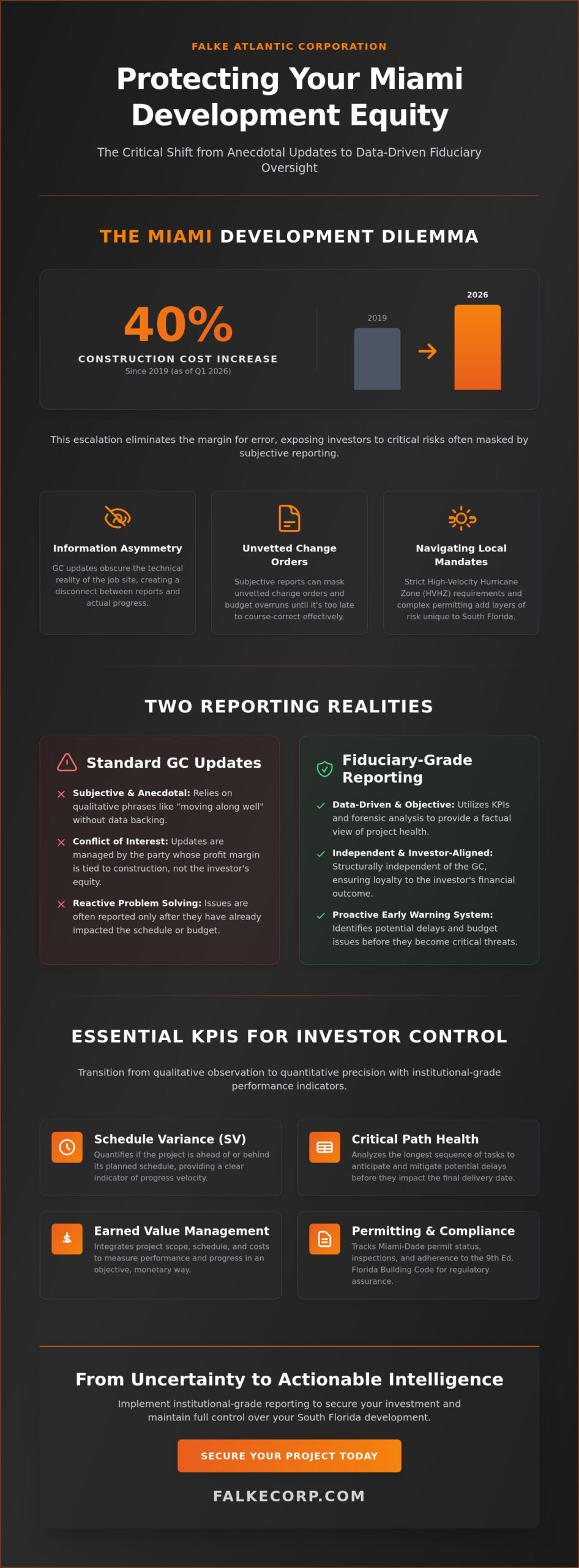
In the current Miami development environment, where construction costs have reached levels approximately 40% higher than those recorded in 2019, the definition of project success has shifted. It’s no longer enough to rely on the qualitative updates of a general contractor. Institutional-grade construction project reporting for investors Miami serves as a rigorous mechanism for capital preservation. It transforms raw site activity into a structured narrative of fiscal and operational health. While a contractor might report that a project is “moving along well,” a fiduciary-led report identifies specific data-backed milestones. It quantifies progress through earned value management and schedule variance analysis. This level of transparency is mandatory for 2026-standard developments, especially as the industry prepares for the structural mandates of the 9th Edition Florida Building Code. Key elements of this reporting include:
- Verification of physical work in place against the financial schedule of values.
- Critical path analysis to anticipate potential delays before they impact the delivery date.
- Rigorous tracking of permit status and inspections within the complex Miami-Dade regulatory framework.
Bridging the Information Gap for Out-of-State Investors
Remote ownership of South Florida real estate assets presents inherent risks. Information asymmetry often leads to delayed reactions to site-level issues, which can be catastrophic in a market where luxury home prices average nearly $5 million. Establishing a single source of truth is the only way to align stakeholders. Professional Owner’s Representative Miami services secure investor interests by providing an objective lens on the ground. These experts verify that the physical work in place matches the financial draws requested. They ensure out-of-state capital isn’t compromised by local regulatory hurdles or unvetted change orders that haven’t been properly scrutinized for technical necessity.
The Fiduciary Standard in Construction Oversight
Effective reporting must remain structurally independent of the General Contractor to avoid inherent conflicts of interest. A fiduciary standard in construction oversight dictates that the reporter’s primary loyalty lies with the investor’s financial outcome, not the contractor’s profit margin. This independence ensures every dollar spent aligns strictly with the approved project budget. Objective reporting identifies financial mismanagement before it becomes a lien or a litigation risk. It provides the technical competence required to scrutinize trade permits and High-Velocity Hurricane Zone compliance. By maintaining this distance, project managers offer the stability and precision that complex developments require. Robust construction project reporting for investors Miami acts as the final line of defense against the erosion of project equity during the most volatile phases of the build.
Essential KPIs for South Florida Construction Development Oversight
Effective construction project reporting for investors Miami requires a transition from qualitative observation to quantitative precision. High-stakes developments in South Florida’s volatile market cannot survive on vague progress updates; they demand rigorous Key Performance Indicators (KPIs) that expose the underlying health of the asset. Cash flow analysis remains the primary diagnostic tool, requiring a monthly comparison of actual expenditures against the baseline projected spend. Discrepancies here often signal deeper issues in procurement or labor productivity that, if left unaddressed, erode the project’s internal rate of return. Technical oversight involves more than just checking dates; it requires measuring Schedule Variance (SV) to assess the health of the critical path. This metric identifies whether the project is truly maintaining its velocity or merely appearing active while falling behind on high-priority structural phases.
Administrative efficiency is equally telling. Tracking RFI (Request for Information) and submittal lag times identifies bottlenecks in the communication chain between the architect and the general contractor before they manifest as physical delays on the job site. Furthermore, change order logs must be meticulously categorized to distinguish between owner-requested enhancements and error-correcting changes resulting from design deficiencies. This distinction is vital for maintaining the fiduciary standard, as it determines which party bears the financial burden of the adjustment. Safety and compliance metrics, specifically Miami-Dade OTV (Official Traffic Verification) and OSHA incident tracking, serve as leading indicators of site management quality. A site with poor compliance records is statistically more likely to face regulatory shutdowns or insurance premium escalations.
Financial Metrics for Capital Control
Investors must prioritize the ‘Cost to Complete’ over the ‘Cost to Date’ to maintain a realistic view of their capital requirements. In a market where construction costs have risen significantly since 2019, monitoring the burn rate of the contingency fund is essential for survival. The Anticipated Final Cost serves as the definitive investor metric, synthesizing current expenditures, pending commitments, and forecasted risks into a single, actionable valuation of the project’s ultimate fiscal requirement. Integrating professional project management frameworks into these financial reviews ensures that every draw request is validated against actual physical completion, preventing the over-payment of contractors for work not yet performed.
Schedule and Operational Performance Indicators
Institutional reporting relies on achievement percentages for specific milestones rather than binary ‘started’ or ‘finished’ statuses. This granularity is necessary to track the procurement of long-lead items, such as specialized glazing systems required for High-Velocity Hurricane Zone compliance, which often dictate the entire project timeline in Miami. Data-driven reporting allows stakeholders to differentiate between excusable delays, such as documented ‘Force Majeure’ weather events, and non-excusable delays caused by contractor inefficiency. This clarity is indispensable when determining the applicability of liquidated damages or schedule recovery plans.
Why General Contractor Status Updates Are Not Fiduciary Reports
Investors often mistake a General Contractor’s weekly progress summary for a comprehensive risk assessment, yet these documents serve fundamentally different purposes. A contractor’s report is frequently a tool for maintaining project momentum and justifying progress payments, which creates an inherent conflict of interest when it’s the sole source of data. Fiduciary-grade construction project reporting for investors Miami must remain independent to bypass the optimistic forecasting that often characterizes contractor-led communication. While a GC might present a series of site photos showing structural progress, these images cannot convey the critical path deviations or administrative lags occurring behind the scenes. This disconnect creates the “Green-Status” trap, where a development appears to be on schedule in every report until a sudden, massive delay is announced late in the construction phase. True fiduciary reporting strips away this subjective layer to provide an unvarnished view of the project’s technical and fiscal reality.
Forensic Analysis vs. Surface-Level Updates
Forensic progress analysis differs from surface-level updates by interrogating the data that drives the project schedule. Instead of accepting a contractor’s qualitative assessment that work is “on track,” a fiduciary reporter analyzes the delta between planned and actual productivity. This involves a granular review of labor densities, trade performance, and submittal turnaround times. Utilizing independent construction phase management Florida allows for the identification of red flag phrasing in contractor correspondence, such as vague references to “pending coordination” or “material availability issues.” These phrases often mask systemic failures in procurement or management that require immediate intervention to protect the investor’s timeline. Accurate data ensures that stakeholders aren’t reacting to a crisis but are instead managing a controlled process.
Protecting Against Change Order Proliferation
The proliferation of change orders represents a significant threat to project solvency, especially in Miami’s high-cost environment where material prices remain 40% above 2019 levels as of early 2026. Independent reporting ensures that every proposed adjustment is technically validated for necessity and contractual alignment. Fiduciary oversight distinguishes between legitimate owner-requested enhancements and “error-correcting” changes that should be absorbed by the contractor’s original lump-sum or GMP agreement. By ensuring all claims are backed by rigorous documentation and forensic cost analysis, investors can prevent budget bloat and the erosion of their contingency funds. This level of scrutiny eliminates the risk of financial mismanagement and ensures that capital is deployed only for work that adds genuine value to the asset, rather than compensating for contractor oversight or design gaps.
Navigating Miami-Specific Risks Through Data-Driven Reporting
Miami’s construction landscape is defined by its exposure to extreme weather and a highly specific regulatory framework that demands constant vigilance. Sophisticated construction project reporting for investors Miami must account for the Miami-Dade Building Department’s unique requirements, particularly as the industry prepares for the 9th Edition of the Florida Building Code taking effect on December 31, 2026. Reporting should detail the status of every trade permit and the results of structural inspections required for High-Velocity Hurricane Zone (HVHZ) compliance. Beyond code adherence, data-driven reporting must capture the volatility of the local labor market. With high demand for skilled trades across Broward and Dade counties, tracking trade availability becomes a leading indicator for potential schedule slippage. Rigorous logs provide the forensic evidence needed to validate “Force Majeure” events, ensuring that weather-related delays are documented with specific meteorological data rather than anecdotal claims during the Atlantic hurricane season.
Resiliency and sea-level rise are no longer abstract concerns but are integrated into the technical specifications of modern South Florida developments. Reporting must track compliance with enhanced wind load requirements and specific roofing system attachments mandated by local ordinances. This level of detail ensures that the asset is built to current standards, which directly impacts the property’s long-term insurability and valuation. By quantifying these regional risks, project managers provide investors with a stable platform for decision-making in a market known for its environmental and regulatory complexity.
Managing Regulatory Hurdles in South Florida
The administrative complexity of a Miami project is often where equity is most at risk. Reporting must meticulously track the ‘Notice of Commencement’ and the subsequent collection of lien waivers to ensure the property remains unencumbered by legal claims. Achieving TCO (Temporary Certificate of Occupancy) milestones requires a coordinated effort between the general contractor and local inspectors, a process that must be transparently reported to stakeholders to avoid costly delays in the final phase. Engaging in comprehensive pre-construction services Miami during the entitlement phase allows investors to anticipate these hurdles before they impact the construction schedule. To secure your capital against these regional complexities, consider the professional development management services offered by our team.
Environmental and Climate Risk Reporting
Environmental factors in South Florida directly correlate with labor productivity and site safety. Modern reporting now integrates heat-stress monitoring, as local safety protocols mandate specific rest and hydration intervals that can impact the daily burn rate of labor hours. During hurricane season, reporting shifts to logistical preparedness and recovery phases, documenting the exact timelines for site securing and post-storm mobilization. Integrating sustainability and resiliency metrics into investor dashboards ensures that the asset is being built to withstand long-term environmental shifts, protecting the property’s future market position and operational stability.
Implementing Institutional-Grade Reporting with FALKE Atlantic Corporation
Implementing institutional-grade construction project reporting for investors Miami requires a systematic integration of technical site data and forensic financial oversight. FALKE Atlantic Corporation utilizes a four-phase methodology designed to eliminate information gaps between the job site and the boardroom. This process begins with pre-construction baseline verification and extends through active construction phase management, where every physical milestone is cross-referenced with budgetary actuals. By integrating forensic accounting with real-time site oversight, we ensure that draw requests are technically validated before capital is deployed. This structured approach provides the stability and quality assurance necessary for complex South Florida developments, where the cost of oversight failure is exceptionally high.
Different stakeholders require different levels of data granularity. Our reporting systems feature customized dashboards that distill complex engineering data into actionable intelligence. For High-Net-Worth Individuals (HNWIs), the focus remains on capital preservation and high-level progress summaries. Conversely, Institutional Investment Committees receive granular compliance data, risk registers, and detailed schedule variance reports. This dual-layered strategy ensures that all parties possess the specific documentation required for their respective fiduciary obligations. Our methodology transforms raw construction data into a strategic asset, providing the technical competence required to navigate Miami’s high-velocity development cycle.
To complement these data-driven dashboards, institutional developers often utilize professional video production to provide high-fidelity visual updates for remote investors. Firms like Aflalo Communications Inc. offer the broadcast-quality production services necessary to create immersive site tours and progress documentaries that meet the standards of global investment committees.
The FALKE Reporting Framework
Monthly executive summaries serve as the cornerstone of our communication strategy, distilling thousands of data points into clear, strategic narratives. These summaries allow investors to understand the technical health of their asset without becoming mired in administrative minutiae. Our Real Estate Development Management Services align directly with investor ROI goals by maintaining a relentless focus on the Anticipated Final Cost. Real-time access to project dashboards provides 24/7 visibility, ensuring that transparency is a constant state rather than a monthly event. This level of access empowers stakeholders to monitor critical path health and contingency burn rates with absolute precision.
Ensuring a Seamless Project Close-Out
The transition from an active construction site to a revenue-ready asset is a critical phase that demands rigorous documentation. We oversee the final financial reconciliation and the completion of the punch-list to ensure no lingering liabilities remain. Closing the loop on Construction Project Management Florida involves the meticulous transfer of warranties, as-built drawings, and Operation and Maintenance (O&M) manuals. This comprehensive close-out process ensures the asset is fully commissioned and ready for its intended operational use, protecting the investor’s long-term exit strategy or yield objectives. Every document is verified to meet the stringent requirements of Miami-Dade regulatory bodies, ensuring a clean transition to property management.
Securing Long-Term Asset Value Through Fiduciary Oversight
Protecting equity in South Florida’s high-stakes development market requires a fundamental shift from passive observation to active, data-driven management. As construction costs remain approximately 40% higher than 2019 levels, the margin for administrative or fiscal oversight has narrowed. Implementing institutional-grade construction project reporting for investors Miami ensures that every capital draw is validated against physical reality rather than optimistic contractor forecasts. By maintaining a strict separation between site execution and independent reporting, stakeholders can anticipate regional risks ranging from High-Velocity Hurricane Zone compliance to complex Miami-Dade permitting cycles.
FALKE Atlantic Corporation serves as the strategic guardian of high-net-worth capital, utilizing a disciplined four-phase methodology to maintain total project transparency across Miami-Dade and Broward jurisdictions. Our technical competence allows us to identify critical path deviations and budget variances before they compromise your return on investment. We invite you to Secure Your Investment with Fiduciary-Grade Reporting from FALKE Atlantic. Establishing this level of professional oversight is the most effective way to ensure your complex development reaches a successful, revenue-ready completion.
Frequently Asked Questions
What should a standard construction report for investors include?
A standard framework for construction project reporting for investors Miami must include a monthly executive summary, a detailed schedule of values, and a critical path analysis. It’s essential to track actual expenditures against the baseline budget while documenting all pending change orders and trade permit statuses. These reports provide the technical transparency required to protect equity in South Florida’s high-cost environment, where construction costs remain 40% higher than 2019 levels.
How often should an investor receive a project status report?
Investors should receive comprehensive narrative reports on a monthly basis to align with the financial draw cycle. However, high-stakes Miami developments increasingly utilize real-time dashboards that offer 24/7 visibility into site productivity and labor densities. This dual approach ensures that stakeholders remain informed of strategic milestones while maintaining the ability to monitor day-to-day operational health through a centralized digital platform.
Can construction reporting software replace an Owner’s Representative?
No, specialized software cannot replace the technical competence and fiduciary responsibility of an Owner’s Representative. While digital tools are efficient for data collection, they lack the ability to perform forensic analysis or verify the physical quality of work in place. An Owner’s Representative interprets raw data to identify systemic risks and ensures that project management strategies align with the investor’s specific financial objectives.
How do I verify the accuracy of a General Contractor’s report?
Accuracy is verified through independent site inspections and a forensic audit of the contractor’s schedule of values. Professional construction project reporting for investors Miami involves cross-referencing physical progress with requested payments to prevent over-billing. By validating that the physical work in place matches the financial draw, project managers ensure that the General Contractor’s qualitative updates are backed by unvarnished technical reality.
What are the most common reporting red flags in Miami construction?
Common red flags include repetitive “on track” statuses that lack supporting data or vague references to “supply chain volatility” without specific documentation. Sudden spikes in “error-correcting” change orders or a lag in trade permit inspections often signal underlying management failures. Investors should also be wary of reports that omit critical path updates, as this often masks significant schedule slippage in structural or glazing phases.
How does hurricane season affect construction reporting in Florida?
Hurricane season mandates the inclusion of specific preparedness logs and meteorological data to document potential Force Majeure events. Reporting must detail site securing timelines and post-storm mobilization schedules to justify any excusable delays. This rigorous documentation is necessary for insurance compliance and ensures that weather-related disruptions are quantified rather than used as a generic excuse for contractor inefficiency.
What is the role of forensic accounting in construction reporting?
Forensic accounting ensures that every project expenditure is technically validated and contractually compliant. This process involves a granular review of labor hours, material invoices, and subcontractor lien waivers to prevent budget bloat. By integrating financial auditing with site oversight, project managers maintain the fiduciary standard and protect the investor’s contingency funds from being eroded by unvetted costs or mismanagement.
Is project reporting different for residential vs. commercial Miami developments?
While the fiduciary standard remains constant, commercial reporting emphasizes institutional KPIs like internal rate of return and debt-coverage ratios. Residential reporting in Miami often focuses on custom finish schedules and High-Velocity Hurricane Zone compliance for specialized glazing. Both sectors require rigorous tracking of Miami-Dade building codes, but the specific milestones are tailored to the asset’s intended operational or residential use.