
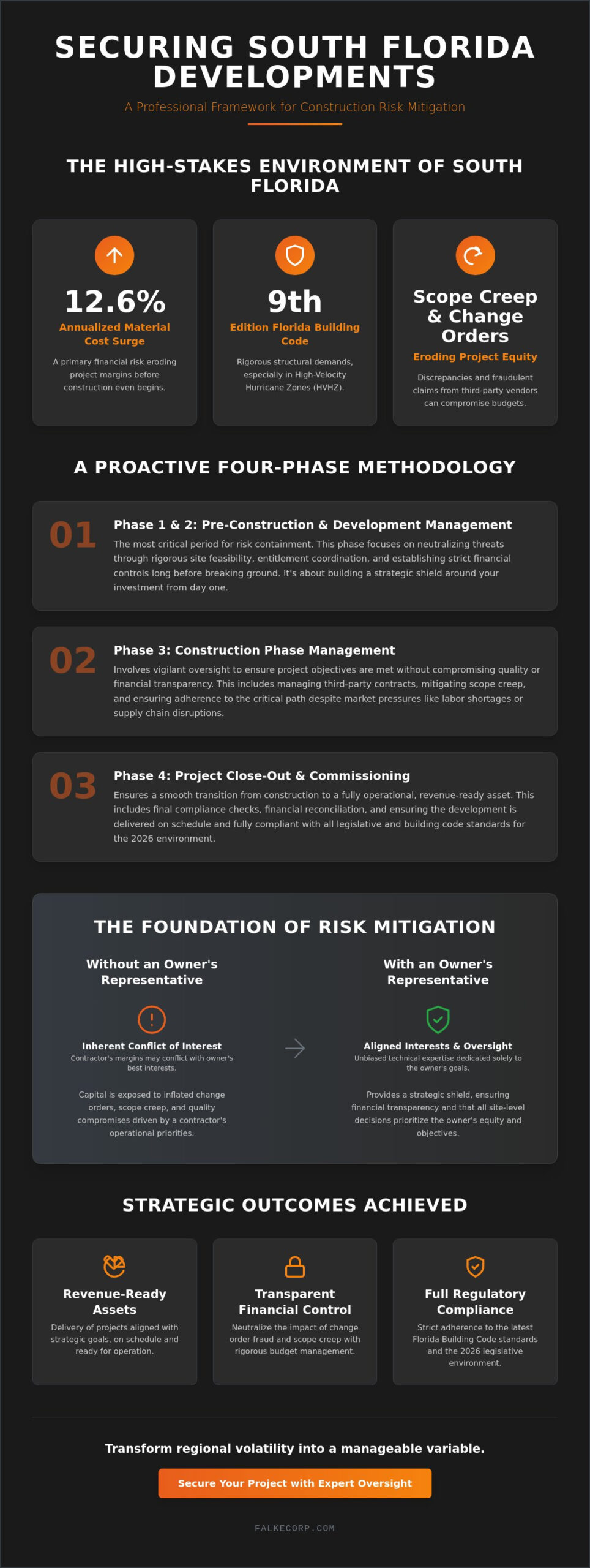
What if the primary threat to your South Florida capital investment isn’t the local climate, but the 12.6% annualized surge in material costs and the rigorous structural demands of the 9th Edition Florida Building Code? You likely recognize that navigating the Miami-Dade and Broward regulatory landscape has become a high-stakes exercise in financial endurance; scope creep and change order discrepancies often erode project margins before vertical construction reaches its midpoint. To protect your equity, you need a sophisticated mechanism for oversight that transcends basic site inspections through professional construction risk management services Miami.
This guide provides a professional framework for securing transparent financial control and mitigating third-party vendor risks. We will examine the strategic implementation of Owner’s Representation and development management to ensure your assets are delivered revenue-ready, on schedule, and fully compliant with the 2026 legislative environment. By adopting a disciplined approach to pre-construction and construction phase management, you can transform regional volatility into a manageable variable. Our analysis focuses on establishing a strategic shield that protects the integrity of your development from inception to final close-out.
Key Takeaways
- Establish a technical framework for identifying and mitigating the systemic financial and regulatory risks unique to the 2026 South Florida development landscape.
- Implement a proactive, four-phase methodology through professional construction risk management services Miami to secure project stability long before the commencement of vertical construction.
- Deploy rigorous financial controls to neutralize the impact of change order fraud and scope creep; this ensures transparent budget management across all third-party contracts.
- Evaluate potential partners based on technical competency and senior-level involvement to ensure high-stakes projects in Miami-Dade and Broward are managed with precision.
- Achieve the delivery of revenue-ready assets by aligning development management with strategic project goals and strict adherence to the latest Florida Building Code standards.
Understanding Construction Risk Management in the Miami Market
Construction risk management is defined as the systematic identification, assessment, and mitigation of variables that threaten the successful execution of a development project. It’s a technical discipline that extends far beyond basic safety protocols or financial audits. For sophisticated owners, this process involves integrating the foundational principles of Project Risk Management with the specific economic and environmental pressures of the South Florida corridor. In the current 2026 climate, the stakes for Miami real estate have never been higher. Owners must distinguish between financial risk, such as the 12.6% annualized rise in material costs, and operational risks that disrupt the sequence of construction. Regulatory risk has also intensified with the full implementation of the 9th Edition Florida Building Code. While many rely on standard insurance, these policies are inherently reactive. They provide compensation for loss but don’t prevent the systemic delays or cost overruns that can render an asset non-viable. Comprehensive construction risk management services Miami offer a proactive shield, ensuring that every technical and financial variable is scrutinized before it impacts the balance sheet.
The Unique Risk Profile of South Florida Construction
Developing in Miami-Dade and Broward counties requires navigating some of the most stringent building codes in the United States. The High-Velocity Hurricane Zone (HVHZ) standards demand specific engineering for impact-resistant envelopes and enhanced roof system attachments. Beyond structural integrity, climate-related risks include humidity-induced material degradation and the logistical disruption of an increasingly active hurricane season. These environmental factors are compounded by persistent labor shortages that threaten project timelines. Without a structured risk framework, these local variables often lead to cascading delays. Effective risk management accounts for these regional nuances by implementing rigorous material storage protocols and detailed labor contingency plans that ensure the project remains on its critical path despite external market pressures.
Why Owner Representation is the Foundation of Risk Mitigation
The role of an Owner’s Representative is to provide the unbiased technical oversight necessary to protect the client’s capital from inception to commissioning. There’s an inherent conflict of interest between General Contractors and Owners; the contractor’s primary motivation is the optimization of their own operational margins and delivery speed. This misalignment can lead to scope creep or the submission of inflated change orders that erode the owner’s equity. By acting as a strategic partner, an Owner’s Rep ensures that the project’s objectives are met without compromising quality or financial transparency. This level of professional oversight is the only way to guarantee that the interests of the owner remain the primary driver of all site-level decisions, providing a level of security that a general contractor cannot offer.
A Four-Phase Methodology for Proactive Risk Mitigation
Project success in the volatile South Florida market isn’t a product of chance; it’s the calculated result of a disciplined, technical methodology. Risk mitigation must be integrated into the project’s DNA long before the first shovel hits the ground. Waiting for the mobilization phase to address potential vulnerabilities is a tactical error that often leads to irreversible budget inflation and schedule slippage. By utilizing professional construction risk management services Miami, owners can implement a structured framework that prioritizes data-driven decision-making at every milestone. This analytical approach allows for the identification of systemic risks, such as supply chain bottlenecks or labor shortages, before they impact the critical path. The pre-construction phase is the most critical period for financial risk containment.
Phase 1 & 2: Pre-Construction and Development Management
The initial phases of development are focused on neutralizing risks through rigorous site feasibility and entitlement coordination. In 2026, navigating the permit processing reforms (HB 267) requires a specialized understanding of local municipal timelines in Miami-Dade and Broward counties. It’s essential that the design team assembly aligns strictly with the project’s financial constraints to prevent the need for costly value engineering later in the cycle. Utilizing Strategic Pre-Construction Services in Miami allows owners to establish a technical baseline. This ensures that the architectural vision is compatible with current material pricing and the structural requirements of the 9th Edition Florida Building Code. Establishing these parameters early is the only way to safeguard the owner’s equity against the unpredictable shifts in the South Florida real estate climate.
Phase 3 & 4: Construction Oversight and Commissioning
Effective risk management during the execution phase requires a consistent, active site presence to manage third-party vendors and general contractors. This oversight isn’t merely about observing progress; it’s about verifying that every installation meets the high standards required for High-Velocity Hurricane Zones. Implementing Construction Phase Management in Florida ensures that the transition from vertical construction to commissioning is seamless and documented. A structured close-out process is vital to transform a complex construction site into a revenue-ready asset. This phase minimizes the delta between physical completion and operational occupancy, ensuring that all milestone inspections are passed without delay. For owners seeking a higher level of precision, engaging a strategic partner for development management provides the professional accountability necessary to secure the project’s final delivery and financial integrity.
Financial Control: Preventing Change Order Fraud and Scope Creep
Change orders represent the most significant threat to capital preservation in South Florida development. In the Miami market, these adjustments aren’t merely administrative updates; they’re often the primary mechanism for budget erosion. A technical framework for construction risk management services Miami must prioritize the identification of fraudulent or inflated claims that often hide within legitimate scope adjustments. To maintain the project’s financial integrity, owners should adopt a rigid approval process that requires every proposed change to be validated through a forensic cost review. This process involves dissecting contractor margins, labor allocations, and material markups to ensure they align with the original contract terms. By identifying hidden contingencies before they’re approved, an owner can prevent the incremental budget inflation that often compromises the project’s final proforma.
The Mechanics of Transparent Budget Oversight
Maintaining financial control requires real-time budget tracking that compares every expenditure against the initial development proforma. This transparency ensures that third-party fees and contractor disbursements are verified before any capital is released. Integrating Construction Project Management in Florida allows for a structured audit trail where every invoice is cross-referenced with site-level progress reports. This level of oversight includes:
- Verification of material delivery logs against billed quantities to prevent over-ordering.
- Detailed audits of labor hours to eliminate redundant or overlapping trade charges.
- Rigorous validation of subcontractor insurance and lien waivers prior to payment.
Mitigating Operational Risks Through Quality Control
Financial liability is often a direct consequence of poor quality control during the vertical construction phase. When technical standards aren’t met, the resulting re-work creates a hidden cost that often surfaces during the high-pressure commissioning phase. Standardizing inspection protocols is essential to prevent these liabilities, particularly concerning the building envelope and structural integrity. Disciplined oversight ensures that contractors adhere to the specific engineering requirements of Miami-Dade county, neutralizing the risk of daily fines or property liens. This methodical approach to quality control doesn’t just protect the current construction budget; it secures the long-term market valuation of the real estate asset, ensuring it remains a stable, high-performing investment.
Selecting the Right Risk Management Partner in Miami
Selecting a strategic partner for construction risk management services Miami requires a granular evaluation of technical competency and local market immersion. In a region where regulatory shifts and economic volatility are constants, a partner’s track record within Miami-Dade and Broward counties serves as the most reliable indicator of future performance. Institutional owners should prioritize boutique firms that offer direct, partner-level involvement throughout the project lifecycle. This ensures that high-stakes decisions are guided by seasoned expertise rather than delegated to junior associates who may lack the field experience to identify subtle indicators of project distress. The complexity of specific asset classes, such as luxury hospitality or high-end retail, demands a partner who understands the unique operational requirements and technical standards inherent to those sectors. A firm’s ability to coordinate complex entitlements and manage the permitting process is not an administrative luxury; it’s a fundamental requirement for project stabilization.
Key Criteria for Owner’s Representative Firms
Professionalism in risk management is characterized by absolute transparency in fee structures and reporting methodologies. An effective Owner’s Representative doesn’t merely provide technical data; they act as a strategic partner who aligns every site-level action with the owner’s financial objectives. When evaluating potential firms, consider their experience with high-profile projects in specialized zones like the Miami Design District. These environments require a higher degree of coordination and a more sophisticated approach to logistical management. The value of a partner lies in their ability to provide unbiased oversight that challenges the status quo of general contracting, ensuring that the project’s quality and schedule remain the primary focus.
The Value of Local Regulatory Expertise
Understanding the specific permitting landscape of the City of Miami is a primary risk-reducer for any developer. With the 2024 Permit Processing Reform (HB 267) now fully operational, local governments are mandated to approve or deny complete applications within 60 business days for non-residential buildings under 25,000 square feet. A partner with established relationships among local architects and engineers can navigate these timelines with greater precision, preventing the administrative bottlenecks that often lead to costly delays. Integrating Real Estate Development Management Services in Miami into your project structure provides the comprehensive oversight necessary to manage these regulatory variables. This local expertise ensures that your project remains compliant with the evolving standards of the 9th Edition Florida Building Code while maintaining its trajectory toward completion.
To secure your South Florida investment against systemic volatility and ensure the delivery of a revenue-ready asset, contact the experts at FALKE Atlantic for a professional consultation on your next development project.
FALKE Atlantic: Your Strategic Partner for Revenue-Ready Assets
FALKE Atlantic stands as the premier boutique consultancy for complex developments within the South Florida corridor. By specializing in construction risk management services Miami, the firm provides a technical shield that preserves the integrity of the owner’s capital against regional volatility. Our approach isn’t merely advisory; it’s a deep-seated commitment to technical precision and professional accountability at every stage of the project lifecycle. We understand that in the high-stakes 2026 real estate market, there’s no margin for administrative error or financial ambiguity. FALKE Atlantic delivers high-quality, revenue-ready assets through unwavering financial control and a disciplined focus on operational excellence.
The success of our partnership model relies on a four-phase methodology that integrates pre-construction services, development management, and construction phase management into a single, cohesive framework. Each phase is engineered to neutralize specific vulnerabilities, from entitlement hurdles to site-level trade coordination. By maintaining a constant, senior-level presence, we ensure that the project’s strategic objectives remain the primary focus of all third-party vendors. This structured oversight allows owners to delegate the complexities of day-to-day management while maintaining absolute authority over the project’s direction and financial health.
Protecting High-Net-Worth and Corporate Investments
High-net-worth individuals and corporate entities require a level of oversight that transcends standard project management. FALKE Atlantic offers tailored Owner’s Representation that’s particularly effective for hospitality brands managing complex renovations or remote developments where local presence is vital. This model provides an essential advantage by ensuring that the interests of the owner are never compromised by the operational preferences of the general contractor. Our commitment to professional integrity is reflected in our reporting methodologies, where every technical decision is backed by forensic data and transparent financial logic. We act as your eyes and ears on the ground, ensuring that quality standards are met without exception.
Next Steps: Securing Your Project’s Future
Securing the future of a development project in the 2026 Miami market requires proactive engagement rather than reactive adjustment. Maximum risk reduction is achieved when professional oversight is integrated during the initial feasibility phase, long before vertical construction commences. This early involvement allows for the precise alignment of the project’s architectural vision with the current regulatory realities of Miami-Dade and Broward counties. We invite you to schedule a strategic consultation to discuss your 2026 developments and how our construction risk management services Miami can protect your investment. By establishing a professional framework today, you ensure the long-term stability and profitability of your real estate assets tomorrow.
Securing Capital Performance in the 2026 South Florida Market
Achieving project stability in the current economic climate requires a transition from reactive site observation to a disciplined, technical framework. The complexities of the 9th Edition Florida Building Code and the persistent volatility of material costs demand a rigorous approach to construction risk management services Miami. By adopting a four-phase methodology, owners can secure their capital against the systemic threats of change order fraud and regulatory delays. Partner-level oversight on every engagement ensures that technical precision is maintained from the initial feasibility study through to final commissioning.
The delivery of a revenue-ready asset isn’t a matter of chance; it’s the result of unwavering financial control and local expertise. We invite you to Schedule a Strategic Consultation for Your Miami Development to establish a professional shield for your upcoming projects. Taking this step ensures your development remains a high-performing investment in one of the nation’s most demanding real estate markets. We look forward to securing your project’s future through technical excellence and strategic partnership.
Frequently Asked Questions
What is the difference between a General Contractor and a construction risk manager?
A General Contractor is responsible for the physical execution of the project and the management of subcontractors, whereas a construction risk manager provides independent oversight to ensure the contractor’s actions align with the owner’s financial objectives. The risk manager acts as an unbiased fiduciary, neutralizing the inherent conflict of interest that arises when a contractor manages their own budget and schedule. This professional separation ensures that quality and cost control remain the primary project drivers.
When is the best time to hire a risk management consultant for a Miami project?
Engagement should occur during the feasibility or pre-construction phase to maximize risk containment. Identifying site-level constraints and establishing a technical baseline before vertical construction begins allows for the mitigation of the 12.6% annualized material cost increases currently seen in 2026. Early involvement ensures that the architectural vision is financially viable and fully compliant with the latest structural requirements of the 9th Edition Florida Building Code.
How do construction risk management services improve ROI?
Professional construction risk management services Miami improve ROI by preventing budget erosion through the systematic neutralization of change order fraud and scope creep. By ensuring that revenue-ready assets are delivered on schedule, these services minimize the carry costs of construction financing. This disciplined oversight protects the owner’s equity and stabilizes the project’s final proforma against the inherent volatility of the South Florida real estate market.
Can a risk management firm help with Miami building permits and entitlements?
Yes, a risk management firm coordinates the complex entitlement process and ensures permit applications comply with recent reforms like HB 267. This legislation mandates that local governments in Miami-Dade and Broward counties approve or deny complete applications within 60 business days for most non-residential projects. Professional management prevents administrative bottlenecks that would otherwise lead to costly mobilization delays and extended project timelines.
How does hurricane season impact construction risk in South Florida?
Hurricane season introduces significant logistical risks, including trade labor shortages and the necessity for specialized material storage protocols to prevent humidity-related degradation. Projects must strictly adhere to High-Velocity Hurricane Zone standards, which require specific engineering for impact-resistant envelopes and enhanced roof attachments. A risk manager ensures that these structural requirements are integrated into the execution phase without compromising the project’s critical path or financial stability.
What are the most common financial risks in Miami construction projects?
The most prevalent financial risks in the 2026 Miami market include unprecedented material price inputs and the 30% projected increase in umbrella liability insurance premiums. Scope creep and fraudulent change orders also represent significant threats to capital preservation. These variables are compounded by stricter lending practices that now require a 15% to 20% contingency for complex vertical construction projects in South Florida.
Is owner representation necessary for small-scale commercial renovations?
Owner representation is essential for small-scale commercial renovations where the margin for error is minimal and the complexity of local codes remains high. Even minor projects still require technical oversight to ensure quality and compliance with the 2026 building standards. Professional management protects the asset’s long-term value and ensures that renovations for hospitality or high-end retail brands are completed without the typical pitfalls of budget inflation.
How do you identify change order fraud in a large-scale project?
Identifying change order fraud requires a forensic cost review that dissects contractor margins and verifies billed quantities against actual site-level delivery logs. A risk manager audits labor hours to eliminate redundant trade charges and ensures all third-party fees are justified before disbursement. This analytical approach reveals hidden contingencies and prevents the incremental budget inflation that often compromises a project’s financial integrity and final delivery.