
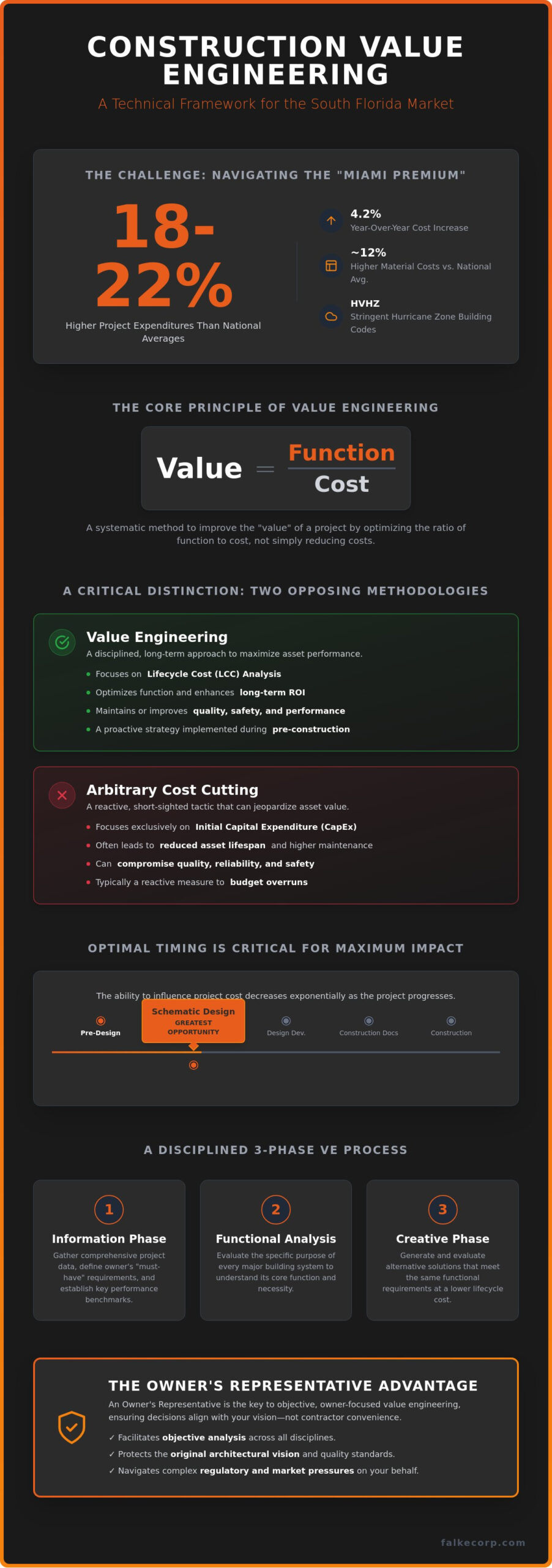
Project expenditures in South Florida frequently exceed national averages by 18% to 22%, creating a “Miami Premium” that can destabilize even the most robust pro forma. This economic reality makes construction value engineering Miami not merely a strategic choice, but a technical necessity for owners navigating the 9th Edition of the Florida Building Code and a 4.2% year-over-year increase in construction costs. You likely recognize that protecting a project’s financial viability requires a methodical approach to function optimization rather than reactionary budget cuts that might jeopardize the asset’s long-term value.
This guide provides the professional framework required to optimize project expenditures and enhance asset performance without compromising structural safety or the original architectural vision. We will detail the methodology for identifying genuine cost-saving opportunities, managing Miami-Dade’s specific regulatory hurdles, and ensuring superior ROI through precise development management and pre-construction oversight. By focusing on technical competence and disciplined process management, owners can secure the stability and quality their investments demand in this complex market.
Key Takeaways
- Understand how construction value engineering Miami focuses on optimizing the ratio of function to cost rather than implementing arbitrary budget reductions that compromise project quality.
- Learn to navigate the specific technical complexities of the Florida Building Code and high-velocity hurricane zone requirements while maintaining project pro forma stability.
- Discover why the schematic design phase represents the most critical window for implementing a value engineering study to maximize cost-efficiency and protect design integrity.
- Identify the strategic advantages of utilizing an Owner’s Representative to facilitate objective analysis, ensuring project decisions align with your vision rather than contractor convenience.
- Shift your focus from initial capital expenditure to comprehensive lifecycle costs to ensure long-term ROI and reduced operational overhead for your South Florida asset.
What is Construction Value Engineering in the Miami Market?
The technical discipline of construction value engineering Miami is governed by a fundamental mathematical ratio where Value equals Function divided by Cost. It’s a systematic, organized approach to providing necessary functions in a project at the lowest cost without sacrificing performance, reliability, or safety. To grasp the historical and theoretical framework of this discipline, it’s helpful to understand What is Value Engineering in a broader industrial context. In the specific landscape of South Florida development, this process isn’t merely a cost-saving exercise; it’s a strategic necessity used to protect the project pro forma against volatile market conditions.
The “Miami Premium” represents a significant financial hurdle for owners. With project expenditures in this region frequently exceeding national averages by 18% to 22%, the margin for error is exceptionally thin. This premium is driven by high material costs, which sit approximately 12% above the national average, and the stringent demands of the High-Velocity Hurricane Zone (HVHZ) building codes. An Owner’s Representative facilitates the cross-disciplinary workshops required to navigate these pressures, bringing together architects, engineers, and stakeholders to analyze every building system through the lens of functional utility. While construction-phase adjustments often occur as reactive measures to budget overruns, true value engineering is most effective during pre-construction services, where design modifications can be implemented without the heavy penalties of rework or permitting delays.
The Core Objectives of Value Engineering
The primary objective is the identification and elimination of non-essential costs that fail to contribute to the asset’s revenue-generating potential or operational efficiency. In the aggressive timelines typical of Miami’s development cycles, improving constructability is paramount. By simplifying complex structural transitions or optimizing material staging, we can reduce labor hours and mitigate the risk of liquidated damages. For high-end retail and hospitality projects, the challenge lies in maintaining the haptics and aesthetic standards required by luxury brands while substituting underlying technical components with more cost-effective, high-performance alternatives.
The Technical Methodology: Beyond the Surface
A rigorous VE study follows a structured sequence of phases. During the information phase, the team gathers comprehensive project data to define the owner’s “must-have” requirements and performance benchmarks. This is followed by functional analysis, where we evaluate the specific purpose of every major building system; for example, asking if a specified HVAC configuration is the most efficient way to achieve the required climate control. Finally, the creative phase involves generating alternative solutions that meet the same functional requirements. This structured approach ensures that every decision is backed by technical data rather than subjective preference, providing a stable foundation for long-term asset performance.
Value Engineering vs. Cost Cutting: Protecting Your Asset
Distinguishing between arbitrary cost-cutting and the disciplined application of construction value engineering Miami is essential for the fiscal health of any South Florida development. Traditional cost-cutting focuses exclusively on the immediate reduction of initial capital expenditure (CapEx). This short-sighted approach often leads to a cycle of deferred maintenance and a significantly reduced asset lifespan. In contrast, value engineering utilizes a comprehensive lifecycle cost (LCC) analysis. This methodology evaluates the total cost of ownership over the asset’s entire functional existence. The Federal Acquisition Regulation on Value Engineering provides a professional framework for this distinction, emphasizing that the process must maintain required performance, reliability, and quality while reducing total cost.
Relying on contractor-led value engineering carries inherent risks for the owner. A general contractor’s primary incentive often aligns with ease of execution or immediate profit margins rather than the long-term performance of the building envelope. They might suggest substituting a specified mechanical component for a cheaper alternative that meets the bare minimum of the current code but lacks the durability to handle Miami’s corrosive salt air. Engaging a specialist in owner’s representation provides an objective layer of technical oversight. This ensures that every proposed change is scrutinized for its impact on the project’s long-term operational budget and design intent.
The Pitfalls of Traditional Cost-Cutting
In the Miami market, cutting corners on mechanical systems is a high-risk strategy. Reducing the quality of HVAC components to save on CapEx frequently results in inadequate humidity control, which leads to mold issues and accelerated degradation of interior finishes. Substituting high-performance finishes in hospitality environments with inferior materials often results in visible wear within months of opening. These “cheap” substitutions rarely provide true savings; they typically trigger expensive change orders during the construction phase or require premature replacement shortly after commissioning.
How Value Engineering Enhances ROI
Strategic construction value engineering Miami focuses on modifications that actually improve the asset’s revenue potential. For instance, optimizing the structural grid through advanced engineering can reduce column diameters, directly increasing leasable square footage. Selecting high-performance, energy-efficient glazing may involve a higher initial cost, but it significantly reduces the building’s cooling load and utility overhead for decades. Consider the mathematical logic: a $50,000 investment in superior roofing membranes or impact-rated systems can prevent $500,000 in cumulative maintenance and insurance premiums over a ten-year period. This data-driven approach accelerates the path to “Revenue Ready” status while securing the project’s permanent financing terms through demonstrated stability.
Miami-Specific Value Engineering Considerations
Executing construction value engineering Miami requires a deep understanding of the High-Velocity Hurricane Zone (HVHZ) requirements, which are among the most stringent in the United States. The upcoming 9th Edition of the Florida Building Code, effective December 31, 2026, incorporates updated ASCE 7-22 wind-load standards that will fundamentally shift structural cost profiles. Finding the value “sweet spot” involves more than meeting minimum safety standards; it requires a technical analysis of resilience versus insurance premiums. For a comprehensive perspective on how these principles apply across a project’s lifecycle, the Whole Building Design Guide to Value Engineering serves as an essential reference for technical teams seeking to balance performance with fiscal discipline.
Local labor market dynamics also dictate the selection of construction methodologies. With a projected national need for 499,000 new workers in 2026, the scarcity of specialized trades in South Florida influences the choice between cast-in-place concrete and tilt-up construction. While cast-in-place offers maximum design flexibility for luxury high-rises, tilt-up methods can significantly reduce labor hours and accelerate schedules for industrial or mid-rise commercial assets. A rigorous value study evaluates these methods against current prevailing wage rates, which for specific trades like pipefitters in Miami-Dade can exceed $43.00 per hour before benefits, ensuring the chosen path aligns with the project’s logistical and financial constraints.
The Impact of South Florida’s Climate
Miami’s extreme latent heat loads demand mechanical systems with superior dehumidification capabilities. Selecting HVAC configurations that prioritize moisture control prevents the degradation of interior finishes and reduces long-term operational costs. Coastal environments also require a specialized focus on material durability to mitigate the effects of salt-spray corrosion on exposed structural elements and glazing systems. A resilient, moisture-resistant building envelope is a fundamental technical requirement for any asset located within the Miami-Dade coastal boundary.
Regulatory and Logistical Efficiency
Value engineering can streamline the complex Miami building permit process by identifying design elements that might trigger lengthy reviews or specialized flood-plain approvals. For projects in dense urban corridors like Brickell or the Miami Design District, logistical planning is a critical component of value. Optimizing material deliveries and staging areas reduces the overhead associated with tight site constraints. Owners should coordinate with pre-construction services Miami to identify these early wins, ensuring that the project remains compliant with local mandates while maintaining a lean execution strategy.
A 5-Step Process for Implementing VE in South Florida
The successful implementation of construction value engineering Miami requires a methodical framework that prioritizes technical data over anecdotal evidence. This process is most effective when initiated during the Schematic Design phase, as the flexibility to modify building systems remains high while the cost of implementation remains relatively low. As the project’s neutral facilitator, the Owner’s Representative coordinates a diverse team of architects, MEP engineers, and specialized consultants, ensuring that every functional requirement is achieved through the most efficient technical means. This structured approach prevents the fragmented decision-making that often compromises project integrity in high-pressure markets.
Phase 1: The Multi-Disciplinary Workshop
The workshop begins by deconstructing the preliminary budget into functional “cost centers” rather than simple line items. This allows the team to brainstorm alternatives without the immediate constraints of the current design, fostering a creative environment where technical experts can challenge established assumptions. We distinguish between “low-hanging fruit”—such as minor material substitutions that offer immediate savings—and “strategic shifts,” which might involve re-engineering the structural system or centralizing mechanical plants to reclaim leasable space and improve long-term utility overhead.
Phase 2: Technical and Financial Validation
Every proposed alternative undergoes a rigorous technical and financial validation process. This stage involves a granular cost-benefit analysis and close coordination with construction project management Florida experts to assess real-world feasibility and market availability. A critical component of this validation is verifying that proposed changes don’t trigger a full re-permitting cycle with Miami-Dade County authorities, as the resulting delays could easily negate any projected capital savings. Every decision is weighed against its impact on the project’s lifecycle cost and revenue-ready timeline.
The culmination of this systematic inquiry is the “Value Proposal” report, a comprehensive, data-driven document that presents the owner with categorized options. This report details the projected impact on initial capital expenditure, long-term operational costs, and the overall project schedule. Once the owner approves specific measures, the final step involves implementation and tracking to ensure that value-engineered decisions are accurately integrated into the construction documents. This persistent oversight prevents the “value erosion” that often occurs during the transition from design to execution. To secure the financial stability of your next development through expert oversight, explore our comprehensive Owner’s Representation services.
The Owner’s Representative: The Key to Objective Value Engineering
The integrity of construction value engineering Miami often hinges on the objectivity of its facilitator. While General Contractors provide essential field expertise, their recommendations frequently lean toward construction methods that simplify their own logistical burden or reduce labor-intensive details. This inherent bias can lead to the erosion of complex architectural features that define a project’s market position. An Owner’s Representative serves as an essential counterweight, acting as the guardian of the original design intent and project vision. By maintaining a technical distance from the profit motives of the build team, the representative ensures that every proposed substitution is evaluated solely on its ability to enhance the owner’s long-term asset value.
FALKE employs a rigorous four-phase methodology that integrates value engineering from initial concept through final commissioning. This structured oversight ensures that transparency remains paramount throughout the development lifecycle. Without independent supervision, “value savings” can sometimes be obscured by hidden markups or used to offset contractor-driven cost overruns in other areas. We provide the technical competence required to audit every proposal, ensuring that the owner receives the full financial benefit of every optimization. This disciplined approach transforms a potentially contentious process into a collaborative effort focused on technical excellence and fiscal stability.
Maintaining the Design Vision
Maintaining the Design Vision requires a delicate mediation between the architect’s aesthetic ambitions and the project’s budget reality. In luxury retail and hospitality sectors, brand identity is non-negotiable; an Owner’s Rep protects these critical elements from being value-engineered into mediocrity. We analyze the functional purpose of high-end finishes and structural systems to find alternatives that preserve the haptic quality and visual impact while reducing procurement costs. For deeper insights into this technical advocacy, owners should refer to our comprehensive guide on Owner’s Representative Miami.
Realizing Financial Control
Realizing Financial Control involves an independent audit of all savings generated through the VE process. This verification ensures that credits are accurately captured and applied to the project’s bottom line rather than being absorbed into contractor contingencies or undisclosed fees. Our Real estate development management services ensure that every technical decision aligns with the owner’s ultimate exit strategy, whether that involves long-term hold or immediate divestment. True value engineering is a proactive risk management tool, not a reactive budget fix. By identifying potential failure points in the building envelope or mechanical systems early, we prevent the catastrophic costs associated with post-occupancy remediation in Miami’s demanding climate.
Securing Your Project’s Financial and Technical Future
A disciplined approach to construction value engineering Miami is the most effective safeguard against the region’s volatile material costs and stringent regulatory environment. By prioritizing function over arbitrary cost reductions, owners can protect their project’s pro forma while maintaining the high aesthetic standards required in the luxury retail and hospitality sectors. The process demands technical precision and an unwavering commitment to lifecycle performance, ensuring that every building system contributes to the asset’s long-term stability and revenue potential.
FALKE provides the specialized experience and independent advocacy necessary to navigate these complexities with 100% transparency. Our disciplined four-phase methodology ensures that value engineering remains a proactive risk management tool rather than a reactive budget fix. We take full responsibility for the technical integrity of your project, ensuring that every optimization aligns with your ultimate exit strategy and brand identity. Your investment deserves the security that only expert, objective oversight can provide.
Ready to optimize your asset’s performance? Request a Strategic Value Engineering Consultation to ensure your development meets the highest professional standards. We look forward to securing the success of your next South Florida project.
Frequently Asked Questions
Is value engineering the same as cost cutting?
No, value engineering isn’t the same as cost cutting. While cost cutting focuses strictly on reducing initial capital expenditure by removing features or lowering material quality, construction value engineering Miami focuses on the ratio of function to cost. The objective is to maintain or improve performance while identifying more efficient technical solutions that protect the project’s long-term asset value.
When is the best time to perform value engineering on a Miami project?
The most effective time to perform a value study is during the Schematic Design phase. At this stage, the project’s building systems and structural grid aren’t yet finalized, allowing for significant optimizations without the heavy penalties of rework. Implementing changes during later phases often triggers permitting delays or expensive redesign fees that can negate any projected savings.
Can value engineering reduce the quality of my building?
Professional value engineering shouldn’t reduce the quality of your asset. In fact, a disciplined study often identifies superior materials or systems that offer better long-term durability in Miami’s corrosive coastal environment. The goal is to eliminate non-essential costs that don’t contribute to the revenue-generating potential or structural integrity of the development.
How much can I expect to save through professional value engineering?
Savings vary based on project complexity and the timing of the study. While specific figures depend on the individual asset, the identification of more efficient structural methods or mechanical systems often generates savings that far exceed the cost of the study itself. These optimizations also reduce long-term operational overhead and can lower insurance premiums through increased resilience.
Does value engineering require a full redesign of my project?
A value engineering study doesn’t typically require a full project redesign. Instead, it focuses on targeted adjustments to specific building systems, such as HVAC configurations or structural transitions. These refined solutions are integrated into the existing architectural vision to improve constructability and financial performance without discarding the original design intent or project identity.
How does an Owner’s Representative help with value engineering?
An Owner’s Representative serves as a neutral facilitator who ensures that the value engineering process remains objective and transparent. They audit contractor proposals to prevent hidden markups and ensure that every technical decision aligns with the owner’s strategic goals. This independent oversight is critical for maintaining the balance between high-end aesthetic standards and budget realities.
Will value engineering delay my construction schedule?
When integrated early in the pre-construction phase, value engineering often accelerates the schedule by identifying methods that improve constructability. By simplifying complex assemblies and optimizing material staging, the build team can reduce labor hours and avoid the logistical bottlenecks common in dense Miami corridors like Brickell or the Miami Design District.
Is value engineering worth the consultant fee for smaller projects?
Value engineering is highly beneficial for smaller projects in the South Florida market due to the high material and labor costs. Even minor technical optimizations can provide a substantial return on investment by reducing the “Miami Premium.” It’s important to note that Miami-Dade County requires a formal value analysis report for all capital projects with construction costs estimated at $1 million or greater.