
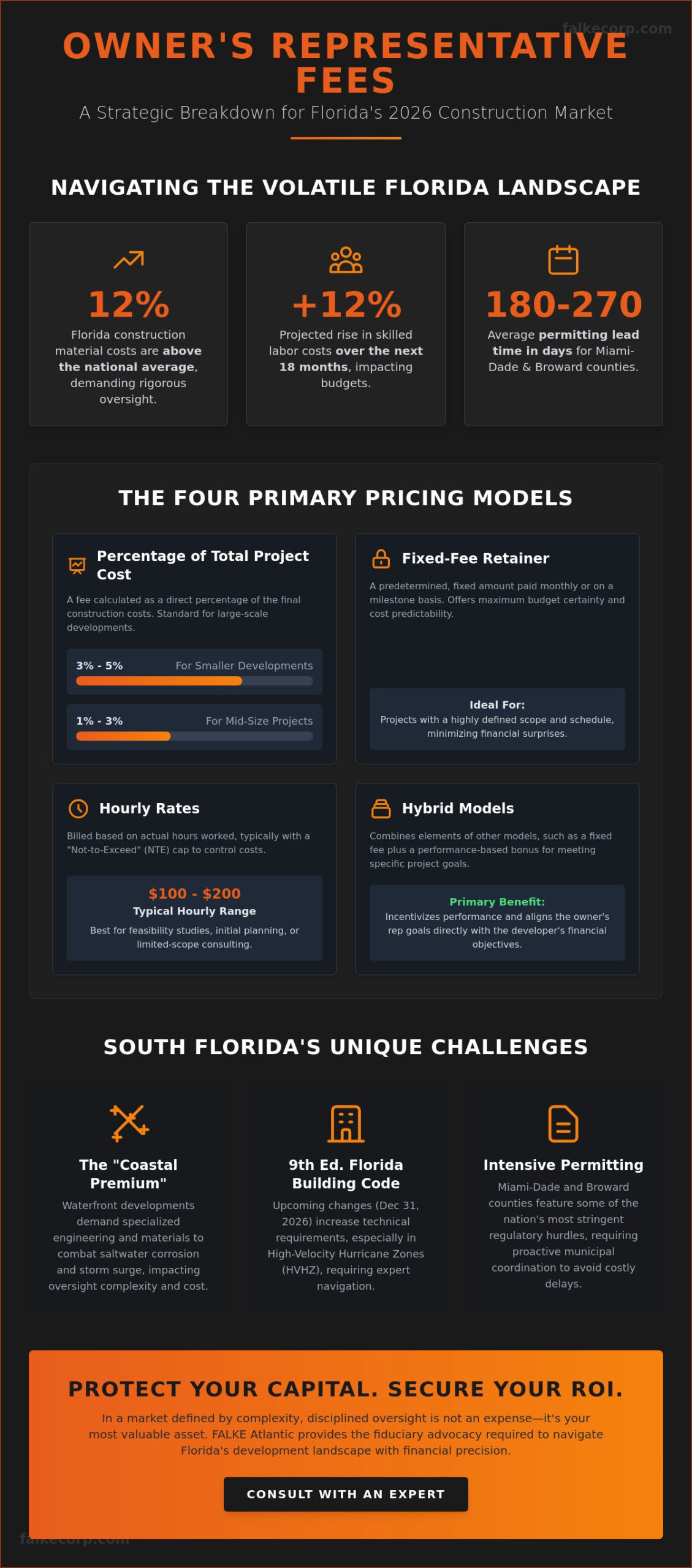
With construction material costs in Florida currently sitting 12% above the national average, the most expensive line item on a 2026 South Florida capital project isn’t the concrete or the steel; it’s the financial leakage caused by undisciplined oversight. You’ve likely experienced the frustration of hidden project costs and the ambiguity that often exists between project management and fiduciary owner’s representation. In a market where skilled labor costs are projected to rise by 12% over the next 18 months, understanding the prevailing fee structures for owner’s representatives in Florida is a technical necessity for maintaining project viability.
This strategic guide provides a professional breakdown of these calculations, offering the clarity needed to navigate the 180 to 270 day permitting lead times and the upcoming 9th Edition of the Florida Building Code. We’ll examine why mid-size projects typically command fees between 1% and 3% of total costs, while smaller developments often require a 3% to 5% allocation to ensure rigorous risk mitigation. By analyzing the four primary pricing models, including fixed monthly retainers and hourly rates ranging from $100 to $200, we’ll outline a framework for predictable capital expenditure in the volatile South Florida landscape.
Key Takeaways
- Identify the most advantageous fee structures for owner’s representatives in Florida by analyzing project complexity and the 2026 construction cost landscape.
- Distinguish between percentage-based models and fixed-fee retainers to establish a transparent budgetary framework that prevents unforeseen management expenses.
- Navigate the stringent regulatory hurdles of Miami-Dade and Broward counties, including the technical requirements of the 9th Edition Florida Building Code.
- Quantify the impact of the “Coastal Premium” on waterfront developments to ensure your oversight strategy aligns with specialized engineering demands.
- Leverage a disciplined four-phase project management methodology to mitigate financial risks and secure the long-term ROI of high-value assets.
Understanding Owner’s Representative Fee Structures in Florida’s 2026 Market
In the context of high-stakes South Florida development, fee structures for owner’s representatives in Florida represent the contractual mechanism for securing professional advocacy across the project lifecycle. This is not merely a line item for administrative overhead; it’s a calculated investment in technical competence designed to protect an owner’s capital from the volatility of the 2026 market. With construction costs in the state rising by 4.2% annually, a disciplined fee structure provides the transparency required to prevent financial mismanagement or change order fraud. This framework is essential for projects operating within the broader Construction Management Overview, where the representative serves as the primary fiduciary advocate.
The distinction between overhead and value-add is critical when evaluating these costs. While a general contractor manages the physical assembly of the structure, the owner’s representative manages the risk associated with that assembly. By implementing a transparent fee structure for owner’s representatives in Florida, developers ensure that their representative’s interests are decoupled from the contractor’s volume of work. This independence is what allows the representative to identify and mitigate hidden project costs before they impact the final balance sheet.
The Fiduciary Role of the Owner’s Representative
The owner’s representative maintains a strict fiduciary duty to act solely in the best interest of the developer, providing a level of loyalty that a standard vendor-contractor relationship cannot offer. This role transcends a typical vendor relationship, evolving into a strategic partnership where the representative takes full responsibility for the project’s financial health. When fees are properly aligned with project outcomes, the representative is incentivized to minimize waste and optimize the construction schedule, directly protecting the project’s bottom line from inflationary pressures.
Why Florida Projects Require Specialized Pricing
Florida’s 2026 regulatory environment demands specialized pricing models due to the extreme technical requirements of the High-Velocity Hurricane Zone standards. As the 9th Edition of the Florida Building Code approaches its December 31, 2026 implementation date, the complexity of structural and energy provisions has increased the necessary oversight hours for every major development. In Miami-Dade and Broward counties, where permitting lead times currently average 180 to 270 days, the fee must account for intensive municipal coordination and proactive risk management. Additionally, with skilled labor costs in South Florida projected to rise by 12% over the next 18 months, the representative must exert more rigorous control over resource allocation to maintain the project’s original financial trajectory.
The Four Primary Pricing Models for Florida Owner’s Reps
Selecting the appropriate fee structures for owner’s representatives in Florida requires a technical evaluation of the project’s risk profile and administrative complexity. Developers in the South Florida corridor typically utilize four distinct pricing mechanisms to ensure fiduciary alignment and financial transparency. The Percentage of Total Project Cost (TPC) remains the industry standard for large scale developments, while Fixed-Fee Retainers offer maximum budget certainty for projects with highly defined parameters. For initial feasibility studies or limited consulting scopes, Hourly Rates with a Not-to-Exceed (NTE) Cap are frequently employed. Finally, Hybrid Models integrate these approaches to incentivize specific performance milestones and align the representative’s goals with the owner’s financial objectives.
The choice between these models often depends on the level of certainty in the project’s scope and the anticipated duration of the construction lifecycle. While hourly rates of $100 to $200 provide flexibility for early-stage planning, they lack the long-term cost predictability required for multi-year capital projects. This is why institutional developers often pivot toward fixed or percentage-based models once the project moves beyond the conceptual phase. These structures ensure that the cost of professional oversight is locked in, preventing management-level inflation from eroding the project’s contingency funds.
Percentage-Based Fees: 2026 Benchmarks
In the Miami and Fort Lauderdale markets, professional oversight fees for 2026 generally range between 1.5% and 4% of the total project cost. The specific placement within this spectrum is determined by the project’s technical complexity and the intensity of the required municipal coordination. High-density residential towers in urban centers often command higher percentages due to the rigorous oversight needed for HVHZ compliance and sophisticated structural engineering. Conversely, large scale industrial programs often benefit from lower percentage rates because the economies of scale allow the representative to spread administrative costs across a wider capital base. This logic is often reflected in Federal Owner’s Representative Contracts, which establish clear precedents for professional service procurement based on project magnitude and complexity.
Hybrid and Performance-Based Structures
Hybrid models represent a sophisticated evolution in fee structures for owner’s representatives in Florida, combining a base retainer with performance-based ‘Success Fees.’ These incentives are typically tied to quantifiable budget savings or the acceleration of the construction schedule without compromising quality standards. Such structures balance risk by ensuring the representative is compensated for their foundational oversight while being rewarded for exceptional financial engineering. This model is particularly effective when transitioning from pre-construction services Miami to the active construction phase. By establishing a fixed fee for the initial planning and a success-based component for the execution, owners can maintain strict control over their ROI. If you are currently evaluating the financial framework for a new development, exploring a tailored management structure can provide the necessary stability for your capital investments.
Comparing Fee Models: Which Structure Protects Your ROI?
The technical efficacy of a fee model is measured by its ability to neutralize financial risk while maintaining management intensity throughout the construction lifecycle. In the 2026 South Florida market, where material costs remain 12% above national averages, selecting the wrong contractual framework can lead to significant budgetary erosion. Fee structures for owner’s representatives in Florida aren’t merely payment schedules; they’re risk-mitigation instruments. Fixed-fee retainers are particularly effective at preventing scope creep within management services, as they lock in the cost of oversight regardless of administrative fluctuations. Conversely, hourly models present a distinct risk in the Miami-Dade permitting environment. With municipal lead times averaging 180 to 270 days, an uncapped hourly structure can quickly exhaust a project’s soft-cost contingency during protracted regulatory delays. Adherence to the CMAA Standards of Practice ensures that the chosen pricing model reflects the professional rigor required for complex industrial and commercial assets, providing a baseline for fiduciary accountability.
Fixed Fee vs. Percentage: A Strategic Comparison
Budget predictability is the primary advantage of the fixed-fee model, making it the preferred choice for projects with a strictly defined scope and a predictable timeline. However, the inherent complexity of commercial project management Miami often necessitates the flexibility of a percentage-based alignment. Percentage models ensure the representative’s interests remain tied to the project’s total value, incentivizing them to manage the large-scale coordination required for HVHZ compliance. For complex hospitality or retail builds, the break-even point typically occurs when the project duration extends beyond 18 months, at which point a percentage-based fee often provides better value-to-cost ratios than a monthly retainer that doesn’t account for shifting project scales.
Fee Allocation Across Project Phases
A disciplined approach to capital management requires structuring payments according to the four phases of real estate development. This methodology involves front-loading a portion of the fee to cover the high-intensity pre-construction and entitlement work, where 80% of project savings are typically identified. As the project moves into the active construction phase, the fee structure should facilitate continuous site oversight and rigorous quality control. It’s essential that the final fee payments for commissioning and close-out are tied to the successful delivery of the asset. This ensures the representative remains technically engaged until the final certificate of occupancy is issued and all contractual obligations are met, securing the long-term stability of the investment.
By establishing these clear financial boundaries, developers can ensure that their fee structures for owner’s representatives in Florida act as a catalyst for project success rather than a source of fiscal uncertainty. The goal is a transparent, logic-driven arrangement that rewards technical precision and protects the owner’s capital from the volatility of the South Florida construction sector.
Regional Factors Influencing Owner’s Rep Costs in South Florida
Geographical location within the South Florida corridor directly dictates the resource allocation required for effective fiduciary oversight. The regulatory friction encountered in Miami-Dade and Broward counties is significantly higher than in other domestic markets, necessitating more intensive fee structures for owner’s representatives in Florida. These costs reflect the technical necessity of managing 180 to 270 day permitting lead times and the rigorous High-Velocity Hurricane Zone (HVHZ) standards. In Palm Beach County, the challenge shifts toward managing multi-jurisdictional entitlements, where a single development might require coordination across several municipal bodies, each with distinct structural and aesthetic requirements. This administrative complexity increases the necessary oversight hours, directly influencing the professional fee calculation.
Waterfront developments introduce a ‘Coastal Premium’ that further impacts the fee structure. These projects require more than standard management; they demand specialized engineering oversight to ensure compliance with stringent environmental and flood mitigation protocols. By 2026, professional liability insurance and bonding requirements for consultants have also become more substantial, reflecting the increased risk profile of the Florida construction market. These overhead costs are a necessary component of a professional fee structure, ensuring the owner is protected against professional negligence in a market where material costs sit 12% above the national average.
Regulatory Complexity and Oversight Hours
The implementation of Florida’s 2026 building safety and milestone inspection laws has fundamentally changed the staffing requirements for major projects. Sophisticated construction phase management Florida now requires higher-level staffing to manage the continuous documentation and technical verification mandated by these laws. A representative must dedicate significant hours to municipal coordination and the oversight of specialized structural inspections. This ensures that the project remains compliant with the 9th Edition of the Florida Building Code, which takes effect on December 31, 2026, and avoids the costly delays associated with late-stage regulatory corrections.
High-Net-Worth and Luxury Retail Standards
Ultra-luxury developments and high-end retail brands, such as Prada or boutique hospitality groups, require ‘White Glove’ representation that goes beyond standard project management. These clients often demand specialized reporting structures and real-time data access, particularly for out-of-state or international owners who cannot be physically present. Ensuring quality control in the Miami luxury market requires a representative with the technical expertise to manage high-specification finishes and complex integrated systems. This level of precision is essential for protecting the asset’s long-term value and ensuring the final delivery meets the exacting standards of the luxury sector. For owners seeking to secure their investments against these regional variables, consulting with a technical expert is the first step toward establishing a disciplined financial framework.
FALKE Atlantic: Disciplined Fee Structures for High-Value Developments
FALKE Atlantic operates on the principle that technical precision in management is the only viable defense against South Florida’s market volatility. Our fee structures for owner’s representatives in Florida are designed to reflect this reality, moving away from ambiguous estimates toward a disciplined, four-phase methodology for financial control. This approach ensures that every dollar allocated to professional oversight is tied to a specific, quantifiable project milestone. By integrating development management and construction oversight under a unified fee framework, we eliminate the communication gaps that often lead to budgetary leakage. Our Owner’s Representative Miami services are engineered to pay for themselves through aggressive risk mitigation. In an environment where skilled labor costs are projected to rise by 12% over the next 18 months, our proactive intervention prevents the cost overruns that typically derail high-value assets.
Transparency serves as the cornerstone of our financial engagement. We provide detailed, audit-ready reporting that gives owners a real-time view of their capital allocation. This level of documentation is essential for international investors and high-net-worth clients who require absolute clarity on project expenditures. Whether managing a luxury retail build-out for a global brand or a complex hospitality development, we customize our fee structures to align with the specific operational requirements of the asset. This ensures that the level of management intensity matches the technical complexity of the build, providing a balanced cost-to-benefit ratio. Our methodology accounts for the 4.2% year-over-year construction cost increase, ensuring that contingencies are managed with engineering-grade precision.
The FALKE Advantage in 2026
Our approach to managing revenue-ready assets focuses on technical competence and project stability. We understand that the South Florida market, with its 180 to 270 day permitting lead times, requires a representative who can maintain momentum through regulatory friction. By consolidating services under one fee structure, we provide a single point of accountability from pre-construction through commissioning. This model is particularly effective for navigating the structural provisions of the 9th Edition Florida Building Code, where specialized oversight is a prerequisite for successful delivery. We don’t just manage tasks; we take full responsibility for the project’s technical integrity and financial health.
Securing Your Project’s Financial Future
A well-structured fee is not a project expense but a strategic safeguard for your investment. By establishing clear financial boundaries and performance milestones, you ensure that your representative’s interests are perfectly aligned with your ROI. This disciplined framework is what allows FALKE Atlantic to deliver high-value developments on schedule and within the established budgetary parameters. We invite you to contact our team for a strategic consultation regarding your project management fees. Please reach out to our office to request a tailored quote for your Florida development and secure the professional oversight your capital deserves.
Optimizing Capital Efficiency in the 2026 South Florida Market
Securing a project’s financial trajectory in the volatile South Florida landscape requires more than standard oversight; it demands a technical alignment between professional fees and project complexity. As established throughout this guide, the 4.2% year-over-year increase in construction costs and the impending implementation of the 9th Edition Florida Building Code on December 31, 2026, necessitate a disciplined approach to fiduciary management. Navigating the technical nuances of fee structures for owner’s representatives in Florida is the first step toward neutralizing the risks inherent in Miami-Dade and Broward County developments. By selecting a pricing model that reflects the specific regulatory friction of your site, you ensure that management intensity remains consistent through the 180 to 270 day permitting lead times common in the region.
FALKE Atlantic provides the stability required for hospitality, retail, and high-net-worth developments through our disciplined four-phase methodology. We act as a strategic partner, ensuring that your capital is protected by technical competence rather than mere administrative tracking. Our expertise in local regulations allows us to turn management costs into a primary driver of project ROI. We invite you to Schedule a Consultation with FALKE Atlantic to Structure Your Project’s Success and secure a predictable future for your Florida assets. Your vision deserves the precision of engineering-grade oversight.
Frequently Asked Questions
What is the typical percentage fee for an owner’s rep in Miami?
The typical fee for an owner’s representative in Miami generally ranges between 1.5% and 4% of the total project cost. For mid-size developments, this often settles in the 1% to 3% range, while smaller, technically complex projects may reach the 5% threshold. These rates reflect the intensive oversight required for HVHZ compliance and the 180 to 270 day permitting lead times common in South Florida.
Do owner’s representative fees cover the cost of third-party inspections?
No, owner’s representative fees typically don’t cover the direct costs of third-party inspections, such as structural testing or environmental assessments. These are considered project soft costs and are usually paid directly by the owner or treated as pass-through expenses. The representative’s fee covers the professional management and technical coordination of these inspectors to ensure compliance with the 9th Edition Florida Building Code.
How do owner’s rep fees differ from general contractor overhead?
General contractor overhead covers the costs of site-level operations, including field office maintenance and project supervision, whereas owner’s representative fees are for fiduciary oversight. While the GC focuses on the physical assembly of the structure, the representative manages the owner’s financial risk and contractual compliance. This distinction is critical for maintaining transparent fee structures for owner’s representatives in Florida that are decoupled from the contractor’s profit margins.
Can owner’s rep fees be financed as part of a construction loan in Florida?
Yes, owner’s representative fees are standard soft costs that can typically be financed as part of a construction loan in Florida. Lenders generally recognize these professional services as essential for risk mitigation, particularly in a market where skilled labor costs are projected to rise by 12% over the next 18 months. Including these fees in the loan budget ensures that professional oversight is maintained from pre-construction through final commissioning.
What happens to the fee structure if the project schedule is delayed?
The impact of project delays on the fee structure depends entirely on the contractual pricing model selected. In a fixed-fee retainer, a significant schedule extension may require a negotiated amendment to cover the additional oversight hours. Conversely, percentage-based fees remain stable unless the total project cost increases, though hybrid models often include clauses to address protracted delays in the Miami-Dade permitting process.
Are owner’s rep fees in Florida negotiable based on project size?
Yes, fee structures for owner’s representatives in Florida are negotiable and often benefit from economies of scale on larger developments. As project magnitude increases, the percentage fee typically trends downward toward the 1% to 1.5% range because administrative costs are spread across a larger capital base. Conversely, smaller projects require a higher percentage to cover the same baseline of technical expertise and municipal coordination.
What is the difference between a monthly retainer and a percentage-based fee?
A monthly retainer provides a fixed, predictable expense for defined management services, while a percentage-based fee is calculated as a portion of the total project cost. Retainers offer maximum budget certainty and are effective for preventing scope creep during the construction phase. Percentage models align the representative’s compensation with the project’s total value, incentivizing comprehensive financial oversight across all development phases.
Does an owner’s representative fee include pre-construction feasibility studies?
Pre-construction feasibility studies are often handled as a distinct phase with a separate fixed fee or hourly rate. While some comprehensive agreements include these services, many owners prefer to structure them independently to evaluate project viability before committing to a full-term representation contract. This phased approach allows for precise financial control during the high-intensity entitlement work required for South Florida developments.