
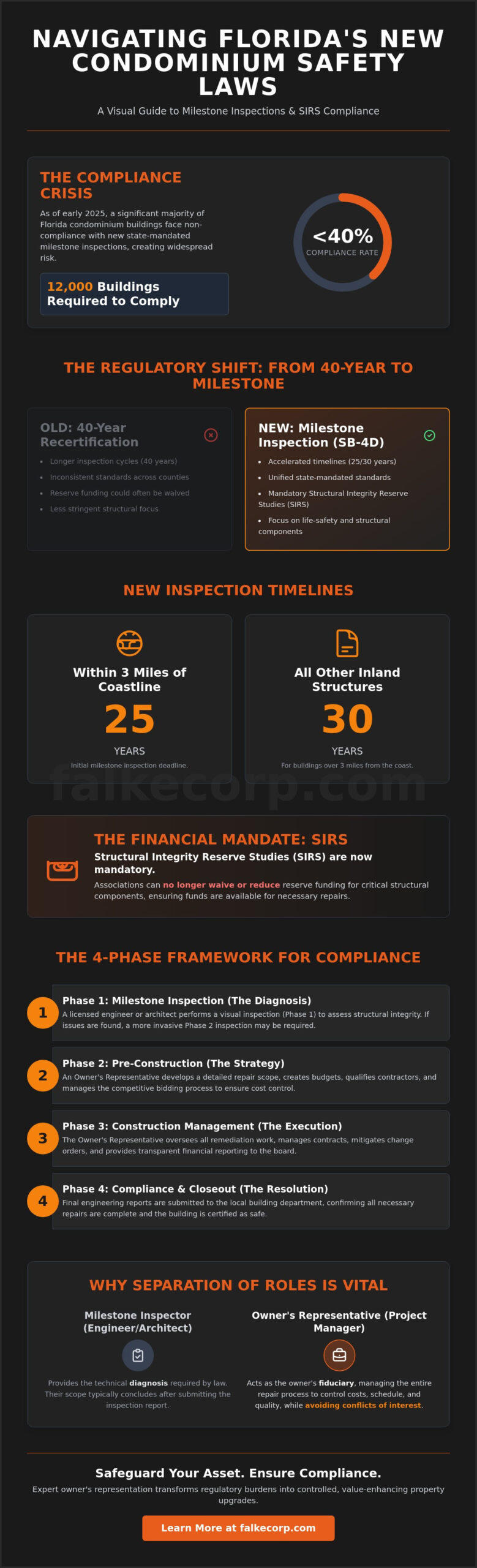
As of early 2025, less than 40% of the 12,000 Florida condominium buildings required to submit milestone inspection results had successfully met their compliance deadlines. This data reflects a systemic struggle to manage the technical and financial complexities introduced by Senate Bill 4-D and updated local ordinances. For many board members, the fear of staggering special assessments and the confusion surrounding new Structural Integrity Reserve Study (SIRS) mandates are a daily reality. You understand that these requirements are no longer simple administrative tasks; they’re high-stakes construction projects that demand rigorous oversight. Implementing a sophisticated approach to Florida 40-year recertification project management is the only way to safeguard your building’s structural integrity while maintaining strict fiscal control.
We recognize that the transition from a visual Phase 1 inspection to a potentially invasive Phase 2 repair program is fraught with technical risks and the potential for costly change orders. This guide provides a strategic framework to transform these regulatory burdens into controlled asset improvements that protect property values. You’ll learn how professional owner’s representation bridges the gap between engineering reports and execution. We will detail the specific steps to achieve full compliance in Miami-Dade and Broward counties, minimize repair contingencies, and deliver the transparent financial reporting your stakeholders require for long-term stability.
Key Takeaways
- Understand the strategic shift from the traditional 40-year standard to the new 25/30-year milestone inspection requirements mandated by Florida law.
- Identify why separating the roles of Milestone Inspector and Owner’s Representative is vital for maintaining technical objectivity and avoiding conflicts of interest.
- Discover how expert Florida 40-year recertification project management utilizes pre-construction services to mitigate the financial impact of structural and electrical remediation.
- Examine a comprehensive four-phase framework designed to streamline compliance while delivering transparent reporting to condominium boards and stakeholders.
- Learn to leverage professional construction phase management to convert regulatory mandates into controlled, value-enhancing property upgrades.
Navigating the Florida Building Recertification Landscape in 2026
The current regulatory environment in Florida necessitates a paradigm shift for condominium boards and property owners. The transition from the legacy 40-year recertification model to the current Milestone Inspection framework represents a fundamental change in safety protocols. While Miami-Dade and Broward counties previously operated independent safety programs, state legislation now dictates a unified, more aggressive timeline for structural evaluations. As of 2026, the traditional 40-year benchmark has largely been superseded by 25 and 30-year thresholds. This accelerated schedule forces associations to confront structural aging much earlier than anticipated. Effective Florida 40-year recertification project management now requires a dual focus: maintaining compliance with local municipal codes while adhering to the mandates of the Florida Building Code. Geographic nuances remain critical; for example, Miami-Dade owners have 90 days from notice to submit reports, whereas Broward’s program allows 180 days for repair completion.
The Impact of SB-4D and SB-1702 on South Florida Owners
Legislative reforms SB-4D and SB-1702 eliminated the ability for local jurisdictions to opt out of state-mandated safety standards. This removal of local autonomy ensures that every building three stories or taller undergoes a Phase 1 milestone inspection. For structures located within three miles of the coastline, the initial inspection occurs at 25 years. Inland structures follow a 30-year cycle. These laws prioritize structural integrity over local administrative preferences, creating a mandatory pathway for building maintenance. Owners must recognize that failure to comply triggers significant penalties and potential building decertification. Since the 2024 deadline for older buildings has already passed, non-compliant properties don’t have the luxury of time. They face immediate enforcement actions and potential insurance cancellations if they haven’t submitted their results to the state.
Structural Integrity Reserve Studies (SIRS) and Recertification
The mandatory integration of Structural Integrity Reserve Studies (SIRS) into building management is a cornerstone of the 2026 landscape. Unlike previous years where associations could waive reserve funding, current law prohibits the reduction of reserves for critical structural components. This data serves as the technical foundation for the recertification repair budget. It ensures that funds are available for necessary remediation identified during inspections. Boards that don’t meet these funding requirements face personal liability and legal exposure. Professional Florida 40-year recertification project management utilizes SIRS data to forecast capital expenditures, preventing the need for emergency special assessments during the repair phase. This systematic approach transforms building maintenance from a reactive crisis into a structured financial strategy. By aligning the SIRS with the recertification cycle, owners can ensure their assets remain both safe and marketable in an increasingly stringent real estate market.
Why Recertification Requires Professional Project Management
While a Milestone Inspector provides the technical diagnosis required by the Miami-Dade County recertification program, their scope typically concludes at the report submission. Relying solely on an engineer leaves a leadership vacuum during the high-stakes repair phase. Professional Florida 40-year recertification project management fills this void by acting as a fiduciary for the building owner. Unlike “design-build” models where a single entity controls both the diagnosis and the cure, an independent project manager eliminates inherent conflicts of interest. This separation ensures structural remediation remains focused on safety and cost-efficiency rather than maximizing contractor profit margins. Without this independent oversight, owners often find themselves caught between an engineer’s theoretical repair and a contractor’s expensive field interpretation.
Selecting the right vendors is a rigorous process that boards shouldn’t navigate alone. A project manager vets general contractors not just for their license, but for their specific experience with high-rise structural repairs and their current bonding capacity. They ensure every bid is an “apples-to-apples” comparison, preventing the “low-ball” estimates that inevitably lead to expensive change orders later in the process. This disciplined approach to vendor selection is a cornerstone of a successful four-phase methodology, providing stability and predictability in an otherwise volatile construction market.
Bridging the Gap Between Engineering and Execution
Engineering reports are often dense with technical jargon and “fail” designations that don’t translate directly into construction tasks. A project manager deconstructs these deficiency reports into actionable bid packages that contractors can price accurately. This clarity is essential when responding to a “Notice of Violation.” Having an advocate during this period allows the association to present a structured remediation plan to building officials, which often secures necessary extensions. By aligning the design team’s specifications with the construction team’s field execution, the project manager prevents scope creep. It’s about ensuring every repair meets the 2026 standards without unnecessary additions.
The Owner’s Representative as a Strategic Partner
The financial implications of structural and electrical remediation can be devastating for associations. An Owner’s Representative protects the board’s interests against aggressive contractor pricing and technical errors. They manage the complex web of communications between the board, unit owners, and municipal building departments. This provides a single point of accountability for a process that can span several years. Engaging a dedicated project management consultant ensures the project moves through its phases with methodical precision. This strategic oversight doesn’t just manage a project; it protects the long-term viability of the community’s most valuable asset while ensuring the board’s decisions are backed by professional expertise.
Mitigating Financial and Operational Risks During Repairs
The transition from the inspection phase to active remediation represents the most volatile period for a building’s finances. Once the scaffolding is erected and the demolition of compromised concrete begins, the true extent of structural deterioration often exceeds the initial visual assessment. This is where Florida 40-year recertification project management becomes indispensable. Without a rigorous cost-control strategy, associations risk falling into a cycle of reactive spending and mounting debt. Effective management ensures that every repair task is verified against the engineer’s original scope and that all financial disclosures remain transparent for the stakeholders. Adhering to the administrative standards of programs like the City of Homestead building recertification program ensures that the project maintains a clear path toward municipal compliance while protecting the association’s reserves. We focus on stabilizing the budget before the first hammer swings.
Controlling Change Orders and Scope Creep
Structural repairs involving concrete spalling or post-tension cables are notoriously difficult to quantify before work starts. Contractors often discover hidden corrosion once the surface is removed, leading to immediate change order requests. A project manager implements a strict review process to validate these claims through technical evidence and field verification. Pre-construction services are vital here; they allow for selective demolition and more invasive testing to narrow the margin of error in initial bids. This proactive identification of hidden issues prevents the scope creep that typically inflates budgets by 20% or more. It’s about maintaining a barrier between the contractor’s field observations and the association’s checkbook.
Bidding and Negotiation for Recertification Projects
The South Florida market is currently saturated with contractors, but few possess the specialized expertise required for complex structural recertification. A disciplined bidding process avoids the trap of the “low-ball” bid, which frequently signals a contractor’s intent to recoup costs through aggressive change orders or subpar materials. We prioritize the negotiation of performance bonds and comprehensive insurance requirements to shift risk away from the building owner. This ensures the contractor is financially capable of finishing the project even if technical challenges arise. By analyzing bids through a technical lens, we ensure the board isn’t just buying a price, but a guaranteed outcome.
Beyond financial risk, the operational disruption to tenants is a significant concern during remediation. Structural work is inherently loud, dusty, and invasive, often requiring the temporary closure of balconies or restricted access to parking areas. A project manager coordinates these logistics to minimize the impact on daily life. They establish clear communication channels and work schedules that respect the residents’ needs while maintaining the project’s momentum. This structured approach preserves the quality of life for residents while the building undergoes its necessary technical evolution.
The 4-Phase Project Management Framework for Compliance
Successful building recertification is not a singular event but a multi-year technical cycle that requires methodological precision. For associations in South Florida, the path from receiving a “Notice of Required Recertification” to securing a final approval from the Building Official is fraught with administrative and structural hurdles. A disciplined framework for Florida 40-year recertification project management ensures that each stage of this cycle is handled with fiduciary oversight. By segmenting the process into four distinct phases, we eliminate the ambiguity that often leads to budget overruns and missed municipal deadlines. This structured approach allows boards to maintain control over their assets while professional experts manage the complex coordination between engineers, contractors, and building departments.
Phase 1 & 2: Setting the Foundation for Success
The initial phase begins with pre-development and inspection coordination. We manage the selection of licensed professionals to perform the Phase 1 visual inspection, which typically costs between $5,000 and $25,000 depending on the structure’s scale. If substantial structural deterioration is identified, we immediately transition into Phase 2, which involves detailed design, competitive bidding, and permitting. Navigating the building permit process in Miami-Dade or Broward County requires a deep understanding of local code variations. Our role involves developing a realistic project schedule that respects the 90-day report submission window or the 180-day repair completion deadline. We ensure that the design documents are technically sound and that the bidding process attracts qualified contractors who understand the nuances of the construction phase management requirements specific to high-rise remediation.
Phase 3 & 4: Execution and Final Approval
Once permits are secured, the project moves into construction oversight and quality control. This phase is the most critical for cost containment. Our on-site representation ensures that structural repairs, such as concrete restoration or electrical system upgrades, adhere strictly to the approved plans. We verify that infrared thermography is conducted for electrical systems of 400 amperes or greater, as now required by updated standards. In the final phase, we manage the commissioning and close-out process. This includes the submission of the final “Certificate of Compliance” to the Building Official and ensuring that all technical warranties are transferred to the board. We don’t consider a project complete until the municipality officially closes the violation and the building’s safety status is secured for the next ten-year cycle. To ensure your building meets these rigorous 2026 standards with minimal operational disruption, engage our expert owner’s representation and project management services today.
This four-phase methodology transforms a chaotic regulatory requirement into a predictable capital improvement project. By maintaining a single point of accountability throughout the design, permitting, and construction stages, associations can avoid the fragmented communication that typically plagues large-scale structural renovations. It’s a strategic investment in the building’s longevity and the board’s peace of mind.
FALKE Atlantic: Expert Owner’s Representation for Recertifications
FALKE Atlantic Corporation operates as a premier boutique consultancy, specializing in the management of high-value, complex assets throughout the state. We don’t just oversee a job site; we provide comprehensive owner’s representation that protects the technical and financial interests of the client. In the context of Florida 40-year recertification project management, our methodology-driven approach ensures that every phase of the process is executed with surgical precision. We understand that for revenue-ready assets, every day of delay or operational disruption translates into a direct loss of value. By acting as a strategic partner rather than a traditional construction manager, we maintain a focus on long-term stability and quality control. Our commitment to transparency ensures that boards and stakeholders receive detailed, accurate reporting throughout the multi-year compliance cycle.
The value of an expert partner lies in the ability to anticipate technical hurdles before they manifest as expensive change orders. While a standard manager might simply track a schedule, we analyze the underlying engineering data to verify that the remediation strategy is the most efficient path to compliance. This level of technical competence is what distinguishes our firm in a market often characterized by fragmented communication and misaligned incentives. We take full responsibility for the outcome, ensuring that structural remediation and electrical upgrades don’t just meet the minimum code, but preserve the premium positioning of the property.
Why Miami Asset Owners Trust FALKE
Miami’s most discerning asset owners, including high-net-worth individuals and luxury hospitality brands in areas like the Miami Design District, rely on our disciplined oversight. These stakeholders require a level of technical competence that transcends standard management practices. As a dedicated Owner’s Representative Miami, we bridge the gap between engineering theory and construction reality. Our experience with complex, revenue-generating structures allows us to manage high-stakes renovations without compromising the resident or guest experience. We focus on stability and quality, ensuring that even the most intricate structural repairs are completed to the highest professional standards.
Getting Started with Your Recertification Project
Proactive engagement is the most effective tool for mitigating the risks associated with building recertification. We recommend that associations and owners begin the planning process 12 to 24 months before their statutory deadline. This lead time is essential for conducting thorough pre-construction assessments and securing the most qualified vendors in a saturated market. When you engage FALKE for Construction Project Management Florida, you gain access to a structured workflow that prioritizes transparency and financial accountability. We provide the technical leadership necessary to navigate the complexities of 2026 compliance without compromising your building’s operational integrity. Contact FALKE Atlantic today for a strategic consultation to secure the structural and financial future of your asset.
Securing Structural Integrity Through Strategic Oversight
The transition from legacy safety programs to the modern milestone inspection framework requires a fundamental shift from reactive maintenance to proactive capital planning. Successfully navigating these mandates involves more than fulfilling a technical requirement; it necessitates a comprehensive strategy that integrates Structural Integrity Reserve Studies with rigorous construction cost control. By implementing a disciplined approach to Florida 40-year recertification project management, asset owners can transform a regulatory burden into a controlled process that preserves property value. Our methodology-driven oversight ensures that structural remediation and electrical upgrades are executed with the technical precision required for Miami-Dade and Broward compliance.
FALKE Atlantic specializes in representing high-net-worth and commercial asset owners who demand transparency and fiscal accountability. Our disciplined 4-phase methodology provides a structured pathway through the complexities of design, bidding, and construction oversight, ensuring that every project phase remains under professional scrutiny. This level of dedication protects your interests against contractor scope creep and technical errors. Secure Your Asset’s Future with FALKE Atlantic Representation and ensure your property remains a stable, compliant, and high-performing asset for years to come. Methodical preparation today is the only guaranteed safeguard against the uncertainties of tomorrow’s compliance deadlines.
Frequently Asked Questions
What is the difference between a 40-year recertification and a Milestone Inspection?
The traditional 40-year recertification was a local safety program specific to Miami-Dade and Broward counties. The Milestone Inspection is a statewide requirement established by Senate Bill 4-D for buildings three stories or taller. While the legacy program focused on a 40-year timeline, the new state mandate requires inspections at 25 years for coastal buildings and 30 years for inland structures. Most local jurisdictions have now integrated their 40-year programs into this stricter state framework.
How much does a 40-year recertification project management service cost?
Fees for professional project management are typically structured as a percentage of the total construction value or as a fixed monthly professional fee. These costs vary based on the technical complexity of the structural remediation and the anticipated duration of the project. Engaging professional oversight is a strategic expenditure designed to prevent the much larger costs associated with change orders, contractor fraud, and construction delays.
Can a condo board be held liable for failing to manage recertification repairs?
Yes, board members face significant legal exposure and potential personal liability for failing to address known structural deficiencies. Florida law now strictly prohibits associations from waiving or underfunding reserves for critical structural components. Failing to complete mandated repairs within the required timelines can result in building decertification, insurance cancellations, and lawsuits for breach of fiduciary duty.
What happens if my building fails its initial structural inspection?
If the Phase 1 visual inspection identifies “substantial structural deterioration,” the building must undergo a more intensive Phase 2 inspection. This phase involves destructive testing to determine the full extent of the damage. Owners are then required to submit a remediation plan and complete all necessary structural or electrical repairs to receive a final certificate of compliance from the building official.
How long does the entire recertification and repair process typically take in Miami?
The complete lifecycle from initial notice to final close-out usually spans 12 to 24 months. This timeline includes the inspection phases, the engineering design period, and the municipal permitting process, which is often the most significant bottleneck. Active construction for structural repairs can take several additional months depending on the extent of the concrete or electrical remediation required.
Do I need an Owner’s Representative if I already have a General Contractor?
Yes, because their roles are fundamentally different. A General Contractor manages their own labor and subcontractors to execute the work. An Owner’s Representative provides independent Florida 40-year recertification project management to ensure the contractor adheres to the budget and technical specifications. This oversight is vital for vetting change orders and ensuring that the owner’s financial interests remain protected throughout the renovation.
Which buildings in Florida are exempt from the 40-year or Milestone inspections?
Exemptions generally apply to single-family homes, duplexes, and any residential structures under three stories in height. Broward County also exempts certain structures that are less than 3,500 square feet. However, most condominium and cooperative buildings that meet the height threshold must comply with the state’s milestone inspection and reserve study requirements without exception.
How does the Structural Integrity Reserve Study (SIRS) affect my recertification?
The SIRS acts as the financial foundation for the technical repairs identified during the recertification process. It ensures that the association has the necessary funds to maintain structural components like the roof, load-bearing walls, and floor systems. By 2026, associations must align their reserve funding with the findings of their milestone inspections to ensure the long-term viability of the building.