
Entrusting the financial oversight of a multi-million dollar South Florida construction project to the same entity responsible for its physical execution creates an inherent conflict of interest that frequently compromises the owner’s capital. You’re likely already aware that navigating the transition to the 9th Edition of the Florida Building Code, with its expanded 160 mph impact-resistant envelope requirements, demands more than just a general contractor’s perspective. It requires a dedicated fiduciary. Understanding how to hire a project manager for my new build is not merely a task of filling a role; it’s a strategic move to decouple project management from the profit-driven motives of the construction site.
This guide provides the technical framework necessary to select an advocate who’ll protect your schedule, budget, and quality standards against the industry’s common pitfalls like change order fraud. You’ll master the process of vetting a professional who ensures your project is delivered revenue-ready while strictly adhering to Florida’s rigorous permitting timelines. We’ll examine how to align manager incentives with your specific goals, providing a clear roadmap for securing a partner who views your investment through a lens of absolute professional responsibility and technical precision.
Key Takeaways
- Identify the critical distinction between a General Contractor’s operational role and the fiduciary advocacy provided by an independent Owner’s Representative.
- Establish a rigorous technical vetting process to determine exactly how to hire a project manager for my new build based on engineering expertise and regional regulatory proficiency.
- Learn to utilize Statements of Qualifications (SOQ) to transition from subjective interviews to objective evaluations of a candidate’s technical competence.
- Analyze various fee structures to ensure professional incentives are logically aligned with the owner’s capital protection and total project cost objectives.
- Explore a structured four-phase management methodology that prioritizes the delivery of revenue-ready assets through disciplined pre-construction and close-out oversight.
Defining Construction Advocacy: Why You Need an Independent Project Manager
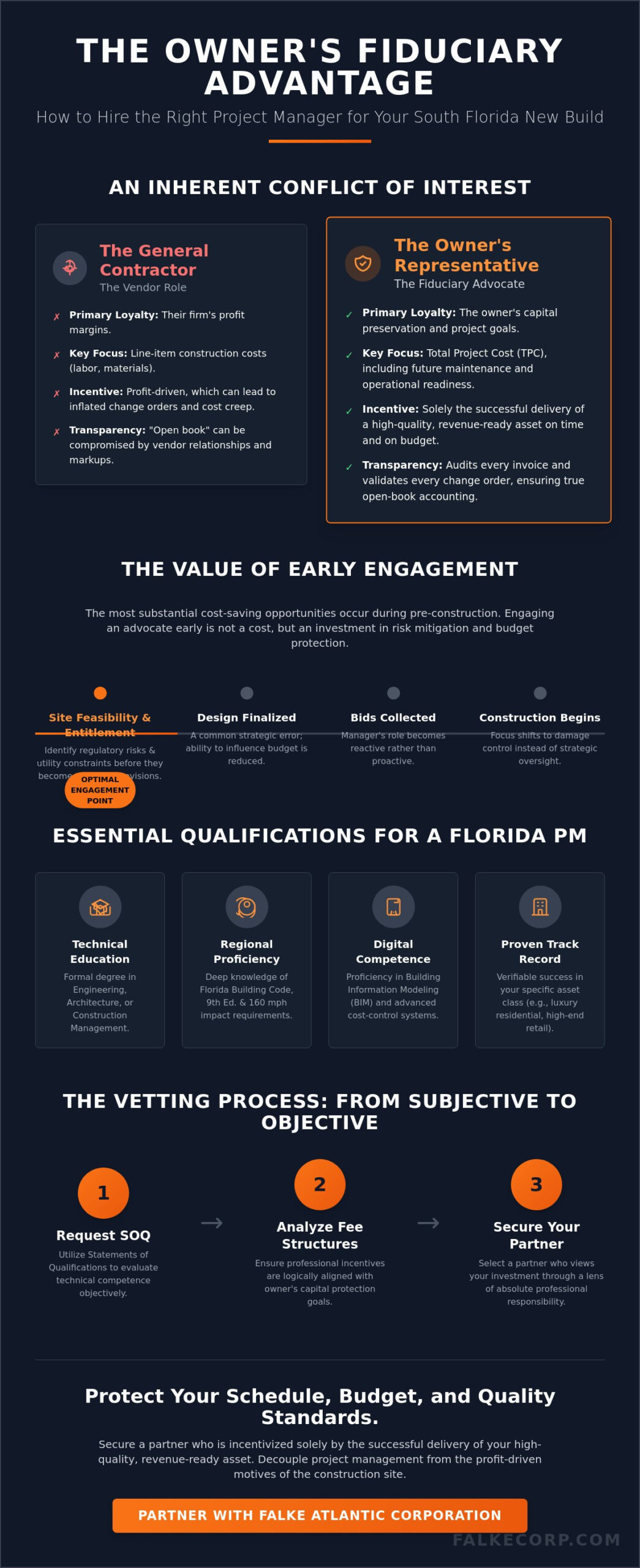
The traditional construction paradigm often conflates the physical execution of a project with its strategic oversight. This overlap creates a systemic conflict of interest. When a General Contractor manages the project budget, their primary loyalty lies with their firm’s profit margins, not necessarily your capital preservation. True advocacy requires a structural separation between the vendor and the supervisor. This is why understanding how to hire a project manager for my new build begins with recognizing project management as a professional fiduciary service rather than a construction trade. An independent advocate acts as a technical extension of your office, ensuring that every decision serves the project’s long-term viability rather than a contractor’s quarterly earnings.
Professional construction management focuses on the comprehensive lifecycle of the asset, prioritizing the Total Project Cost (TPC) over simple line-item expenses. While a contractor is concerned with the cost of labor and materials, a dedicated project manager evaluates how those choices impact insurance premiums, future maintenance, and operational readiness. This disciplined oversight transforms construction from a series of reactive events into a controlled, professional process where data drives every milestone.
The Fiduciary vs. The Vendor
An independent Owner’s Representative maintains no financial interest in the specific labor or materials selected for the project. This independence is the only mechanism that allows for authentic “open-book” transparency. Unlike a manager employed by the General Contractor, a fiduciary advocate audits every invoice and validates every change order against the original contract scope. They manage all third-party vendor relationships, including the architect and engineering teams, to ensure that design intent doesn’t lead to unnecessary cost creep. By removing the profit motive from the management layer, you gain a partner who’s incentivized solely by the successful delivery of a high-quality, revenue-ready asset.
When to Hire: The Value of Early Engagement
Timing is the most significant variable in determining the return on investment for professional management services. Engaging an advocate after the design is finalized or the bids are collected is a common strategic error that limits the manager’s ability to influence the budget. The most substantial cost-saving opportunities occur during the pre-construction phase. If you’re researching how to hire a project manager for my new build, the optimal window is during site feasibility and the entitlement process. Early integration allows your manager to identify regulatory risks and utility constraints before they become expensive mid-construction revisions. This proactive approach ensures that the project’s technical foundation is sound and that all subsequent vendor incentives are correctly aligned from the moment the first permit is filed.
Essential Qualifications: What to Look for in a Florida Construction Manager
Determining how to hire a project manager for my new build requires a shift from evaluating personality to auditing technical credentials. A high-tier manager must possess a formal foundation in Engineering, Architecture, or Construction Management. This academic background provides the necessary framework for understanding structural integrity, mechanical systems, and material science. Beyond degrees, proficiency in Building Information Modeling (BIM) and advanced cost-control systems is mandatory for modern projects. A manager who cannot navigate digital project management platforms will struggle to maintain the transparency required for a fiduciary relationship. You should seek a professional with a proven track record in your specific asset class, whether that’s high-end retail or luxury residential—sectors where teams like Steve Kooner & Associates provide specialized expertise—to ensure they understand the unique operational requirements of a revenue-ready delivery.
When researching how to hire a construction project manager, it’s essential to prioritize those who demonstrate a mastery of local market dynamics. This includes familiarity with regional labor rates, which in Florida have averaged between $42 and $58 per hour in early 2026. This data-driven approach ensures that your manager can accurately benchmark contractor bids against current market realities.
Navigating the South Florida Regulatory Landscape
South Florida’s construction environment is governed by some of the most stringent regulations in the nation. A qualified manager must be deeply familiar with the 9th Edition of the Florida Building Code, which takes effect on December 31, 2026. This update includes the critical expansion of the 160 mph impact-resistant envelope requirement to new residential builds within five miles of tidal waters. Navigating the permitting bottlenecks in Miami-Dade and Broward counties requires more than just following a checklist. It demands established relationships with municipal reviewers and a strategic understanding of utility provider lead times. A local expert anticipates these delays, integrating them into the master schedule to prevent revenue loss.
Soft Skills and Strategic Leadership
While technical skills are non-negotiable, the ability to exercise strategic leadership in high-pressure environments defines the most effective advocates. Construction sites are prone to friction; a manager must resolve conflicts between trades without compromising the owner’s schedule. They must also possess the financial acumen to move beyond simple cost-tracking. True Project Management involves active cost-avoidance, where the manager anticipates potential change orders and mitigates them before they impact the capital stack. This leadership extends to executive reporting, where complex site data is distilled into actionable information for the owner’s office. By ensuring that technical details are translated into strategic insights, the manager maintains the project’s alignment with your long-term investment goals.
The Vetting Process: How to Interview and Evaluate Candidates
Selecting a fiduciary advocate is a disciplined audit of technical reliability, not a search for a compatible personality. The process must be structured to strip away marketing narratives and reveal the candidate’s actual competence in managing complex capital projects. When you’re determining how to hire a project manager for my new build, the first step is requesting a comprehensive Statement of Qualifications (SOQ). This document should detail the firm’s specific experience with South Florida’s high-velocity hurricane zones and their history with projects of similar scale. A professional SOQ serves as a technical filter, allowing you to benchmark candidates against objective criteria before any face-to-face interaction occurs.
Once you’ve narrowed the field, the interview phase should function as a technical interrogation. You’re looking for a manager who demonstrates a systems-thinking approach to construction. They must be able to articulate their specific project management methodology, particularly how they integrate pre-construction services with construction phase management. Demand to see sample reporting and budget-tracking deliverables from previous projects. A manager’s value is reflected in the precision of their documentation; if their sample reports lack granular detail regarding cost-avoidance or schedule recovery, they’re unlikely to provide the protection your capital requires.
Critical Interview Questions for Project Managers
The interview is your opportunity to test the candidate’s ability to handle the inevitable friction of a construction site. You should pose specific, high-stakes scenarios to gauge their strategic leadership:
- “How do you handle a General Contractor who’s 30 days behind schedule?” Look for a response that mentions specific schedule recovery plans and liquidated damages rather than vague promises of “better communication.”
- “Describe your process for verifying the validity of a major change order.” An effective advocate will detail a process of auditing the original contract scope, verifying material quantities, and benchmarking labor rates against the current Florida average of $42 to $58 per hour.
- “What specific cost-control measures have you implemented on a $10M+ build?” They should be able to provide examples of active cost-avoidance strategies used during the design phase to prevent future budget overruns.
The Reference Check: Asking the Tough Questions
Deep-dive reference checks are the final stage of the vetting process. You must move beyond the list of satisfied clients provided by the candidate and speak with the other professionals on their past projects. Contacting the project architect is essential. Ask if the manager was an asset to the design intent or if they prioritized cost-cutting at the expense of architectural integrity. When speaking with previous owners, focus on the “Revenue-Ready” status of the asset. Was the building truly ready for operation on Day 1, or were there unresolved liens and punch-list items that delayed the return on investment? Understanding how to hire a project manager for my new build means verifying that the candidate has a history of closing out projects without lingering claims or legal complications.
Fee Structures and Fiduciary Alignment: Ensuring ROI
Establishing a fee structure that reinforces fiduciary alignment is a critical component of how to hire a project manager for my new build. Most professional managers operate under two primary models: a percentage of the total construction cost or a fixed monthly retainer. While the percentage model is common, the fixed retainer often provides superior alignment for complex builds because it decouples the manager’s compensation from the inflation of the project’s budget. It’s vital to view these professional fees as a strategic percentage of the Total Project Cost (TPC) rather than an added expense. A disciplined manager frequently offsets their own cost by identifying inefficiencies and preventing the “hidden markup” trap often found when project management is bundled within a General Contractor’s services.
In Florida’s current market, where construction costs have seen a 4.2% year-over-year increase as of early 2026, active cost-avoidance is essential for capital protection. By engaging an independent advocate who prioritizes your financial interests, you ensure that every dollar spent is audited and every vendor incentive is correctly positioned. This level of oversight is particularly important for managing the 10% to 25% fees typically charged by Florida general contractors, ensuring these costs remain at the lower end of the spectrum through competitive bidding and rigorous scope verification.
The ROI of Professional Representation
The financial return of professional oversight is often realized through the mitigation of schedule delays. For a commercial project, a 3-month delay can result in significant lost revenue and increased carry costs that far exceed the price of professional management. Learn how Construction Project Management in Florida drives ROI by reducing change order volume through intensive pre-construction reviews. This phase allows the manager to resolve design conflicts before they reach the field, where the cost of correction is exponentially higher. To secure these benefits for your next project, consider a consultation with FALKE Atlantic to align your management strategy with your financial objectives.
Contractual Protections for the Owner
A well-drafted professional services agreement must define the manager’s authority limits regarding financial approvals and technical changes. It should mandate clear deliverables, such as weekly budget-tracking reports and monthly forensic audits of contractor pay applications. These reporting standards ensure that you maintain full visibility into the capital stack at all times. Additionally, the contract should include an “at-will” termination clause, reflecting the nature of project management as a professional service based on performance and trust. This contractual flexibility ensures that the manager remains perpetually incentivized to deliver the highest level of fiduciary care throughout the project’s lifecycle. Understanding how to hire a project manager for my new build means ensuring these legal safeguards are in place before the first shovel hits the ground.
The FALKE Advantage: Strategic Project Management in Miami
FALKE Atlantic Corporation utilizes a structured, four-phase management framework to navigate the inherent volatility of the South Florida real estate market. When evaluating how to hire a project manager for my new build, owners must look beyond basic site supervision and prioritize a partner capable of executing a comprehensive asset delivery strategy. Our methodology is designed to bridge the gap between architectural intent and operational reality, ensuring that every technical decision is backed by forensic data and fiduciary responsibility. We operate with a coolly elegant and strictly objective approach, providing the high-level clarity required to manage complex capital projects from initial concept through final commissioning. With local expertise established since 2015, we provide the stability needed to protect investments across Miami-Dade, Broward, and Palm Beach counties.
Our commitment to delivering revenue-ready assets is rooted in a culture of technical precision. We don’t merely track progress. Instead, we actively manage the critical path to ensure that every milestone aligns with the owner’s financial objectives. This level of professional oversight is particularly vital given the 4.2% year-over-year increase in Florida construction costs seen in 2026. By acting as a technical extension of your office, we translate complex site data into strategic insights that facilitate informed executive decision-making.
Comprehensive Owner Representation
At FALKE Atlantic, we define our role as your primary advocate against financial and operational risks. Managing the complexity of high-stakes hospitality and retail developments in South Florida requires a deep understanding of regional permitting bottlenecks and utility provider lead times. Explore our Owner’s Representative Miami services to understand how we secure real estate assets through every phase of the development lifecycle. Our team ensures that your project remains compliant with the 9th Edition of the Florida Building Code while maintaining the highest quality of execution, even in the most demanding high-velocity hurricane zones.
From Pre-Construction to Close-out
The FALKE methodology prioritizes early engagement to maximize capital efficiency and risk mitigation. Our approach to Strategic Pre-Construction Services identifies potential design conflicts and regulatory hurdles before they impact the capital stack. This proactive phase is followed by a seamless transition into Construction Phase Management, where we maintain unwavering oversight of the general contractor’s performance. We ensure that the final close-out is a delivery of an operationally ready asset, not just a completion of physical work. If you’re determining how to hire a project manager for my new build, contact FALKE Atlantic Corporation for a professional consultation to align your next project with our disciplined management standards.
Securing Fiduciary Oversight for Your Construction Capital
The transition from conceptual design to a revenue-ready asset requires more than a general contractor’s perspective; it demands a structural separation of duties. By prioritizing technical vetting and fiduciary alignment, you ensure that your project’s budget and schedule are protected from the inherent conflicts of the traditional vendor model. Successfully mastering how to hire a project manager for my new build involves selecting an advocate who possesses the engineering depth to navigate Florida’s evolving regulatory landscape while maintaining a disciplined audit of every capital expenditure. This level of oversight is the only mechanism that ensures your quality standards are met without compromise.
FALKE Atlantic Corporation has provided specialized expertise in high-stakes hospitality and corporate assets across South Florida since 2015. Our four-phase disciplined methodology ensures that every technical milestone is managed with absolute precision, from initial feasibility through final commissioning. You’re invited to Secure Your Project’s Success with FALKE Atlantic and gain a strategic partner committed to the long-term stability of your real estate portfolio. Your investment deserves the protection of unwavering professional standards and technical excellence.
Frequently Asked Questions
Is a project manager the same as a General Contractor?
No, a General Contractor is a vendor responsible for the physical execution of labor and materials, whereas a Project Manager serves as a fiduciary advocate for the owner. While the contractor focuses on site operations and firm profitability, the manager ensures that every technical and financial decision aligns with the owner’s strategic goals. This distinction is critical for maintaining an objective oversight layer that prevents conflicts of interest during the construction lifecycle.
How much does it cost to hire a project manager for a new build?
Professional fees for construction management are typically structured as fixed monthly retainers or a percentage of the total project cost. These costs vary based on the complexity and duration of the development. It’s essential to view these fees as a strategic investment in capital protection, as an effective manager often identifies savings through cost-avoidance and schedule adherence that exceed the price of their professional services.
Can I manage my own construction project to save money?
Self-management frequently results in higher total expenditures due to technical knowledge gaps and the inability to effectively audit complex change orders. Professional managers bring a level of engineering expertise and market data that individual owners rarely possess. Without a dedicated advocate, projects are more susceptible to budget overruns, regulatory delays, and quality compromises that diminish the asset’s long-term value.
What is the difference between a Project Manager and an Owner’s Representative?
In the context of professional construction services, these terms are often used interchangeably to describe a fiduciary who acts on the owner’s behalf. An Owner’s Representative specifically functions as a technical extension of your office, managing all third-party relationships, including architects and contractors. Both roles prioritize the owner’s financial and operational interests over the profit motives of the construction trades.
How do I know if a project manager is qualified for a Miami build?
Qualification is established through a combination of professional degrees in Engineering or Architecture and a documented history of navigating South Florida’s unique regulatory environment. When researching how to hire a project manager for my new build, you must verify their proficiency with high-velocity hurricane zone requirements and local permitting processes. A qualified candidate will provide a Statement of Qualifications (SOQ) detailing their success in delivering revenue-ready assets in the Miami market.
When is the best time to hire a project manager for my project?
Engagement should ideally occur during the initial pre-construction and feasibility phases. Integrating a manager early in the process allows for the identification of regulatory risks and utility constraints before they impact the budget. This proactive involvement ensures that the project’s technical foundation is sound and that all subsequent vendor contracts are structured to protect the owner’s capital from the outset.
Does a project manager help with Florida building permits?
Yes, a manager provides comprehensive oversight of the permitting strategy, ensuring that all applications are complete and compliant with current codes. They manage the technical coordination between engineers and municipal reviewers to mitigate bottlenecks. This oversight is vital for adhering to the 30-business-day approval timelines mandated by Florida law for complete permit applications on specific residential structures.
What happens if my project manager and General Contractor disagree?
The project manager serves as the owner’s technical authority, resolving disagreements through contract enforcement and forensic data analysis. If a contractor proposes a change order or schedule adjustment that the manager deems invalid, the manager provides the technical justification to deny or renegotiate the claim. This structured oversight ensures that the General Contractor remains accountable to the project’s original scope and financial constraints.