
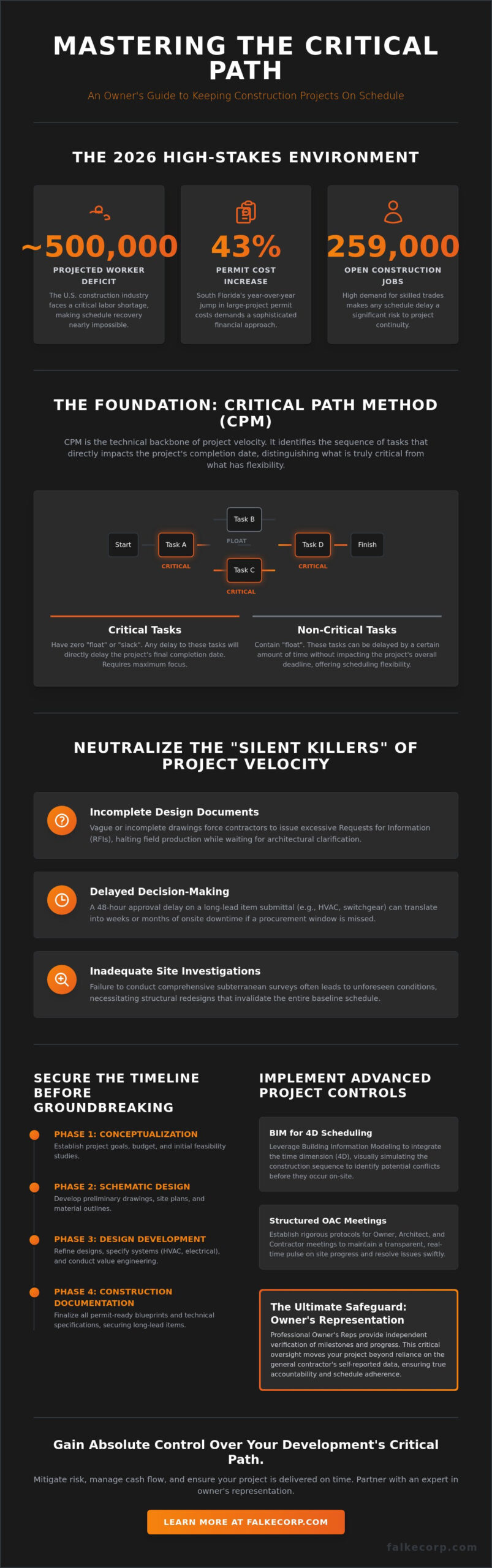
With the U.S. construction industry facing a deficit of nearly 500,000 workers in 2026, the traditional reliance on a general contractor’s verbal assurance is no longer a viable risk management strategy. You likely recognize that even a minor lapse in coordination can trigger a cascade of compounding carrying charges and delayed revenue-readiness. It’s a high-stakes environment where South Florida’s 43% year-over-year jump in large-project permit costs necessitates a more sophisticated, analytical approach to how to keep a construction project on schedule.
This guide provides the technical frameworks and owner-centric strategies required to maintain absolute control over your development’s critical path. You’ll master the sophisticated project management methodologies needed to navigate the 8th Edition Florida Building Code requirements and leverage BIM workflows for predictable cash flow management. We’ll examine the transition from static planning to live, data-driven oversight, offering a clear strategic roadmap to mitigate liquidated damages and ensure your project is delivered on the promised date.
Key Takeaways
- Identify how the Critical Path Method (CPM) serves as the technical backbone of project velocity and learn to neutralize “silent killers” like poor scope definition and delayed decision-making.
- Implement a rigorous four-phase pre-construction methodology to secure long-lead items such as custom glazing and HVAC systems before groundbreaking occurs.
- Learn how to keep a construction project on schedule by integrating South Florida’s specific environmental risks and the 2025-2026 permitting deadlines into your master plan.
- Leverage Building Information Modeling (BIM) for 4D scheduling and establish structured OAC meeting protocols to maintain a transparent, real-time pulse on site progress.
- Discover how professional Owner’s Representation provides independent verification of milestones, moving your oversight beyond the general contractor’s self-reported monthly data.
The Anatomy of a Construction Schedule: Why Projects Fall Behind in 2026
A construction schedule isn’t merely a visual representation of progress; it’s a rigorous technical framework that dictates the financial health of your development. Understanding how to keep a construction project on schedule requires a departure from surface-level milestones toward a deep analysis of the Critical Path Method. In 2026, the Florida market presents a unique set of challenges, specifically a labor shortage where the industry needs between 349,000 and 499,000 new workers to meet current demand. This scarcity transforms minor delays into systemic failures, as the lack of available trades prevents the recovery of lost time.
The Critical Path Method (CPM) Explained
The Critical Path Method is a mathematical algorithm for scheduling a set of project activities. It identifies the longest sequence of dependent tasks that determines the shortest possible project duration. Professional construction management relies on this logic to distinguish between “critical” tasks, which have zero flexibility, and activities with “float” or “slack.” Float represents the amount of time a task can be delayed without impacting the final completion date. If an owner doesn’t monitor the critical path with precision, they risk focusing resources on secondary tasks while the project’s completion date quietly slips away due to a bottleneck in a high-priority sequence.
Root Causes of Schedule Slippage
Schedule erosion often begins long before the first shovel hits the ground. The “silent killers” of velocity are frequently found in the administrative and design phases. When an owner understands how to keep a construction project on schedule, they prioritize the elimination of these specific friction points:
- Incomplete design documents: When drawings lack technical detail, the general contractor is forced to issue excessive Requests for Information (RFIs). This stalls production while the field team waits for architectural clarification.
- Delayed decision-making: A 48-hour delay in approving a submittal for long-lead items, such as specialized HVAC systems or switchgear, can translate into weeks of onsite downtime if a procurement window is missed.
- Inadequate site investigations: Failing to conduct comprehensive subterranean surveys often leads to unforeseen conditions. These discoveries necessitate structural redesigns that invalidate the initial baseline.
Unrealistic baselines are a primary source of project friction. In a market where early 2026 permit costs for large projects jumped 43% year-over-year, the pressure to begin work often leads to truncated planning phases. However, current labor dynamics, characterized by 259,000 open jobs as of April 2026, demand more conservative buffer zones. Without these tactical reserves, the schedule becomes brittle and unable to absorb the inevitable volatility of the modern supply chain or labor availability.
Strategic Pre-Construction: Securing the Timeline Before Groundbreaking
Groundbreaking is often perceived as the project’s commencement, yet the schedule is effectively won or lost during the pre-construction phase. Implementing a rigorous four-phase methodology—encompassing conceptualization, schematic design, design development, and construction documentation—establishes the necessary financial and temporal baseline. Engaging expert pre-construction services in Miami allows owners to vet contractor estimates against 2026 market realities, such as the 4.8% jump in residential construction costs. This phase isn’t just about planning; it’s about de-risking the critical path before resources are mobilized.
A frequent but avoidable bottleneck is the owner’s own approval process. Establishing a formal Decision Matrix ensures that technical submittals and change orders don’t linger in administrative limbo. By defining precise authority levels for cost and time thresholds, the project maintains its momentum. This structured approach is central to how to keep a construction project on schedule, as it prevents internal friction from cascading into field delays. Comprehensive site feasibility studies further support this by identifying subterranean or structural constraints early, preventing the mid-project redesigns that typically devastate timelines.
Procurement Strategy and Supply Chain Management
Procurement in 2026 requires a defensive and highly organized posture. A detailed procurement log must track every major component from the initial specification to final onsite delivery. Given that tariffs on imported steel and aluminum have reached 50%, regional sourcing has become a strategic necessity for both cost and time stability. Utilizing early-release packages allows the team to secure long-lead items like HVAC units, switchgear, and custom glazing before the full design package is finalized. This proactive step adheres to fundamental Construction Management Principles by decoupling material availability from the primary construction sequence.
Design Coordination and Peer Reviews
High-velocity projects require drawings that are 100% coordinated across all architectural, structural, and MEP disciplines. Constructability reviews identify potential field issues within the digital environment rather than during active construction. Rigorous peer reviews are essential; industry data suggests they reduce the frequency of field-generated RFIs by approximately 30%. This reduction is critical for maintaining flow, as each RFI represents a potential work stoppage. For owners seeking to protect their assets, investing in thorough pre-construction oversight is the most effective method to ensure that technical complexity doesn’t compromise the delivery date.
Navigating South Florida’s Unique Constraints: Weather, Permitting, and Logistics
South Florida’s development environment is governed by rigid environmental and bureaucratic parameters that demand a specialized management approach. To understand how to keep a construction project on schedule in this region, an owner must account for the High-Velocity Hurricane Zone (HVHZ) requirements and the logistical friction of high-density corridors like Brickell or the Miami Design District. Staging space in these urban centers is virtually non-existent; this necessitates “just-in-time” delivery protocols that leave no margin for error in the supply chain. Coordination with local utilities, including FPL and WASD, must also be initiated months in advance to prevent infrastructure connections from becoming the final bottleneck before occupancy.
The Florida Permitting Landscape
Effective January 1, 2025, Florida regulations mandate that local governments approve or deny complete permit applications within 60 business days for non-residential buildings under 25,000 square feet. Despite these statutory deadlines, observed processing times in Miami-Dade County still range from 6 to 10 weeks, while the City of Miami often requires 8 to 12 weeks. Utilizing the “dry-run” permit process allows for a concurrent review of architectural and structural plans while the design is finalized. Owners should also consider utilizing private providers to accelerate the building official review process, as these specialized consultants can often bypass municipal backlogs to keep the critical path moving.
Weather Mitigation and Contingency Planning
Hurricane season, spanning from June through November, is a non-negotiable constraint in the master project schedule. A sophisticated schedule incorporates “weather days” based on historical NOAA data, ensuring that the baseline remains realistic despite the inevitable summer disruptions. Beyond tropical storms, the intense South Florida heat triggers a measurable decline in labor productivity during the summer months; this is particularly impactful given the 2026 labor shortage where 259,000 jobs remain open. To mitigate these effects, managers must sequence the project to ensure interior trades are working in conditioned or shaded environments during peak temperature windows.
Strategic demobilization protocols are equally vital. Establishing clear criteria for securing the site and protecting unfinished structural elements during storm warnings prevents long-term damage and costly recovery periods. When considering how to keep a construction project on schedule, the ability to rapidly demobilize and subsequently resume operations is what separates a resilient project from one that suffers months of weather-related slippage.
Implementation of Advanced Project Controls and Communication Protocols
Technical oversight during the execution phase is the primary mechanism for maintaining the project’s critical path. While pre-construction sets the baseline, active project controls provide the analytical data necessary to identify and correct deviations before they compound into systemic delays. In an era where 65% of global construction projects utilize Building Information Modeling (BIM) workflows, an owner’s strategy for how to keep a construction project on schedule must prioritize the integration of real-time field data with sophisticated scheduling software. This level of transparency ensures that the general contractor remains accountable to the contractual timeline through every phase of the build.
The Owner-Architect-Contractor (OAC) meeting serves as the project’s operational pulse. These sessions must transcend mere status updates; they are the forum for rigorous schedule analysis and proactive problem-solving. To maintain this momentum, owners should mandate the use of platforms like Procore for daily field reports and real-time photo documentation. This creates an immutable record of progress, allowing the project team to verify field conditions against the reported percentage of completion. For owners requiring this level of technical oversight, professional construction phase management florida ensures that field reality never deviates from the contractual baseline.
The Power of 4D Scheduling
4D BIM integrates time-related data into a 3D model, allowing stakeholders to visualize the construction sequence within a digital environment before field mobilization. By adding the dimension of time to spatial coordination, the project team can identify logistical bottlenecks, such as crane placement conflicts or material staging overlaps, that traditional 2D schedules fail to capture. Time-lapse simulations further enhance communication by providing a clear visual expectation of milestones for all stakeholders, ensuring that the entire project team understands the sequence of essential tasks determined by the critical path.
Reporting and Transparency Requirements
Rigorous reporting standards are essential for maintaining visibility into the project’s velocity. Owners should mandate weekly schedule updates from the general contractor using industry-standard software like Primavera P6 or Microsoft Project. To simplify complex data for executive review, a “Red-Yellow-Green” status reporting system should be established for all major milestones. This allows the team to immediately flag activities that have lost float or are trending toward the critical path. Additionally, implementing “Pull Planning” sessions encourages subcontractors to make collaborative commitments to specific work windows, which significantly improves the reliability of the short-term schedule and reduces friction between trades.
The Role of Owner’s Representation in Schedule Recovery and Oversight
While sophisticated software and rigorous pre-construction planning provide the foundation for success, the ultimate determination of how to keep a construction project on schedule lies in independent, professional oversight. A general contractor’s monthly report is, by definition, a self-assessment that may inadvertently obscure emerging risks or logic failures. An Owner’s representative Miami serves as the technical filter between field reality and executive reporting, acting as the professional “eyes and ears” for the client. This role is essential for navigating the 2026 development landscape, where labor shortages and supply chain volatility require immediate, expert intervention to prevent minor slippage from becoming a permanent delay.
When critical path activities deviate from the baseline, the Owner’s Rep doesn’t merely accept a revised completion date. Instead, they mandate and verify a formal Schedule Recovery Plan. This plan must detail specific corrective actions, such as re-sequencing trades or increasing labor density, without compromising the project’s quality or safety standards. This systematic approach to construction project management Florida is also the primary defense against change order fraud. It ensures that every request for additional time or budget is substantiated by technical data rather than opportunistic claims, protecting the owner’s capital and timeline simultaneously.
Independent Schedule Analysis
Effective oversight requires a deep dive into the scheduling software’s underlying logic. The Owner’s Rep performs “What-If” scenarios to quantify the temporal impact of proposed design changes or unforeseen site conditions before they’re approved. They audit the logic ties within the schedule, such as finish-to-start or start-to-start relationships, to ensure the contractor isn’t manipulating “float” to hide delays in critical sequences. This rigor must extend into the project close-out phase, which is often neglected in early planning. Scheduling the commissioning and punch-list phases with the same precision as the foundation ensures that revenue-readiness isn’t lost in the final 5% of the build.
Protecting the Owner’s Interests
The relationship between the design team and the contractor is often characterized by friction when delays occur. An Owner’s Rep manages this dynamic, preventing unproductive finger-pointing by providing an objective, data-driven analysis of the delay’s root cause. An Owner’s Rep provides an unbiased assessment of project health, allowing the owner to make informed decisions based on technical reality rather than defensive posturing. By enforcing liquidated damages and incentive clauses, the Rep aligns the contractor’s financial goals with the owner’s timeline. This ensures that the entire project team remains focused on the primary objective: delivering a high-quality asset on the contractually mandated date.
Securing Temporal Stability in 2026 Development
Maintaining a project’s velocity in the current market demands a departure from reactive management toward a model of technical excellence. Success requires the integration of advanced project controls, such as 4D BIM, with a disciplined four-phase pre-construction methodology that addresses risks before field mobilization. By navigating the specific logistical and permitting constraints of South Florida with analytical precision, owners can effectively neutralize the factors that lead to revenue-readiness delays. Mastery of how to keep a construction project on schedule is ultimately a function of disciplined oversight and the refusal to accept surface-level status updates as technical reality.
FALKE Atlantic Corporation provides the professional “eyes and ears” necessary to protect your interests in high-stakes Miami real estate development. Our team maintains an unwavering focus on financial and temporal control, ensuring that every milestone is verified through independent data analysis rather than general contractor self-reporting. Protect your project timeline with FALKE Atlantic Corporation’s expert Owner’s Representation services. We’re committed to ensuring your development remains a stable, high-performing asset from inception through final commissioning.
Frequently Asked Questions
What is the most common reason construction projects go over schedule?
The primary driver of schedule slippage in 2026 is the national construction labor shortage, which currently leaves approximately 259,000 positions unfilled. This scarcity is compounded by poor scope definition and late owner decision-making, which force contractors into reactive re-sequencing. When essential trades aren’t available to absorb these shifts, the project’s critical path suffers irreversible delays that compound over time.
How much contingency time should be built into a Florida construction schedule?
A robust Florida schedule typically includes a 10% to 15% temporal contingency to account for regional volatility. This buffer must incorporate observed permitting timelines, which in Miami-Dade can extend to 10 weeks, and the mandatory site securing protocols required during hurricane season. Without this structured reserve, any environmental or bureaucratic disruption will immediately impact the final delivery date and financial projections.
Can an owner be held liable for construction delays?
Owners are frequently held liable for delays stemming from “owner-caused” disruptions, such as delayed technical submittal approvals or late-stage design changes. These delays can trigger claims for extended carrying charges or increased overhead costs from the general contractor. Establishing a clear decision matrix is a primary strategy for how to keep a construction project on schedule while mitigating these legal and financial risks. For developers managing international assets, especially in the UAE, Gulf Legal Advisors offers specialized counsel to navigate complex labor laws and contractual obligations.
What is a “Schedule Recovery Plan” and when do I need one?
A Schedule Recovery Plan is a formal technical document required when a project’s actual progress falls behind the established baseline. It outlines specific corrective measures, such as trade stacking or double-shifting, to regain lost time on critical path activities. You need this plan the moment a major milestone is missed to prevent the delay from cascading into subsequent phases and impacting revenue-readiness.
How does hurricane season impact construction timelines in Miami?
Hurricane season, spanning from June through November, requires the integration of “weather days” into the master schedule based on historical NOAA data. Beyond the threat of active storms, the season necessitates specific demobilization and site-securing protocols that can halt production for several days per event. Productivity also declines during these months due to extreme heat and high humidity, which directly affects outdoor trade performance and milestone achievement.
Is it possible to accelerate a construction schedule without compromising quality?
Schedule acceleration is achievable through technical re-sequencing and increasing labor density on non-conflicting tasks. This process, often referred to as “crashing” the schedule, focuses on adding resources specifically to critical path activities to shorten their duration. It doesn’t compromise quality if the oversight team maintains rigorous inspection protocols and ensures that trade coordination remains synchronized throughout the accelerated work window.
What is the difference between an Owner’s Rep and a Project Manager regarding scheduling?
A Project Manager, often employed by the contractor, focuses on the tactical execution of site tasks and resource allocation. In contrast, an Owner’s Representative acts as a strategic advocate who filters and verifies all project data to protect the client’s interests. The Rep provides the independent analysis required for how to keep a construction project on schedule, ensuring that the contractor’s self-reported progress aligns with technical field reality.
How do I know if my contractor’s schedule is realistic?
A realistic schedule must be grounded in current market data, such as 2026 material lead times and South Florida’s specific permitting durations. You can verify its validity by auditing the logic ties between tasks to ensure they follow a strictly logical sequence without artificial padding or float manipulation. If the schedule doesn’t account for the 8th Edition Florida Building Code requirements or current labor scarcity, it’s likely technically flawed.