Remote construction management is not merely a matter of occasional video calls; it is a rigorous architecture of reporting and professional fiduciary oversight. For stakeholders managing developments from a distance, the primary challenge isn’t the physical absence but the potential erosion of control over capital and compliance. Understanding how to manage a construction project remotely requires a shift from passive observation to a structured system of technical verification. You likely recognize the inherent risks of this distance, particularly the anxiety surrounding change order fraud and the complexities of Florida’s evolving building codes.
It’s a valid concern that local teams might prioritize speed over transparency when the owner isn’t physically present to audit the progress. This article provides a professional framework for maintaining absolute financial and operational command over your developments from any global location. We’ll examine the essential reporting structures, the impact of Florida’s HB 803 on virtual oversight, and the methodology required to ensure your interests remain protected through every phase of the project lifecycle.
Key Takeaways
- Establish a structured system of professional fiduciary oversight where rigorous reporting frameworks replace the necessity of physical site presence.
- Deploy digital infrastructure, such as cloud-based PMIS and drone-captured visual data, to maintain real-time document control and technical transparency.
- Master how to manage a construction project remotely by implementing disciplined Change Order approval workflows and Schedule of Values audits to prevent financial leakage.
- Navigate South Florida’s regulatory landscape and climate risks through strategic alignment with local permitting reforms and established site stabilization protocols.
- Integrate a local owner’s representative to execute a comprehensive four-phase methodology that ensures your interests are protected from concept to final commissioning.
The Architecture of Remote Construction Oversight
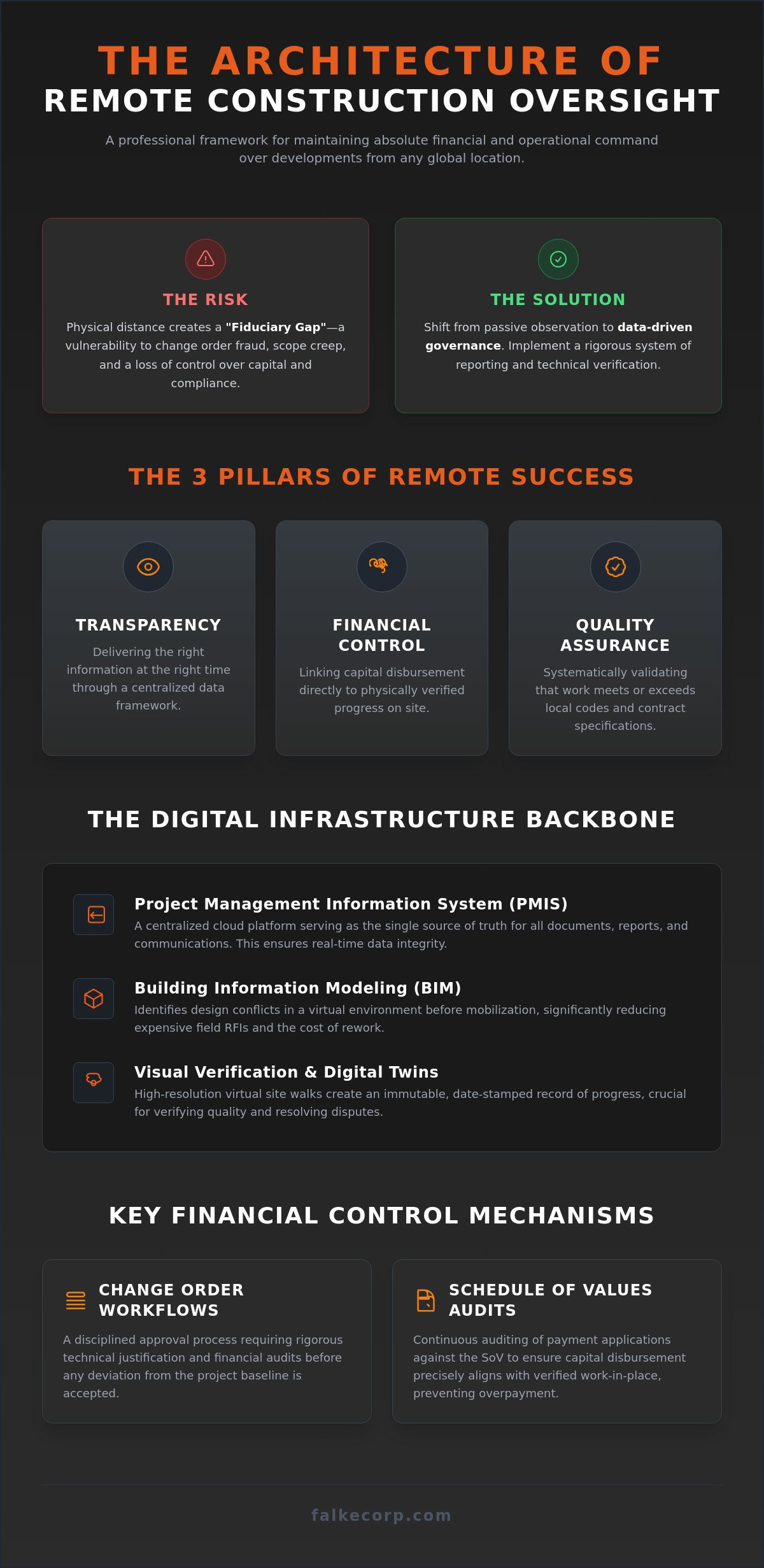
Effective oversight of a capital development from a distance isn’t achieved through sporadic site visits or low-resolution video feeds. It’s a disciplined system of professional fiduciary oversight. When considering how to manage a construction project remotely, stakeholders must understand that physical presence is often less impactful than a rigorous, data-driven reporting framework. Traditional construction management principles emphasize the coordination of labor and materials, but remote oversight elevates this to strategic project governance. It’s the shift from watching the work to validating the data that defines the work. Mastering how to manage a construction project remotely requires a transition from tactical site-watching to a model of high-level project governance.
The Owner’s Representative serves as the primary instrument of this governance. They act as the local eyes and ears, but more importantly, they function as the technical filter through which all site data must pass. This role ensures that every report, schedule update, and payment application aligns with the owner’s strategic objectives rather than the contractor’s operational convenience. They provide the necessary friction to ensure that speed doesn’t come at the expense of quality or financial integrity.
The Fiduciary Gap: Why Owners Need More Than a PM
A fundamental tension exists between the General Contractor’s operational goals and the Owner’s investment interests. While a Project Manager employed by a contractor focuses on production efficiency and margin preservation, the remote owner remains uniquely vulnerable to scope creep and change order fraud. Without a local advocate, communication gaps often hide the “fiduciary gap,” where project decisions favor the builder’s bottom line over the owner’s long-term asset value. Project Governance serves as the defense mechanism here. It establishes a hierarchy where every deviation from the baseline must be technically justified and financially audited before approval.
Defining Success for Remote Stakeholders
Success in a remote environment rests upon three pillars: Transparency, Financial Control, and Quality Assurance. Transparency isn’t about having more information; it’s about having the right information at the right time. Financial control requires a direct link between physical progress and capital disbursement. Quality assurance ensures that local standards, such as the stringent Miami-Dade or Broward County building codes, are met without compromise. Remote oversight is the systematic validation of on-site claims against established project benchmarks. This method ensures that the owner’s interests are protected, even when they are thousands of miles away from the job site.
Digital Infrastructure for Seamless Remote Management
The efficacy of remote oversight depends entirely on the integrity of the underlying digital infrastructure. It’s not enough to rely on periodic updates; owners must establish a Project Management Information System (PMIS) that facilitates real-time document control. This centralized environment serves as the technical backbone for how to manage a construction project remotely, ensuring that every architectural revision and field report is archived within a secure, searchable database. With cloud-based solutions now representing over 63% of the market revenue, the transition to digital-first management is no longer optional for high-stakes developments.
Building Information Modeling (BIM) further enhances this infrastructure by acting as a remote coordination tool during design and pre-construction. By identifying design conflicts in a virtual environment before mobilization, owners can significantly reduce the volume of field RFIs and the associated costs of rework. Standardizing these communication protocols early in the project lifecycle creates a predictable rhythm of information exchange, preventing the fragmentation that typically occurs within disjointed email chains.
Visual Verification and Digital Twins
Visual validation tools have evolved beyond simple site photography. Platforms such as OpenSpace or Matterport allow stakeholders to generate high-resolution digital twins, enabling an owner in London to virtually walk a site in Miami with millimeter precision. These date-stamped records provide an immutable trail of evidence that is crucial for resolving future disputes or verifying installation quality. Integrating this visual data into weekly construction phase management florida reports ensures that the narrative provided by the contractor matches the physical reality on the ground.
Centralizing the ‘Single Source of Truth’
Establishing a ‘Single Source of Truth’ is the most effective method to mitigate the risks of information silos. Owners must insist on a digital hub where RFI, Submittal, and Change Order logs are maintained with total transparency. It’s vital that the owner or their representative maintains ‘Read-Only’ access to the contractor’s live schedule to monitor float and critical path deviations in real-time. This level of scrutiny should begin early, ensuring data continuity during the pre-construction services miami phase. For stakeholders who require this level of technical precision, partnering with an owner’s representative ensures these systems are correctly configured and rigorously maintained throughout the development lifecycle.
Financial Control and Risk Mitigation from a Distance
Financial integrity remains the most vulnerable aspect of a development when the stakeholder is not physically present. Maintaining absolute command over capital disbursement requires a shift from trust-based relationships to a system of technical validation. Understanding how to manage a construction project remotely involves more than reviewing high-level budgets; it requires a granular analysis of the flow of capital through a disciplined Change Order approval workflow and rigorous Schedule of Values (SOV) audits. This financial architecture ensures that every dollar spent is tied directly to verified physical progress on the job site.
A central component of this strategy is the integration of third-party inspections. Progress payments should never be released based solely on a contractor’s self-reporting. Instead, a professional Owner’s Representative must validate that the work in place matches the technical specifications and quality standards defined in the contract documents. This disciplined four-phase methodology, from concept to commissioning, provides the necessary framework to manage the contingency fund with strategic precision rather than reactive adjustments.
The Remote Owner’s Guide to Change Orders
Scope creep often disguises itself as “unforeseen field conditions” or “necessary technical adjustments.” Remote owners are particularly susceptible to these claims because they cannot personally verify the site conditions cited in the request. To mitigate this risk, owners must demand a detailed cost-breakdown for every requested deviation, including labor hours, material quantities, and equipment rentals. Given the 2026 market volatility, where steel mill products have seen a 20.9% increase and aluminum mill shapes have risen by 39.1%, contractors may use market fluctuations to justify excessive markups. Implementing a structured approach to Construction Project Management Florida ensures that these requests are audited against current market data and existing contract obligations before any funds are committed.
Auditing Progress Payments Remotely
The process of auditing progress payments must begin with a “pencil draw” review. This is a preliminary meeting where the contractor’s draft pay application is scrutinized by the Owner’s Representative to ensure the requested amounts accurately reflect the work completed. It’s a critical rule for remote stakeholders: never pay for stored materials without physical verification by a trusted local agent to confirm the items are on-site, insured, and properly protected. In Florida’s legal environment, the collection of partial and final lien waivers is a non-negotiable safety net. These documents protect the property from claims by subcontractors or suppliers who may not have been paid by the General Contractor. Mastering how to manage a construction project remotely means ensuring that the financial close-out of each month is as rigorous as the physical construction itself.
Navigating South Florida Variables Remotely
The regulatory environment in South Florida has undergone significant structural changes following the implementation of Florida House Bill 803 on July 1, 2026. For stakeholders determining how to manage a construction project remotely, these legislative updates offer both streamlined opportunities and new technical requirements. Building departments in Miami-Dade and Broward counties are now subject to mandatory plan review deadlines ranging from 5 to 30 business days. Failure to meet these statutory deadlines results in the permit being “deemed approved” the next business day. While this accelerates the pre-construction phase, it places a higher burden on the owner to ensure all documentation is technically perfect before submission.
Successfully executing these complex local requirements from a distance requires a partner who understands the intersection of legislation and logistics. Engaging strategic owner’s representation ensures that your project remains compliant with 2026 regulations while maintaining the momentum required for a successful delivery.
Permitting and Entitlements in Miami-Dade
Remote developers often struggle to decide between “dry-run” and “concurrent” permit reviews. While concurrent reviews can shave weeks off a timeline, they require a high level of coordination between architectural and engineering disciplines to avoid conflicting comments. Establishing local relationships with building departments in the City of Miami remains essential, as these entities can no longer require construction contracts or cost breakdowns as a condition for permit issuance. Managing local impact fees and utility connections from afar requires a local proxy who understands the nuances of the 9th Edition of the Florida Building Code. This code now mandates more robust, wind-hardened building envelopes, particularly for coastal developments in Palm Beach or Miami Beach.
Climate Risk and Site Security
Managing a site in a High-Velocity Hurricane Zone (HVHZ) necessitates a “Storm Preparedness Plan” that functions as a self-executing protocol. This plan should trigger site stabilization measures, such as securing loose materials and crane tie-downs, based on National Hurricane Center advisories without requiring direct owner intervention. Beyond catastrophic events, remote monitoring for humidity and moisture control is vital in South Florida’s high-heat environment to prevent mold growth during the “dry-in” phase. Protecting high-value assets in dense urban areas like the Miami Design District or Fort Lauderdale requires integrated security systems that provide real-time visual alerts to remote stakeholders. Understanding how to manage a construction project remotely in this climate means preparing for environmental variables long before they manifest on the radar.
The Strategic Advantage of Professional Owner’s Representation
The transition from fragmented oversight to a cohesive, high-performance development requires more than just software; it demands a local strategic partner who operates with a fiduciary mindset. For global stakeholders, an Owner’s representative Miami serves as the critical link between remote investment and local execution. While digital tools provide the data, a professional representative provides the interpretation and enforcement necessary to protect the owner’s interests. This level of professional oversight offers a measurable ROI by reducing schedule delays and preventing the technical oversights that frequently lead to costly litigation. Experience in high-complexity environments, such as the delivery of the Prada Design District store, demonstrates that success in how to manage a construction project remotely depends on having an expert on-site who is solely committed to the owner’s objectives.
The Four-Phase Methodology for Remote Success
FALKE Atlantic’s disciplined four-phase methodology provides the structural framework for remote stakeholders to maintain control from concept to commissioning. In Phases 1 and 2, the foundation for remote success is established through rigorous feasibility studies and site selection. These early stages ensure that the project’s technical and financial assumptions are validated before any capital is committed. During Phase 3, active construction phase management shifts the focus to real-time reporting and the validation of on-site claims against project benchmarks. This phase is characterized by the systematic auditing of schedule performance and financial integrity. Finally, Phase 4 focuses on commissioning and close-out, ensuring that the final product is a revenue-ready asset that meets every architectural and engineering specification defined at the project’s inception.
Choosing the Right Strategic Partner
Selecting a representative requires a careful evaluation of local expertise and technical competence. The primary distinction between a traditional consultant and a fiduciary partner lies in the level of responsibility assumed. A strategic partner doesn’t just offer advice; they take full responsibility for the project’s outcome, ensuring that the contractor’s performance aligns with the owner’s strategic vision. When evaluating how to manage a construction project remotely, prioritize partners with a proven track record in the specific South Florida municipalities where your project is located. The complexities of Miami-Dade, Broward, and Palm Beach counties require an advocate who understands both the technical building codes and the local regulatory environment. For stakeholders seeking to secure their interests in the Florida market, the next logical step is requesting a consultation for Real estate development management services to establish a professional framework for your next development.
Securing Fiduciary Control Over Your Florida Development
Strategic oversight of a capital development from a distance requires a transition from passive observation to a structured system of technical validation. The architecture of virtual oversight rests upon three pillars: rigorous digital infrastructure, disciplined financial auditing, and a deep understanding of local Florida regulations. Mastering how to manage a construction project remotely isn’t about attending every site meeting; it’s about establishing a reporting framework that makes physical distance irrelevant to your decision-making process. By implementing cloud-based document control and verifying every payment application against physical progress, you ensure your capital is protected from the inherent risks of remote development.
FALKE Atlantic Corporation provides the specialized South Florida expertise and fiduciary-first approach necessary to navigate these complexities. Our disciplined four-phase methodology ensures your interests remain the primary focus from initial concept through final commissioning. Protect your Florida assets with expert Owner’s Representation. Contact FALKE Atlantic today. Your vision deserves the stability and precision that only professional oversight can provide.
Frequently Asked Questions
Can I really manage a multi-million dollar Miami project without being there?
Successful oversight of high-stakes developments from a distance is achievable provided you establish a rigorous system of professional fiduciary oversight. While physical presence is traditional, modern advancements like Florida’s HB 803 now mandate virtual inspections and streamlined permit reviews, facilitating a more efficient remote workflow. The key to how to manage a construction project remotely is shifting your focus from passive observation to the technical validation of on-site data through a trusted local representative.
What is the biggest risk for a remote construction project owner?
Financial leakage through undetected scope creep and change order fraud represents the most significant risk to remote stakeholders. Without a local proxy to verify field conditions, owners are uniquely vulnerable to inflated material costs or labor hours that do not align with the physical reality on-site. Establishing a disciplined approval workflow for every requested deviation is the only way to mitigate these fiduciary vulnerabilities effectively.
How often should a remote owner receive progress reports?
High-end developments require a weekly reporting cadence to maintain total transparency and schedule control. These reports must transcend basic narratives, incorporating date-stamped visual evidence from drones or 360-degree photography to provide an immutable record of progress. This frequency allows for the early identification of critical path deviations, ensuring that corrective measures are implemented before minor delays escalate into major disruptions.
Do I need an Owner’s Representative if I already have a General Contractor?
Yes, because the General Contractor’s operational goals often diverge from the owner’s long-term investment interests. While a contractor focuses on production efficiency and margin preservation, an Owner’s Representative acts as your fiduciary partner to ensure technical compliance and financial integrity. They provide the necessary friction to ensure that speed never comes at the expense of quality or budget discipline.
What software is best for remote construction project management in 2026?
Professional Project Management Information Systems (PMIS) such as Procore or Autodesk Build are the industry standards for 2026. These platforms serve as a “Single Source of Truth,” centralizing all RFI, Submittal, and Change Order logs within a secure digital hub. Utilizing these tools is essential for how to manage a construction project remotely, as they provide real-time access to the live schedule and document control archives.
How does Florida’s hurricane season affect remote project timelines?
Hurricane season necessitates a self-executing Storm Preparedness Plan that triggers site stabilization protocols automatically based on National Hurricane Center advisories. Remote owners must account for potential 16 to 22-week lead times for critical equipment, such as commercial HVAC units, which can be further exacerbated by storm-related logistics disruptions. Proactive site stabilization and material staging are vital to protecting your assets in High-Velocity Hurricane Zones.
How do I verify that the work I am paying for has actually been completed?
Verification is achieved through a “pencil draw” review process where the contractor’s draft pay application is audited against physical site progress. Progress payments should only be released after a third-party inspection confirms the work in place meets the technical specifications defined in the contract. Additionally, the collection of partial and final lien waivers is a non-negotiable requirement to protect the property from subcontractor claims.
What is the role of an Owner’s Rep during the project close-out phase?
During the commissioning and close-out phase, the Owner’s Representative ensures the asset is fully revenue-ready and compliant with all local standards. They manage the final punch list, secure all warranties and O&M manuals, and verify that the final certificate of occupancy is issued. This final phase is critical for ensuring that the transition from construction to operations is seamless and that all contract obligations have been met.