
The lowest bid on a high-stakes construction project is often the most expensive mistake a capital owner can make in the current market. You likely recognize that Florida’s regulatory environment is uniquely volatile, particularly as the industry prepares for the 9th Edition Florida Building Code mandates. Learning how to select a general contractor in florida requires more than a simple review of past portfolios; it demands a rigorous, data-driven strategy to insulate your assets from contractor insolvency, vicarious liability, and fraudulent change orders.
This guide provides a professional framework for high-net-worth owners and corporations to vet, select, and manage general contractors while neutralizing the specific risks inherent to South Florida’s complex construction landscape. You’ll gain the technical tools necessary to verify fiscal stability, evaluate FICO score prerequisites, and ensure strict compliance with High-Velocity Hurricane Zone standards. We will detail a disciplined, four-phase methodology for pre-construction oversight that transforms contractor selection from a standard procurement task into a comprehensive risk-mitigation protocol designed to protect your capital through project completion.
Key Takeaways
- Identify the legal distinctions between Certified and Registered licenses under Florida Statutes Chapter 489 to ensure cross-jurisdictional compliance for 2026 projects.
- Apply a structured 5-step framework on how to select a general contractor in florida that emphasizes quantitative vetting of financial solvency and historical safety performance.
- Protect capital assets by mandating rigorous ‘Additional Insured’ endorsements to mitigate the high risk of vicarious liability and job site litigation in South Florida.
- Assess contractor technical readiness by requiring proficiency in Building Information Modeling (BIM) and real-time transparency through integrated project management platforms.
- Utilize an Owner’s Representative to execute professional bid leveling, removing selection bias and ensuring all proposals are evaluated against identical technical benchmarks.
Navigating the Florida Regulatory Baseline for General Contractors
Establishing a technical baseline for construction projects starts with a granular understanding of Florida Statutes Chapter 489. This legal framework defines the General contractor as the primary entity responsible for the coordination and execution of a project’s structural and non-structural components. When you’re determining how to select a general contractor in florida, you aren’t just looking for a builder; you’re vetting a fiduciary who must comply with the state’s rigorous licensing and financial responsibility standards. In 2026, the complexity of these standards has intensified, particularly with the transition toward the 9th Edition Florida Building Code. Compliance isn’t a post-permitting task. It begins during the selection stage by verifying that a contractor’s technical expertise aligns with the latest wind-load and flood-protection mandates.
Certified vs. Registered: Legal Implications for Owners
The distinction between a “Certified” and a “Registered” license is a critical pivot point for risk management. A state-certified contractor has passed the rigorous Florida Department of Business and Professional Regulation (DBPR) examinations and is authorized to operate in any jurisdiction across the state. Conversely, a registered contractor is limited to specific local counties or municipalities. For high-net-worth projects in South Florida, institutional owners almost exclusively mandate state-certified status. This ensures the contractor has met the highest state-level financial stability requirements, including the 660 FICO score threshold. It’s also vital to identify the “Qualifying Agent.” This is the individual whose credentials allow the corporation to contract legally. If the Qualifying Agent leaves the firm mid-project, the entity’s ability to pull permits or defend its work may be compromised, creating a significant operational vacuum.
2026 Regulatory Nuances in Miami-Dade and Broward
Operating within Miami-Dade and Broward counties requires specialized knowledge of High-Velocity Hurricane Zone (HVHZ) standards. These are the most stringent building requirements in the United States. When evaluating how to select a general contractor in florida for South Florida developments, you must audit their specific experience with these codes. The 9th Edition Florida Building Code, effective December 31, 2026, further elevates these requirements. Contractors with a history of disciplinary actions or frequent permit delays often struggle with the increased scrutiny of local building departments. A deep-dive audit of the DBPR’s public records is mandatory. You should look beyond the active status of a license to find any history of administrative complaints or financial disputes. This data-driven approach ensures that your project is overseen by a firm with the technical competence and ethical standing to navigate Florida’s unique regulatory environment without costly delays.
A 5-Step Strategic Framework for General Contractor Selection
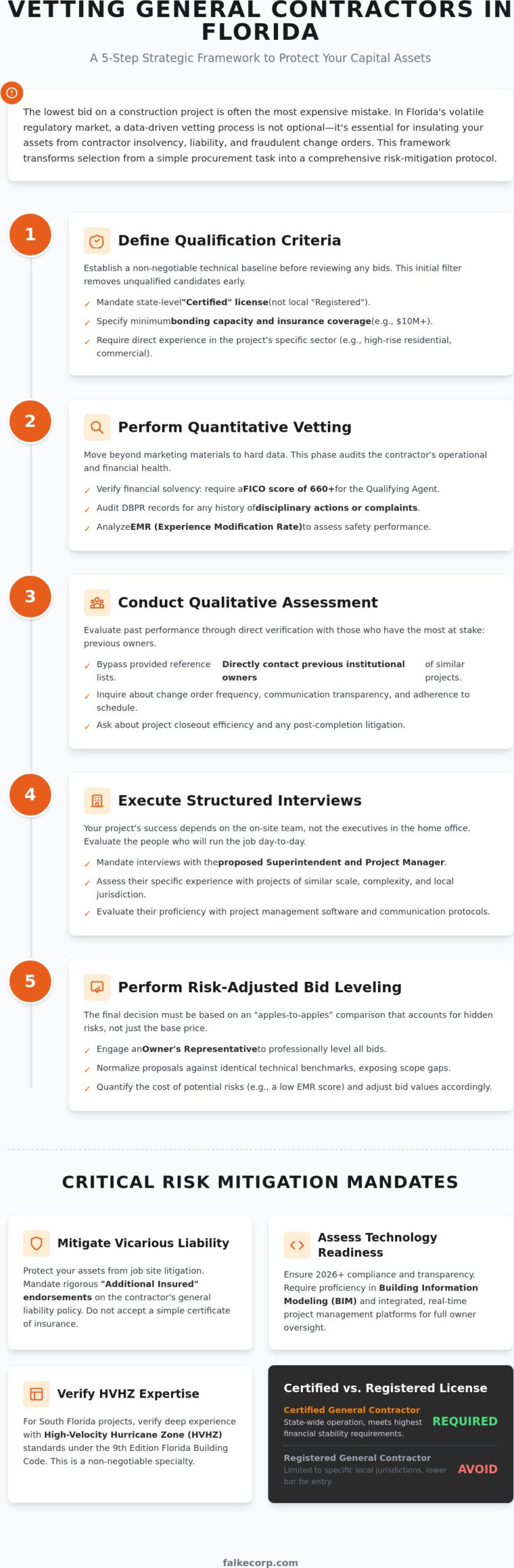
Successful capital project delivery depends on a selection process that prioritizes technical resilience over the lowest initial bid. Owners often struggle with how to select a general contractor in florida because they focus on aesthetic portfolios rather than operational capacity. A disciplined, five-phase framework eliminates subjectivity and ensures the chosen partner possesses the specific infrastructure to handle Florida’s 2026 regulatory environment. This sequence begins with defining rigid qualification criteria and concludes with a risk-adjusted financial analysis that exposes hidden costs before any contracts are signed.
- Phase 1: Defining project-specific qualification criteria. Establish the baseline for bonding, insurance, and sector experience.
- Phase 2: Quantitative vetting. Audit safety records, financial solvency, and current workload capacity.
- Phase 3: Qualitative assessment. Verify relevant project history through direct contact with previous institutional owners.
- Phase 4: Structured interview and site visit protocols. Evaluate the specific project team, including the superintendent and project manager, rather than just the firm’s executives.
- Phase 5: Final bid leveling and risk-adjusted cost analysis. Normalize all proposals to ensure an apples-to-apples comparison of scope and value.
Defining Your Minimum Viable Contractor (MVC)
Matching a contractor’s capacity to the project’s scale is a fundamental step in mitigating risk. An MVC profile should account for specific bonding limits and industry-specific expertise. A firm specializing in high-end residential builds may lack the specialized logistical knowledge required for a hospitality project governed by strict 2026 fire safety codes. By establishing a pre-qualified short list of three to five firms that meet these MVC standards, owners can focus their energy on deep-dive vetting rather than managing a surplus of unqualified bidders. Utilizing professional pre-construction services during this phase allows for a more rigorous definition of these requirements.
Quantitative Vetting: Beyond the Balance Sheet
Financial stability and safety performance are predictive indicators of project success. One of the most telling metrics is the Experience Modification Rate (EMR). An EMR below 1.0 indicates a contractor with superior safety protocols, which directly correlates to lower insurance premiums and fewer job site disruptions. Owners should also request ‘Work in Progress’ (WIP) reports to ensure the GC isn’t overextended. Before moving to the interview phase, always verify that the license is current via the DBPR portal to confirm there are no pending financial responsibility issues. This technical scrutiny ensures the contractor has the liquidity to manage procurement cycles in a market defined by fluctuating material costs and labor shortages.
Mitigating Vicarious Liability and Financial Risk in South Florida
Understanding how to select a general contractor in florida requires an acute awareness of the legal vulnerabilities that persist even after the contract execution. Owners often operate under the misconception that hiring a licensed professional absolves them of all job site liability. In reality, the doctrine of vicarious liability can hold an owner responsible for accidents or negligence occurring on their property, particularly when high-risk activities are involved. To insulate your capital, you must move beyond basic license checks. Utilizing the Florida DBPR License Verification Portal is merely the first step in a deep-dive audit that should include a review of past litigation and insurance claim history.
Financial risk mitigation also demands the implementation of strict administrative controls. Lien waivers and sworn statements must be integrated into the selection and payment cycle. These documents ensure that subcontractors and material suppliers are being paid by the general contractor, preventing the placement of a mechanic’s lien on your property. If a contractor is hesitant to provide a notarized Sworn Statement of Account, it’s often a lead indicator of systemic financial instability or cash flow mismanagement. These administrative safeguards are non-negotiable components of a professional construction phase management strategy.
Insurance Requirements for 2026 Construction Projects
State-mandated minimums are rarely sufficient for the complexity of South Florida developments. While Florida law requires specific liability and property damage coverage, institutional owners should mandate Commercial General Liability (CGL) policies with significant Excess or Umbrella coverage. For projects on coastal or environmentally sensitive sites, Pollution and Professional Liability insurance are essential to cover remediation or design-related errors. Verification of Workers’ Compensation is equally critical. You must confirm coverage through the Florida Department of Financial Services (DFS) to ensure the contractor hasn’t filed for exemptions that could leave you vulnerable to personal injury lawsuits from job site laborers.
Protecting Your Capital from Fraudulent Change Orders
The most common form of financial leakage in Florida construction is the fraudulent or unnecessary change order. This often stems from poor pre-construction vetting where a contractor intentionally submits a “low-ball” bid to secure the project, intending to recoup profit through aggressive scope creep later. A detailed Schedule of Values (SOV) is your primary defense. By breaking down the project into granular line items during the selection phase, you can identify where costs are being hidden. A transparent SOV allows for real-time monitoring of progress and prevents the front-loading of costs, ensuring that payments always align with the actual value of work completed on-site. This level of technical oversight is what distinguishes a strategic partnership from a standard transactional hire.
Assessing Technical Competency and 2026 Technology Readiness
In 2026, technical competency is no longer defined by manual labor alone. It’s defined by digital maturity and the ability to manage complex data sets. Owners evaluating how to select a general contractor in florida must look for firms that utilize integrated project management platforms like Procore or Autodesk Construction Cloud. These systems provide a single source of truth for all stakeholders. They ensure real-time project transparency, allowing for immediate identification of budget variances or schedule slippage. Without these tools, project data becomes siloed, leading to communication failures and expensive, reactive decision-making during the construction phase.
Technology readiness also extends to environmental stewardship and the procurement of sustainable materials. As regulatory pressure for green building increases, a contractor’s experience with LEED certifications and low-carbon construction methods becomes a strategic asset. You aren’t just hiring a builder; you’re selecting a partner capable of navigating the intersection of engineering precision and environmental compliance. This technical depth is essential for protecting the long-term value of your real estate assets in a market that increasingly rewards climate-resilient architecture.
BIM and VDC: The New Standard for Large Projects
Virtual Design and Construction (VDC) is the primary defense against field-level coordination errors. When vetting a GC, ask for specific Clash Detection reports from their previous projects. These reports identify structural, mechanical, or plumbing conflicts within a digital twin before a single cubic yard of concrete is poured. This proactive approach significantly increases project delivery speed. It reduces the need for change orders by resolving spatial conflicts in a virtual environment. A contractor proficient in Building Information Modeling (BIM) can simulate the construction sequence, identifying logistical bottlenecks that traditional 2D drawings simply cannot capture.
Climate Resilience and Hurricane Preparedness
South Florida’s environmental profile requires a contractor with specialized climate management protocols. This includes documented procedures for securing a job site during hurricane season to prevent wind-borne debris damage. Experience with flood-mitigation technologies, such as advanced waterproofing membranes and storm-surge barriers in coastal Miami, is mandatory. Beyond physical site safety, evaluate the GC’s supply chain resilience. Ask how they mitigate the risk of critical material shortages during peak storm activity. A technically competent contractor maintains redundant supplier relationships to ensure work doesn’t halt when regional logistics are disrupted. Professional oversight ensures that these technical standards are met without compromise. You can secure this level of expertise through FALKE Atlantic’s construction phase management services.
The Strategic Advantage: Why an Owner’s Representative is Essential
The selection of a construction partner is a technical audit rather than a simple interview process. Many owners struggle with how to select a general contractor in florida because they lack the specialized data required to challenge a firm’s internal cost structures or operational claims. An Owner’s Representative eliminates selection bias by applying a cold, analytical lens to every proposal. This professional oversight ensures that the general contractor is selected based on historical performance metrics and current operational capacity, not marketing narratives. By acting as a technical buffer, the Owner’s Rep secures project viability before the first shovel hits the ground.
Managing the transition from pre-construction to active site management requires a partner who maintains unwavering financial control. Without this oversight, the initial selection’s strategic value often erodes during the procurement of subcontracts. A professional representative ensures that the standards established during the vetting phase are enforced through every subsequent project stage. This continuity is the only way to insulate a capital project from the systemic risks of South Florida’s construction landscape.
Professional Bid Leveling and Negotiation
Raw bids are rarely comparable upon first submission. One firm might include temporary utilities in their “General Conditions” while another lists them as a separate owner’s expense. Professional bid leveling is the process of normalizing these variables to ensure an apples-to-apples comparison of total project costs. This phase requires a deep-dive into fee structures, alternates, and exclusions that often hide significant financial exposure. Negotiating contract terms that favor the owner requires a granular understanding of Florida’s 2026 construction risks. We ensure that every line item is quantified and that the owner doesn’t unknowingly assume liabilities that should be carried by the contractor.
FALKE Atlantic’s Four-Phase Methodology for Selection
Our selection process is integrated into a broader Development Management framework. This systems-based approach transitions seamlessly from vetting to execution. By providing rigorous oversight during the Pre-Construction phase, we establish a foundation of financial control and transparency. This methodology focuses on identifying the specific technical competencies required for the 9th Edition Florida Building Code. We don’t just help you understand how to select a general contractor in florida; we manage the entire procurement lifecycle to ensure your capital is protected from the inherent volatility of the South Florida market. Contact FALKE Atlantic for a strategic consultation to secure the expert supervision your next Florida project demands.
Securing Capital Integrity Through Strategic Oversight
Mastering how to select a general contractor in florida is the most critical decision in the development lifecycle. Success requires a transition from subjective bidding to a rigorous, data-driven audit of technical and financial capacity. By prioritizing 9th Edition Florida Building Code compliance and implementing strict administrative controls like lien waivers, you insulate your project from the systemic volatility of the South Florida market. These protocols ensure that your investment remains resilient against contractor insolvency and the complexities of High-Velocity Hurricane Zone standards.
FALKE Atlantic Corporation brings a disciplined four-phase methodology to this process, leveraging deep expertise in Miami-Dade and Broward county regulations. Our track record includes managing high-profile developments like the Prada Design District store, where technical precision and financial transparency were paramount. Secure your project’s future with FALKE Atlantic’s Owner’s Representation services. Your vision deserves a partner who treats risk mitigation as a core engineering discipline and ensures your project’s success through uncompromising professional oversight.
Frequently Asked Questions
What is the difference between a Certified and Registered contractor in Florida?
A Certified license is issued by the state and allows a contractor to operate in any Florida jurisdiction after passing rigorous state-level examinations. A Registered license is limited to specific local counties or cities where the contractor has met local requirements. For institutional or high-value projects, state-certified contractors are preferred because they’ve met the highest financial and technical benchmarks required by the DBPR.
How do I verify a general contractor’s license in Florida for 2026?
Owners should use the Florida Department of Business and Professional Regulation (DBPR) online portal to confirm current license status and review disciplinary history. This real-time verification is a non-negotiable step in the process of how to select a general contractor in florida. It ensures the firm is legally authorized to pull permits under the latest 9th Edition Florida Building Code standards.
What is a ‘good’ Experience Modification Rate (EMR) for a Florida GC?
An EMR below 1.0 is considered superior, indicating a safety record that’s better than the industry average. A rate above 1.0 suggests a history of job site accidents, which can lead to higher insurance premiums and increased vicarious liability for the owner. We utilize this metric as a primary indicator of a contractor’s operational discipline and risk management culture.
Should I always choose the lowest bidder for my construction project?
Choosing the lowest bidder is often a strategic error that leads to fraudulent change orders and scope creep. Low bids frequently hide systemic financial instability or a failure to understand complex project requirements. A technical bid-leveling process is necessary to normalize all proposals and identify the true, risk-adjusted cost of the project before signing a contract.
What insurance coverages are mandatory for a general contractor in Miami-Dade?
Florida law mandates minimum insurance of $300,000 for bodily injury and $50,000 for property damage for certified general contractors. Additionally, workers’ compensation is required for any company with one or more employees. While these are the state minimums, high-net-worth projects in Miami-Dade typically demand much higher coverage limits, often exceeding $1,000,000, to protect against South Florida’s unique litigation risks.
How does an Owner’s Representative help in the selection of a general contractor?
An Owner’s Representative provides an objective, data-driven framework to evaluate how to select a general contractor in florida without the influence of selection bias. They perform deep-dive financial audits, verify technical competency in Building Information Modeling (BIM), and manage the entire pre-construction vetting process. This oversight ensures the contractor is selected based on merit and fiscal stability rather than marketing promises.
What is vicarious liability in the context of Florida construction?
Vicarious liability is a legal doctrine where a property owner is held responsible for accidents or negligence caused by their contractor or subcontractors. In Florida, this risk is especially high during complex structural work. Owners must mitigate this exposure by mandating ‘Additional Insured’ endorsements and verifying that all contractors maintain active workers’ compensation coverage through the Florida Department of Financial Services.
How long does the general contractor vetting process typically take?
A thorough vetting process for a commercial or high-end residential project typically requires four to eight weeks. This duration allows for a disciplined four-phase methodology, including quantitative financial reviews, qualitative reference checks, and structured interviews with the project team. Rushing this phase often results in selecting a partner who lacks the liquidity or technical expertise to complete the project successfully.