
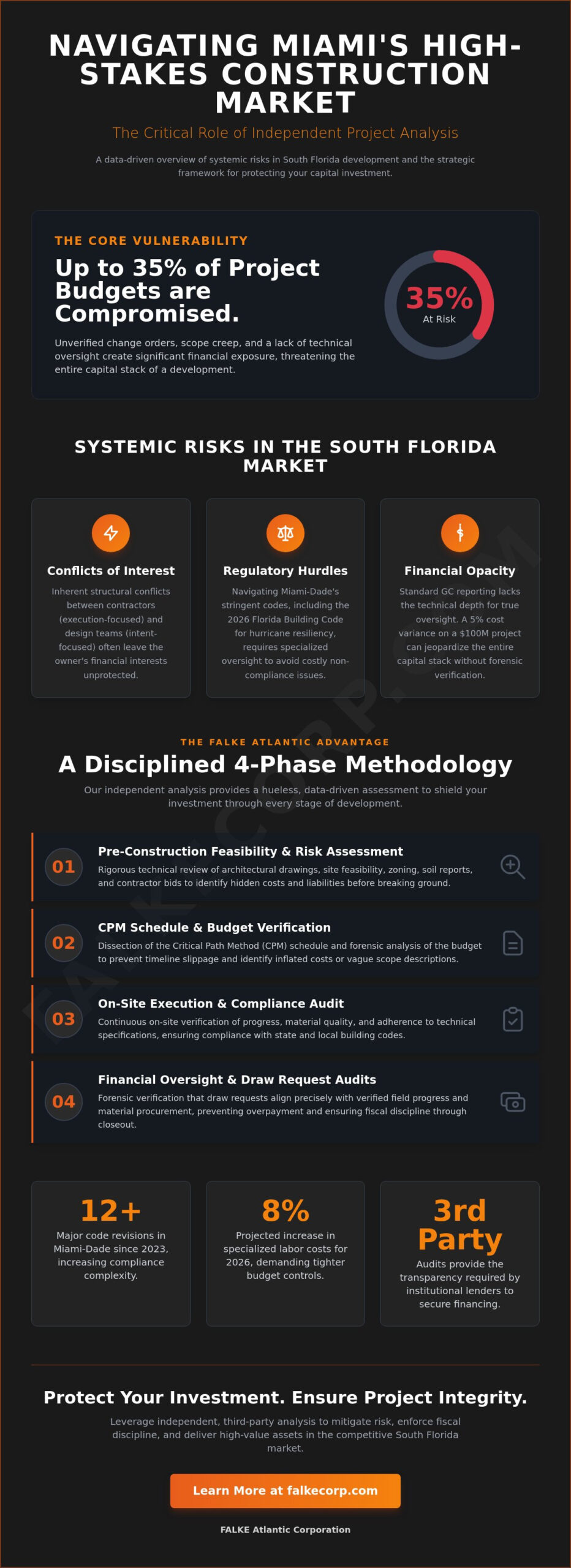
A major development in Miami-Dade is less an architectural milestone and more a complex exercise in capital risk management where up to 35% of project budgets are compromised by unverified change orders. You’re likely aware that standard general contractor reporting rarely offers the technical depth needed for true institutional oversight. The persistent threat of permitting delays and the financial impact of technical non-compliance under the 2026 Florida building codes demand a more rigorous approach. Utilizing a comprehensive independent construction project analysis Miami provides the objective verification required to shield your investment from these systemic vulnerabilities.
This strategic audit ensures full financial transparency and technical integrity throughout every phase of the build. You’ll discover how specialized engineering oversight identifies hidden costs and prevents the litigation that often follows budget overruns. We’ll outline the precise methodologies used to align your project with evolving state safety mandates while maintaining the strict fiscal discipline your stakeholders expect. The following analysis serves as a roadmap for delivering a high-value asset without the typical friction of the South Florida construction market.
Key Takeaways
- Mitigate systemic project risk by identifying the inherent structural conflicts between contractors and design teams through objective, third-party technical oversight.
- Navigate the stringent regulatory landscape of Miami-Dade and Broward counties, ensuring strict compliance with the latest Florida Building Code for hurricane resiliency.
- Implement a disciplined financial framework for cost control and draw request verification via a professional independent construction project analysis Miami.
- Protect capital investments by conducting rigorous technical reviews of architectural drawings and site feasibility before project commencement.
- Leverage a four-phase owner representation methodology that ensures high-level technical competency and disciplined execution throughout the development lifecycle.
The Necessity of Independent Construction Project Analysis in Miami
In the high-pressure environment of South Florida’s vertical development, independent construction project analysis Miami serves as a rigorous technical audit designed to verify project health through an external lens. Unlike internal reports generated by the build team, this analysis provides a hueless, data-driven assessment of both financial and operational metrics. The primary objective is to identify systemic risks before they manifest as costly delays or structural liabilities. While General Contractors (GCs) focus on execution efficiency and Design Teams prioritize architectural intent, their interests often diverge from the owner’s long-term capital protection. This inherent conflict of interest necessitates a third-party evaluator who operates without allegiance to the project’s vendors or contractors.
The distinction between a standard project manager and an independent analyst is fundamental to maintaining project integrity. A project manager coordinates daily tasks, logistics, and schedules; conversely, the independent analyst audits the integrity of those very processes. They scrutinize the application of construction accounting principles to ensure that draw requests align precisely with verified field progress and material procurement. This level of oversight is vital in Miami’s high-stakes market, where a 5% variance in material costs on a $100 million tower can jeopardize the entire capital stack. It’s a layer of protection that moves beyond simple coordination into the territory of forensic technical verification.
The Objective Perspective: Owner Protection
High-end residential and commercial developments in Miami often suffer from emotional bias during the decision-making process, especially when deadlines loom. Technical flaws frequently remain hidden beneath the surface of aggressive timelines. By utilizing an independent construction project analysis Miami, owners gain a partner who acts as the Owner’s Technical Fiduciary. This role ensures that technical specifications are met without compromise, identifying potential failures in the mechanical, electrical, or structural systems that a standard inspection might overlook. This rigorous approach transforms raw data into actionable intelligence, protecting the owner from future litigation and operational inefficiencies.
Market Drivers in South Florida for 2026
The landscape for 2026 presents unique challenges, including a projected 8% increase in specialized labor costs and continued volatility in raw material supply chains. Traditional oversight methods often fail to navigate the Miami-Dade regulatory environment, which has seen 12 major code revisions since 2023. Independent analysis provides the transparency required by institutional lenders to secure financing for large-scale developments. When developers present a project backed by a third-party audit, they demonstrate a commitment to fiscal discipline and technical excellence that mitigates the perceived risk of the South Florida market. It’s about ensuring that every engineering decision aligns with the project’s long-term structural and financial viability.
Core Components of a Strategic Construction Audit
A strategic audit isn’t a cursory glance at a project folder; it’s a deep-dive technical verification of every engineering and financial assumption made by the project team. Conducting an independent construction project analysis Miami ensures that the owner’s capital remains protected against the specific volatility of the 2026 South Florida market. This process involves a rigorous dissection of the Critical Path Method (CPM) schedule. We verify every logical dependency and float calculation to prevent the timeline slippage that frequently results in liquidated damages and escalated carrying costs.
Pre-Construction Feasibility and Risk Assessment
Site constraints in Broward and Dade counties require granular attention to detail during the initial phases. Zoning overlays, environmental impact studies, and soil density reports aren’t just administrative checkboxes; they’re critical financial variables. When evaluating contractor bids, we identify red flags such as suspiciously low mobilization costs or vague scope descriptions that often signal future change orders. Consulting Miami-Dade County’s Permitting and Inspection Center provides the necessary regulatory baseline to identify these discrepancies before they manifest as site-level delays. For a more exhaustive breakdown of these initial phases, owners should review our strategic pre-construction services Miami to understand the mechanics of risk mitigation.
Design and Specification Review
The technical audit extends to the architectural drawings and engineering specifications to ensure the design intent mirrors the owner’s long-term objectives. We analyze material specifications against the demands of Florida’s tropical climate, specifically focusing on High-Velocity Hurricane Zone (HVHZ) requirements and salt-air corrosion resistance. This review includes:
- MEP System Efficiency: Verification of Mechanical, Electrical, and Plumbing systems to ensure they meet modern energy codes and operational load requirements.
- Structural Integrity: Confirming that engineering specifications align with the latest Florida Building Code revisions.
- Material Durability: Auditing the lifecycle costs of specified finishes to ensure they match the project’s intended use, whether for high-traffic commercial or luxury residential applications.
By performing an independent construction project analysis Miami, owners receive a clear picture of whether their design team has prioritized aesthetic appeal over technical longevity. Budget benchmarking for 2026 indicates that while labor costs in South Florida have stabilized, material procurement remains sensitive to global supply chain shifts. We benchmark every line item against current market indices to ensure the project remains financially viable. Owners seeking to solidify their project’s technical foundation can consult with our engineering team for a detailed feasibility report that prioritizes stability and quality over marketing promises.
Navigating Miami-Dade and Broward Regulatory Hurdles
The administrative landscape in South Florida demands more than simple compliance; it requires a predictive approach to risk management. The complexity of the Miami building permit process directly influences a project’s internal rate of return (IRR) by extending carry costs and delaying revenue generation. Industry data from 2023 indicates that regulatory friction and permit delays can inflate South Florida construction budgets by 12% to 18% if not managed through a structured technical audit. Integrating an independent construction project analysis Miami allows owners to quantify these risks through a rigorous engineering lens before capital is fully committed.
The 8th Edition of the Florida Building Code, which became effective on December 31, 2023, introduced stringent requirements for the High Velocity Hurricane Zone (HVHZ). These standards dictate precise wind load calculations and impact-resistant glazing specifications that must be verified during the pre-construction phase. Failure to align architectural plans with these technical mandates results in iterative revisions that stall progress. A professional audit ensures that the structural design meets these 2024 standards, preventing the costly mid-cycle redesigns that frequently plague South Florida developments.
Permitting and Entitlement Strategy
Navigating local jurisdictions such as the Design District or North Bay Village involves managing distinct zoning overlays and specific municipal requirements. Strategic “dry-run” permit submittals allow technical teams to identify conflicts in life safety or structural plans before the formal review cycles begin. An independent construction project analysis Miami provides a critical audit of these submittals, ensuring that the coordination between mechanical, electrical, and plumbing (MEP) systems and architectural entitlements is seamless. This proactive identification of bottlenecks prevents the 4 to 6 month delays often seen in unmonitored permit tracks.
Resiliency and Environmental Compliance
South Florida’s geographic reality necessitates a rigorous evaluation of waterfront assets against storm surge and sea-level rise data. The Southeast Florida Regional Climate Change Compact projects a sea-level rise of 10 to 17 inches by 2040, making flood zone considerations a primary technical concern for any asset’s longevity. Engineering teams must verify structural integrity against these projections while maintaining LEED or Green Building standards to satisfy both regulatory bodies and institutional investors. Resiliency-first engineering constitutes the non-negotiable foundation for all 2026 Miami construction projects to ensure long-term structural viability. Independent analysis verifies that these environmental protections are integrated into the core structural design to protect the owner’s equity over a 30-year horizon.
Financial Oversight: Cost Control and Draw Request Audits
Financial oversight in high-stakes environments demands more than basic accounting. It requires engineering-grade precision. The independent construction project analysis Miami serves as the primary mechanism for this level of control. It ensures that every dollar leaving the owner’s account correlates directly with physical progress on the job site. Without this technical audit, owners often find themselves in a position of diminished leverage, having overpaid for work that isn’t yet complete or compliant with the original specifications.
The independent review of monthly draw requests isn’t a clerical formality. It’s a rigorous validation process. Our analysts physically inspect the site to confirm that the 45% completion claimed for structural steel actually reflects the tonnage erected and bolted. This prevents the common industry practice of front-loading, where contractors seek early payment to cover overhead or unrelated project deficits. By maintaining a neutral perspective, the audit protects the project’s cash flow and ensures the remaining budget is always sufficient to complete the work.
Transparency in the Payment Cycle
Establishing transparency requires a “Three-Way Match” protocol. This system cross-references the actual work verified in the field with the specific line items in the contract and the figures presented in the contractor’s invoice. Discrepancies are identified before the payment is authorized, not after the funds have cleared. This structured information transfer is vital for maintaining the project’s financial stability.
In Florida, the payment cycle is inextricably linked to legal protection. Under Florida Statute Chapter 713, managing lien waivers is a critical administrative requirement. An analyst ensures that every payment is exchanged for a corresponding partial or final release of lien. This discipline prevents the risk of double payment or clouded titles that can stall a project’s financing. Owners can find more on these integrated financial protections in our guide to Construction Project Management in Florida.
Change Order Management
Change order creep is a primary driver of budget failure. A professional independent construction project analysis Miami distinguishes between necessary scope adjustments, such as those caused by unforeseen sub-surface conditions, and contractor-driven cost inflation. Every change request undergoes a technical validation. We analyze the proposed labor hours and material quantities against South Florida market benchmarks for items like 4000 PSI concrete or Grade 60 rebar.
- Verification of technical necessity against original design intent.
- Negotiation of fair value pricing based on current regional indices.
- Assessment of schedule impact to prevent hidden delay claims.
The final phase of financial oversight occurs during commissioning and close-out. The goal is to ensure the asset is revenue-ready. This involves a final audit of all punch-list items, warranty transfers, and as-built documentation. Only when every technical requirement is met and the asset is ready for its intended industrial or commercial use is the final retainage released. This methodical approach ensures the owner receives the exact value defined in the initial investment strategy.
The FALKE Atlantic Advantage: Disciplined Owner Representation
FALKE Atlantic operates through a structured, four-phase methodology specifically engineered for the high-stakes environment of Miami development. This approach bridges the gap between conceptual design and physical execution, ensuring that technical specifications aren’t compromised during the construction process. As a boutique consultancy, we provide a level of senior technical competency that mega-firms often struggle to maintain. Our clients deal directly with experts who understand the engineering nuances of the Florida market, avoiding the communication gaps common in larger, layered organizations.
Our firm positions itself as a strategic partner for complex builds, focusing on stability and quality. We don’t rely on emotional persuasion; we rely on the strength of engineering reliability and data. For developers and owners, this means having a representative who applies a disciplined, analytical lens to every contractor report and site inspection. This level of independent construction project analysis Miami ensures that project milestones are met with precision rather than optimistic estimates.
Expertise in High-Value Assets
The firm’s track record includes the oversight of complex, high-precision builds like the Prada Design District store. This project required strict adherence to global brand standards and intricate technical requirements, demonstrating our ability to manage luxury retail assets where the margin for error is zero. We apply this same rigor to the hospitality and high-net-worth residential sectors, where quality is the primary metric of success.
Out-of-state and international investors face unique challenges in the Florida market, including specific environmental regulations and localized labor market volatility. We protect these interests by serving as an objective, on-the-ground technical authority. You can examine our asset protection framework by visiting our Owner’s Representative Miami page, which details how we safeguard capital in the regional construction landscape.
Engaging FALKE Atlantic
The process for initiating a project health audit or full-scale representation is designed for professional alacrity. We begin with a comprehensive diagnostic of the project’s current state, identifying latent risks in technical compliance and procurement. This independent construction project analysis Miami provides the objective data necessary to correct course or confirm that a project is meeting its intended performance standards.
Our commitment is to technical precision and a solution-oriented mindset. We don’t offer vague promises; we deliver structured information and professional accountability. Whether a build is in the pre-construction phase or currently mid-cycle, our involvement introduces a layer of engineering discipline that protects the owner’s bottom line. To secure your development’s future, Schedule a confidential project analysis with FALKE Atlantic.
Securing Capital Stability through Technical Oversight
Navigating the complex landscape of Miami-Dade and Broward regulatory frameworks demands more than just general oversight; it requires a systematic approach to risk mitigation. Implementing a rigorous draw request audit and financial oversight protocol helps owners prevent the common cost overruns that often derail high-stakes developments. Utilizing an independent construction project analysis Miami ensures that every technical phase aligns precisely with the owner’s strategic objectives. Since 2015, FALKE Atlantic Corporation has applied a specialized four-phase disciplined methodology to safeguard investments for luxury brands such as Prada and various high-net-worth estates across South Florida. This level of engineering-grade precision transforms raw data into actionable intelligence. It’s the difference between reactive crisis management and proactive project control. Technical competence and local expertise are the only reliable defenses against the inherent volatility of the construction sector. Protecting your capital requires a partner who understands these technical nuances and maintains an unwavering commitment to professional standards.
Secure your investment with a professional project analysis from FALKE Atlantic Corporation
Your vision deserves the stability that only rigorous engineering discipline and documented local experience can provide.
Frequently Asked Questions
What is the difference between a construction consultant and an independent analyst?
An independent analyst focuses on objective verification and risk mitigation without a vested interest in the project’s design or construction outcomes. While a consultant often integrates into the project team to provide ongoing advice, an independent analyst provides a detached, third-party audit of technical specifications and financial data. This structural separation ensures that the audit remains unbiased by the internal politics or profit motives of the primary contractors.
How much does an independent construction project analysis in Miami cost?
The cost of an independent construction project analysis Miami typically scales with the project’s total development cost. Industry benchmarks from the Royal Institution of Chartered Surveyors suggest that specialized audit services generally range from 0.5% to 1.5% of the total project budget. For a 50 million dollar development, this represents a technical investment that protects against the 20% to 30% cost overruns frequently documented in large-scale urban projects.
At what phase of development should I hire an independent project analyst?
You should hire an independent analyst during the pre-construction phase, specifically when the design reaches 30% to 60% completion. Engaging an expert at this stage allows for the identification of structural inconsistencies and procurement risks before the first slab is poured. Early intervention provides the highest return on investment by aligning the technical specifications with the owner’s financial constraints before contracts are finalized.
Can an independent analysis help if my project is already behind schedule?
Yes, an independent analysis provides a critical recovery roadmap for projects that have exceeded their baseline schedule. The analyst performs a forensic delay analysis to identify the root causes of stagnation, whether they stem from supply chain failures or labor inefficiencies. By quantifying the exact impact of these delays, the owner gains the data necessary to implement corrective measures and negotiate liquidated damages based on factual evidence.
What local Miami regulations most frequently cause project delays in 2026?
The 2026 updates to the Florida Building Code, specifically the enhanced structural integrity requirements for high-rise developments, are a primary source of project delays. Compliance with the latest Miami-Dade County sea-level rise mitigation standards and the mandatory recertification reforms often requires additional engineering reviews. These regulatory hurdles can extend the permitting timeline by 12 to 18 weeks if they aren’t addressed during the initial planning phase.
How does independent analysis prevent change order fraud?
Independent analysis prevents change order fraud by establishing a rigorous technical baseline against which every modification request is measured. The analyst verifies that the requested changes aren’t already covered under the original scope of work or caused by contractor negligence. By requiring detailed cost breakdowns and engineering justifications, the audit process reduces the frequency of inflated material costs and ghost labor charges by approximately 15%.
Do I need an independent analyst for a residential project in North Bay Village?
A residential project in North Bay Village requires an analyst due to the unique geotechnical and zoning complexities of the island. With the village’s 2023 NBV100 master plan introducing specific density and environmental mandates, an independent construction project analysis Miami ensures your luxury development adheres to these local ordinances. This oversight is vital for managing the 10% higher logistics costs associated with the limited causeway access and waterfront construction requirements.