
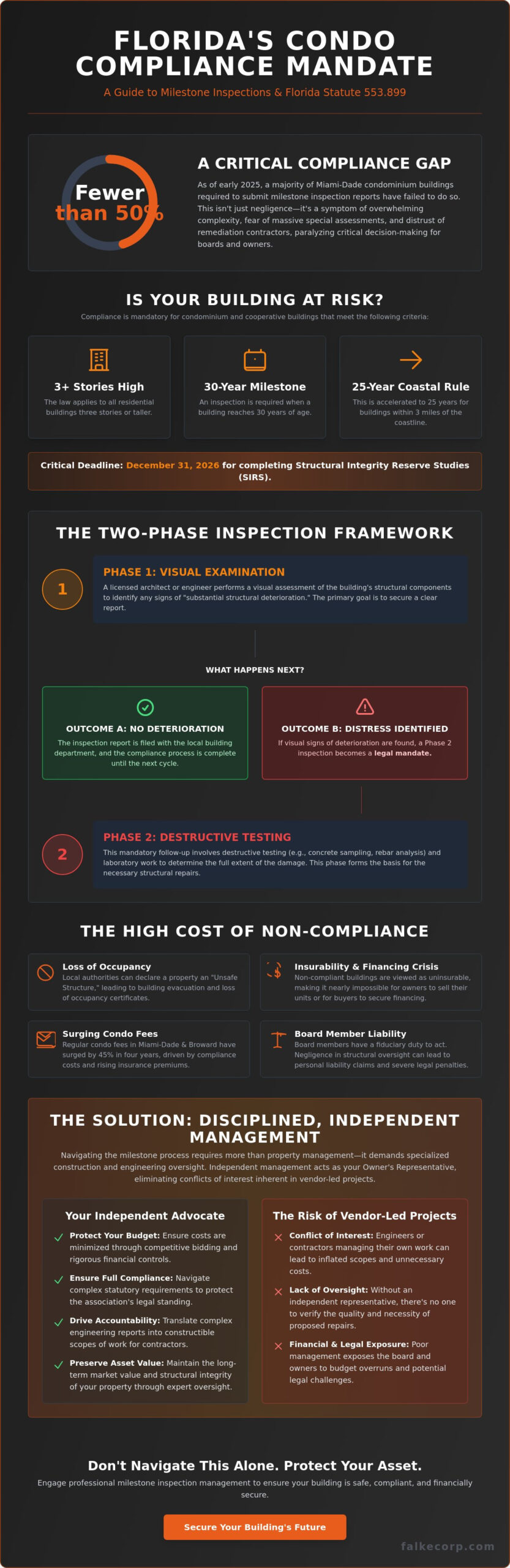
As of early 2025, fewer than 50% of the condominium buildings in Miami-Dade required to submit milestone inspection reports have successfully achieved compliance. For many owners and board members, this delay isn’t a matter of negligence; it’s a response to the overwhelming complexity of Florida Statute 553.899. The fear of massive special assessments and the inherent distrust of remediation contractors often paralyze critical decision-making. Engaging professional milestone inspection management services Miami ensures your building navigates the transition from Phase 1 visual exams to potential structural repairs without compromising its financial stability.
We understand that the shift from reactive maintenance to rigorous structural oversight requires technical precision and a systems-based approach. You’ll learn how a professional management framework protects your budget, ensures full legal compliance, and minimizes repair costs through competitive bidding. This guide provides a technical roadmap for managing Phase 1 and Phase 2 requirements while protecting your asset’s long-term market value through rigorous owner’s representation and project oversight.
Key Takeaways
- Identify the specific regulatory triggers under SB-4D and SB-154 to align your building with the 2026 compliance window and avoid statutory penalties.
- Distinguish between Phase 1 visual inspections and Phase 2 destructive testing to mitigate the risk of unforeseen structural remediation costs.
- Utilize milestone inspection management services Miami to establish independent oversight, ensuring your project avoids the inherent conflicts of interest found in vendor-led management.
- Translate complex engineering findings into constructible scopes of work that drive competitive bidding and ensure contractor accountability during remediation.
- Maintain financial control through a structured, four-phase management framework that preserves the long-term market value of your South Florida property.
The 2026 Regulatory Landscape: Milestone Inspections in Miami-Dade and Broward
The legislative landscape in South Florida shifted permanently after the Champlain Towers South collapse, leading to the creation of Florida Statute 553.899. This law mandates a comprehensive assessment of a building’s structural integrity to identify potential failure points before they become critical. Known as the Milestone Inspection, this process isn’t merely a routine check; it’s a two-phase technical audit required for buildings three stories or higher. While Senate Bill 4-D and Senate Bill 154 established the state-wide baseline, Miami-Dade and Broward counties have long-standing recertification programs that now synchronize with these new laws. Most buildings reaching 30 years of age, or 25 years if located within three miles of the coastline, face strict deadlines. For many associations, the Dec 31, 2026, deadline for completing Structural Integrity Reserve Studies (SIRS) creates a parallel pressure to ensure the physical asset is sound and the financial reserves are adequate.
Who is Subject to Milestone Inspections?
The “three-story” rule is the primary threshold for compliance, but the complexity lies in the specific triggers for coastal properties. In Miami-Dade, the 25-year requirement often supersedes the standard 30-year window for most oceanfront high-rises. This regulatory overlap means boards can’t rely on outdated 40-year recertification timelines. Utilizing professional milestone inspection management services Miami provides the technical oversight needed to categorize building components correctly and determine exact filing windows. Certain structures, such as single-family homes or specific industrial buildings, fall outside these requirements, but the vast majority of South Florida’s 900,000 affected condo units must comply with the new mandates.
The Consequences of Non-Compliance
Failure to adhere to these timelines results in more than just administrative fines. Local building departments hold the authority to declare a property an “Unsafe Structure,” a designation that can lead to total building evacuation and the loss of occupancy certificates. The financial repercussions are equally severe. Recent data indicates that regular monthly condo fees in Miami-Dade and Broward have surged by 45% over the past four years, largely due to the costs of compliance and rising insurance premiums. Buildings that lack current inspection reports are increasingly viewed as uninsurable risks, making it nearly impossible for owners to secure financing or sell their units. Board members have a strict fiduciary duty to manage these processes, and negligence in structural oversight can lead to personal liability claims. Engaging milestone inspection management services Miami ensures that every phase of the inspection and subsequent remediation is documented and filed correctly to protect the association’s legal and financial standing.
Phase 1 vs. Phase 2: Understanding the Inspection Management Framework
The regulatory framework for milestone inspections is structured as a sequential, risk-based process. Under Florida Statute 553.899, the primary objective is to identify “substantial structural deterioration,” which is defined as distress that negatively affects a building’s general structural condition and integrity. A Phase 1 inspection is essentially a visual examination performed by a licensed architect or engineer. If the inspector finds no signs of such deterioration, the process concludes with a filed report. However, if structural distress is identified, a Phase 2 inspection becomes a legal mandate involving destructive testing and laboratory analysis. Managing this transition requires a disciplined approach to documentation and technical oversight to prevent scope creep and escalating costs.
Phase 1: Minimizing the Risk of Phase 2
The goal of Phase 1 is a clear, “no deterioration” report. Achieving this requires more than just scheduling an engineer. Professional milestone inspection management services Miami facilitate pre-inspection audits to identify visible red flags, such as minor concrete cracking or waterproofing failures, before the official filing. Organizing historical repair records and original structural blueprints is critical. An inspector who can’t verify the condition of load-bearing elements due to lack of access or data is more likely to trigger a Phase 2 requirement. Ensuring all critical areas are accessible and well-documented reduces the engineer’s uncertainty, which is the primary driver of Phase 2 mandates.
Phase 2: Managing Destructive Testing and Analysis
When a Phase 1 report identifies structural distress, the project enters a high-stakes technical phase. Phase 2 involves forensic engineering techniques, such as core sampling, ground-penetrating radar (GPR), and chemical analysis of rebar corrosion. Without independent oversight, the scope of Phase 2 can easily expand into unnecessary damage to the building’s envelope. A dedicated manager coordinates with forensic engineers to ensure testing is targeted and the data is interpreted accurately. This phase requires a separate, specialized budget and a project management framework that accounts for the remediation timeline. Associations must commence repairs within 365 days of receiving a Phase 2 report, making the transition to Owner’s Representation essential for maintaining financial control.
The Architect or Engineer of Record remains the final authority on the building’s safety status throughout this process. Simultaneously, associations must manage the Structural Integrity Reserve Study (SIRS), which must be completed by December 31, 2026. This study ensures that the findings from the milestone inspection are translated into a long-term funding plan. Integrating these two requirements ensures that the building remains both physically safe and fiscally sound, protecting the long-term interests of the unit owners.
Why Property Management is Not Construction Management
Building associations often operate under the misconception that their existing property management team possesses the requisite expertise to oversee structural remediation. While these professionals excel at operational maintenance and administrative coordination, the technical demands of milestone compliance require a different specialized discipline. Property managers are typically generalists; they’re skilled at maintaining the status quo but often lack the engineering background to evaluate complex forensic data or manage large-scale structural repairs. The Miami-Dade County building recertification program now integrates state-level milestone mandates, creating a complex administrative and technical burden that exceeds the scope of standard management contracts.
By utilizing milestone inspection management services Miami, boards establish a clear boundary between daily operations and high-stakes capital improvements. This separation is vital for liability shielding. When a board relies solely on a property manager to direct structural work, they inadvertently assume significant risk. Professional project management transfers the burden of technical decision-making from layperson board members to experts who specialize in construction delivery. This framework ensures that every decision, from material selection to waterproofing details, is backed by technical competence rather than operational convenience.
The Limitations of Standard Property Management
Standard property management focuses on the immediate needs of the residents and the building’s envelope. However, structural remediation involves invasive procedures that can disrupt the entire facility. Property managers rarely have the capacity to provide the daily field oversight required for milestone projects. Relying on “preferred vendor” lists can also create a conflict of interest, as these vendors may not be the most qualified for specialized concrete restoration. Without independent oversight, associations often fall victim to a “change order culture” where contractors exploit gaps in the original scope of work to inflate costs.
The Owner’s Representative Advantage
A dedicated Owner’s Representative Miami serves as the essential technical liaison between the Board, the Engineer of Record, and the General Contractor. This role is focused entirely on the owner’s best interests, ensuring financial transparency through rigorous bidding and contract negotiation. By implementing milestone inspection management services Miami, associations gain access to a disciplined management methodology that prioritizes cost control and quality assurance. This strategic oversight prevents vendor-managed projects from spiraling out of budget while ensuring that the final close-out documents satisfy all municipal requirements for long-term compliance.
Navigating the Remediation Lifecycle: From Inspection to Close-out
The transition from a technical audit to a physical remediation project represents the most volatile phase for a building association’s capital reserves. Once a Phase 2 report identifies “substantial structural deterioration,” the legal obligation under Florida Statute 553.899 shifts to active remediation. This process requires translating a diagnostic engineering report into a constructible scope of work that contractors can accurately bid upon. Without this translation, associations risk vague proposals that lead to catastrophic cost overruns. Utilizing milestone inspection management services Miami ensures that the remediation strategy is built on technical precision rather than contractor assumptions. This phase involves navigating the specific permitting and entitlement requirements of Miami-Dade or Broward building departments, where structural repairs must strictly adhere to the 2026 Florida Building Code.
Developing the Remediation Strategy
A disciplined strategy prioritizes immediate life-safety concerns while integrating long-term waterproofing and maintenance objectives. Value engineering plays a critical role here; it’s the process of identifying cost-effective restoration methods that don’t compromise structural integrity. Contracts must be structured with technical granularity, including specific milestones, clear payment schedules, and liquidated damages to protect the association from project delays. This level of pre-construction planning prevents the “change order culture” that often plagues unmanaged structural projects. For boards seeking to stabilize their remediation budget and ensure technical excellence, engaging an independent Project Management partner is the most effective way to transfer project risk.
Field Oversight and Quality Control
Physical demolition often reveals unforeseen structural distress, such as deeper rebar corrosion or concrete carbonation that wasn’t visible during Phase 2 testing. Managing these “unknowns” requires a professional milestone inspection management services Miami framework to verify that the contractor’s proposed solutions align with the engineer’s specifications. Rigorous field oversight ensures that materials, such as high-performance repair mortars and cathodic protection systems, are applied correctly. Effective Construction Phase Management Florida provides the necessary verification to ensure the building remains compliant through to the final close-out and municipal sign-off. This systematic approach guarantees that the remediation isn’t just a temporary fix but a long-term stabilization of the building’s market value.
FALKE Atlantic: Disciplined Management for Milestone Compliance
FALKE Atlantic provides a framework of methodological rigor to address the systemic challenges of milestone compliance. By positioning ourselves as an independent advocate for the building association, we eliminate the inherent conflicts of interest that arise when contractors manage their own oversight. Our milestone inspection management services Miami focus on absolute financial transparency, ensuring that every dollar of a special assessment is accounted for through detailed cost reporting and rigorous procurement standards. This disciplined approach is essential for Boards of Directors who must demonstrate fiduciary stewardship while navigating the technical complexities of South Florida’s evolving safety mandates.
The FALKE Four-Phase Methodology
Our engagement follows a structured lifecycle designed to mitigate risk at every technical junction. This process ensures that no phase begins without the data required to protect the owner’s budget and the building’s structural integrity.
- Phase 1: Concept & Strategy. We evaluate the specific inspection requirements based on the building’s age and proximity to the coastline, identifying the appropriate engineering team to conduct the initial audit.
- Phase 2: Pre-Construction. This phase involves translating engineering findings into a constructible scope. We manage the bidding process, analyze contractor proposals for technical accuracy, and finalize the remediation budget before any physical work commences.
- Phase 3: Execution. Our team provides daily construction oversight and schedule management. We verify that the contractor’s field performance aligns with the engineer’s specifications and the 2026 Florida Building Code.
- Phase 4: Commissioning & Close-out. We supervise the final inspections and ensure all compliance paperwork is filed correctly with Miami-Dade, Broward, or Palm Beach building departments to secure the recertification.
Why Miami Owners Trust FALKE Atlantic
Our reputation is built on a foundation of technical competence developed through the management of complex hospitality and high-end retail developments. Unlike firms that offer general contracting, FALKE Atlantic maintains a dedicated focus on Owner’s Representation. This lack of conflict ensures that our loyalty remains exclusively with the building association throughout the remediation process. By leveraging our deep expertise in Construction Project Management Florida, we provide the stability and precision required to handle the most complex structural challenges. Miami owners choose our milestone inspection management services Miami because we don’t just facilitate repairs; we act as a strategic partner to protect the long-term market value and safety of their real estate assets.
Securing Long-Term Asset Value through Structural Compliance
The regulatory shifts following the 2021 Surfside tragedy have redefined the responsibilities of building associations across South Florida. Navigating the 2026 compliance window requires more than simple administrative coordination; it demands a technical framework that addresses the specific engineering and financial risks of the milestone process. By distinguishing between operational maintenance and complex structural remediation, boards can protect their fiduciary interests and prevent the “change order culture” that often depletes reserves. Utilizing professional milestone inspection management services Miami ensures that every phase, from the initial visual audit to the final municipal close-out, is executed with technical precision.
FALKE Atlantic provides the independent oversight necessary to manage these high-stakes projects without the inherent conflicts of interest found in vendor-led models. Our disciplined four-phase methodology and deep expertise in South Florida building codes allow us to act as a strategic partner in stabilizing your property’s market value. We invite you to Request a Consultation for Milestone Inspection Management to ensure your building meets the highest standards of safety and fiscal responsibility. Proactive management today is the most effective safeguard for your building’s future.
Frequently Asked Questions
What is the deadline for Milestone Inspections in Miami-Dade for 2026?
Buildings reaching their 25 or 30-year threshold in 2026 must complete the milestone inspection by December 31 of that year. This deadline coincides with the mandatory completion of Structural Integrity Reserve Studies (SIRS) for associations existing on or before July 1, 2022. Failure to meet these concurrent timelines can result in significant municipal penalties and potential “Unsafe Structure” declarations by local building departments.
How much does a Phase 1 Milestone Inspection typically cost?
Phase 1 costs are determined by the building’s scale, height, and total square footage. While smaller buildings involve less intensive visual audits, high-rise structures require more extensive technical assessments and documentation. These fees are paid to the licensed engineer or architect of record. Utilizing milestone inspection management services Miami ensures that associations receive competitive proposals from qualified professionals without overpaying for unnecessary diagnostic services.
Can a property manager act as the Owner’s Representative for Milestone remediation?
Property managers generally focus on operational maintenance and lack the specialized technical training required for structural project oversight. An independent Owner’s Representative provides a dedicated discipline focused on capital project delivery and financial control. This separation of duties is essential to avoid conflicts of interest and ensures that the remediation project receives the rigorous field supervision required for structural compliance.
What happens if our building fails the Phase 1 inspection?
If an inspector identifies substantial structural deterioration during Phase 1, the association is legally mandated to proceed to a Phase 2 inspection. This second phase involves destructive testing and forensic analysis to determine the exact extent of the structural distress. Once the Phase 2 report is filed, the building association must commence necessary repairs within 365 days to remain in compliance with Florida law.
Is a Structural Integrity Reserve Study (SIRS) the same as a Milestone Inspection?
No, these are distinct requirements with different objectives. The Milestone Inspection is a physical audit of the building’s structural safety, while the SIRS is a financial assessment designed to ensure the association has adequate funding for future repairs. Both are mandatory for buildings three stories or higher, but the SIRS focuses on the fiscal health of the association’s reserve accounts rather than the physical condition of the concrete.
How long do we have to complete repairs after a Milestone Inspection report is filed?
Associations must commence structural repairs within 365 days of receiving a Phase 2 report that identifies the need for remediation. This narrow window requires an efficient transition into pre-construction phases, including bidding, permitting, and contractor selection. Professional milestone inspection management services Miami are critical during this period to ensure the project remains on schedule and meets all municipal safety requirements.
Do commercial buildings in Miami need Milestone Inspections?
Florida’s Milestone Inspection law primarily targets condominium and cooperative buildings that are three stories or higher. However, purely commercial structures in Miami-Dade and Broward counties remain subject to long-standing local recertification programs. These local requirements often align with the technical standards of the state law, ensuring that all high-occupancy buildings maintain their structural integrity through periodic professional assessments.
What qualifications should an Owner’s Rep have for structural remediation projects?
A qualified Owner’s Representative must demonstrate technical competency in construction phase management and structural remediation oversight. They should have a deep understanding of the 2026 Florida Building Code and a proven methodology for managing multi-phase capital projects. Independence is a critical qualification; the firm should not have any affiliations with general contractors to ensure their oversight remains objective and focused on the owner’s interests.