
The assumption that standard project management suffices in the South Florida market often leads to significant capital erosion before the first shovel hits the ground. With the 9th Edition of the Florida Building Code set to mandate stricter structural and energy standards by December 31, 2026, the technical margin for error has narrowed considerably. Successfully mitigating risks in Florida real estate development requires more than just awareness; it demands a rigorous, system-oriented approach to navigate unpredictable Miami-Dade permitting cycles and climate-driven cost escalations that threaten the viability of even the most robust pro formas.
You likely understand that traditional reliance on general contractors for transparency is insufficient to protect your interests in this high-stakes environment. This article provides a strategic framework for maintaining absolute financial control and minimizing change orders through expert pre-construction and development management. We’ll analyze how to leverage the July 2026 private provider fee reductions, manage the complexities of the updated Live Local Act, and implement the professional oversight necessary to deliver a revenue-ready asset on schedule.
Key Takeaways
- Learn how to implement a disciplined framework for mitigating risks in Florida real estate development by addressing regulatory shifts and climatic volatility before site selection.
- Identify latent property defects early through rigorous feasibility studies and the establishment of a centralized documentation system to maintain project transparency.
- Secure financial control over your investment by utilizing forensic budgeting techniques to expose hidden costs within contractor bids and prevent budget overruns.
- Master the complexities of South Florida permitting and construction phase management to ensure your asset remains revenue-ready and strictly on schedule.
- Understand the critical distinction between general contracting and professional owner’s representation in safeguarding your capital throughout the entire project lifecycle.
The Florida Real Estate Risk Landscape in 2026
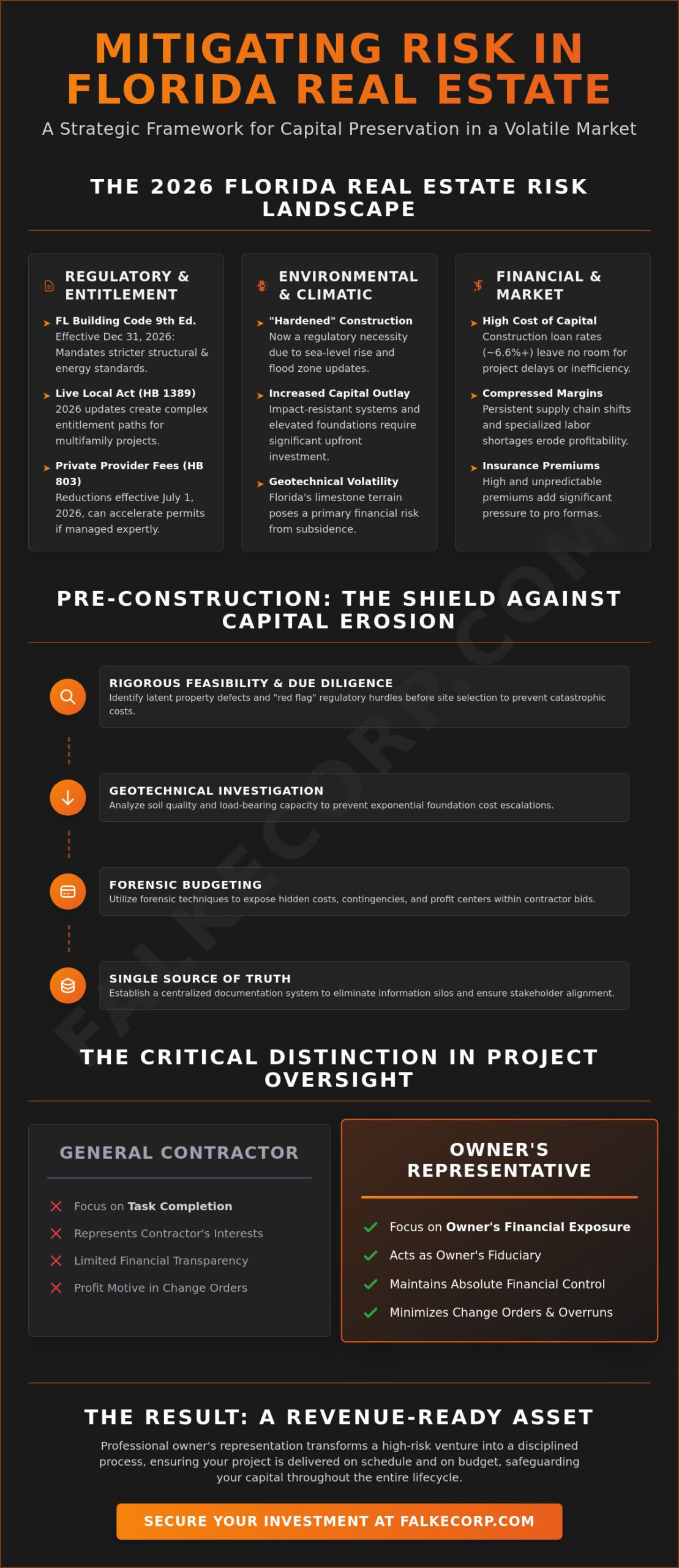
In the current market, mitigating risks in Florida real estate development involves the systematic identification and neutralization of variables that threaten capital preservation and project solvency. It’s a discipline that transcends basic scheduling or site supervision. Florida’s market remains uniquely volatile, characterized by persistent supply chain shifts and specialized labor shortages that continue to compress developer margins. With construction loan rates for 30-year terms hovering around 6.625% as of May 2026, the cost of capital leaves no room for operational inefficiency or extended delays. Traditional project management often fails because it prioritizes task completion over the owner’s specific financial exposure. Understanding The Real Estate Development Process from a position of professional stewardship is the only way to safeguard equity against insurance premiums that show no signs of substantial retreat. Effective risk management requires a transition from reactive problem-solving to a model of technical foresight and forensic budgeting.
Environmental and Climatic Hazards
The impending implementation of the Florida Building Code’s 9th Edition on December 31, 2026, introduces rigorous standards for wind resistance and water intrusion protection. In coastal Miami-Dade, sea-level rise projections and updated flood zone designations have turned “hardened” construction from a premium choice into a regulatory necessity. Owners must balance the increased initial capital expenditure of impact-resistant systems and elevated foundations against the long-term stability and insurability of the asset. The new code specifically emphasizes roofing and stormwater management improvements that require specialized engineering expertise. Failing to account for these climatic shifts during the feasibility stage often results in catastrophic cost escalations during the execution phase, as retrofitting for resilience is far more expensive than integrated design.
Regulatory and Entitlement Complexity
Municipalities like West Palm Beach and Ft. Lauderdale are experiencing rapid shifts in zoning laws and density requirements. The 2026 updates to the Live Local Act (HB 1389) have further complicated the entitlement landscape, requiring municipalities to permit multifamily projects in commercial zones under specific affordability criteria. Identifying “red flag” regulatory hurdles early is essential for mitigating risks in Florida real estate development. Local political shifts can alter project approvals overnight, and the lack of uniformity in how building departments interpret state-level mandates creates friction. HB 803, effective July 1, 2026, introduces fee reductions for private providers, which can accelerate timelines if managed correctly. However, navigating these incentives requires a deep technical analysis of local ordinances to prevent a project from stalling in the conceptual phase.
Pre-Construction Mitigation: Protecting Capital Before Breaking Ground
The pre-construction phase represents the most critical window for mitigating risks in Florida real estate development. It’s during this period that an owner can neutralize threats to capital before they manifest as costly field changes or litigation. Establishing a “Single Source of Truth” for project documentation ensures that every stakeholder, from the architect to the lender, operates from a verified and synchronized data set. This centralized reporting structure eliminates the information silos that often lead to misaligned expectations and budget overruns. Utilizing strategic pre-construction services in Miami allows owners to transition from a speculative posture to one of informed technical control. By assembling a design team that functions as risk partners rather than mere service providers, the development process becomes a disciplined pursuit of the owner’s financial objectives.
Site Feasibility and Environmental Due Diligence
Geotechnical investigations are non-negotiable in Florida’s unique geological landscape. The state’s limestone terrain is prone to subsidence and variable load-bearing capacities, making soil quality a primary financial risk. Without detailed geotechnical reports, foundation costs can escalate exponentially once excavation begins. Similarly, Phase I and II Environmental Site Assessments are vital to avoid long-term liability associated with soil contamination or hazardous materials. Owners must also conduct utility capacity audits to verify that the existing municipal grid can support the proposed development’s density. These audits prevent the late-stage discovery of inadequate infrastructure, which could necessitate expensive off-site improvements or significant project delays. Addressing these Regulatory and Permitting Hurdles early is the only way to ensure the project remains viable under current municipal constraints.
Design Alignment and Value Engineering
Scope creep is a silent killer of development pro formas. It typically occurs when the architectural vision drifts away from the established budget during the design development phase. Rigorous design reviews and milestone approvals are necessary to maintain alignment between the project’s physical form and its economic reality. The discipline of value engineering isn’t about cutting costs at the expense of quality. Instead, it’s a systematic analysis of functions to reduce expenditure while preserving the asset’s revenue potential. Ensuring constructability bridges the gap between complex architectural concepts and the practicalities of contractor execution. This alignment is best achieved through comprehensive pre-construction services that validate every technical detail before construction begins.
Financial Stewardship and Fraud Prevention in South Florida Construction
Forensic budgeting serves as a primary defense when mitigating risks in Florida real estate development. It involves a granular analysis of contractor bids to expose hidden contingencies or inflated line items that don’t align with market benchmarks. One common risk is “front-loading,” where a general contractor allocates a disproportionate amount of profit and overhead to early-stage work. This practice leaves the owner with less leverage during the critical finishing phases. By maintaining a technical, owner-centric perspective on construction project management in Florida, investors can ensure that capital is disbursed only for verified progress. This level of fiscal discipline is essential for Financial and Market Risk Mitigation, protecting the project’s debt-to-equity ratio against unforeseen market contractions. Professional oversight during this phase ensures that the schedule of values is balanced and reflects the actual cost of labor and materials.
Change Order Governance and Scope Control
Managing change orders requires a rigorous approval hierarchy. Not every request for additional funds is legitimate. Owners must distinguish between necessary adjustments, such as those caused by unforeseen site conditions, and contractor errors or omissions. Implementing “Not-to-Exceed” clauses and liquidated damages within the contract structure provides a legal and financial shield. It ensures that the responsibility for schedule integrity remains with the executing party. Without these protocols, scope creep can quickly erode the contingency fund, leaving the project underfunded at completion. A disciplined approach to change order governance prevents the “death by a thousand cuts” that often characterizes poorly managed South Florida projects.
Audit Trails and Financial Transparency
Cloud-based project management software creates an immutable audit trail. This technology allows for real-time financial reporting and ensures that every draw request is backed by third-party verification. Vetting vendors for financial stability is equally vital. The insolvency of a major subcontractor can stall a project for months, making rigorous financial vetting a cornerstone of mitigating risks in Florida real estate development. Establishing strict protocols for draw requests and lien waivers isn’t merely an administrative task; it’s a fundamental requirement for securing the owner’s interest against lien claims and unauthorized cost escalations. Every payment must be tied to a corresponding lien waiver from subcontractors and suppliers to prevent “double jeopardy” where an owner pays a general contractor but remains liable to the trades. This systematic approach to financial stewardship ensures that every dollar spent contributes directly to the asset’s valuation.
Operational Resilience: Navigating Permitting and Execution
Operational resilience is the capacity of a project to maintain its trajectory despite the administrative and environmental friction inherent in the South Florida market. Mitigating risks in Florida real estate development during the execution phase requires a transition from theoretical planning to rigorous field oversight. The complexity of managing concurrent permits for foundation, shell, and interior build-outs in jurisdictions like the City of Miami demands a sophisticated synchronization of schedules. It’s not merely about technical compliance; it’s about managing the human element and the intricate relationships between owners, general contractors, and specialized subcontractors. Without a disciplined approach to construction phase management in Florida, owners often find themselves vulnerable to schedule slippage and unauthorized scope adjustments that threaten the project’s ultimate viability.
Navigating the Florida Permitting Maze
Effective July 1, 2026, HB 803 introduces significant opportunities for streamlining the permitting process through private provider fee reductions of up to 50% for commercial projects. Leveraging these regulatory shifts is essential for expediting reviews in complex municipalities across Miami-Dade, Broward, and Palm Beach counties. A proactive permitting strategy must account for the 9th Edition of the Florida Building Code’s updated standards for life safety and MEP (Mechanical, Electrical, Plumbing) systems. Managing these inspections requires technical precision to avoid the “stop-work” orders that frequently derail ambitious timelines. By utilizing private providers for plans review and inspections, owners can reduce their reliance on local building department timelines, which remain notoriously unpredictable in high-density urban centers.
Schedule Integrity and Milestone Management
Maintaining schedule integrity relies on the Critical Path Method (CPM) to identify potential bottlenecks before they manifest as delays. In Florida, weather-related risk management is a fundamental component of operational resilience. Hurricane season protocols must be integrated into the master schedule, ensuring that site protection and stabilization measures are ready for immediate implementation. This foresight prevents the catastrophic loss of materials and labor hours during the summer and fall months. Quality control serves as a primary risk mitigation tool, as it identifies potential defects during the installation phase rather than after completion. This meticulous oversight ensures a seamless transition from construction to commissioning, delivering a revenue-ready asset that adheres to the highest professional standards. To secure your project’s timeline and quality standards, explore our comprehensive construction phase management solutions.
Owner’s Representation as the Ultimate Risk Shield
A common misconception in the industry is that a general contractor can adequately represent an owner’s interests while simultaneously managing their own profit margins. This inherent conflict of interest creates a structural vulnerability for the investor. An Owner’s Representative in Miami serves as a dedicated advocate whose primary objective is the preservation of the owner’s capital and the integrity of the project’s vision. By providing technical competence and objective oversight, professional representation becomes the ultimate shield when mitigating risks in Florida real estate development. The ROI of this fee-based management is realized through the systematic avoidance of litigation, change order fraud, and schedule delays that typically exceed the cost of professional stewardship. We don’t just observe; we enforce the standards that protect your equity.
The FALKE Atlantic four-phase methodology represents a disciplined approach to project stewardship that begins long before construction. This systems-based framework provides the technical rigor necessary to manage the complexities of the South Florida market. It ensures that every decision, from site selection to final commissioning, is filtered through the lens of the owner’s long-term financial objectives. This level of oversight is the foundation of mitigating risks in Florida real estate development, transforming a speculative process into a predictable, high-quality asset delivery.
Protecting the Owner’s Interests
Information asymmetry often exists between sophisticated contractors and owners who may not possess deep technical backgrounds in construction engineering. This gap is where most capital erosion occurs. We act as the strategic partner for high-net-worth individuals and corporate entities, ensuring that every line item is verified and every technical interface is optimized. This is particularly critical in commercial project management in Miami, where the scale of the investment requires a forensic level of detail. Our presence eliminates the contractor’s ability to “front-load” costs or obscure project delays, maintaining the owner’s leverage throughout the entire lifecycle.
The FALKE Difference: Technical Excellence
The FALKE difference is rooted in a commitment to transparency and unwavering financial control. We leverage decades of engineering and construction experience to provide an elite level of project oversight that general contractors cannot offer. Our focus remains on high-quality asset delivery, ensuring that the final product adheres to the strictest building codes and design specifications. We don’t accept compromises that threaten the asset’s durability or revenue potential. Our expertise serves as your technical insurance policy. Secure your development’s future and maintain absolute control over your capital with a professional consultation.
Securing the Future of Your South Florida Development
Success in the 2026 market is defined by the ability to neutralize threats before they impact the balance sheet. We’ve detailed the necessity of technical pre-construction diligence and the implementation of rigorous financial controls to prevent capital erosion. Successfully mitigating risks in Florida real estate development requires a transition from passive observation to proactive, technical stewardship. By eliminating the information asymmetry between owners and contractors, you ensure that your project remains a viable, revenue-ready asset regardless of climatic or regulatory volatility.
FALKE Atlantic provides the objective advocacy required to navigate these complexities. Our disciplined four-phase methodology and deep expertise in Miami-Dade and Broward county regulations offer a stable foundation for high-stakes commercial and hospitality developments. We invite you to leverage our proven track record to safeguard your equity and maintain absolute schedule integrity. Secure Your Project’s Success with Expert Owner Representation and ensure your vision is executed without compromise. Your capital deserves the protection of unwavering professional competence.
Frequently Asked Questions
What is the biggest risk facing Florida real estate developers in 2026?
The primary risk in 2026 is the convergence of elevated financing costs and the implementation of the 9th Edition of the Florida Building Code. These factors increase technical requirements for wind and water resistance while maintaining significant capital pressure. Failure to align architectural designs with these new standards before the December 31 deadline results in costly redesigns and severe permitting delays.
How does an Owner’s Representative differ from a Construction Project Manager?
An Owner’s Representative provides comprehensive advocacy across the entire development lifecycle, whereas a Construction Project Manager typically focuses on the execution phase. While the project manager handles job site logistics and contractor schedules, the Owner’s Rep oversees site selection, financing, and design alignment. This broader perspective ensures the project serves the owner’s long-term financial objectives rather than just meeting construction milestones.
Can an Owner’s Representative help reduce construction costs in Miami?
Professional representation reduces costs through forensic budgeting and the elimination of information asymmetry between owners and contractors. By identifying “front-loaded” bids and unnecessary contingencies, an Owner’s Representative ensures that capital is allocated efficiently. This technical oversight is a core component of mitigating risks in Florida real estate development, often saving more in avoided change orders than the cost of the management fee.
What are the specific environmental risks for coastal development in South Florida?
Coastal development faces intensified risks from updated FEMA flood zone designations and sea-level rise projections in Miami-Dade. The 2026 building code updates mandate stricter impact resistance for windows and enhanced roofing standards to combat high-velocity hurricane zones. These requirements necessitate “hardened” construction techniques that must be integrated into initial feasibility studies to ensure the asset remains insurable and resilient.
How do I prevent change order fraud on a large-scale construction project?
Preventing fraud requires a rigorous approval hierarchy and the use of “Not-to-Exceed” clauses within construction contracts. Every request for additional funds must be verified against the original scope of work by an independent party. Establishing a clear audit trail through cloud-based software prevents unauthorized budget escalations and ensures that contractors are held accountable for errors or omissions that they should’ve anticipated.
What should be included in a Florida site feasibility study?
A comprehensive study must include geotechnical reports to assess Florida’s limestone terrain, Phase I and II environmental assessments, and utility capacity audits. It also requires a detailed analysis of local zoning laws and the 2026 Live Local Act updates. These elements allow owners to identify latent property defects or regulatory barriers that could render a project financially unfeasible before capital is committed.
Why is the pre-construction phase the most critical for risk mitigation?
Pre-construction is the most critical phase because it offers the highest leverage for mitigating risks in Florida real estate development at the lowest cost. Decisions made during design and planning dictate approximately 80% of the project’s final cost. By neutralizing regulatory and technical threats before breaking ground, owners avoid the exponential expenses associated with field retrofits or legal disputes during the construction phase.
How does FALKE Atlantic Corporation protect out-of-state investors in Florida?
FALKE Atlantic Corporation protects out-of-state investors by serving as a technically competent, local surrogate who maintains absolute transparency. We provide objective oversight in Miami-Dade and Broward counties, ensuring that general contractors and subcontractors adhere to the owner’s standards. Our presence eliminates the risks associated with remote management, providing investors with real-time reporting and a disciplined framework to safeguard their capital from local market volatility.