
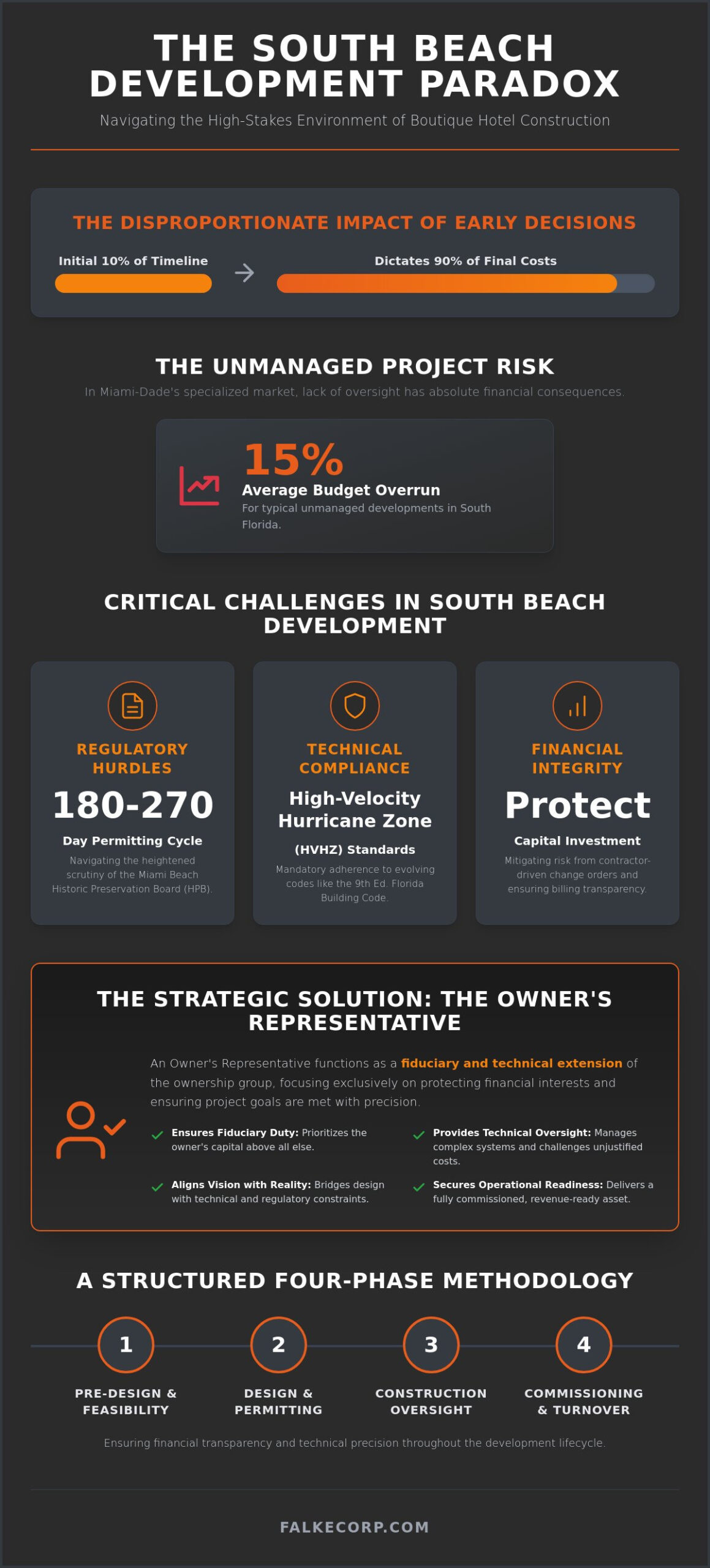
Did you know that decisions made during the initial 10% of a project’s timeline influence 90% of its final costs? In the specialized market of Miami-Dade, where unmanaged developments frequently experience budget overruns of 15%, the financial implications of early-stage oversight are absolute. Engaging a professional owner’s rep for boutique hotel construction South Beach serves as a critical safeguard against the systemic friction of the local regulatory environment. You likely recognize that the path to a revenue-ready asset is increasingly restricted by the Miami Beach Historic Preservation Board and the stringent technical requirements of High-Velocity Hurricane Zone standards.
This strategic guide provides the technical framework necessary to navigate these complexities while maintaining strict alignment between your architectural vision and operational requirements. We’ll examine the methodologies for managing contractor billing transparency and the impact of the 9th Edition of the Florida Building Code, which takes effect on December 31, 2026. By implementing a structured approach to development management, you can mitigate the risks associated with the typical 180 to 270-day permitting cycle and secure a high-performance hospitality asset on schedule.
Key Takeaways
- Understand the critical role of an owner’s rep for boutique hotel construction South Beach in navigating the heightened scrutiny of the Historic Preservation Board.
- Identify how technical compliance with High-Velocity Hurricane Zone (HVHZ) standards directly influences the viability of project financing and long-term insurance structures.
- Differentiate between the fiduciary responsibilities of a strategic advocate and the operational scope of traditional project management to protect capital investment.
- Implement a structured four-phase methodology to ensure rigorous financial transparency and technical precision throughout the development lifecycle.
- Learn to align sophisticated design visions with the rigorous technical requirements necessary to deliver a fully commissioned, revenue-ready hospitality asset.
Navigating the Complexity of Boutique Hotel Construction in South Beach
The architectural landscape of South Beach represents a sophisticated intersection where historic preservation mandates collide with modern structural requirements. Developing a boutique hotel within the Art Deco District isn’t merely an exercise in construction; it’s a technical negotiation between heritage and high-performance engineering. Unlike residential developments in neighboring enclaves, boutique hospitality assets face a higher degree of scrutiny due to their public impact and the inherent complexity of their internal systems. Engaging a professional owner’s rep for boutique hotel construction South Beach provides the necessary technical oversight to bridge this gap, ensuring that the design vision doesn’t compromise the asset’s structural or financial integrity.
Financial risks in this specific market are absolute. With unmanaged projects in South Florida seeing an average budget overrun of 15%, the hospitality sector doesn’t allow for the inefficiencies of trial and error. Professional Construction management and strategic representation ensure that every design choice is vetted against the 9th Edition of the Florida Building Code, which becomes mandatory on December 31, 2026. This level of oversight is vital for maintaining the stability of the project’s capital structure and avoiding the costly delays that stem from non-compliance with evolving High-Velocity Hurricane Zone (HVHZ) standards.
The Regulatory Landscape: HPB and the Art Deco District
The Miami Beach Historic Preservation Board (HPB) wields significant influence over development timelines, often requiring a level of detail that exceeds standard municipal reviews. Managing the delicate balance between restoring a 1930s facade and integrating 21st-century luxury amenities requires a disciplined approach to municipal coordination. Proactive engagement during the pre-design phase is essential to mitigate the typical 180 to 270-day permitting lead times found in Miami-Dade. Success depends on a rigorous understanding of the City of Miami Beach’s specific building department requirements, where even minor deviations can lead to protracted work stoppages.
Operational Readiness: Building for Immediate Revenue
A boutique hotel is a machine designed for revenue, and its value is realized only when it’s fully operational. Operational readiness means the asset is commissioned and ready for guests from the moment of turnover. This requires an owner’s rep for boutique hotel construction South Beach to oversee the precise integration of Property Management Systems (PMS), specialized HVAC configurations designed for the South Florida climate, and smart room technologies. These systems must function in a unified ecosystem to meet the expectations of the luxury hospitality sector. We focus on the technical completion of these phases to ensure that the transition from construction to operations is seamless and predictable.
Defining the Owner’s Representative: A Strategic Advocate for Hospitality Assets
In the high-stakes environment of South Florida hospitality, an owner’s rep for boutique hotel construction South Beach functions as a technical extension of the ownership group. While a general contractor manages the labor and a project manager tracks the schedule, the owner’s representative serves as a fiduciary. This legal and ethical obligation ensures that every decision aligns with the owner’s financial interests rather than the contractor’s profit margins. This role requires deep technical competence to oversee the complex interplay between architects, engineers, and specialized hospitality vendors. Managing the integration of hospitality-specific systems, such as Property Management Systems (PMS) and complex MEP (Mechanical, Electrical, Plumbing) configurations, requires specialized knowledge that generalist managers often lack.
A primary source of financial erosion in hotel development is the contractor-driven change order. Without expert oversight, owners often lack the technical leverage to challenge these additional costs effectively. A strategic advocate performs rigorous document reviews to identify gaps in the construction drawings before they manifest as field issues. This proactive stance is the most effective method for controlling project costs and maintaining the structural integrity of the asset. The goal is a revenue-ready asset. Achieving this requires a partner who understands the engineering behind Art Deco facades and the specific logistics of the South Florida supply chain.
Owner’s Rep vs. Project Manager: The Fiduciary Difference
The distinction between these roles is fundamental. A project manager typically operates within a defined operational scope, focusing on task completion and logistical coordination. In contrast, an owner’s representative adopts a broader strategic perspective. For high-net-worth developers, this fiduciary layer is indispensable for managing the multifaceted construction project management in Florida. This oversight ensures that the project team remains accountable to the original pro forma throughout the construction lifecycle. It’s a relationship built on transparency and technical accountability.
Protecting Your ROI Through Technical Oversight
Mitigating development risk requires more than just administrative tracking. It demands frequent, high-level site inspections and a granular review of contractor billing practices. In multi-million dollar boutique renovations, financial control is synonymous with technical precision. By enforcing quality standards that match the brand’s luxury positioning, an advocate protects the long-term value of the asset. Owners find that pre-construction services provide the necessary clarity to finalize budgets before the first shovel hits the ground, acknowledging that early-stage decisions dictate up to 90% of final expenditures, according to the Project Management Institute. This ensures that the design vision remains aligned with the operational reality of a competitive market.
Mitigating Financial and Regulatory Risks in South Florida
Regulatory environments in South Florida aren’t static. The impending implementation of the 9th Edition of the Florida Building Code on December 31, 2026, introduces a higher tier of technical requirements that directly impact project viability. An owner’s rep for boutique hotel construction South Beach manages these transitions by ensuring that the design and engineering teams aren’t just meeting current standards, but are future-proofing the asset against upcoming mandates. This technical foresight is essential for securing favorable insurance premiums and maintaining the confidence of institutional lenders who view regulatory non-compliance as a primary development risk. Because owner’s representative fees are standard soft costs, they can typically be financed as part of a construction loan in Florida, providing a structured way to integrate professional oversight into the capital stack.
Skilled labor costs in the South Florida market are projected to increase by 12% over the next 18 months. This escalation makes the selection of specialized hospitality vendors a critical financial decision. Generalist contractors often lack the nuanced experience required for historic Art Deco renovations, which frequently leads to inefficient resource allocation and schedule slippage. A strategic representative mitigates this by vetting vendors based on their specific performance history with high-velocity hurricane zones and municipal preservation boards, ensuring the project team possesses the technical competence required for the 2026 market.
Hurricane Resiliency and Building Code Compliance
The technical integrity of a boutique hotel in South Beach depends on its ability to withstand extreme atmospheric events while preserving its aesthetic character. In 2026, High-Velocity Hurricane Zone (HVHZ) standards for Miami-Dade County mandate that all building envelope components, including impact-resistant glazing and reinforced roofing systems, must withstand wind speeds exceeding 175 mph while maintaining structural load-path continuity. Compliance with these standards is non-negotiable for obtaining a Certificate of Occupancy and protecting long-term asset value. Proactive engineering oversight ensures that these rigid requirements are integrated into the luxury design without compromising the guest experience or operational flow.
Cost Control and Transparency in South Beach
Market volatility in Miami often results in a “South Beach premium” where contractor bids are inflated due to the perceived complexity of the local environment. Rigorous auditing of these bids is a core function of an owner’s representative Miami: protecting your real estate assets in 2026. We implement detailed cost-tracking mechanisms to manage the contingency funds required for unforeseen structural issues common in historic buildings. By maintaining absolute transparency in change orders and billing, we ensure that the project pro forma remains stable despite fluctuating material costs. This level of financial control is the only way to deliver a hospitality asset that meets its ROI targets.
Executing the Four-Phase Methodology for Hospitality Assets
A disciplined, phase-based methodology is the only reliable mechanism for maintaining transparency between ownership and project teams. In the volatile South Beach market, where regulatory friction and labor escalations are constant, a reactive approach inevitably leads to financial erosion. An owner’s rep for boutique hotel construction South Beach ensures that the original design intent isn’t diluted by the technical constraints of the field. This structured framework bridges the gap between conceptual vision and operational reality, providing the technical oversight necessary to manage complex hospitality assets through every stage of development. By establishing clear milestones, we eliminate the ambiguity that often leads to contractor-driven delays.
Reducing friction between design intent and construction execution requires a partner who understands the engineering behind the aesthetics. When architects and contractors operate in silos, the owner often bears the cost of the resulting coordination gaps. Our methodology integrates these stakeholders through a unified communication protocol, ensuring that every change order is vetted for both technical necessity and financial impact. This level of oversight is essential for maintaining the stability of the project pro forma during the high-velocity construction cycles typical of the Miami market.
Phase 1 & 2: Concept, Feasibility, and Pre-Construction
The success of a boutique hotel is determined before the first shovel hits the ground. Validating financial feasibility requires a granular analysis of site constraints and a realistic assessment of the entitlement process in Miami-Dade County. Assembling a team that includes specialized MEP engineers and interior designers who understand the Art Deco aesthetic is vital. We manage the pre-construction phase with a focus on value engineering that doesn’t compromise the luxury positioning of the brand. This early intervention is critical because decisions made during this period influence 90% of the final costs, according to the Project Management Institute. We ensure that permitting strategies are aligned with the 180 to 270-day lead times typical for major South Beach developments.
Phase 3 & 4: Active Construction and Commissioning
During the execution phase, on-site representation becomes the primary tool for maintaining budget and schedule adherence. Rigorous construction phase management in Florida involves daily oversight of contractor performance and the immediate resolution of field conflicts. The methodology concludes with a comprehensive commissioning process, where all hospitality systems, from PMS integration to smart room climate controls, are tested for guest-ready status. Managing the final punch list and close-out documentation ensures that the transition to operations is methodical and free of lingering technical liabilities. To secure the technical precision your development requires, explore our development management services today.
FALKE Atlantic: Securing Your Investment in South Beach Hospitality
FALKE Atlantic Corporation provides the technical stability required to navigate the high-velocity South Beach development market. Our role as an owner’s rep for boutique hotel construction South Beach is defined by a commitment to fiduciary responsibility and engineering precision. We recognize that current market conditions demand a more rigorous approach to vendor management and cost control. By leveraging our deep local regulatory knowledge, we mitigate the systemic friction that often leads to significant budget overruns in unmanaged Florida developments. Our team ensures that every phase of the construction lifecycle is governed by technical accountability and transparent communication.
Transitioning from a complex construction site to a revenue-generating hospitality asset requires a partner who understands the operational nuances of the Miami-Dade market. We don’t just oversee the build; we manage the alignment of technical systems with the owner’s strategic objectives. This ensures that the final product is truly commissioned and guest-ready upon turnover. Our presence on-site provides the necessary oversight to enforce quality standards that protect the asset’s long-term valuation and operational efficiency. We act as the single point of accountability, ensuring that the project team adheres to the pro forma while navigating the complex permitting cycles characteristic of the region.
Boutique Expertise for Discerning Owners
FALKE Atlantic Corporation specializes in the unique scale and complexity of boutique hotel renovations within the Art Deco District. High-design hospitality projects require a level of coordination that standard residential or commercial builds do not. We manage the integration of luxury aesthetics with rigid structural requirements, ensuring that the latest Florida Building Code standards are fully implemented. Owners seeking a comprehensive understanding of the local market can refer to our commercial project management in Miami: the owner’s strategic guide (2026) for further technical insights. Our experience ensures that the delicate balance between historic restoration and modern luxury amenities is maintained without compromising the construction schedule.
Protecting the Future of Your Asset
Our commitment extends beyond the physical completion of the building to the long-term viability of your investment. A revenue-ready asset is a more liquid asset, providing a stronger position for future exit strategies or refinancing efforts. By maintaining a rigorous record of compliance and quality control throughout the construction phase, we enhance the asset’s desirability in the institutional market. This strategic foresight is what distinguishes a professional owner’s rep for boutique hotel construction South Beach from a standard project manager. We invite you to contact FALKE Atlantic Corporation for a professional consultation to discuss the technical requirements and strategic alignment of your next South Beach hospitality project.
Optimizing Hospitality Asset Delivery in 2026
Success in the South Beach boutique market is predicated on technical precision and the proactive mitigation of regulatory friction. We’ve detailed how a fiduciary advocate protects capital through rigorous document review and the enforcement of High-Velocity Hurricane Zone standards. Engaging a professional owner’s rep for boutique hotel construction South Beach ensures that your development remains resilient against labor cost escalations and evolving building codes. By implementing a disciplined, four-phase methodology, owners can transition from the complexity of the build to operations with a fully commissioned, revenue-ready asset. Secure your South Beach hospitality investment with FALKE Atlantic Corporation’s expert representation. Our commitment to technical excellence provides the stability required to achieve your strategic objectives in this competitive landscape.
Frequently Asked Questions
What is the difference between an owner’s rep and a general contractor for a boutique hotel?
An owner’s representative acts as a fiduciary advocate with a legal obligation to protect the owner’s financial and strategic interests, whereas a general contractor is responsible for the physical execution of the build and the management of subcontractors. While the contractor focuses on labor and material logistics, the owner’s rep provides independent oversight of the contractor’s performance, billing, and schedule adherence. This separation of roles ensures that technical decisions are vetted for cost-effectiveness rather than contractor profit margins.
How much does it cost to hire an owner’s representative for a South Beach construction project?
Fee structures for professional representation typically follow industry standard models, including a percentage of the total project cost, fixed monthly retainers, or hourly rates for initial feasibility studies. The specific arrangement depends on the technical complexity of the asset and the required level of on-site presence. Because these fees are categorized as standard soft costs, they’re often eligible for inclusion in Florida construction loan financing, allowing owners to integrate expert oversight into the initial capital stack.
When is the best time to hire an owner’s rep for a hotel renovation?
The optimal time to engage an owner’s rep for boutique hotel construction South Beach is during the conceptual or pre-design phase. Early engagement allows for rigorous validation of the project pro forma and the selection of a project team that possesses specialized hospitality experience. Since the majority of a project’s final costs are determined by decisions made in the first 10% of the timeline, having professional oversight during site selection and entitlement is critical for long-term financial stability.
How does an owner’s rep help navigate the Miami Beach Historic Preservation Board?
The representative manages the technical coordination required to secure a Certificate of Appropriateness from the Historic Preservation Board (HPB). This involves balancing the restoration of historic Art Deco elements with the integration of modern luxury amenities and High-Velocity Hurricane Zone (HVHZ) requirements. By proactively managing the relationship with municipal building departments, the rep helps mitigate the extended permitting lead times that are common in the South Beach market.
Can an owner’s rep help reduce change orders in luxury hotel construction?
Yes, an owner’s representative reduces change orders through a disciplined process of document review and pre-construction gap analysis. By identifying inconsistencies in architectural and MEP drawings before construction begins, the rep prevents the field conflicts that contractors typically use to justify additional costs. This technical scrutiny ensures that the project remains within the original budget and minimizes the depletion of the contingency fund.
Does a boutique hotel really need an owner’s rep if the owner is experienced?
Even experienced developers benefit from dedicated representation due to the extreme regulatory friction and technical complexity specific to South Beach. Managing a boutique hotel development requires constant oversight of specialized hospitality systems that generalist teams may overlook. A dedicated owner’s rep for boutique hotel construction South Beach allows the owner to focus on high-level investment strategy while a technical expert manages the granular daily risks of the construction site.
What specific permits are required for boutique hotel construction in South Beach?
Boutique hotel projects require a complex stack of approvals, starting with a Certificate of Appropriateness from the HPB for any exterior or structural modifications. Developers must also secure standard building permits from the City of Miami Beach, which include rigorous reviews for HVHZ compliance and fire/life safety systems. Additional specialized permits may be required for rooftop amenities, sidewalk café enhancements, or environmental impacts related to the coastal location.
How does an owner’s rep ensure a hotel is ‘revenue-ready’ upon completion?
The representative oversees a comprehensive commissioning process that tests all critical hospitality systems, including PMS integration, smart room technology, and HVAC performance, under operational loads. This ensures that the asset isn’t just physically complete, but technically ready to receive guests the moment the Certificate of Occupancy is issued. By managing the final punch list and staff training logistics, the rep facilitates a seamless transition from the construction phase to active revenue generation.