
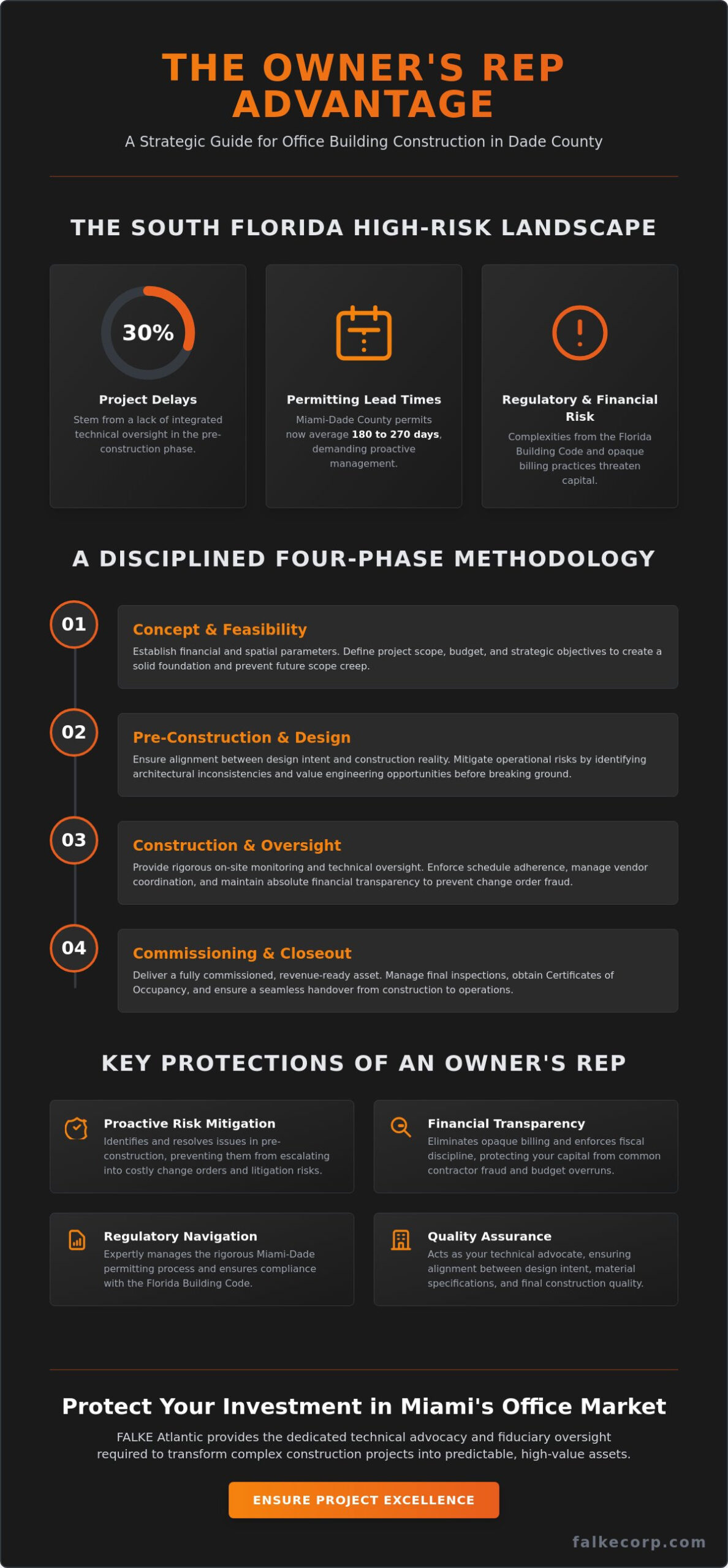
Industry data from 2024 reveals that approximately 30% of commercial project delays in South Florida stem directly from a lack of integrated technical oversight during the pre-construction phase. In an environment where permitting lead times in Miami-Dade now average between 180 and 270 days, the role of a dedicated owner’s rep for office building construction Dade County becomes a critical safeguard against capital erosion. You’re likely aware that the intersection of the upcoming 9th Edition of the Florida Building Code and opaque contractor billing practices creates a high-risk landscape for any commercial developer. Managing these variables requires more than just oversight; it demands a rigorous, technical approach to project fiduciary duties.
This guide provides a disciplined four-phase methodology to ensure your office project is delivered on time, under budget, and fully revenue-ready. You’ll learn how to navigate the specific complexities of the Miami-Dade regulatory environment while maintaining absolute financial transparency. We’ll examine the structural requirements for mitigating litigation risks and ensuring seamless coordination across all third-party vendors, from initial design through final commissioning and the issuance of certificates of occupancy.
Key Takeaways
- Understand how a technical advocate ensures alignment between design intent and final construction quality, mitigating operational risks before they manifest.
- Discover a disciplined four-phase methodology used by an owner’s rep for office building construction Dade County to maintain schedule adherence and budget control.
- Learn to navigate the rigorous Miami-Dade permitting environment and the complexities of the updated Florida Building Code through proactive risk management.
- Identify the mechanisms for enforcing financial transparency to eliminate opaque billing and protect your capital from common change order fraud.
- Evaluate the criteria for selecting a strategic partner capable of coordinating diverse third-party vendors to deliver a fully commissioned, revenue-ready asset.
The Strategic Necessity of an Owner’s Rep in Dade County Office Projects
An owner’s representative serves as a dedicated technical advocate, operating under a fiduciary mandate to align the project’s execution with the owner’s long-term strategic objectives. In the context of Dade County, where commercial development faces a unique intersection of regulatory rigor and environmental demands, this role transcends basic administrative oversight. It’s a strategic partnership that provides the technical friction necessary to ensure that third-party vendors, including architects and engineers, adhere to the owner’s vision without compromising on quality or fiscal discipline. This level of oversight is essential for maintaining project momentum in a market characterized by high volatility and complex permitting requirements.
While a general contractor focuses on the physical assembly of the structure, an expert in Construction management acting as an owner’s rep manages the broader ecosystem of risk, finance, and quality. Standard project management often lacks the technical depth required to challenge contractor assumptions or identify systemic inefficiencies that lead to budget overruns. Professional oversight prevents the most common causes of office project failure, such as mismanaged schedules, opaque billing practices, and the misalignment between design intent and final construction quality. By acting as the owner’s eyes and ears on the ground, the representative ensures that the project doesn’t fall victim to the typical pitfalls of South Florida construction.
The Complexity of the South Florida Commercial Sector
Class A office construction in Miami-Dade necessitates a balance between high-end architectural aesthetics and the structural requirements of the High-Velocity Hurricane Zone (HVHZ). Climate challenges, such as extreme humidity and salt air exposure, dictate specific material selections that, if mismanaged, compromise the building’s operational life cycle. Navigating these high stakes requires a partner who understands how to maintain design standards while ensuring structural integrity remains uncompromised by local environmental stressors.
Protecting Capital through Technical Competence
Technical competence is the primary defense against capital erosion. By identifying architectural inconsistencies during pre-construction, an expert rep prevents issues from escalating into expensive change orders. This methodology adheres to a rigorous Construction Project Management Florida framework, ensuring every dollar invested contributes to the asset’s valuation. Utilizing an owner’s rep for office building construction Dade County provides the oversight necessary to verify that technical specifications are met.
Ultimately, the strategic necessity of this role lies in its ability to transform a complex construction process into a predictable, manageable investment. Without a dedicated advocate, owners often find themselves caught between the conflicting interests of various vendors, leading to compromised results. A professional representative eliminates these conflicts by establishing clear lines of accountability and maintaining a singular focus on the owner’s best interests throughout the development lifecycle.
A Disciplined Four-Phase Methodology for Office Building Excellence
Achieving excellence in commercial development requires more than just oversight; it necessitates a chronological framework that enforces accountability at every milestone. This four-phase delivery model serves as the backbone for complex projects, ensuring that no technical detail is overlooked during the transition from abstract design to physical asset. It’s during these stages that the technical competence of an owner’s rep for office building construction Dade County becomes most visible, transforming volatile variables into predictable outcomes. By structuring the workflow into distinct phases, owners can maintain a high-level strategic perspective while their representative manages the granular technical complexities of the site.
Phase 1 begins with initial concept and feasibility, establishing the financial and spatial parameters that define the project’s viability. Phase 2 transitions into pre-construction and design, where the focus shifts to risk mitigation and technical precision. This evolution is vital as the industry sees an increasing demand for owner’s representatives who can navigate the escalating costs and technical requirements of modern office infrastructure. Phase 3 involves active construction, where the primary objective is maintaining financial and operational control, followed by Phase 4, commissioning and close-out, which ensures the building is fully revenue-ready.
Pre-Construction: The Foundation of Risk Mitigation
In the Miami market, site feasibility studies are not merely procedural; they’re the primary defense against unforeseen subsurface conditions and restrictive zoning ordinances. Coordinating entitlements and permitting within the City of Miami requires a granular understanding of local building codes to avoid the 180 to 270-day delays often encountered in major developments. You can learn more about strategic pre-construction services in Miami to understand how this phase serves as a critical filter for operational risks. Establishing this foundation ensures that the project doesn’t encounter legal or structural roadblocks once capital is fully committed.
Active construction demands rigorous financial and operational control to prevent the erosion of the project’s pro forma. This involves verifying that every change order is technically justified and that contractor billing remains transparent and accurate. It ensures the design intent is maintained without succumbing to the value-engineering pressures that often degrade Class A office standards. Effective development management during this phase keeps all third-party vendors aligned with the owner’s budgetary constraints.
Commissioning: Ensuring the Asset is Revenue-Ready
The final phase, commissioning and close-out, represents the transition from a construction site to a functioning commercial environment. This process involves the systematic verification of all mechanical, electrical, and plumbing (MEP) systems to ensure they perform according to the specified design parameters. In Dade County, achieving revenue-readiness also requires meticulous attention to final documentation and compliance procedures, ensuring the project meets all municipal standards for a Certificate of Occupancy. This disciplined approach ensures that the asset is ready for immediate occupancy and long-term operational stability.
Mitigating Risks: From Dade County Permitting to Cost Control
Risk mitigation in South Florida isn’t a secondary objective. It’s the primary driver of fiscal stability. An owner’s rep for office building construction Dade County must navigate a regulatory landscape that has become increasingly technical since the implementation of the newest Florida Building Code updates. This environment requires a granular understanding of the 40-year recertification process, which now demands higher levels of structural scrutiny for aging office assets. Beyond standard municipal building departments, projects often fall under the jurisdiction of the Miami-Dade Aviation Department, adding layers of height and zoning restrictions that can derail a project if not managed during the feasibility phase. This complexity necessitates a technical advocate who can translate regulatory requirements into actionable construction milestones.
Navigating Local Regulatory Hurdles
The introduction of Milestone Inspection and Structural Integrity Reserve Study (SIRS) requirements has fundamentally altered how commercial office assets are managed in Dade County. Owners must now account for rigorous structural, electrical, and roofing repairs to maintain compliance with local codes. Engaging an Owner’s Representative in Miami provides the necessary regulatory advocacy to ensure these inspections don’t lead to unnecessary operational shutdowns or inflated repair costs. This oversight ensures that every repair is technically justified and performed to the standards required by the Building Department, effectively preventing the litigation risks associated with non-compliance and structural negligence.
Financial Control and Transparency
Financial erosion in large-scale office projects often occurs through opaque contractor billing and change order fraud. Preventing these issues requires a systematic validation of contractor pay applications to ensure that billed amounts align strictly with the verified percentage of work completed on-site. Managing contingency funds involves more than just tracking expenses; it requires proactive cash flow forecasting to anticipate budgetary variances before they impact the project’s bottom line. Effective construction cost control in Dade County requires a disciplined audit of every line item against the original project scope to eliminate unauthorized expenditures. By maintaining this level of transparency, an owner’s rep protects the owner’s capital and ensures the project remains financially viable through to final commissioning.
Implementing rigorous financial oversight also involves the scrutiny of subcontractor lien waivers and insurance certificates. In the volatile Miami-Dade market, a lapse in subcontractor documentation can lead to costly delays or legal encumbrances on the property. A professional representative establishes a centralized document control system that tracks these variables in real-time. This disciplined approach eliminates the information gaps that contractors might otherwise exploit, ensuring that the owner’s interests are protected from the initial groundbreaking to the final close-out of the construction loan.
Selecting the Right Partner for South Florida Commercial Developments
Selecting the ideal partner is a decision that fundamentally dictates the project’s risk profile. While large-scale management firms offer broad resources, they often delegate the granular technical oversight of Class A office projects to junior staff who may lack the necessary field experience. A boutique consultancy ensures that senior-level technical competence remains present at every site meeting and during every budgetary review. This distinction is critical when engaging an owner’s rep for office building construction Dade County, as the technical demands of the local market leave little room for administrative oversight that lacks engineering depth. You need a partner whose reputation is built on the precision of their execution rather than the size of their marketing budget.
Local vendor networks are the lifeblood of successful South Florida developments. A partner with deep roots in the Dade County market understands which MEP engineers and structural consultants possess the specific expertise required for High-Velocity Hurricane Zone (HVHZ) compliance. This knowledge prevents the friction that typically occurs when out-of-market vendors attempt to apply standard national practices to Miami’s unique regulatory environment. Transparency and reporting standards should be non-negotiable; an owner should expect real-time access to project dashboards that track every line item and schedule variance with absolute clarity. Interestingly, the demand for digital transparency is also growing in the care and social sectors—you can read more about how fokus digital GmbH utilizes specialized recruiting dashboards to streamline operations.
Evaluating Technical Expertise in Office Construction
Technical expertise in the office sector requires a deep understanding of Class A infrastructure, including redundant power systems, high-speed fiber optics, and advanced HVAC configurations. In mixed-use developments, the integration of retail and hospitality elements adds layers of complexity to the core office structure. Reviewing the Commercial Project Management in Miami standards ensures your representative can manage Tenant Improvement (TI) coordination with the same level of discipline applied to the shell and core construction. This ensures that the final delivery meets the sophisticated expectations of modern corporate tenants.
The Value of a Strategic Partnership
A strategic partnership moves beyond the transactional nature of a standard service contract. It involves finding a partner who is hűvösen elegáns (coolly elegant) and remains composed under the pressures of Miami’s fast-paced development cycle. This professional approach is essential when managing the expectations of corporate boards or high-net-worth individuals who demand results without the noise of project-level friction. A dedicated representative acts as a stabilizer, ensuring that the project’s ROI remains the central focus of every technical decision made on the ground. If you are ready to secure your investment with this level of professional discipline, contact FALKE Atlantic to discuss your project’s specific requirements.
Ultimately, the right partner doesn’t just report on problems; they provide the technical solutions that prevent them. By assessing a firm’s competence in TI coordination and their commitment to financial transparency, owners can ensure their capital is protected. This level of oversight transforms the construction process into a predictable, high-value asset delivery, securing the long-term viability of your Dade County office investment.
FALKE Atlantic: Protecting Your Investment in Miami’s Office Market
FALKE Atlantic operates with a steadfast commitment to technical precision and financial discipline, recognizing that the margin for error in South Florida’s commercial sector is non-existent. As a premier owner’s rep for office building construction Dade County, we provide the rigorous oversight necessary to protect capital in a market defined by complex regulatory shifts and rising labor costs. Our methodology isn’t a passive observation but a proactive management of the entire development ecosystem. We ensure that every technical specification and budgetary allocation serves the owner’s ultimate ROI. This disciplined approach transforms the inherent volatility of construction into a structured, predictable process that prioritizes asset quality above all else.
Our experience managing complex developments across South Florida has allowed us to refine a delivery model that anticipates the specific challenges of the Miami-Dade environment. By enforcing strict accountability among all third-party vendors, we eliminate the information gaps that typically lead to project failure. We don’t rely on emotional persuasion or marketing-driven promises. Instead, we rely on the strength of our technical competence and a proven track record of delivering Class A office assets that are fully commissioned and ready for immediate revenue generation.
A Boutique Approach to Complex Construction
A boutique approach is essential for high-stakes office developments because it guarantees that senior expertise is applied to every critical decision. Unlike larger management firms that may dilute their focus across too many projects, FALKE Atlantic maintains a concentrated portfolio to ensure absolute quality control. Our track record in Construction Phase Management in Florida demonstrates our ability to maintain schedule adherence while navigating the technical hurdles of Class A office infrastructure. We protect client interests through every stage of the real estate lifecycle, ensuring that the design intent is never compromised by field-level inefficiencies.
Initiating Your Office Project
Initiating a project with FALKE Atlantic begins with a strategic advisory consultation focused on site selection and feasibility. This initial phase is critical for identifying potential regulatory roadblocks or subsurface conditions before capital is fully committed. We tailor our services to the specific needs of your corporate or hospitality-integrated office project, ensuring that the project foundation is structurally and financially sound. Our four-phase methodology provides the transparency you need to manage high-net-worth or corporate expectations with confidence. To secure your project’s financial and operational future, contact FALKE Atlantic for a technical evaluation of your development objectives. We provide the stability and expertise required to navigate the most complex construction processes in Dade County.
Securing Your Commercial Legacy in South Florida
The successful delivery of a Class A office project in South Florida depends on the rigorous integration of technical precision and unwavering financial discipline. By adopting a structured four-phase delivery model, owners can transform the complexities of the Miami-Dade regulatory landscape into a manageable and predictable process. This approach ensures that every architectural decision and budgetary allocation aligns with the long-term valuation of the asset. It’s about maintaining control over the variables that typically lead to project failure in a volatile market.
Engaging an expert owner’s rep for office building construction Dade County provides the fiduciary oversight necessary to navigate the 180 to 270 day permitting lead times and the stringent requirements of the High-Velocity Hurricane Zone. FALKE Atlantic offers a boutique consultancy model that prioritizes senior-level technical competence for high-net-worth and corporate developments. Our methodology eliminates the information gaps that lead to capital erosion, ensuring your project is delivered as a revenue-ready asset. Secure your commercial investment with FALKE Atlantic’s expert representation. We look forward to establishing a strategic partnership that ensures your project meets the highest professional standards from initial feasibility through final commissioning.
Frequently Asked Questions
What is the primary difference between an owner’s rep and a project manager in Dade County?
An owner’s representative acts as a fiduciary advocate with a scope that encompasses the entire development lifecycle, including site selection, financing, and legal coordination. While a project manager often focuses on specific task execution or works directly for the general contractor, the representative manages the broader ecosystem to protect the owner’s capital. In the complex Miami market, this distinction is vital for ensuring that every technical decision aligns with the owner’s long-term strategic goals rather than just immediate construction milestones.
How does an owner’s representative help with the Miami-Dade 40-year recertification process?
The representative coordinates the mandatory Milestone Inspection and Structural Integrity Reserve Study (SIRS) required under updated Florida statutes. They manage the technical interface between structural engineers and the building department to ensure that all identified repairs for roofing, electrical, and structural systems are technically justified. This oversight prevents contractors from inflating repair scopes and ensures that the asset remains compliant with the rigorous safety standards now enforced throughout Dade County.
Can an owner’s rep help reduce construction costs for an office building?
Cost reduction is achieved through proactive risk mitigation and the elimination of unauthorized change orders during the pre-construction and active phases. By performing a disciplined audit of the initial project scope and contractor pay applications, an owner’s rep for office building construction Dade County identifies fiscal inefficiencies before they impact the pro forma. This technical scrutiny ensures that the owner only pays for verified work that meets the specified Class A quality standards.
At what stage of an office construction project should I hire an owner’s rep?
Engagement should ideally occur during the initial feasibility or pre-design phase to maximize the impact on risk mitigation. Early involvement allows the representative to influence the site selection and entitlement process, which is critical given that permitting lead times for major developments in Miami-Dade can range from 180 to 270 days. Establishing a technical foundation early prevents the architectural flaws and zoning conflicts that lead to costly delays once capital is fully committed.
How do owner’s representative fees typically work in Florida?
Fee structures in the Florida market are generally organized as either a percentage of the total project cost or a fixed monthly retainer. These structures are designed to align the representative’s interests with the owner’s financial goals, providing a transparent framework for technical oversight. Many sophisticated owners prefer a retainer model for larger office projects to ensure consistent, senior-level attention throughout the multi-year development cycle without the conflicts that can arise from variable cost structures.
What specific Dade County permitting hurdles can an owner’s rep help navigate?
The representative manages compliance with the High-Velocity Hurricane Zone (HVHZ) standards and the unique height restrictions imposed by the Miami-Dade Aviation Department for projects near flight paths. They also navigate the 7.5% building permitting surcharge and the complexities of the updated Florida Building Code, which requires intensive energy and structural oversight. Their expertise ensures that the project moves through the municipal system without the administrative friction that often stalls unmanaged developments.
Is an owner’s rep necessary if I already have a reputable General Contractor?
Yes, because the interests of a general contractor and an owner aren’t always perfectly aligned regarding financial transparency and risk allocation. The representative provides the technical “friction” necessary to audit contractor billing and verify that the design intent is being executed without unauthorized substitutions. They act as an independent layer of protection, ensuring that the contractor’s performance remains strictly within the parameters of the established contract and budget.
How does FALKE Atlantic ensure an office building is ‘revenue-ready’?
FALKE Atlantic utilizes a rigorous commissioning and close-out process that verifies every mechanical, electrical, and plumbing (MEP) system performs according to the design specifications. We manage the final transition from a construction site to an operational asset by securing the Certificate of Occupancy and ensuring all tenant improvement coordination is complete. This disciplined approach ensures that the building is ready for immediate occupancy and that the owner can begin generating returns without operational interruptions.