
In the current regulatory climate of South Florida, hiring an owner’s representative for condominium associations in Fort Lauderdale is no longer an elective luxury; it’s a critical fiduciary safeguard for boards facing the December 31, 2026, Structural Integrity Reserve Study (SIRS) deadline. Most board members recognize that the complexity of House Bill 1021 and House Bill 913 requires a level of technical oversight that goes beyond traditional property management. It’s understood that the pressure to maintain structural safety while protecting property values often creates friction between fiscal responsibility and resident expectations.
This strategic guide demonstrates how expert representation mitigates these risks by enforcing strict budget adherence and ensuring total transparency during the construction phase. It’s possible to navigate the 30-year recertification process without the burden of surprise change orders or project delays. We’ll explore the specific methodologies used to manage mandatory insurance appraisals, online document compliance, and the transition to mandatory reserve funding by early 2027. This overview provides the technical clarity needed to maintain absolute control over your association’s most significant capital expenditures.
Key Takeaways
- Understand the critical 2026 deadlines for Structural Integrity Reserve Studies (SIRS) and how updated Florida legislation mandates stricter financial and structural transparency for boards.
- Learn why engaging an owner’s representative for condominium associations Fort Lauderdale is a vital fiduciary safeguard to ensure independent oversight and eliminate conflicts of interest.
- Discover how to mitigate the risks of the ‘Design-Build’ model by maintaining a clear separation between project advocacy and construction execution.
- Identify the specific advantages of a structured four-phase project management methodology in controlling budgets and ensuring rigorous adherence to technical specifications.
- Explore how applying professional development management standards protects property values and resident safety during complex multi-million dollar renovations.
The 2026 Regulatory Landscape for Fort Lauderdale Condominiums
The year 2026 represents a definitive threshold for Florida’s multi-family residential sector. For associations in Fort Lauderdale, the extension of the Structural Integrity Reserve Study (SIRS) deadline to December 31, 2026, by House Bill 913 provides a narrow window to achieve compliance. This legislative shift transforms structural maintenance from a discretionary budgetary item into a mandatory fiduciary obligation. Boards that fail to initiate these studies or begin funding reserves by the January 1, 2027, deadline face significant legal and financial exposure. Engaging an owner’s representative for condominium associations Fort Lauderdale ensures that these technical requirements are met with precision rather than reactive haste. The current market shows a distinct flight to quality; buyers and insurers now prioritize buildings with fully funded reserves and documented structural integrity.
SB-4D and SB-154: Beyond the Basics
SB-4D and SB-154 establish the rigorous framework for Milestone Inspections, requiring buildings of three stories or higher to undergo comprehensive structural assessments. In Broward County, these mandates are particularly critical due to the corrosive effects of the salt-air environment on reinforced concrete. An owner’s representative acts as a technical liaison, translating the complex findings of structural engineers into actionable project phases. This specialized oversight aligns with the principles of professional Construction Management; it focuses on protecting the association’s interests through every phase of the inspection and remediation cycle. Without this advocacy, boards often struggle to interpret engineering reports, leading to either insufficient repairs or unnecessary over-scoping by contractors.
Fort Lauderdale’s Local Building Ordinances
The City of Fort Lauderdale maintains specific and evolving expectations regarding high-rise certifications and coastal construction permits. Navigating the local building department requires an intimate understanding of both the 30-year recertification process and the subsequent 10-year cycles. Coastal properties face additional scrutiny regarding seawall integrity, waterproofing, and balcony railing specifications. It’s a reality that the insurance market has no appetite for deferred maintenance. Buildings without updated certifications often see premiums escalate or coverage rescinded entirely.
Professional representation ensures that permitting hurdles are cleared efficiently and that the association’s capital is deployed effectively. This is especially true when managing the 17% list-to-sale price differential currently observed in the local market. By utilizing an owner’s representative for condominium associations Fort Lauderdale, boards can demonstrate to residents and stakeholders that they’re following a disciplined, expert-led path toward long-term building safety. This structured approach prevents the common pitfall of “emergency” assessments, which often arise when local authorities identify non-compliance issues that could have been mitigated through proactive planning.
Defining the Owner’s Representative for Condo Associations
An owner’s representative serves as a professional surrogate for a board of directors, exercising technical oversight where lay knowledge is often insufficient. In the complex regulatory environment of 2026, an owner’s representative for condominium associations Fort Lauderdale acts as a dedicated advocate whose sole objective is the protection of the association’s assets. Unlike a general contractor, who operates under a profit-driven motive tied to construction volume, the representative maintains a strictly fiduciary posture. This role is defined by its total lack of financial interest in the execution of the work. This independence ensures that every recommendation is made with the board’s legal and financial safety in mind. They are the eyes and ears of the board on-site, ensuring that reality matches the technical specifications.
The necessity for this role is underscored by the Florida Condominium Act, which mandates specific governance and transparency standards for association boards. By bridging the gap between technical engineering jargon and board-level decision making, the representative prevents the common pitfall of financial mismanagement. They translate complex site reports into clear, risk-adjusted options. This allows directors to fulfill their duties without becoming mired in technical details they aren’t trained to manage. It’s about data-driven clarity. High-stakes projects require a level of scrutiny that property managers, despite their competence, are rarely equipped to provide alone.
The Fiduciary Relationship
Independence is the cornerstone of effective representation. When a representative is financially decoupled from the construction crew, they can perform objective audits of work quality and billing accuracy without compromise. This structural separation is vital for transparency. It protects the board’s liability during major capital improvements by providing a documented trail of professional oversight. A strategic partner doesn’t just manage a project; they insulate the association from the litigation risks inherent in South Florida construction. This protection is a non-negotiable asset in an era of heightened accountability.
Stakeholder Coordination in Shared Ownership
Condominium projects are unique because of the diverse interests of the board, property managers, and individual unit owners. The representative facilitates consensus by providing a single point of truth for all technical matters. They ensure that third-party vendors, from architects to specialized subcontractors, remain aligned with the association’s core interests. This methodical coordination is essential for maintaining project momentum. It prevents the internal friction that often stalls critical safety upgrades. For boards seeking to formalize this level of oversight, professional owner’s representation provides the necessary framework for long-term project success.
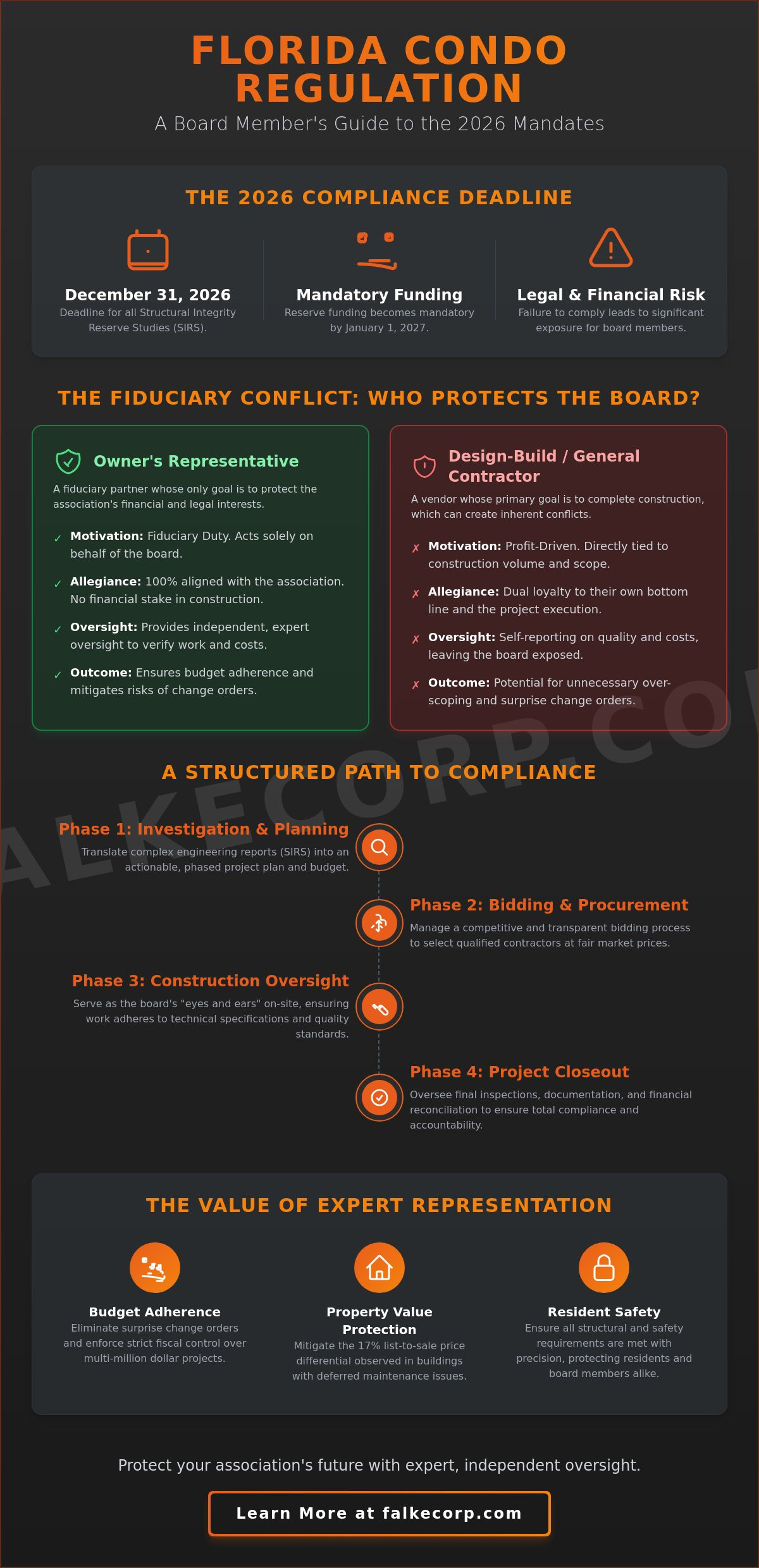
Owner’s Rep vs. General Contractor: Navigating the Conflict of Interest
The “Design-Build” delivery method is frequently presented to boards as a model of efficiency. In this structure, a single entity manages both the design and the construction phases. While this appears to streamline communication, it removes the essential system of checks and balances required for multi-million dollar capital improvements. A general contractor (GC) is a vendor with a primary profit motive tied to the volume and cost of construction. They cannot effectively audit their own performance or objectively evaluate the necessity of their own change orders. This inherent conflict of interest often leads to scope creep and budgetary inflation that boards are ill-equipped to challenge.
An independent owner’s representative for condominium associations Fort Lauderdale serves as the critical counterweight to the contractor’s commercial interests. By maintaining total financial independence from the construction crew, the representative ensures that every technical decision is made in the association’s favor. This role is not merely about project oversight; it’s about enforcing a disciplined framework where the contractor is held to the exact letter of the contract. This level of scrutiny is what separates a successful renovation from a project plagued by financial mismanagement.
The Conflict of Interest Problem
Self-policing in the construction industry is a systemic risk for condominium boards. When a contractor identifies “unforeseen conditions,” the resulting change orders can quickly erode an association’s reserves. Without a third-party technical audit, boards often feel compelled to approve these costs to avoid project delays. Adhering to the CMAA Standards of Practice, a professional representative provides an unbiased evaluation of every site condition and cost claim. They verify if a change order is legitimate or if it’s simply “fat” added to the contractor’s bottom line. This professional friction is necessary to protect the board’s fiduciary standing.
Cost Control and Bid Leveling
The pre-construction phase is where the most significant cost savings are realized. Contractors often submit bids with varying scopes, making it impossible for boards to conduct “apples-to-apples” comparisons. An owner’s representative for condominium associations Fort Lauderdale performs rigorous bid leveling, stripping away vague qualifiers to reveal the true cost of the work. This process ensures that the association isn’t just selecting the lowest price, but the most comprehensive and realistic proposal.
Strict contract oversight continues throughout the execution phase to prevent change order fraud and billing errors. For boards seeking a deeper understanding of these protective measures, our guide on Construction Project Management in Florida details the specific protocols used to maintain budget integrity. By implementing these controls, associations can move forward with confidence, knowing their capital is being managed with professional precision.
The Four-Phase Methodology for Condo Project Success
Project success for high-rise associations is never accidental. It’s the product of a structured, linear progression that prioritizes data over assumptions. By utilizing an owner’s representative for condominium associations Fort Lauderdale, boards move away from reactive decision-making and toward a controlled execution model. This methodology is divided into four distinct phases: Initiate, Strategize, Execute, and Commission. Each phase acts as a gateway, ensuring that the project only proceeds once specific technical and financial benchmarks are met. This disciplined approach provides the clarity needed to manage multi-million dollar budgets with absolute confidence.
Phase 1 & 2: Planning and Risk Mitigation
The initial phase centers on feasibility. It’s here that the association’s goals are reconciled with the physical reality of the building and the current regulatory landscape. Site feasibility studies are conducted to identify latent defects or permitting hurdles that could derail a project later. Once the concept is validated, the focus shifts to assembling the design team. An expert representative ensures that the architects and engineers selected have specific experience with South Florida’s coastal environment and high-rise structural requirements. This prevents the selection of vendors who lack the specialized knowledge required for 2026 compliance standards.
This pre-construction period is the most vital stage for risk mitigation. Detailed oversight during entitlements and permitting prevents the costly delays often associated with local building department backlogs. For a deeper analysis of these early-stage protocols, boards should review our guide on Strategic Pre-Construction Services in Miami, which outlines the essential steps for insulating an association from project volatility. Proper planning at this stage is what allows an owner’s representative for condominium associations Fort Lauderdale to lock in budgets before a single shovel hits the ground.
Phase 3 & 4: Execution and Delivery
During the execution phase, the representative maintains a constant on-site presence. This oversight is focused on two primary objectives: quality control and schedule adherence. In a condominium environment, maintaining the timeline is essential to minimize disruption to residents and protect seasonal rental income. Financial control is enforced through the rigorous auditing of contractor pay applications, ensuring that the association only pays for work that’s been completed and verified to meet technical specifications. This level of scrutiny eliminates the ambiguity that often leads to budget overruns.
The final phase, Commissioning and Close-out, is often where projects falter without professional guidance. This stage involves the thorough testing of all life-safety systems and the documentation of every component for long-term warranty protection. Delivering a revenue-ready asset means that every aspect of the project, from the mechanical systems to the final punch list, is fully operational and compliant. Boards seeking to implement this level of professional project management can ensure their capital improvements are delivered with the highest standards of technical excellence.
Why FALKE Atlantic Corporation is the Strategic Choice for Fort Lauderdale Boards
FALKE Atlantic Corporation applies a level of technical rigor typically reserved for luxury hospitality and high-end retail developments to the residential sector. By serving as an owner’s representative for condominium associations Fort Lauderdale, we provide a structured framework that eliminates the operational chaos often associated with large-scale renovations. Our methodology ensures that association capital is protected through every stage of the project lifecycle. This corporate-level discipline is essential for boards managing the transition to mandatory reserve funding and structural compliance in 2026. We prioritize technical competence over emotional persuasion, ensuring that every decision is backed by data and professional oversight.
A project is only successful if it delivers a revenue-ready asset. For many Fort Lauderdale associations, this means ensuring that premium amenities and resident services are restored to full operational capacity without delay. We understand that properties with active rental programs can’t afford prolonged disruptions. Our commissioning process includes a meticulous verification of all systems to ensure they meet the aesthetic and functional standards expected in the luxury market. This focus on the final delivery stage protects the property’s market value and ensures that the transition from construction site back to a residential sanctuary is seamless.
A Disciplined Methodology
Our four-phase approach acts as a safeguard against the common pitfalls of South Florida construction. By applying the same standards used in multi-million dollar commercial projects, FALKE Atlantic Corporation brings a predictable structure to the often-unpredictable world of condo renovations. This methodology focuses on risk mitigation from the earliest feasibility studies through to the final close-out. For associations with regional interests, our analysis of Owner’s Representative Miami: Protecting Your Real Estate Assets highlights how these professional standards are applied to maintain stability across the South Florida market. We believe that transparency is the foundation of trust between a board and its unit owners.
The FALKE Atlantic Corporation Difference in Broward County
Our presence in Broward County is defined by localized expertise and a deep understanding of Fort Lauderdale’s evolving high-rise market. We recognize that every building has a unique set of challenges, from coastal salt-air corrosion to specific local permitting requirements. FALKE Atlantic Corporation doesn’t operate as mere project consultants; we act as strategic partners who take full responsibility for the technical integrity of the work. This partnership ensures that boards can fulfill their fiduciary duties while maintaining absolute control over their capital expenditures.
The 2026 deadlines for SIRS and milestone inspections are approaching quickly. Associations must move beyond reactive maintenance and adopt a professional development management approach to remain compliant and competitive. We invite boards to schedule a technical consultation to discuss upcoming recertification projects and capital improvements. Our team provides the expertise required to navigate these complexities with precision, ensuring your association’s long-term safety and financial stability.
Securing Your Association’s Future in a Post-Compliance Era
The transition toward 2027 mandates a fundamental shift in how Fort Lauderdale boards manage their real estate assets. Successful navigation of the Structural Integrity Reserve Study (SIRS) and SB-4D compliance requires more than just administrative effort; it demands a rigorous, technical approach to capital improvement. By prioritizing fiduciary-level transparency and financial control, boards can insulate their communities from the risks of deferred maintenance and contractor conflicts. Our disciplined four-phase methodology ensures that every project benchmark is met with professional precision and total accountability.
Engaging an owner’s representative for condominium associations Fort Lauderdale provides the essential oversight needed to protect property values and resident safety. This strategic partnership transforms complex regulatory burdens into a structured path toward long-term stability. If your board is preparing for upcoming recertifications or major renovations, now is the time to implement a professional management framework. We invite you to Schedule a Consultation for Your Fort Lauderdale Condo Association to ensure your project is handled with the highest level of expertise. Proactive planning is the most effective way to secure your association’s financial and structural integrity for the years ahead.
Frequently Asked Questions
What is the difference between a property manager and an owner’s representative?
A property manager handles the daily operations and resident relations of the building, while an owner’s representative provides specialized technical oversight for major capital projects. While the property manager maintains the existing asset, the representative manages the complex lifecycle of construction from pre-construction through to commissioning. This distinction ensures that the technical demands of a multi-million dollar renovation don’t overwhelm the board’s operational staff.
When is the best time to engage an owner’s representative for a condo project?
Engaging an owner’s representative for condominium associations Fort Lauderdale is most effective during the initial feasibility and concept phase. Early involvement allows the representative to establish a realistic budget and assemble a qualified design team before any financial commitments are made. This proactive approach identifies potential permitting hurdles and site constraints before they become costly delays during the execution phase.
How does an owner’s rep save a condo association money?
An owner’s representative identifies cost savings through rigorous bid leveling and the elimination of unnecessary scope creep. By auditing every change order and verifying technical specifications on-site, they prevent the financial inflation often associated with unmonitored general contractors. This level of financial control ensures that association reserves are deployed efficiently and that the project remains within the established budgetary framework.
Does an owner’s rep replace the need for a general contractor?
An owner’s representative doesn’t replace a general contractor; instead, they serve as the board’s technical advocate to manage the contractor’s performance. The general contractor is responsible for the physical execution of the work, while the representative ensures that the work adheres strictly to the contract and quality standards. This separation of duties creates the necessary checks and balances to protect the association’s interests.
How do owner’s representative fees work for condominium associations?
Owner’s representative fees are typically structured as a percentage of the total project cost, a fixed monthly fee, or an hourly rate for specialized pre-construction consulting. This fee structure is negotiated based on the project’s complexity and duration. By formalizing these costs upfront, the board gains a predictable expense for professional oversight that often pays for itself through the mitigation of change orders and delays.
Can an owner’s representative help with 30-year recertification in Fort Lauderdale?
Yes, an owner’s representative is instrumental in managing the 30-year recertification process by coordinating with structural and electrical engineers to address identified deficiencies. They manage the resulting repair projects to ensure compliance with the City of Fort Lauderdale’s building department requirements. This oversight is particularly valuable for meeting the December 31, 2026, SIRS deadline established by House Bill 913.
What problems does an owner’s rep solve during the construction phase?
During the construction phase, the representative resolves technical disputes regarding work quality, schedule delays, and payment applications. They provide a professional filter for all site communications, ensuring the board isn’t forced to make decisions based on incomplete or biased information. This presence on-site enforces contractor accountability and ensures that all life-safety systems are installed according to the approved engineering plans.
Is an owner’s rep worth the cost for smaller capital improvement projects?
An owner’s representative for condominium associations Fort Lauderdale provides significant value to smaller projects when technical complexity or liability risks are high. Projects such as roof replacements or balcony restorations involve critical structural considerations where errors lead to long-term financial damage. Professional representation ensures that the association receives the exact quality of work specified in the contract regardless of project size.