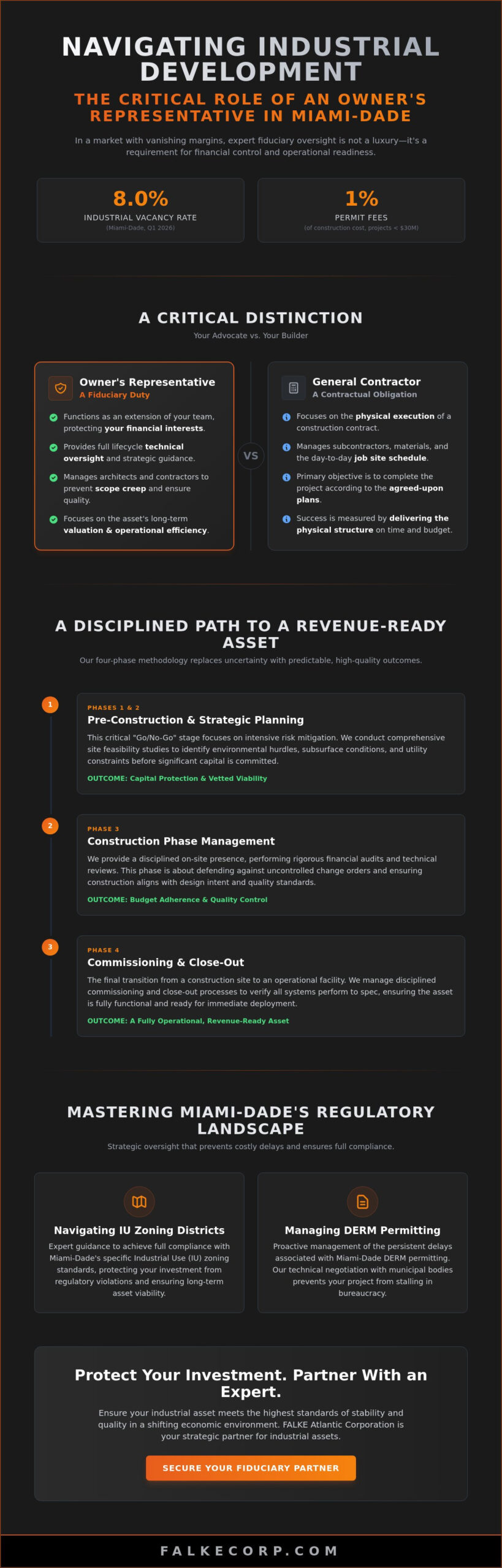
With industrial vacancy rates in Miami-Dade reaching 8.0% in the first quarter of 2026 and permit fees now structured at 1% of construction costs for projects under $30 million, the margin for error in capital deployment has effectively vanished. You recognize that securing a revenue-ready asset requires more than just a construction contract; it demands a rigorous defense against uncontrolled change orders and the persistent delays associated with Miami-Dade DERM permitting. Engaging a qualified owner’s representative for industrial projects Dade County transforms the development process from a series of reactive corrections into a disciplined, technical negotiation with municipal regulations and site complexities.
This guide details how expert oversight ensures financial control and operational readiness while navigating the 2026 Comprehensive Development Master Plan updates. We’ll examine the critical role of pre-construction services and construction phase management in achieving full compliance with IU zoning standards and protecting your investment from market volatility. By prioritizing a fiduciary relationship over a standard vendor arrangement, you can ensure that your project meets the highest professional standards of stability and quality in a shifting economic environment.
Key Takeaways
- Understand why a specialized owner’s representative for industrial projects Dade County is essential for managing the technical demands of high-spec South Florida assets.
- Learn the structured four-phase development methodology that prioritizes rigorous feasibility studies to mitigate financial risk before capital is committed.
- Discover the critical functional differences between a fiduciary representative and a general contractor to ensure your project’s ROI remains the primary objective.
- Navigate the complexities of Miami-Dade IU Zoning Districts and DERM requirements with strategic oversight that prevents costly regulatory delays.
- Identify how disciplined commissioning and close-out processes transition a construction site into a fully operational, revenue-ready industrial asset.
The Role of an Owner’s Representative for Industrial Projects in Dade County
An owner’s representative for industrial projects Dade County functions as a professional fiduciary, providing technical oversight that spans the entire lifecycle of a development, from initial concept through final commissioning. This role isn’t merely administrative; it’s a strategic necessity within the South Florida market where industrial assets involve significantly higher technical complexity than standard commercial builds. While a general contractor focuses on the physical execution of a contract, the representative ensures that every decision aligns with the owner’s financial interests and long-term operational goals. This distinction is vital because industrial facilities are often purpose-built machines rather than simple real estate shells.
The Role of an Owner’s Representative is to bridge the systemic gaps that often emerge between architectural design and field execution. By maintaining a disciplined presence on-site and within the boardroom, they mitigate the risks of scope creep and technical obsolescence. This oversight is particularly critical in Dade County, where infrastructure demands are intensified by specific zoning requirements and a highly competitive industrial landscape. Protecting the owner’s capital requires a partner who understands that every technical compromise in the field has a direct impact on the asset’s future valuation and operational efficiency.
Fiduciary Duty vs. Contractual Execution
The representative operates as an extension of your internal corporate team, providing a level of transparency that’s often absent in traditional design-bid-build models. They don’t just monitor progress; they perform rigorous financial audits and technical reviews to verify that the project’s fiscal health remains intact. By managing the complex interface between the architect and the general contractor, the representative ensures that technical specifications aren’t compromised for the sake of construction convenience. This structured approach to reporting allows owners to maintain full control over their capital without needing to manage the daily minutiae of the job site.
Industrial Asset Specialization in South Florida
Industrial development in Miami-Dade requires a deep understanding of specialized infrastructure, including high-capacity logistics hubs, cold storage facilities, and heavy manufacturing plants. Because these facilities often serve as the terminus for international trade, coordinating with a Panama Canal ship agent is a common requirement for tenants who need to manage the maritime transit of goods before they reach the South Florida market. These projects involve the integration of proprietary technologies and sensitive equipment that demand precise environmental controls. The representative oversees these technical integrations while simultaneously mitigating risks inherent to the South Florida climate, such as high humidity and coastal salt exposure. This specialized focus ensures that the final asset isn’t just a shell, but a high-performing industrial tool ready for immediate operational deployment.
A Disciplined Four-Phase Methodology for Industrial Development
Industrial development requires a linear, yet highly technical progression to avoid the compounding errors that often plague large-scale capital projects. By adopting a structured four-phase methodology, an owner’s representative for industrial projects Dade County provides the stability needed to navigate shifting market conditions, such as the 7.2% to 8.0% vacancy rates observed in early 2026. This framework ensures that every milestone is validated by data and technical competence before the project advances to the next stage of deployment. It’s a system designed to replace uncertainty with predictable, high-quality outcomes.
Phase 1 & 2: Pre-Construction and Strategic Planning
The initial phases represent the most critical period for risk mitigation and capital protection. During the “Go/No-Go” stage, the representative facilitates comprehensive site feasibility studies in Florida to identify environmental hurdles, subsurface conditions, or utility constraints that could jeopardize the budget. As noted in the industry analysis regarding The Role of an Owner’s Representative, assembling a specialized design team early is paramount. This process includes managing the entitlement sequence to secure industrial permits under the revised October 2025 fee schedule, ensuring that regulatory compliance doesn’t become a bottleneck for the development timeline.
Phase 3 & 4: Execution and Delivery
Once the project breaks ground, the focus shifts to rigorous construction phase management in Florida to maintain the schedule and enforce financial discipline. Maintaining financial control during construction requires a constant presence that most owners can’t provide internally. A dedicated owner’s representative for industrial projects Dade County serves as the final arbiter for change orders and schedule adjustments, protecting the project’s ROI from erosion.
The final phase involves the commissioning of complex industrial systems, such as specialized HVAC for cold storage or heavy power grids for manufacturing, followed by final safety inspections. This meticulous close-out process ensures the asset is revenue-ready and fully compliant with Dade County IU zoning before the transition to operations. For developers seeking to institutionalize this level of precision, partnering with a firm like FALKE Atlantic provides the fiduciary oversight necessary for long-term project success.
Owner’s Rep vs. General Contractor: Protecting the Industrial Fiduciary
In the traditional Design-Bid-Build framework, a systemic conflict of interest exists between the General Contractor (GC) and the project owner. The GC’s primary objective is efficient execution within the constraints of their contract, which often prioritizes speed and margin over the owner’s long-term return on investment. An owner’s representative for industrial projects Dade County serves as the necessary counterweight, acting as a technical fiduciary whose loyalty is exclusively to the owner. This relationship is fundamental to maintaining project integrity, as it replaces the “trust but verify” approach with a “verify then approve” protocol that safeguards capital throughout the construction lifecycle.
A dedicated owner’s representative for industrial projects Dade County performs exhaustive audits of pay applications and scrutinizes every change order for technical validity. In the complex landscape of industrial construction, where material costs fluctuate and specialized equipment requires precise installation, this oversight prevents common forms of mismanagement or inflated billing. The representative ensures that the owner pays only for verified progress, protecting the capital from the “nickel-and-diming” that frequently erodes industrial development budgets. This disciplined supervision is particularly vital in 2026, as asset pricing for industrial space in Dade County reached a record $257 per square foot, leaving no room for financial leakage or administrative oversight.
Financial Oversight and Cost Control
Effective construction project management in Florida requires more than just tracking a schedule; it demands independent verification of material procurement and labor allocations. In industrial builds, the representative manages the contingency fund with a high degree of discipline, ensuring it isn’t treated as a secondary profit center for the GC. This process includes:
- Independent Cost Auditing: Verifying that material invoices match the agreed-upon procurement rates and market data.
- Labor Allocation Tracking: Ensuring that on-site manpower levels align with the reported progress and the critical path of the schedule.
- Change Order Validation: Confirming that any requested scope adjustments are technically necessary and fairly priced before approval.
Technical Quality Assurance
Technical quality assurance is where the representative’s value becomes most visible. Industrial facilities require adherence to strict specifications, such as specific floor loading capacities, minimum ceiling heights, and robust power requirements for heavy manufacturing. The representative manages the Request for Information (RFI) process to ensure that field adjustments don’t compromise these critical parameters. By referencing the nuances of Dade County Industrial Zoning and Regulations, they ensure that the GC’s execution remains in full alignment with both the design intent and municipal mandates. Independent site inspections go beyond standard building codes to verify that the facility is truly fit for its specific industrial purpose.
Navigating Dade County Industrial Zoning and Regulations
The regulatory landscape in Miami-Dade County is currently shaped by the 2026 Evaluation and Appraisal Report (EAR) updates to the Comprehensive Development Master Plan (CDMP). For developers, this means site planning is no longer just a matter of architectural preference; it’s a technical negotiation with municipal mandates. An owner’s representative for industrial projects Dade County provides the necessary oversight to navigate these requirements, ensuring that every phase of the development remains in full compliance with Chapter 33 zoning regulations and the updated impact fee schedule effective through late 2027.
IU-1, IU-2, and IU-3: Selecting the Right District
Selecting the appropriate industrial district is a strategic decision that impacts both operational capacity and long-term asset value. IU-1 districts are designed for light manufacturing and wholesale distribution, requiring a minimum of 10% net lot area as landscaped open space. In contrast, heavy manufacturing under IU-C districts mandates a more substantial 20% landscaping requirement. The representative assists in this selection process by analyzing how specific setbacks and lot sizes affect the proposed facility’s efficiency. They also manage the public hearing process for variances or special exceptions, which is often necessary when industrial assets require non-standard configurations to accommodate proprietary technology or specialized logistics workflows.
Environmental and Infrastructure Compliance
Industrial projects in Dade County face rigorous scrutiny from the Department of Environmental Resources Management (DERM), particularly regarding Chapter 24 environmental code compliance. This oversight is vital for facilities handling industrial wastewater or hazardous materials, where improper planning can lead to significant delays or remediation costs. The representative coordinates directly with the Miami-Dade Water and Sewer Department (WASD) to secure the necessary capacity for heavy industrial use, ensuring that infrastructure doesn’t become a bottleneck during the construction phase.
Additionally, site planning must account for local flood zone regulations and sea-level rise mitigation, factors that are increasingly critical for institutional-grade industrial assets. As market demand shifts toward high-quality, modern spaces, integrating LEED or green building standards has become a hallmark of disciplined development. For owners looking to secure a compliant and resilient industrial asset, partnering with FALKE Atlantic ensures that these technical and regulatory hurdles are managed with unwavering precision and professional accountability.
FALKE Atlantic: Your Strategic Partner for Industrial Assets
Securing a high-performing industrial asset in the competitive 2026 Miami-Dade market requires a partner who operates with surgical precision and absolute fiduciary loyalty. FALKE Atlantic functions as a disciplined extension of your organization, providing the technical competence necessary to manage the inherent complexities of large-scale development. By engaging a specialized owner’s representative for industrial projects Dade County, you ensure that every technical decision and capital allocation is scrutinized through the lens of long-term asset value. Our approach isn’t based on emotional persuasion, but on the unwavering application of engineering standards and financial discipline.
The role of an owner’s representative for industrial projects Dade County is to eliminate the information asymmetry that often exists between developers and construction entities. We provide corporations and high-net-worth individuals with the transparency required to maintain full control over their investments without the burden of daily site management. This professional oversight is critical for delivering revenue-ready assets that meet the exact operational specifications of modern logistics and manufacturing tenants, particularly as asset pricing remains at record highs.
The FALKE Four-Phase Guarantee
Our project delivery is governed by a rigorous four-phase methodology that translates theoretical design into operational reality. This structured approach provides the financial stability and project transparency required to mitigate the risks of scope creep and schedule slippage. We’ve demonstrated this precision through complex case studies, including the integration of retail and heavy industrial requirements within high-density South Florida corridors. Every phase, from pre-construction to final commissioning, is documented and audited to ensure the final delivery meets our hallowed standards of quality and technical integrity.
Next Steps for Your Development
Successful industrial development begins with a clear identification of primary risks, ranging from subsurface environmental constraints to municipal permit bottlenecks. FALKE Atlantic mitigates these variables through proactive development management and disciplined construction phase oversight. We invite you to initiate a strategic session with our Florida-based team to analyze your project’s specific requirements and regulatory hurdles. Requesting a tailored proposal for owner’s representative services in Miami allows you to benchmark your current development strategy against the highest professional standards in the industry. Contact us to ensure your next industrial project is delivered with the stability and precision it demands.
Maximizing Asset Stability in a Shifting Industrial Landscape
The industrial market in Miami-Dade continues to evolve, with vacancy rates reaching 8.0% and average sales prices peaking at $257 per square foot in early 2026. Successfully navigating this environment requires more than just capital; it demands a technical partner capable of enforcing financial discipline and regulatory compliance. The decision to appoint a qualified owner’s representative for industrial projects Dade County is a strategic commitment to project stability. By leveraging a disciplined Four-Phase Methodology and deep expertise in Miami-Dade IU Zoning, you ensure that your asset is delivered revenue-ready and free from the systemic risks of mismanagement.
FALKE Atlantic provides the strategic fiduciary oversight required by corporations and high-net-worth individuals to protect their South Florida interests. We bridge the gap between technical design and operational deployment, ensuring that every square foot of your development serves its intended purpose. Secure Your Industrial Investment with FALKE Atlantic and establish a foundation of professional excellence for your next industrial project.
Frequently Asked Questions
What is the difference between an owner’s representative and a construction manager?
An owner’s representative acts as a fiduciary for the owner’s interests across the entire project lifecycle, while a construction manager typically focuses on the execution phase and site operations. The representative oversees the construction manager, architect, and other consultants to ensure alignment with the owner’s strategic objectives. This role provides an additional layer of accountability that transcends traditional management by auditing financial reports and validating technical decisions.
When should I hire an owner’s representative for my industrial project in Dade County?
Hiring should occur during the initial concept or feasibility stage to maximize the impact on project stability. Engaging an owner’s representative for industrial projects Dade County early allows for rigorous pre-construction services, including site selection and entitlement coordination. This early involvement identifies environmental hurdles and regulatory constraints before capital is committed, ensuring that the project foundation is technically sound and financially viable from the outset.
How much does an owner’s representative cost for large-scale industrial builds?
Fees for these services are typically structured as a percentage of the total construction cost or a fixed monthly management fee based on the project’s complexity. While specific rates vary across the South Florida market, the investment is generally offset by the cost savings achieved through disciplined change order management and schedule adherence. Owners should evaluate the fee relative to the risk mitigation and technical oversight provided throughout the development lifecycle.
Can an owner’s representative help with Miami-Dade IU zoning and permitting?
The representative manages the technical interface with the Department of Regulatory and Economic Resources to navigate IU-1, IU-2, and IU-3 zoning requirements. They oversee the submission process for permits and variances, ensuring compliance with the updated 2025 fee schedule and Chapter 33 regulations. This coordination reduces the likelihood of administrative delays and ensures that the facility’s design remains within the legal parameters of its specific industrial district.
How does an owner’s rep manage change orders and budget overruns?
Change orders are managed through a rigorous validation process that requires technical justification and independent cost auditing before approval. The representative scrutinizes every request to ensure it isn’t an attempt to inflate the contract or cover contractor errors. By maintaining strict control over the contingency fund and performing regular financial audits, they protect the project’s ROI and prevent the budget erosion common in complex industrial builds.
What specific local Dade County regulations impact industrial construction most?
The most impactful regulations include Chapter 24 environmental codes managed by DERM and the 2026 Comprehensive Development Master Plan updates. Industrial projects must also comply with specific landscaping requirements, such as the 10% to 20% open space mandates for IU districts, and mobility impact fees effective through 2027. Sea-level rise mitigation and flood zone compliance are also critical factors that influence site planning and structural engineering in the region.
Does an owner’s representative replace the need for an architect?
The representative doesn’t replace the architect but manages their output to ensure it aligns with the owner’s operational needs and budget. While the architect provides the design and technical drawings, the representative provides the oversight to verify that these designs are constructible and cost-effective. This collaborative structure ensures that the design intent is maintained without sacrificing financial control or operational efficiency during the construction phase.
How does FALKE Atlantic ensure my industrial project is revenue-ready?
FALKE Atlantic utilizes a disciplined Four-Phase Methodology that prioritizes commissioning and close-out as essential components of the delivery process. We ensure that all specialized industrial systems are fully operational and that all compliance documentation is complete before the transition to operations. This hallowed precision guarantees that the asset is ready for immediate tenant occupancy or manufacturing use, securing the owner’s revenue stream without the delays of a protracted close-out period.