
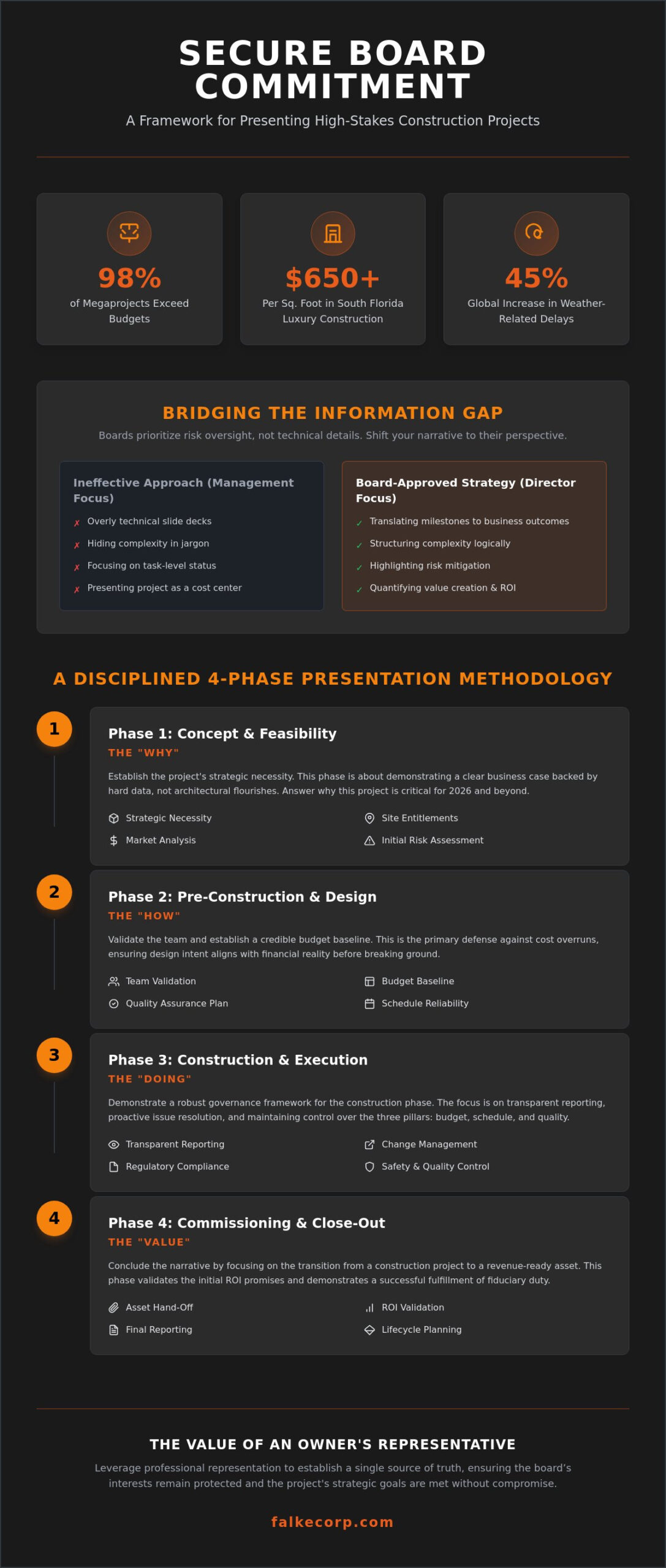
With 98% of megaprojects exceeding their original budgets and South Florida luxury construction costs now frequently surpassing $650 per square foot, a board’s primary concern isn’t the technical methodology; it’s the mitigation of fiscal and regulatory exposure. When you’re presenting a construction plan to a board of directors in 2026, the challenge lies in translating complex engineering phases into a stable business case that accounts for the Florida Building Code 9th Edition and the recent Miami-Dade permit fee escalations.
You’ve likely felt the pressure of balancing granular project details with the high-level strategic oversight that directors demand. It’s difficult to discuss the implications of Florida House Bill 803 or the 45% global increase in weather-related delays without appearing “in the weeds” or defensive about potential setbacks. This article provides a sophisticated framework to move beyond simple status reporting, teaching you to leverage professional owner representation and risk-focused data to secure immediate project ratification. We’ll examine how a structured, logical presentation of development management and pre-construction services can transform technical complexity into a clear, credible path toward project completion and enhanced professional authority.
Key Takeaways
- Shift the presentation focus from technical project management to risk-based oversight to align with the board’s primary fiduciary and strategic responsibilities.
- Adopt a disciplined four-phase methodology when presenting a construction plan to a board of directors to move beyond simple ratification toward active institutional commitment.
- Integrate specific South Florida regulatory data and climate-resiliency requirements into your feasibility narrative to proactively address permitting and cost volatility.
- Prepare for high-stakes inquiries regarding budget contingencies and schedule acceleration by developing a framework for informed trade-offs and data-backed reporting.
- Leverage professional owner representation to establish a single source of truth, ensuring the board’s interests remain protected throughout the project lifecycle.
The Boardroom Perspective: Why Construction Plans Fail or Succeed
A board’s primary function isn’t the management of day-to-day construction activities; it’s the fulfillment of a fiduciary duty through rigorous risk oversight. When you’re presenting a construction plan to a board of directors, the objective isn’t to demonstrate technical brilliance, but to prove that the capital allocation is secure. Construction projects are uniquely scrutinized because they represent high-visibility, illiquid investments that are notoriously susceptible to scope creep and market volatility. Success in the boardroom depends on your ability to provide a structured project governance framework that balances long-term strategic goals with immediate fiscal realities.
Directors seek three specific pillars of confidence: financial transparency, schedule reliability, and uncompromising quality assurance. If any of these pillars appear unstable, the board will likely retreat into a defensive posture. There’s a fundamental difference between receiving a “ratification,” which is often a passive rubber-stamping of a request, and securing “commitment.” Passive approval often evaporates at the first sign of a Miami-Dade permitting delay or a cost escalation. Active buy-in, however, means the board understands the trade-offs and stands behind the project’s strategic necessity despite inevitable construction challenges.
The Information Gap: Management vs. Directors
Boards often feel isolated from the reality of large-scale development projects, leading to a sense of being “in the dark.” This anxiety often stems from management teams that stonewall directors with overly technical, 100-page slide decks. These presentations might show every HVAC specification, but they fail to explain how those details impact the delivery date. You must bridge this gap by translating technical milestones into business outcomes. Don’t hide the complexity; instead, structure it so directors can see the logic of the work-flow without getting lost in the engineering weeds. Clear, concise reporting builds the professional credibility needed to navigate the 2026 regulatory environment.
Defining Success Beyond the Budget
While the initial budget is a critical benchmark, true success involves positioning the project as a revenue-ready asset rather than a simple cost center. Every slide in your presentation should reflect the “Owner’s Perspective,” focusing on how the construction plan aligns with the corporation’s long-term strategic vision. If a project is designed to lower insurance premiums through resilient design or to meet specific ESG targets, those benefits must be quantified. By focusing on the asset’s total lifecycle and its eventual ROI, you move the conversation away from “how much are we spending” and toward “what value are we creating.” This shift in narrative is essential for maintaining board confidence through the commissioning and close-out phases.
Structuring the Narrative: From Concept to Commissioning
Effective communication in the boardroom requires a disciplined, chronological structure that mirrors the project’s actual capital deployment lifecycle. When presenting a construction plan to a board of directors, you shouldn’t rely on fragmented updates or disconnected data points. Instead, adopting a rigorous four-phase methodology guides directors from the initial feasibility study through to the final hand-off. This approach aligns with the Government Framework for Project Boards, which emphasizes that every decision-point must be backed by technical logic and fiduciary responsibility. By following this sequence, you demonstrate that the project isn’t just a series of tasks, but a managed journey toward a specific business objective.
Phase 1 begins with Concept and Feasibility. Here, you must articulate why this project is a strategic necessity for 2026. This isn’t the time for architectural flourishes; it’s the time for hard data regarding site entitlements and market windows. Moving into Phase 2, Pre-Construction and Design, the focus shifts to validating the team and the budget baseline. This phase serves as the primary defense against future cost overruns by ensuring that design intent matches the financial constraints of the corporation. Precision at this stage is non-negotiable.
Phase 1 & 2: Building the Foundation of Trust
The initial phases must prove that the project is viable before significant capital is committed. Presenting site feasibility studies as risk-reduction steps shows the board that the land can legally and physically support the intended use without hidden liabilities. By integrating strategic pre-construction services in Miami, you provide a verified cost estimate that accounts for local volatility in labor and material prices. Justifying the selection of architects and vendors through a transparent bidding process further reinforces this foundation. It demonstrates that the team was selected based on technical competence and merit, which is essential for maintaining long-term board confidence. For complex projects, our development management ensures these early phases are handled with the necessary technical precision.
Phase 3 & 4: Demonstrating Operational Control
Once the project enters the active phase, the board’s concern shifts from “if we can build it” to “how we are executing.” Visualizing the schedule through high-level milestones is more effective than overwhelming directors with granular Gantt charts that change weekly. You must explain the construction phase management in Florida framework, specifically how the team handles change orders and unforeseen site conditions in real-time. The narrative concludes with Phase 4: Commissioning and Close-out. This is the critical transition where the physical structure becomes a revenue-ready asset. For a board, commissioning marks the end of capital expenditure and the beginning of operational ROI. Defining this hand-off clearly ensures the board understands exactly when the project will begin contributing to the bottom line.
Navigating South Florida Specifics: Costs, Permitting, and Climate Risks
South Florida represents one of the most volatile construction environments in the United States, characterized by stringent high-velocity hurricane zone requirements and a labor market that remains persistently tight. When presenting a construction plan to a board of directors in this region, generic risk assessments are insufficient. You must address the “Miami Factor” directly, accounting for luxury high-end construction costs that frequently exceed $650 per square foot in 2026. This volatility isn’t merely a budgetary concern; it’s a structural risk that requires a sophisticated procurement and vendor management strategy to ensure quality control in a market where demand often outstrips technical capacity.
The regulatory landscape adds another layer of complexity. While Florida House Bill 803, effective July 1, 2026, introduced mandatory review deadlines and “deemed-approved” mechanisms, significant carve-outs remain for coastal and flood-prone areas. This means projects in Miami-Dade and Broward counties still face unique hurdles. Your presentation should explicitly reference the Florida Building Code 9th Edition, which takes effect on December 31, 2026, and its implications for wind load and stormwater provisions. Failing to account for these specifics when presenting a construction plan to a board of directors can lead to costly late-stage design revisions that erode institutional trust.
Managing Permitting and Entitlement Uncertainty
A realistic timeline is the most valuable asset you can provide to a governing body. You shouldn’t minimize the potential for City of Miami building department delays; instead, you should present a mitigation plan that includes the use of private providers for plan reviews, as expanded by recent legislation. Proactive coordination between engineers and municipal staff is essential to minimize holding costs that otherwise accumulate while capital remains idle. The efficient resolution of local entitlements directly dictates the project’s eventual ROI by preventing the erosion of margins through non-productive carry costs during the approval phase.
Climate Resilience as a Financial Strategy
In 2026, boards view environmental resilience through a fiscal lens rather than a purely altruistic one. Asset durability in the face of sea-level rise and extreme weather is a prerequisite for securing favorable insurance premiums and long-term financing. Presenting hurricane-ready specifications, such as advanced impact resistance and elevated structural slabs, demonstrates a commitment to protecting the corporation’s capital over a thirty-year horizon. By linking these sustainable design choices to the real estate development management services provided by FALKE Atlantic Corporation, you position the project as a resilient, ESG-compliant asset. This strategic alignment ensures that the technical execution serves the broader financial objectives of the organization.
Mastering the Q&A: Addressing the Board’s Most Difficult Questions
The Q&A session is the ultimate stress test of institutional trust. When presenting a construction plan to a board of directors, the most critical moments occur after the slides are finished. Directors will probe for weaknesses in the financial structure and the viability of the timeline. You must anticipate the inevitable question regarding a 20% budget overrun. Rather than offering vague assurances, present a structured “Trade-off” strategy. This involves identifying non-critical scope elements that can be deferred or removed if market volatility impacts the primary budget. This demonstrates that you’ve already considered the worst-case scenario and have a plan to maintain fiscal discipline.
Schedule-related pushback is equally common. Directors often inquire about accelerating the grand opening to capture earlier revenue. Your response must be rooted in technical reality. Explain the dependencies, such as the mandatory review deadlines established by Florida House Bill 803 or the curing times for high-performance concrete required by the 9th Edition of the Florida Building Code. By providing technical justification instead of simple refusals, you maintain professional credibility while protecting the project’s structural integrity. Clear communication at this stage prevents the “stonewalling” that often leads to boardroom friction.
The “What-If” Analysis: Financial Contingencies
For non-technical directors, it’s vital to distinguish between hard costs, the physical construction expenses, and soft costs, such as permitting fees and professional services. A robust contingency fund isn’t a sign of imprecise planning; it’s a strategic buffer against the 41% increase in South Florida construction prices seen since 2020. Utilizing historical data from construction project management in Florida allows you to justify these figures with empirical evidence. This transparency ensures the board views the contingency as a tool for stability rather than a lack of control. To ensure your capital remains protected from inception to close-out, partner with a dedicated owner’s representative who provides unbiased fiscal oversight.
Closing the Loop: From Approval to Execution
Establishing a clear reporting cadence and decision-making thresholds prevents the board from becoming “in the weeds” during execution. Define a specific dollar amount for change orders that requires board intervention, allowing the project team to resolve minor technical issues without delaying the schedule. Disagreements between directors regarding aesthetic versus functional priorities are inevitable. Once a consensus is reached, the board must speak with a single voice to prevent the project team from receiving conflicting directives that could jeopardize the delivery schedule. Institutional unity in the boardroom is the primary driver of project stability on the ground.
The Role of an Owner’s Representative in Boardroom Success
A board’s primary challenge during capital-intensive projects is the inherent conflict of interest between various stakeholders. General contractors focus on execution efficiency, while architects prioritize design intent; neither is primarily tasked with the board’s fiduciary protection. Positioning FALKE Atlantic Corporation as your strategic partner ensures that every technical decision is filtered through the lens of the corporation’s financial and operational goals. When presenting a construction plan to a board of directors, the inclusion of an owner’s representative in Miami establishes an unbiased single source of truth. This professional oversight is essential for managing third-party vendors and general contractors, ensuring that the information reaching the boardroom is accurate, timely, and free from the bias of the project team.
Effective financial control is maintained through disciplined audit and reporting processes that go beyond simple budget tracking. An owner’s representative provides the technical expertise to scrutinize payment applications, evaluate the validity of change orders, and verify that the work performed matches the billed amounts. This level of granular oversight allows the board to maintain its high-level strategic focus without the fear of being “in the weeds.” By delegating the technical verification to a trusted expert, directors can focus on the long-term ROI of the asset rather than the minutiae of the job site.
Mitigating Financial and Operational Risk
The disciplined four-phase methodology we utilize acts as a critical safeguard against cost overruns and schedule slippage. FALKE Atlantic Corporation serves as a necessary buffer between the board and technical complexities, translating engineering challenges into actionable business decisions. This process culminates in a rigorous commissioning phase, which is vital for ensuring the structure is a revenue-ready asset from the moment of hand-off. Without this professional oversight, the transition from construction to operations often becomes a source of unexpected friction and additional expense.
Why a Boutique Consultancy Matters
Large project management firms often delegate critical oversight tasks to junior staff, which can lead to oversight gaps in high-stakes environments. A boutique consultancy like FALKE Atlantic Corporation ensures senior-level attention on every project, bringing specialized expertise to sectors such as hospitality, retail, and luxury residential development. This focused approach is particularly valuable when presenting a construction plan to a board of directors, as it provides the depth of experience required to answer the most challenging institutional questions. To ensure your next capital project is handled with the highest professional standards, request a corporate project management consultation with FALKE Atlantic Corporation today.
Securing Institutional Commitment for 2026 and Beyond
Successful project governance requires transitioning from technical status reports to a framework of risk-focused transparency. By adopting a disciplined four-phase methodology, you ensure that every capital expenditure is justified by strategic necessity and rigorous technical feasibility. When presenting a construction plan to a board of directors, the objective is to transform market uncertainty into a managed path toward asset delivery. This process relies on integrating local expertise in the Miami-Dade and Broward regulatory environments to navigate the complexities of the 2026 building codes and permitting reforms.
FALKE Atlantic Corporation provides the professional oversight necessary to maintain this stability. With a proven track record in hospitality and high-net-worth developments, we act as the unbiased single source of truth that boards require to fulfill their fiduciary duties. Our approach ensures that your project remains a revenue-ready asset, protected from the volatility of the South Florida market. Protect your real estate assets with FALKE Atlantic Corporation’s expert Owner’s Representation. We look forward to ensuring your next major development achieves its full strategic potential.
Frequently Asked Questions
What are the most common mistakes when presenting a construction plan to a board?
Leading with technical engineering minutiae instead of risk oversight is the most frequent error. Directors require a fiduciary perspective, so burying the executive summary in jargon often leads to a loss of institutional confidence. It’s essential to avoid the perception of “stonewalling” or being “in the weeds” by providing a clear, logical structure that focuses on business outcomes rather than physical tasks.
How much detail should be included in a board-level construction budget?
A board-level budget should focus on broad capital allocation categories rather than line-item material costs. You must clearly distinguish between hard costs and soft costs while justifying a robust contingency fund based on current market volatility. This high-level transparency allows directors to monitor fiscal stability without becoming entangled in the procurement details of specific building components.
How do I explain construction delays to a board of directors?
Explaining delays requires a data-driven approach that references external factors like the 45% global increase in weather-related delays or local regulatory hurdles. When presenting a construction plan to a board of directors, you should lead with the mitigation strategy rather than the problem itself. This shifts the focus from the setback to the team’s ability to maintain operational control and protect the project’s eventual ROI.
Should the General Contractor be present during the board presentation?
The General Contractor should typically not be present during the primary strategic board deliberation. Their presence can create a conflict of interest, as their primary motivation is execution efficiency rather than the board’s fiduciary protection. Relying on an owner’s representative ensures the board receives an unbiased assessment of project status and vendor performance without the pressure of a contractor’s presence.
What is the difference between a project manager and an owner’s representative in a board report?
A project manager focuses on the tactical execution of the construction phase, whereas an owner’s representative provides strategic development management and fiduciary oversight. In a board report, the project manager provides technical data, but the owner’s representative synthesizes that data into a “single source of truth.” This ensures the board’s interests remain protected across all project phases, from feasibility to commissioning.
How far in advance should the construction plan deck be circulated as a pre-read?
The presentation deck should be circulated at least five business days before the meeting to allow for a thorough review by all directors. This timeline respects the board’s fiduciary responsibilities and ensures that the actual meeting focuses on strategic trade-offs rather than basic information gathering. Providing the pre-read early builds professional credibility and demonstrates a disciplined approach to project governance.
How do we handle a board member who wants to micro-manage the design phase?
Address micromanagement by pivoting the conversation back to the corporation’s long-term strategic vision and the project’s established ROI targets. If a director focuses on aesthetic minutiae, remind the board of the approved design-intent and its alignment with revenue-ready goals. Maintaining this high-level focus prevents scope creep and ensures the project remains on its technical and financial track without unnecessary delays.
What are the key KPIs a board should track during the construction phase?
Boards should track budget variance, schedule milestones, and the status of critical regulatory entitlements like Miami-Dade permits. Monitoring the progress toward commissioning and the resolution of safety incidents also provides a comprehensive view of project health. These KPIs offer the necessary data to evaluate the effectiveness of the current presenting a construction plan to a board of directors framework and ensure the asset’s long-term durability.