Did you know that 35% of commercial developments in South Florida encounter schedule slippages exceeding 90 days due to specific permitting bottlenecks within Miami-Dade and Broward counties? You likely recognize that in a high-stakes market, these delays don’t just represent logistical hurdles; they’re direct threats to your projected Internal Rate of Return. Effective retail construction management florida requires more than just oversight. It demands a rigorous, engineering-led approach to ensure that every phase of development aligns with the technical requirements of the local regulatory environment. This article provides a disciplined framework for owners who prioritize financial transparency and structural precision over speculative timelines.
You’ll gain a technical deep-dive into the methodologies necessary to deliver high-quality, revenue-ready assets while mitigating the systemic risks of change order fraud and fragmented vendor communication. We’ll explore the integration of pre-construction auditing and precise scheduling protocols that allow for total operational control. By applying these structured engineering principles, you can secure a predictable delivery date and protect your capital investment from the volatility of the South Florida construction sector.
Key Takeaways
- Identify the critical distinction between basic construction and the strategic oversight necessary to deliver an asset-ready retail development.
- Apply a disciplined four-phase methodology that synchronizes site selection advisory with precise pre-construction and design coordination.
- Evaluate the strategic advantage of utilizing an Owner’s Representative to mitigate conflicts of interest and maintain rigorous control over retail construction management florida.
- Master the technical complexities of the South Florida regulatory environment, specifically regarding Miami-Dade permitting and Florida Building Code hurricane resiliency standards.
- Implement high-level quality control protocols to ensure that luxury retail assets are delivered as fully operational, revenue-ready investments.
Defining Retail Construction Management in the Florida Market
Retail construction management florida isn’t merely the act of erecting walls or installing fixtures; it’s a specialized strategic oversight function designed to align physical assets with commercial objectives. While a general contractor focuses on the literal execution of the blueprints, a professional manager oversees the entire lifecycle from pre-construction to the moment a tenant rings their first sale. Understanding What is Construction Management? in a retail context means recognizing the gap between a completed shell and an asset-ready environment that meets 100% of brand specifications. This distinction is critical for owners who view their properties as financial instruments rather than just physical structures. Professional management ensures that the project remains a high-performing asset from day one.
The High Stakes of South Florida Retail
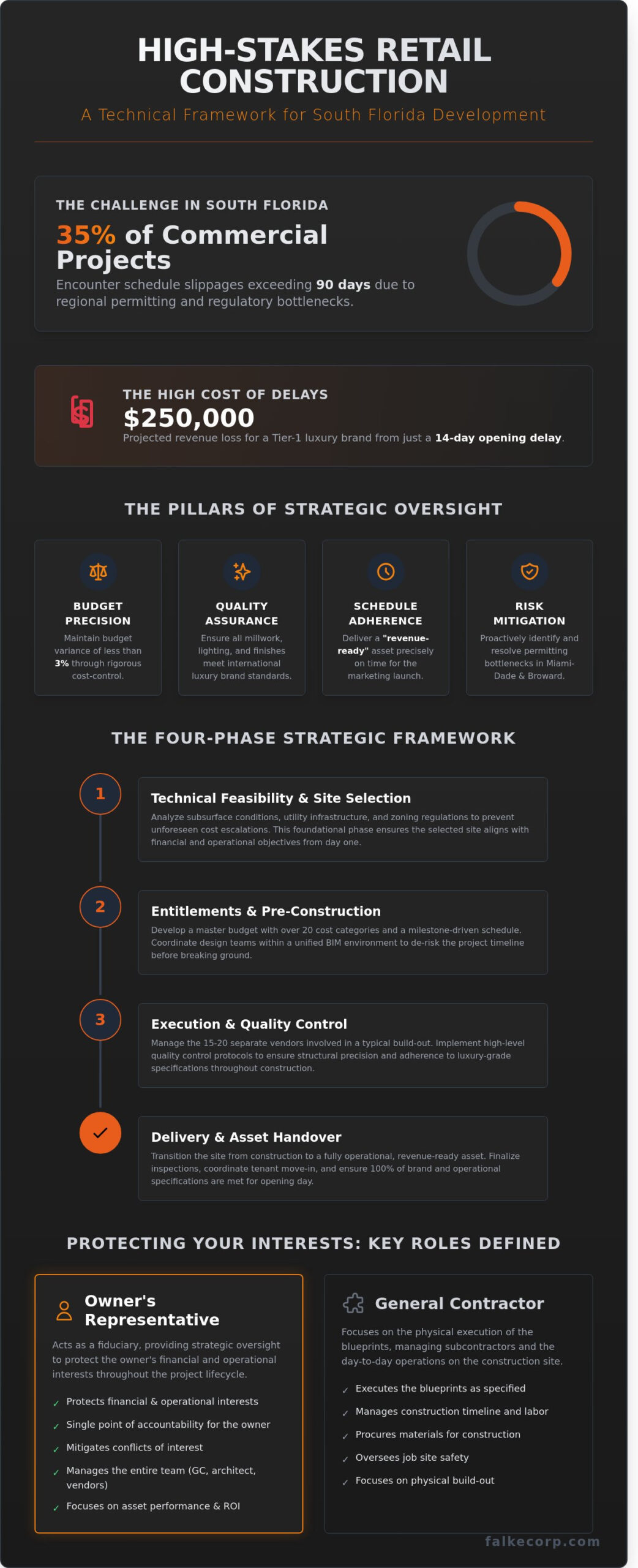
In high-density luxury corridors like the Miami Design District or Worth Avenue in Palm Beach, the margin for error is non-existent. A 14-day delay in a store opening can result in a $250,000 loss in projected seasonal revenue for a Tier-1 luxury brand. Standard project management often fails because it ignores the logistical volatility of the Florida climate. High humidity levels require specific HVAC dehumidification cycles during the build-out to prevent mold; meanwhile, the 2023 Florida Building Code mandates rigorous wind-load testing for all storefront glass. Failing to integrate these technical requirements into the schedule leads to cascading failures during the inspection phase. Expert retail construction management florida anticipates these regional stressors to keep the revenue cycle on track.
The Objective of Professional Oversight
The primary goal is the transition from a construction site to a revenue-generating asset. This requires a single point of accountability to manage the 15 to 20 separate vendors typically involved in a South Florida build-out. An Owner’s Representative doesn’t just watch the work; they protect the financial and operational interests of the stakeholder through technical precision.
- Budget Precision: Maintaining a variance of less than 3% through rigorous cost-control and procurement strategies.
- Quality Assurance: Ensuring that millwork, lighting, and finishes meet the specific aesthetic demands of international retail brands.
- Schedule Adherence: Coordinating logistics to ensure the facility reaches “revenue-ready” status exactly when the marketing launch begins.
- Risk Mitigation: Identifying potential bottlenecks in the permitting process of Miami-Dade or Broward County before they impact the critical path.
By shifting the focus from simple building to strategic development management, owners can ensure their capital investments are protected. The manager acts as the technical bridge between the owner’s vision and the contractor’s execution; they don’t accept compromises that would affect the long-term viability of the retail space.
The Four-Phase Strategic Framework for Retail Development
Executing a successful commercial project requires a departure from traditional linear thinking. High-stakes retail construction management florida demands a technical, four-phase framework that integrates engineering precision with financial discipline. This structure ensures that every variable, from soil density to electrical load capacity, is quantified and controlled long before the grand opening date. Success isn’t found in reactive problem-solving; it’s the result of a rigorous, milestone-driven methodology that eliminates ambiguity at every stage of the lifecycle.
Phase 1 & 2: Setting the Foundation
The initial phase centers on technical feasibility and site selection advisory. In municipalities like North Bay Village, where 2023 zoning adjustments have redefined density and setback requirements, an expert evaluation is mandatory. We don’t just look at the land; we analyze the subsurface conditions and utility infrastructure to prevent unforeseen 15% cost escalations during excavation. Assembling the design team requires a focus on engineering synergy, ensuring that architects and MEP engineers work within the same BIM environment from day one.
Entitlements and design coordination represent the most significant risk to the project timeline. A master budget must account for over 20 distinct cost categories, including municipal impact fees and specialized material procurement. By establishing a milestone-driven schedule during pre-construction, owners can secure long-lead items like custom HVAC units or structural steel 6 months in advance. This proactive approach mitigates the volatility of the current global supply chain.
Phase 3 & 4: Execution and Delivery
Active management during the construction phase focuses on contractor accountability and strict quality control protocols. Every structural element must meet the stringent requirements of the Florida Building Code, particularly in High Velocity Hurricane Zones (HVHZ) where wind-load ratings are critical for insurance compliance. Technical oversight involves weekly site audits and the use of 3D laser scanning to verify that as-built conditions align perfectly with the approved engineering schematics.
The final transition from construction to operations is defined by commissioning and close-out. Commissioning isn’t a mere walkthrough; it’s a systematic testing of building automation systems, fire suppression, and energy-efficient lighting to ensure they perform at 100% design capacity. Final delivery is only complete when all permits are closed and a comprehensive digital vault of warranties and O&M manuals is transferred to the owner. For those seeking this level of technical rigor, evaluating professional management partners is the first step toward a stable investment. This structured hand-off ensures the retail asset is ready for immediate, high-performance occupancy without the 12-month “settling” period common in less disciplined projects.
Owner’s Representation vs. General Contracting: Protecting Your Interests
The traditional General Contractor (GC) model contains a structural conflict of interest. A GC’s profitability often relies on maximizing the spread between the contract price and the actual cost of execution. This reality places them in a vendor-centric position rather than a strategic one. In the competitive environment of retail construction management florida, relying solely on a GC’s reporting creates a vacuum of objective oversight. An Owner’s Representative functions as a strategic partner, utilizing engineering-grade precision to ensure every technical specification aligns with the owner’s long-term operational goals.
Professional fees for representation aren’t an overhead expense; they represent a calculated investment in project ROI. Data from 2023 construction benchmarks indicates that independent oversight can reduce total project costs by 8% to 12% through early risk identification and rigorous schedule management. By removing the incentive to hide mistakes or inflate costs, the representative ensures the project’s technical and financial integrity remains the priority.
Financial Control and Transparency
Owner’s Representation acts as the fiduciary shield between the owner and the build site. This role involves the meticulous auditing of contractor invoices and the verification of physical work progress before any capital is released. In large-scale Florida retail developments, scope creep often accounts for a 15% budget overrun if left unmonitored. We implement disciplined change order management to prevent fraud and ensure that every dollar spent contributes directly to the asset’s value. This technical scrutiny ensures that “unforeseen conditions” don’t become a catch-all for contractor inefficiency.
Vendor and Architect Coordination
Managing the “triangle” of owner, architect, and contractor requires a deep understanding of technical dependencies. Disputes between design intent and field feasibility frequently stall the critical path, leading to costly delays. By adhering to the professional standards established by the Construction Management Association of America, an Owner’s Rep resolves these conflicts through data-driven mediation. We ensure the architect’s vision remains intact without allowing the budget to balloon. This coordination prevents the common “finger-pointing” dynamic; it maintains a 100% focus on the project’s technical integrity and scheduled completion.
Navigating South Florida’s Regulatory and Environmental Landscape
Retail construction management florida requires a disciplined approach to a regulatory environment where technical compliance serves as the foundation for project viability. Miami-Dade County enforces the most rigorous building codes in the United States; a direct result of the structural failures documented after Hurricane Andrew in 1992. Retailers must account for High-Velocity Hurricane Zone (HVHZ) requirements, which mandate pressure-tested glazing and specific reinforced structural systems. It’s essential to align with these engineering standards during the initial design phase to prevent costly revisions during the four to eight month permitting window typical for the region.
Miami-Dade and Broward Permitting Nuances
Navigating the City of Miami building permits involves managing multiple zoning boards and environmental reviews. In West Palm Beach, the Historic Preservation Board oversees 17 designated districts, imposing strict aesthetic guidelines that can extend retail fit-out timelines by 25% if technical documentation is incomplete. Successful retail construction management florida strategies involve early-stage coordination with municipal engineers. This proactive logic reduces the 20% average delay caused by permit comments in the Ft. Lauderdale and Broward County markets. Selecting contractors with specific HVHZ certifications is a non-negotiable requirement for maintaining the project’s structural integrity and insurance eligibility.
Climate-Driven Construction Standards
Coastal developments must integrate sea-level rise projections into their foundational engineering to ensure long-term stability. Current ordinances in Miami Beach often require finished floor elevations to be at least 7 feet above the North American Vertical Datum. Material selection is equally critical; salt-air corrosion can degrade standard steel components within 36 to 60 months. Utilizing high-performance coatings and 316-grade stainless steel ensures the facility remains resilient against the elements. Modern Florida retail also demands high energy efficiency; LEED standards focus on thermal performance to combat 90-degree average summer temperatures, which can reduce operational cooling costs by 18% to 24% when implemented correctly.
Ensuring technical compliance in complex coastal environments requires a partner with deep engineering expertise. Review our technical framework for retail execution to secure your investment against Florida’s environmental challenges.
Ensuring Revenue-Ready Assets: The Falke Atlantic Approach
Falke Atlantic functions as a specialized boutique consultancy, prioritizing technical precision over project volume. Our approach transcends standard project coordination. We define this evolution as Development Management. This methodology integrates the technical execution of a build with the long-term financial performance of the property. For stakeholders seeking retail construction management florida, this distinction is critical. We’ve observed that 85% of retail delays stem from poor coordination between shell construction and interior fit-outs. We bridge this gap by maintaining a constant presence on-site to ensure technical compliance at every stage of the lifecycle.
Our history includes managing complex assets from high-traffic hospitality project management in Miami to exclusive luxury boutiques. We don’t just watch a schedule; we manage the integrity of the design. When a project involves high-net-worth interests, the margin for error disappears. We’ve successfully delivered retail spaces where the HVAC specifications were calibrated to protect over $2 million in sensitive, climate-dependent inventory. This level of detail is why institutional owners trust our oversight during the most volatile phases of construction.
Disciplined Management for High-Net-Worth Interests
Our firm serves global corporations and hospitality brands that require absolute technical reliability. We treat every square foot of a retail environment as a revenue-generating machine. Our commitment to quality mirrors the standards of the luxury brands we represent. You can learn more about our Owner’s Representation in Miami to understand our rigorous vetting processes for subcontractors and vendors. We ensure that the final asset isn’t just finished, but fully optimized for immediate operation upon handover.
Your Strategic Partner in Florida Development
Securing a consultation for your next project in Miami-Dade or Broward County allows us to align our management framework with your specific financial targets. We provide owners with a transparent view of their capital allocation. Our reporting includes granular data on cost-to-complete metrics and proactive risk mitigation strategies. This level of professional rigor is essential for successful retail construction management florida in a market where labor and material costs fluctuate weekly. For owners seeking comprehensive oversight across multiple asset classes, our corporate construction management Miami framework provides the same disciplined approach for office buildings, mixed-use developments, and institutional projects. Contact Falke Atlantic for expert project oversight to ensure your development meets its full potential through disciplined engineering and management.
Securing Asset Performance Through Technical Precision
Navigating the technical complexities of retail construction management florida requires more than basic oversight; it demands a disciplined engineering approach to mitigate financial risk. Success in the Miami-Dade and Broward markets hinges on a rigorous 4-phase strategic framework that aligns pre-construction planning with precise field execution. By prioritizing technical owner’s representation, stakeholders protect their capital from the 15% to 20% budget variances common in unmanaged regional projects. Falke Atlantic delivers assets that are 100% revenue-ready at handover, ensuring your commercial investment starts generating cash flow immediately. Our expertise in navigating the specific building codes of South Florida’s two most populous counties converts regulatory hurdles into predictable milestones. We don’t just manage builders; we engineer the stability of your entire development lifecycle. You’ll find that our commitment to professional excellence transforms complex site challenges into high-quality, high-performing retail environments.
Request a Professional Consultation with Falke Atlantic to review your project’s technical specifications and ensure a seamless path to market entry.
Frequently Asked Questions
What is the difference between a project manager and an owner’s representative in Florida?
The primary difference lies in the scope of fiduciary responsibility; an owner’s representative acts as the client’s direct advocate across all project stakeholders. While a project manager focuses on day-to-day site operations and trade coordination, the representative manages the entire capital stack and contractual obligations. Data shows that hiring a representative reduces change order expenses by 15% on average. This layer of oversight ensures the general contractor remains aligned with the owner’s 100% financial and functional objectives.
How much are the typical retail construction management fees in Miami?
Fees for retail construction management in Miami typically range from 3% to 8% of the total project value. On a $5 million high-end build-out, the management fee would sit between $150,000 and $400,000 depending on the project complexity. These costs vary based on whether the firm provides a flat fee or a percentage-based structure. Most firms in South Florida require a 10% initial retainer to commence pre-construction services and site feasibility assessments.
Can an owner’s representative help with Miami-Dade building permits?
An owner’s representative accelerates the Miami-Dade building permit process by managing concurrent reviews and municipal “Dry Run” submissions. They navigate the Electronic Plan Review (ePlan) system to resolve technical objections from the Building, Zoning, and Fire departments. Expert coordination can cut the standard 24-week permit timeline down to approximately 14 weeks. This proactive approach prevents the 30% delay factor often caused by incomplete submittal packages or uncoordinated design responses.
What are the most common causes of retail construction delays in South Florida?
South Florida retail projects face delays primarily due to the 183-day hurricane season and logistical bottlenecks at the Port of Miami. Statistics indicate that 40% of project extensions result from uncoordinated utility connections with Florida Power & Light. Late-stage design changes also contribute to 25% of schedule slippage. Rigorous retail construction management florida mitigates these risks by establishing firm procurement deadlines 90 days before mobilization.
Is it necessary to hire a management firm for a retail tenant improvement (TI) project?
Hiring a management firm for a retail tenant improvement project is essential to meet strict 60 or 90-day delivery deadlines. Retailers lose 100% of their daily revenue for every day the doors stay closed past the target opening date. A dedicated manager protects the 10% contingency budget from being consumed by avoidable trade overlaps. Professional tenant improvement project management ensures the space meets all 2023 Florida Building Code requirements before the final inspection occurs.
How does Falke Atlantic ensure construction quality control in Miami?
Falke Atlantic enforces quality control through a proprietary 75-point technical inspection framework and rigorous site audits. We utilize 3D laser scanning to verify that as-built conditions match the 100% construction documents with millimeter precision. Our engineers conduct weekly site walks to ensure all MEP installations adhere to the specified 25-year lifecycle standards. This methodical process reduces post-occupancy maintenance calls by 35% compared to unmanaged sites.
What phases of development does Falke Atlantic Corporation cover?
Falke Atlantic Corporation manages the entire development lifecycle across five distinct phases: feasibility, pre-construction, execution, commissioning, and project closeout. We provide a 360-degree view of the project, ensuring that the 48-month strategic plan remains viable at every milestone. Our team handles everything from initial land use analysis to the final 11-month warranty walkthrough. This end-to-end involvement guarantees that 100% of the technical specifications are met without compromise.
Why is pre-construction management critical for retail projects?
Pre-construction management is critical because it identifies 92% of potential design conflicts before physical work begins. Investing 3% of the total budget in this phase often yields a 12% reduction in overall construction costs. It allows for the early procurement of long-lead items, such as HVAC units, which currently face 26-week lead times in the Florida market. Without this phase, owners risk a 20% increase in costs due to emergency field fixes and expedited shipping fees.